
NEW
Font size
 Worksheets
EDUC 5 Final Quiz
Total questions: 40
Worksheet time: 1hrs 3mins
___ is the act of analyzing student responses to individual exam questions with the intention of evaluating exam quality
Validation
Item Analysis
Discrimination Index
Difficulty Index
A______ is one that has good discriminating ability and has a sufficient level of difficulty (not too difficult nor too easy)
Good items
Easy items
Item discrimination
Item difficulty
What is a probable cause of a test item with a negative discrimination index?
Item not taught well
Academically poor students
Item vague and is open to many interpretations
Subjective scoring
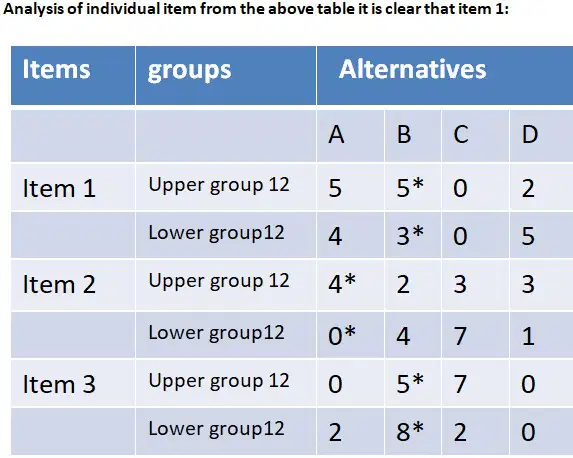
Analysis of individual item from the above table it is clear that item 1:
Distracter A is poor, because it attracts more persons from upper group than the lower group
Distracter D is completely ineffective , as it has attracted few student
Distracter A is Good, because it attracts more persons from upper group than the lower group
None of the above
How can the use of a Table of Specifications benefit your students?
ensures that there is a match between what is taught and what is tested
be a collaborator in constructing the TOS
outline the subject matter into smaller components
design plans, strategies, and schedules based on an outline of content
Which of the following is the first step to making a TOS?
Get your test questionnaire
Determine the coverage of your exam
Know the objectives for each topic area.
Determine the Test Types
Arrange the levels of Bloom's Taxonomy in ascending order (from Low to higher order). Which of the following is correct?
Knowledge, Comprehension, Application, Analysis, Evaluation, Synthesis
Knowledge, Comprehension, Application, Analysis, Synthesis, Evaluation
Evaluation, Synthesis, Analysis, Application, Comprehension, Knowledge
Synthesis, Evaluation, Analysis, Application, Comprehension, Knowledge


Standard deviation is to variability as mode to?
Correlation
Discrimination
Central Tendency
Level of Difficulty
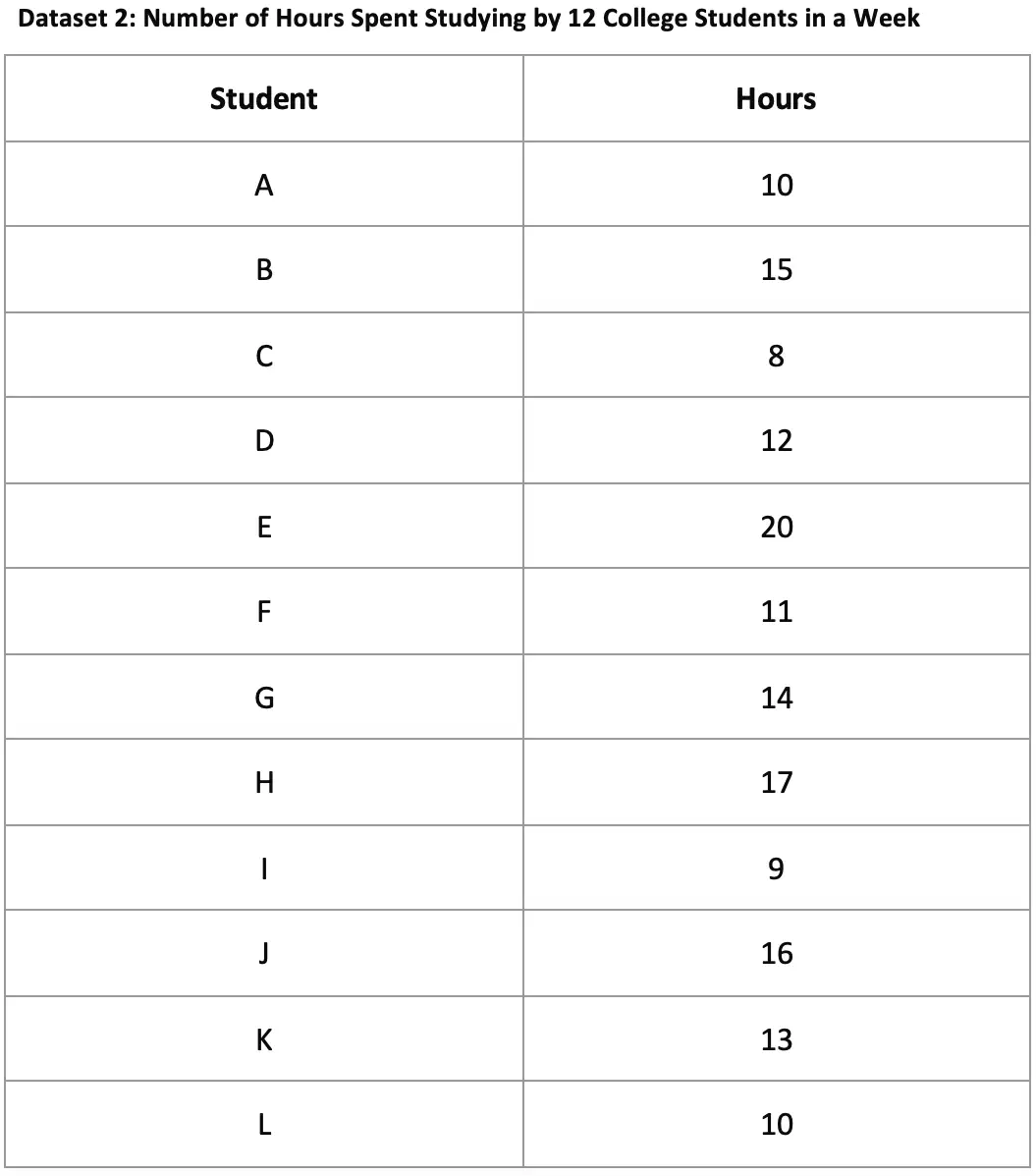
What is the mean number of hours spent studying?
13
12.5
13.5
14
What is the median number of hours spent studying?
13
12.5
13.5
14
What is the mode of hours spent studying?
10
12
no mode
15
What is the range of hours spent studying?
10
12
8
15
What is the third quartile (Q3) of hours spent studying?
17
15
15.5
16
Which of the following questions indicate a norm - referred interpretation?
How does the pupils test performance in our school compare with that of other schools?
How does a pupil's test performance in reading and mathematics compare?
What type of remedial work will be most helpful for a slow- learning pupil?
Which pupils have achieved master of computational skills?
How does a teacher explain the criterion-referenced grading to parents?
I. Describes standard of mastery
II. Explains what each grade means in terms of the standard of mastery
III. Shows each student grade in comparison with the other students
III
I
II
I and II
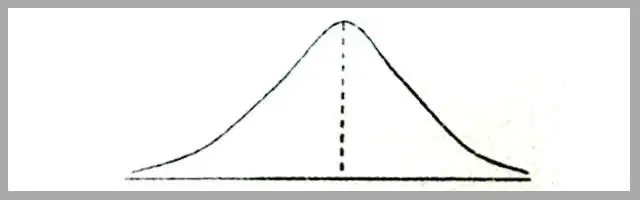
Based on the figure, which is true about the distribution?
Mean=55, median=48, mode=34
Mean=46, median=40, mode=37
Mean=63, median=63, mode=63
The distribution is mesokrutic
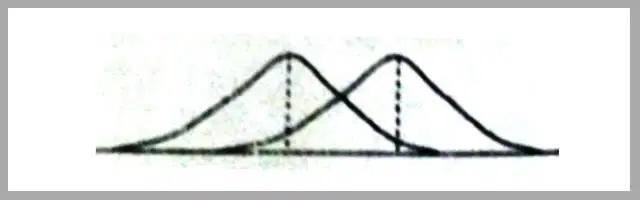
What does the figure indicate?
unequal means, unequal standard deviations
equal means, unequal standard deviations
unequal means, equal standard deviations
equal means, equal standard deviations
Two sections have the same mean but the standard deviation of section 2 is higher than section 1. Which of the two sections is more homogeneous?
Section 1
Section 2
Both Section 1 and Section 2
None of the Above
Miss Corteza administered a test to her class and the result is positively skewed. What kind of test do you think Miss Corteza gave to her pupils?
Posttest
Pretest
Mastery Test
Criterion-referenced test
18. Which set of scores has the least variability?
Set 1 0,5,10,15,20
Set 2 25,35,45,55
Set 3 0,2,8,15,20
Set 4 505,501,503
Set 1
Set 2
Set 3
Set 4
Goring performed better than 65% of the total number of examinees in the district achievement test. What is his percentile rank?
P35
P65
P66
P75
Michael got a score of 60 which is equivalent to a 75th percentile rank in a Science test. Which of the following is NOT true?
His score is below the 7th decile.
He scored above 75% of his classmates.
If the passing mark is the 7th decile, he passed the test.
Twenty-five percent of the class got scores 60 and above.
Student Justin got a percentile score of 85. What does this mean?
He belongs to the upper 85% of the examinees.
He belongs to the lower 15% of the examinees.
He went beyond the cut off score.
He belongs to the upper 15% of the examinees.
When the distribution is skewed to the right, what kind of test was administered?
Difficult
Easy
Average
Partly easy - partly difficulty
In a negatively skewed distribution, what kind of students does Teacher B have?
Very Good
Very Poor
Average
Heterogeneous
Teacher M does not teach well. His students do not study well, too. Expected learning outcomes are not clear to both teacher and students. Teacher's assessment tasks are not aligned to learning outcomes. What is most likely the result of assessment? Describe the score distribution.
skewed to the right
follows the normal curve
skewed to the left
leptokurtic
A score distribution follows a normal curve. What does this mean?
Most of the scores are on the -2SD.
Most of the scores are on the +2SD.
The scores coincide with the mean.
Most of the scores pile up between -1SD to +1SD.

What percentage of the data is between -2 and -3 standard deviations
34%
.15%
2.35%
13.5%

In the second row with a frequency of 42, what is the class boundary?
9.5-19.5
10.5-18.5
10-19
10.5-19.5

What is the class mark of the third row, with frequency 33?
24
25
24.5
25.5
What is the self assessment?
This powerful mechanism contributes to the student's judgment and reflection about their parents and their family.
This powerful mechanism contributes to the student's judgment and reflection about their classmates and improve their class.
This powerful mechanism contributes to the student's judgment and reflection about their own performance and to improve their work
This powerful mechanism contributes to the students judgment and refletion about the performance of the teacher and his/ her work.
What is the peer- assessment?
It provides a structured learning process for students to critique, analyze and provide feedback to each other on their work.
It provides a structured learning process for students to critique, analyze and provide feedback about me.
It provides a structured learning process for students to critique, analyze and provide feedback about the teacher.
Which of the following is an example of reflective learning?
Memorizing a list of vocabulary words for a test.
Writing a journal entry about a personal experience.
Listening to a lecture and taking notes.
None of the above
Which of the following is NOT typically included in a portfolio?
a.) finished projects
b.) reflections on learning
c.) teacher’s personal notes
d.) drafts and revisions
Based on DepEd Order 8, s. 2015, how are Kinder pupils graded?
By the use of numerical grades
By the use of checklists and portfolios
Neither numerical nor portfolios
Depends on schools
Which rubric takes more time to plan?
Hologram Rubric
Holistic Rubric
Analytic Rubric
Analyze Rubric

