Wayground logo

Free Printable Worksheets

Font size

S
M
L
XL
Worksheets

CFA #2 - Chapters 4.1, 4.2, 4.3

Total questions: 15

Worksheet time: 15mins

Name
Class
Date
1.

Cells use a molecule called __​ (a)   __to store and release energy like a battery. The energy is stored in chemical bonds between ( nucleotide / oxygen / phosphate / ribose ) groups of the molecule, and the energy is released when the chemical bonds are broken.

Choose from the below words
DNA
RNA
ATP
CMP
2.

Cells use a molecule called ( DNA / RNA / ATP / CMP ) to store and release energy like a battery. The energy is stored in chemical bonds between __​ (a)   __ groups of the molecule, and the energy is released when the chemical bonds are broken.

Choose from the below words
nucleotide
oxygen
phosphate
ribose
3.

Plants, algae, and some bacteria use the energy of sunlight in the process of __​ (a)   __ . The process converts the energy from sunlight into chemical energy stored in the bonds of ( carbon dioxide / carbohydrates / proteins / water molecules ) .

Choose from the below words
herbivory
respiration
photoperiodism
photosynthesis
4.

Plants, algae, and some bacteria use the energy of sunlight in the process of ( herbivory / respiration / photoperiodism / photosynthesis ) . The process converts the energy from sunlight into chemical energy stored in the bonds of __​ (a)   __.

Choose from the below words
carbon dioxide
carbohydrates
proteins
water molecules
5.
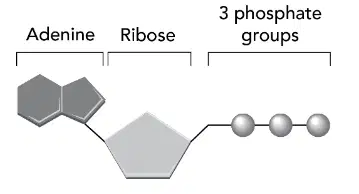
The diagram shows the molecular structure of adenosine triphosphate (ATP) Which of these events occurs during the normal function of ATP in the cell?
a)
A chemical bond forms between the adenine unit and the third phosphate group.
b)
The chemical bond breaks between the adenine and ribose units.
c)
The chemical bond breaks between the ribose unit and the first phosphate group.
d)
The chemical bond breaks between the second and third phosphate groups.
6.
Which statement best describes the relationship between adenosine diphosphate (ADP) and adenosine triphosphate (ATP)?
a)
With an input of energy, ADP rearranges to become ATP.
b)
Without any energy change, ADP rearranges to become ATP.
c)
With an input of energy, ADP combines with a phosphate group to become ATP.
d)
With a release of energy, ADP combines with a phosphate group to become ATP.
7.
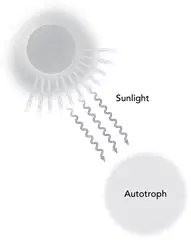
Chloe is developing a model of photosynthesis. The first part of the model is shown below. Which would be the MOST useful next step for Chloe to develop the photosynthesis model further?
a)
Extend the lines for sunlight so that they pass through the autotroph.
b)
Represent a chemical reaction in the autotroph that produces high-energy carbohydrates.
c)
Represent a chemical reaction in the autotroph that produces high-energy proteins.
d)
Draw a circle to represent a heterotroph, and draw a line to connect it to the autotroph. _______
8.

During photosynthesis, cells capture the energy of sunlight using ( thylakoid / stroma / NADPH / chlorophyll ) , which is a type of __​ (a)   __ . Photosynthesis also relies on a compound called ( ATP synthase / NADP + / glucose / DNA ) , which is an electron ( sink / source / carrier / donor ) that accepts and transfers high-energy electrons.

Choose from the below words
nucleotide
carbohydrate
hormone
pigment
9.
During photosynthesis, cells capture the energy of sunlight using ( thylakoid / stroma / NADPH / chlorophyll ) , which is a type of ( nucleotide / carbohydrate / hormone / pigment ) . Photosynthesis also relies on a compound called _________________ , which is an electron ( sink / source / carrier / donor ) that accepts and transfers high-energy electrons.
a)
ATP synthase
b)
NADP +
c)
glucose
d)
DNA
10.
During photosynthesis, cells capture the energy of sunlight using ( thylakoid / stroma / NADPH / chlorophyll ) , which is a type of ( nucleotide / carbohydrate / hormone / pigment ) . Photosynthesis also relies on a compound called ( ATP synthase / NADP + / glucose / DNA ) , which is an electron _____________________ that accepts and transfers high-energy electrons.
a)
sink
b)
source
c)
carrier
d)
donor
11.

Label #1-9 on the diagram of photosynthesis. Also name the organelle in which photosynthesis occurs.

12.
What best describes the relationship between the two sets of reactions of photosynthesis, which are the light-dependent reactions and the light-independent reactions?
a)
a. Each set produces sugars, and by working together they produce more sugars than they would produce separately.
b)
b. Each set produces half of a sugar molecule, and later the two halves are joined together.
c)
c. Only the light-dependent reactions produce sugars, but they depend on products of the light-independent reactions.
d)
d. Only the light-independent reactions produce sugars, but they depend on products of the light-dependent reactions._
13.
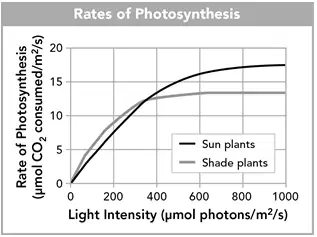
The graph shows how the rates of photosynthesis vary with light intensity for two groups of plants: plants that thrive in direct sunlight, and plants that thrive in the shade. The plants in both groups receive the same amount of water and are kept at the same temperature. For both groups of plants, what best describes the relationship between light intensity and rate of photosynthesis?
a)
The rate of photosynthesis increases with light intensity, and might be limited by other factors such as water and temperature.
b)
The rate of photosynthesis increases with light intensity, and it increases without limit.
c)
The rate of photosynthesis is independent of light intensity, but may be limited by other factors such as water and temperature.
d)
The rate of photosynthesis is at a maximum over a narrow range of light intensities.
14.

Look at the diagram. What are the inputs (reactants) of photosynthesis?

a)

Water and chlorophyll

b)

Water and oxygen

c)

Water and carbon dioxide

d)

Glucose and oxygen

15.

What are the outputs (products) of photosynthesis?

a)

Glucose and chlorophyll

b)

Oxygen and water

c)

Water and carbon dioxide

d)

Glucose and oxygen