
 Worksheets
Energy Flow Retake
Total questions: 20
Worksheet time: 10mins
Name
Class
Date
1.
A forest ecosystem has producers that provide 120,000 joules of energy. Of this energy, 120 joules make it to the tertiary consumers.
Based on this model, estimate how much energy is provided to the secondary consumers.
a)
12,000 J
b)
1,200 J
c)
120 J
d)
12 J
2.
A certain insect species that feeds on leaves was introduced to a forest. Over time, scientists noticed a decrease in the number of plant-eating birds and an increase in plant density.
a)
The introduced insects competed with the plant-eating birds, causing their decline and allowing plants to grow.
b)
The birds started preying on the insects, leading to an increase in plant density.
c)
The insects consumed leaves, reducing the food for birds and allowing remaining plants to grow with less grazing pressure.
d)
The introduced insects poisoned the plants, making the area uninhabitable for birds.
3.

If the rabbit population doubled, which organism would most likely benefit from the increase in energy flow?
a)
Fox
b)
Snake
c)
Bird
d)
Grasshopper
4.
A species of large fish was introduced to a freshwater lake ecosystem. After some time, scientists observed a decline in the population of small fish and an increase in the population of aquatic plants.
a)
The small fish adapted by eating more plants, which caused a decline in their own population.
b)
The large fish preyed on the small fish, reducing their numbers and allowing plant populations to grow with fewer grazers.
c)
The introduction of the large fish disrupted the ecosystem, making it uninhabitable for the small fish.
d)
The small fish migrated to another lake, resulting in a population decline in their former habitat.
5.
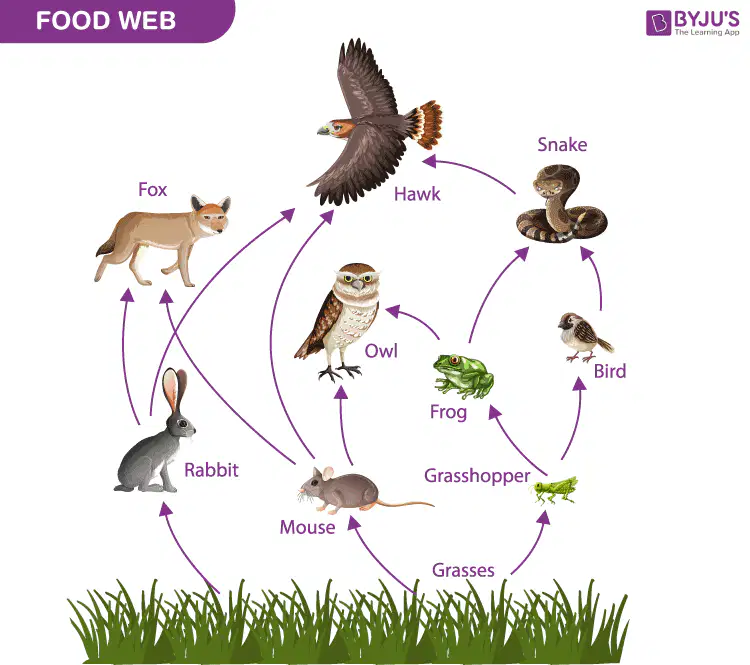
Which of these organisms is in a trophic level that receives a smaller percentage of energy from the producers than the percentage received by the frog?
a)
Owl
b)
Grasshopper
c)
Rabbit
d)
Mouse
6.
In a grassland ecosystem, producers generate 80,000 joules of energy. Out of this, tertiary consumers receive 80 joules.
Estimate the amount of energy that reaches the primary consumers.
a)
80,000 J
b)
8,000 J
c)
800 J
d)
80 J
7.
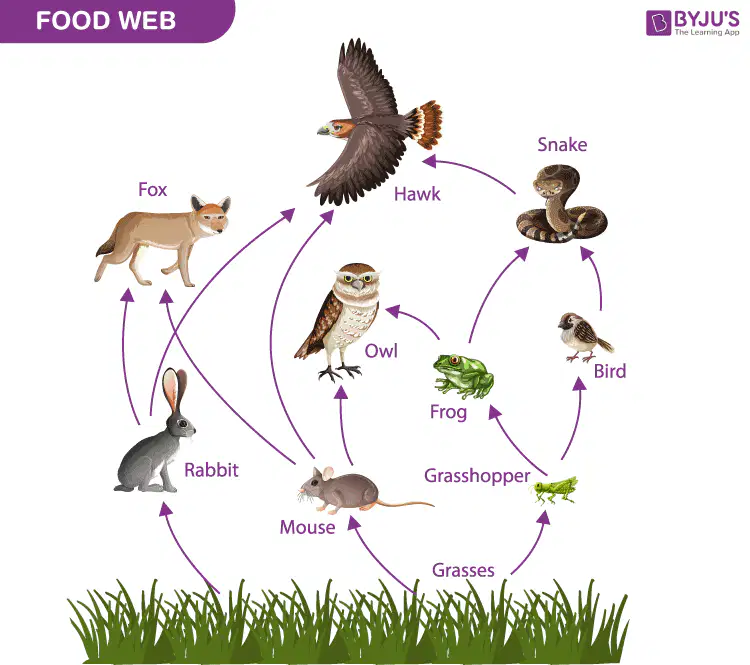
Which of these organisms receives a larger percentage of the energy captured by the grasses than the percentage received at the hawk's trophic level?
a)
Rabbit
b)
Snake
c)
Fox
d)
Owl
8.
In a grassland ecosystem, the population of hawks has significantly increased over the past year. Scientists noticed a decline in the rabbit population and an increase in grass growth.
a)
The hawks began competing with rabbits for grass, leading to a decrease in rabbit numbers.
b)
The hawks frightened the rabbits away, leading to more grass growth.
c)
The rabbits adapted to eating hawks, reducing their own population.
d)
The increased hawk population hunted more rabbits, allowing grass to grow with fewer grazers.
9.
In a marine ecosystem, the population of a small fish species has decreased sharply, while the populations of zooplankton and a larger predatory fish have increased.
a)
The large fish preyed on the small fish, decreasing their population and allowing zooplankton to increase with fewer predators.
b)
The small fish moved to a different part of the ocean, causing zooplankton and large fish populations to increase.
c)
The zooplankton began competing with the small fish for resources, leading to a population shift.
d)
The large fish and zooplankton became more abundant due to environmental changes, indirectly causing the small fish to decline.
10.
In an ocean food chain, phytoplankton as producers generate 100,000 joules of energy. Out of this, secondary consumers receive 1,000 joules.
How much energy is provided to the primary consumers?
a)
10,000 J
b)
1,000 J
c)
100 J
d)
10 J
11.
A catalyzed reaction will have a activation energy, and this leads to a(n) in the reaction rate.
a)
A. lower, decrease
b)
B. lower, increase
c)
C. higher, decrease
d)
D. higher, increase
12.
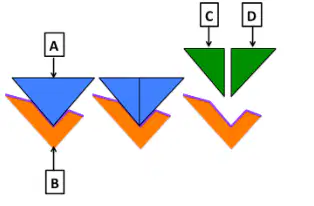
In the enzyme substrate complex, what is happening during step 2?
a)
A. The catalyzed reaction is releasing a product.
b)
B. The enzyme is breaking bonds in the substrate.
c)
C. The enzyme leaves the bonds between the substrates.
d)
D. The substrates are beginning to bind to the enzyme.
13.
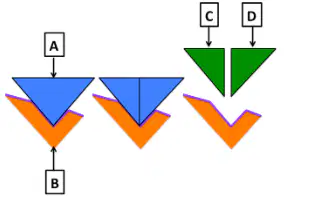
In the picture above, C and D represent the .
a)
A. substrates
b)
B. reactants
c)
C. active site
d)
D. products
14.
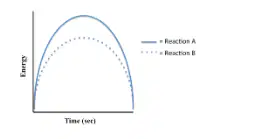
Which statement best describes the graph shown at right?
a)
A. More energy is released by reaction A.
b)
B. More energy is needed to start reaction B.
c)
C. Reaction B is the catalyzed version of Reaction A.
d)
D. Reaction B occurs at a slower rate.
15.
Which of the following reactions directly provides chemical energy for most cell functions?
a)
A. ADP 🡪 ATP + P
b)
B. ADP + P 🡪 ATP
c)
C. ATP + P 🡪 ADP
d)
D. ATP 🡪 ADP + P
16.
Energy is released from an ATP molecule when it
a)
A. loses a phosphate group.
b)
B. converts a phosphate group to ADP.
c)
C. stores an extra phosphate group.
d)
D. produces a sugar molecule.
17.
Which phrase best describes the function of ATP molecule?
a)
absorb energy
b)
increase energy
c)
store energy
d)
create energy
18.
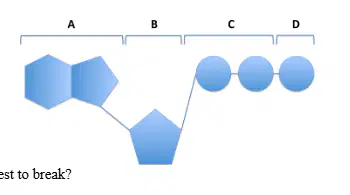
All of the following parts make up an ADP molecule EXCEPT ______
a)
A
b)
B
c)
C
d)
D
19.
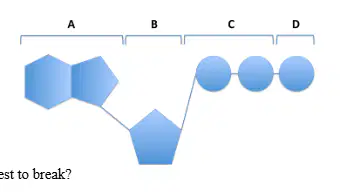
Which structures pictured would make up an ATP molecule?
a)
A. A and B only
b)
B. A, B and C
c)
C. C and D only
d)
D. A, B, C, and D
20.
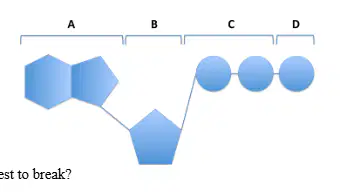
Between which two letters is the bond the most unstable and easiest to break ?
a)
A. A and B
b)
B. B and C
c)
C. C and D
d)
D. B and C and C and D
100 %

