
 Worksheets
Force and resistance in practical applications
Total questions: 52
Worksheet time: 26mins
Which of the following is a force that opposes motion between two surfaces in contact?
Gravitational force
Frictional resistance
Tractive effort
Spring force
What is the term for the force exerted by a vehicle's engine to move it forward?
Braking force
Gravitational force
Tractive effort
Rotational kinetic energy
Which of the following is an example of energy due to an object's rotation?
Moment of inertia
Rotational kinetic energy
Spring force
Frictional resistance
What is the term for the resistance to change in rotational motion?
Gravitational force
Tractive effort
Moment of inertia
Braking force
What is the formula for calculating the force of gravity on an object?
F = ma
W = mg
P = mv
E = mc²
What is the approximate value of gravitational acceleration on Earth?
9.81 m/s²
8.91 m/s²
10.81 m/s²
7.81 m/s²
What type of force is gravity?
Contact force
Non-contact force
Frictional force
Tension force
What is the only force acting on an object in freefall?
Friction
Air resistance
Gravity
Tension
Which equation represents the vertical displacement of an object in freefall?
h = gt
v = gt
h = gt²
v² = 2gh
In the equation v = gt, what does 'v' represent?
Initial velocity
Final velocity
Vertical displacement
Time
What does 'g' stand for in the equations of motion under gravity?
Gravitational force
Gravitational constant
Acceleration due to gravity
Ground level
What is the formula used to calculate the initial height of a body falling under gravity?
h = gt^2
h = \frac{1}{2}gt^2
h = gt
h = \frac{1}{2}gt
If a body falls for 5 seconds, what is the value of t^2 used in the calculation?
10
25
5
15
What is the value of gravitational acceleration g used in the calculation?
9.8 m/s²
10 m/s²
8.9 m/s²
9.5 m/s²
calculate the initial height above the ground of a body of mass of 2kg which reaches the ground after falling vertically for 5 seconds
100.5 m
122.5 m
150.5 m
110.5 m
What is frictional resistance?
The force exerted by an object as it moves across a surface
The force exerted by a surface as an object moves across it
The energy required to move an object
The speed at which an object moves
Which of the following is NOT a type of friction force?
Sliding friction
Rolling friction
Static friction
Dynamic friction
What effect does friction force have on the motion of an object?
It enhances the motion
It opposes the motion
It has no effect on the motion
It changes the direction of motion
Why does a box require more force to move on a carpet than on a wooden floor?
Because the box is heavier on a carpet
Because there is more friction between the carpet and the box
Because the carpet is softer
Because the wooden floor is smoother
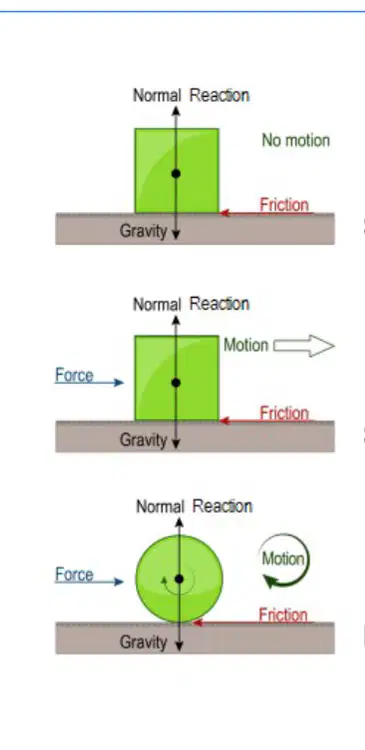
Illustrations showing static, sliding, and rolling friction with labeled forces
Illustrations showing static, sliding, and rolling friction with labeled forces
Illustrations showing only static friction with labeled forces
Illustrations showing only sliding friction with labeled forces
Illustrations showing only rolling friction with labeled forces
What causes friction between two surfaces?
Gravitational forces
Intermolecular attractive forces
Magnetic forces
Electrical forces
On what factors does friction depend?
Temperature and pressure
Nature of surfaces and degree of pressing
Speed and velocity
Mass and volume
What is the formula for calculating the maximum friction force?
F_max = μ × velocity
F_max = μ × acceleration
F_max = μ × normal reaction
F_max = μ × mass
What is the term used for the linear force applied to a wheel, which can be either a pushing or a pulling force?
Tractive effort
Kinetic energy
Potential energy
Rotational force
How is the tractive effort between a car wheel and the surface of the road expressed?
F = μₜW
F = mgh
F = 1/2mv²
F = ma
What does the symbol μₜ represent in the context of tractive effort?
Traction (or friction) coefficient
Mass of the wheel
Acceleration due to gravity
Weight of the wheel
What is the value of acceleration due to gravity used in the formula for tractive effort?
9.81 m/s²
10 m/s²
8.9 m/s²
9.5 m/s²
What is another term for braking force?
Brake power
Brake efficiency
Brake energy
Brake speed
What does the symbol $ F_{\text{braking}} $ represent?
Total braking force (N)
Total vehicle mass (kg)
Deceleration (m/s²)
Initial velocity (m/s)
In the formula $ F_{\text{braking}} = ma $, what does $ m $ stand for?
Total vehicle mass (kg)
Deceleration (m/s²)
Initial velocity (m/s)
Final velocity (m/s)
In the context of braking force, what does $ a $ represent?
Deceleration (m/s²)
Initial velocity (m/s)
Final velocity (m/s)
Total vehicle mass (kg)
What is the initial speed of the vehicle in meters per second if it is traveling at 90 km/h?
20 m/s
25 m/s
30 m/s
35 m/s
What is the formula for kinetic energy (Ek) used in the document?
Ek = mv^2
Ek = 1/2 mv^2
Ek = 2mv^2
Ek = 1/3 mv^2
What is rotational kinetic energy?
Energy stored in a stationary object
Energy stored in a rotating object
Energy stored in a moving object in a straight line
Energy stored in a compressed spring
What two factors determine the amount of rotational kinetic energy a body has?
Mass and velocity
Moment of inertia and angular velocity
Temperature and pressure
Height and gravity
What does the moment of inertia measure?
The speed of a rotating object
The difficulty of changing rotational motion
The temperature of a rotating object
The color of a rotating object
Why can angular velocity be used to express the kinetic energy of a rotating object?
It varies for each point on the rigid body
It is the same for the entire rigid body
It depends on the temperature
It changes with color
What is the formula for rotational kinetic energy?
E_{rot} = \frac{1}{2} \sum_j m_j r_j^2 \omega^2
E_{rot} = \frac{1}{2} m v^2
E_{rot} = mgh
E_{rot} = \frac{1}{2} I \omega^2
What does \( r \) represent in the formula for rotational kinetic energy?
Radius of the circle
Distance from the axis of rotation
Mass of the object
Time period of rotation
What is the new variable introduced to describe the relationship between rotational and translational kinetic energy?
Angular velocity
Torque
Moment of inertia
Centripetal force
What is the unit of the moment of inertia?
kg m
kg m²
m/s²
N m
What is the moment of inertia a measure of?
Linear velocity
Rotational inertia
Angular momentum
Translational motion
How does the mass of an object affect its inertia?
Less mass means more inertia
More mass means less inertia
More mass means more inertia
Mass does not affect inertia
What does a greater moment of inertia indicate about a rigid body?
Less resistance to change in angular velocity
Greater resistance to change in angular velocity
No resistance to change in angular velocity
Constant angular velocity
Moment of inertia of a system of particles
Six small washers are spaced 10cm apart on a rod of negligible mass and length 0.5m. The mass of each washer is 20g. The rod rotates about an axis located at 25cm from the outermost washers, as shown on the next slide.
0.05 kg·m²
0.10 kg·m²
0.15 kg·m²
0.0035 kg·m²
Six small washers are spaced 10cm apart on a rod of negligible mass and length 0.5m. The mass of each washer is 20g. The rod rotates about an axis located at 25cm from the outermost washers, as shown on the next slide
0.02 kg·m²
0.03 kg·m²
0.0034 kg·m²
0.05 kg·m²
Six small washers are spaced 10cm apart on a rod of negligible mass and length 0.5m. The mass of each washer is 20g. The rod rotates about an axis located at 25cm from the outermost washers, as shown on the next slide.
0.5 J
1.0 J
1.73 J
2.0 J
What is the force exerted by a compressed or stretched spring on an object called?
Gravitational force
Magnetic force
Spring force
Frictional force
According to Hooke's law, the magnitude of the spring force is directly proportional to what?
Mass of the object
Temperature of the spring
Amount of stretch or compression
Speed of the object
In the formula $ F_{\text{spring}} = kx $, what does the variable $ k $ represent?
Kinetic energy
Spring constant
Potential energy
Friction coefficient
In the formula $ F_{\text{spring}} = kx $, what does the variable $ x $ represent?
Mass of the spring
Extension or compression
Velocity of the spring
Temperature of the spring
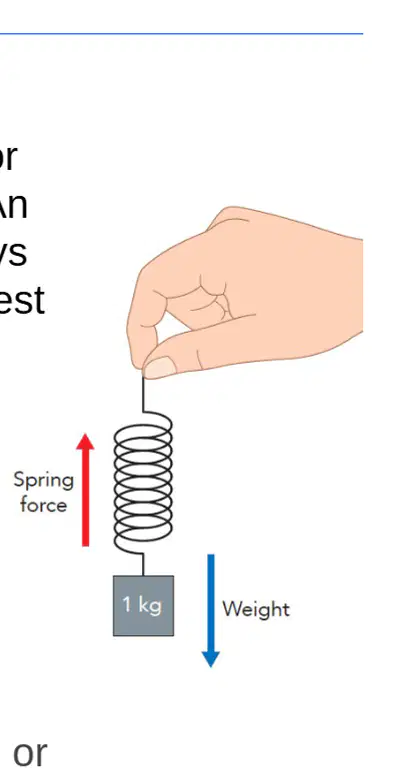
Diagram showing a hand compressing a spring with a weight attached, illustrating spring force.
The spring is being compressed by a hand.
The spring is being stretched by a hand.
The spring is in a relaxed state with no force applied.
The spring is being compressed by a machine.

