
 Worksheets
Biology Quiz
Total questions: 15
Worksheet time: 20mins
Cells use a molecule called (DNA / RNA / ATP / CMP) to store and release energy like a battery. The energy is stored in chemical bonds between (nucleotide / oxygen / phosphate / ribose) groups of the molecule, and the energy is released when the chemical bonds are broken.
(a)
Plants, algae, and some bacteria use the energy of sunlight in the process of (herbivory / respiration / photoperiodism / photosynthesis). The process converts the energy from sunlight into chemical energy stored in the bonds of (carbon dioxide / carbohydrates / proteins / water molecules).
(a)
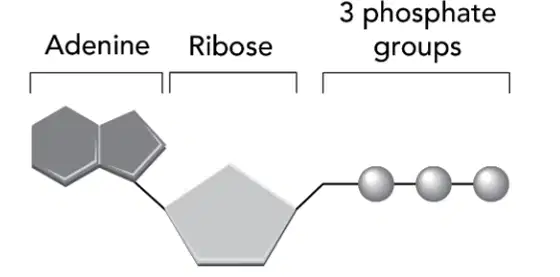
The diagram shows the molecular structure of adenosine triphosphate (ATP). Which of these events occurs during the normal function of ATP in the cell?
A chemical bond forms between the adenine unit and the third phosphate group.
The chemical bond breaks between the adenine and ribose units.
The chemical bond breaks between the ribose unit and the first phosphate group.
The chemical bond breaks between the second and third phosphate groups.
Which statement best describes the relationship between adenosine diphosphate (ADP) and adenosine triphosphate (ATP)?
With an input of energy, ADP rearranges to become ATP.
Without any energy change, ADP rearranges to become ATP.
With an input of energy, ADP combines with a phosphate group to become ATP.
With a release of energy, ADP combines with a phosphate group to become ATP.
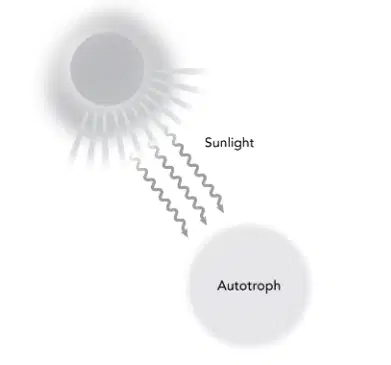
Chloe is developing a model of photosynthesis. The first part of the model is shown below. Which would be the MOST useful next step for Chloe to develop the photosynthesis model further?
Extend the lines for sunlight so that they pass through the autotroph.
Represent a chemical reaction in the autotroph that produces high-energy carbohydrates.
Represent a chemical reaction in the autotroph that produces high-energy proteins.
Draw a circle to represent a heterotroph, and draw a line to connect it to the autotroph.
A mushroom gains its energy by decomposing the tissues of dead organisms. Should mushrooms be classified as autotrophs, heterotrophs, in both groups, or in neither group, and for what reason?
They are autotrophs because they do not eat their food, as animals do.
They are autotrophs because decomposition is very similar to photosynthesis.
They are heterotrophs because their food is made by other organisms.
They are both autotrophs and heterotrophs, because they may grow in sunlight or darkness.
Neurons are cells of the nervous system. As part of its normal function, a neuron pumps sodium ions (Na⁺) out of the cell and potassium ions (K⁺) into the cell. Which statement describes the role of energy in this process?
The process releases energy that is used to make ATP.
The process releases energy in the form of heat.
The process requires energy that is provided by the sodium and potassium ions.
The process requires energy that is provided by ATP.
Which of these molecules does NOT store energy?
NADPH
NADH
FADH2
NADP+
stores energy
lipids
protein's
nucleic acid
carbon hydrates


Energy is released from an ATP molecule for cellular processes when it
converts a phosphate group to ADP
attaches an extra phosphate group
loses a phosphate group
produces a sugar molecule

