
 Worksheets
Aircraft Engines & Propulsion
Total questions: 65
Worksheet time: 22mins
Put the four main stages of engine operation in order:
intake
compression
power
exhaust
Which component of a jet engine is responsible for compressing the incoming air before it enters the combustion chamber?
Turbine
Compressor
Nozzle
Fan
In a turboprop engine, what is the primary function of the propeller?
To increase the engine's thrust by accelerating air
To cool the engine components
To reduce noise levels
To stabilize the aircraft
What is the main difference between a turbojet and a turbofan engine?
Turbojets are more fuel-efficient than turbofans
Turbofans have a bypass air stream, while turbojets do not
Turbojets are quieter than turbofans
Turbofans are used only in military aircraft
What is the role of the turbine in a jet engine?
To compress the air entering the engine
To extract energy from the exhaust gases
To ignite the fuel-air mixture
To direct the exhaust flow
In a turboprop engine, what component connects the turbine to the propeller?
Gearbox
Shaft
Nozzle
Combustion chamber
What is a key advantage of turbofan engines over turbojet engines?
Higher speed capability
Greater fuel efficiency
Simpler design
Lower maintenance cost
Which of the following is a measure of an engine's efficiency in converting fuel into thrust?
Specific fuel consumption
Thrust-to-weight ratio
Power output
Thermal efficiency
What is the primary purpose of the combustion chamber in a jet engine?
To cool the air before it enters the turbine
To mix fuel with air and ignite the mixture
To increase the pressure of the air
To direct the exhaust gases
In a turboprop engine, what is the main advantage of using a propeller?
Higher speed at high altitudes
Better fuel efficiency at lower speeds
Reduced noise levels
Increased engine lifespan
What is the primary function of the fan in a turbofan engine?
To increase the speed of the aircraft
To cool the engine components
To provide additional thrust by moving a large volume of air
To reduce engine noise
Which performance metric is used to compare the thrust produced by an engine to its weight?
Specific fuel consumption
Thrust-to-weight ratio
Power-to-weight ratio
Thermal efficiency
What is the primary function of a propulsion system?
To generate thrust
To reduce drag
To increase lift
To reduce fuel consumption
Which component in a turbojet engine increases air pressure?
Nozzle
Compressor
Turbine
Inlet
Which engine type is most suited for high-speed, supersonic flight?
Ramjet
Turboprop
Turboshaft
Piston engine
Which engine type is mainly used in helicopters?
Turbojet
Turboprop
Turboshaft
Ramjet
Which type of propulsion system is most commonly used for commercial aircraft?
Ramjet
Turboshaft
Turbofan
Piston engine
Compare and contrast the efficiency of turbojet and turbofan engines in aircraft propulsion systems.
Turbojets are more efficient at lower speeds, while turbofans are more efficient at higher speeds.
Turbojets are more efficient at higher speeds, while turbofans are more efficient at lower speeds.
Both turbojets and turbofans have the same efficiency at all speeds.
Turbojets are more efficient at all speeds compared to turbofans.
Explain how the thrust-to-weight ratio affects the performance of an aircraft.
A higher thrust-to-weight ratio generally improves an aircraft's acceleration and climb rate.
A higher thrust-to-weight ratio generally decreases an aircraft's acceleration and climb rate.
The thrust-to-weight ratio has no impact on an aircraft's performance.
A higher thrust-to-weight ratio generally improves an aircraft's fuel efficiency.
The Bypass Ratio of an engine is the ratio of:
A) primary air to tertiary air
B) cold stream air to that flowing through the hot core of the engine
C) exhaust gas pressure to air intake pressure
D) primary air to secondary air
A Bypass Ratio of 5:1 means that:
A) 5 pounds of air is bypassed for every 10 pounds entering the engine intake
B) 5 pounds of goes through the HP compressor for every 10 pounds that enters the intake
C) 10 pounds of air goes through the bypass for every 5 pounds that enters the intake
D) 5 pounds of air is bypassed for every 1 pound that goes through the hot core of the engine
Why can't the fan size in turbofan engines be infinitely large?
Limited by the speed of sound
Because of ground clearance issues
Due to weight constraints
All of these
What is the primary reason for employing a low bypass ratio in some turbofans?
To reduce engine noise
To improve crusing efficiency
To increase fuel efficiency
To decrease air intake
What is the main function of afterburners in a jet engine?
To cool down the engine
To reduce engine noise
To increase thrust dramatically
To improve fuel efficiency
Four-stroke engines are commonly installed on handheld power equipment due to their smaller size and reduced weight.
True
False
Which is an example of an aircraft with a turboshaft engine?


A turbo- shaft or turbo-prop engine can be thought of as a
mix of fuel and air
mix between a donkey and a horse
blend of efficiency and practicality
hybrid of a jet and a propeller engine
What happens in the combustion chamber?
Air is cooled and mixed with oil.
Bypass air and fuel are ignited.
Fuel and air mix and burn.
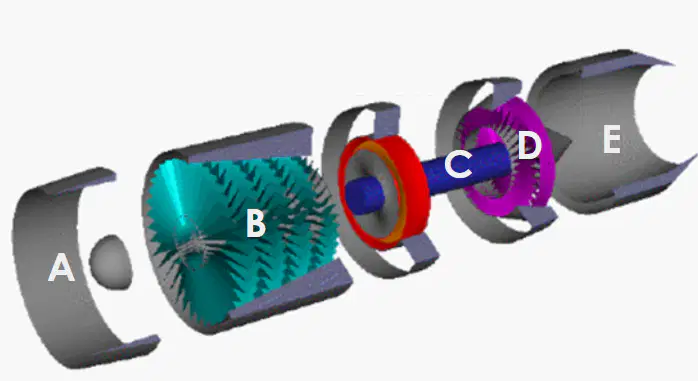
What is the name of the section labeled B?
Combustor
Compressor
Fan
Turbine
What is the name of the section labeled D?
Combustor
Compressor
Fan
Turbine
In the ____, fuel is injected and mixed with air, then ignited.
Combustor
Compressor
Fan
Turbine
The ____ extracts energy from the air flow, which is used to spin the compressor and fan (which continues the cycle).
Combustor
Intake
Exhaust
Turbine
What is the benefit to a low-bypass jet engine?
Supersonic Flight
More compact
Afterburner modifications available
All of the above
What is the benefit to a HIGH bypass jet engine?
Much quieter than other engine options
More efficiency
Higher thrust (non-afterburning)
All of the above
Why would high bypass air benefit commercial aircraft?
Bypass air surrounds the hot jet exhaust and makes the aircraft quieter
Bypass air powers all of the electronics that passengers need for their iphones
Bypass air is clean so it reduces the aircraft's carbon footprint
High bypass engines are only in military aircraft.
Which type of engine is typically found in small (personal) aircraft?
Propellor
(Reciprocating)
Turbojet
Turbofan
Turboprop
Afterburning
Turbojet
Which type of engine is typically found in low-speed transport aircraft and small commuter planes?
Propellor
(Reciprocating)
Turbojet
Turbofan
Turboprop
Afterburning
Turbojet
Icing can be a problem with ____ engines.
Propellor
(Reciprocating)
Turbojet
Turbofan
Turboprop
Afterburning
Turbojet
Which engine is easily identified by its large air intake?
Propellor
(Reciprocating)
Turbojet
Turbofan
Turboprop
Afterburning
Turbojet
Which type of engine is typically found in military fighter jets?
Propellor
(Reciprocating)
Turbojet
Turbofan
Turboprop
Afterburning
Turbojet
____ engines are known for their high thrust, giving the aircraft speed and maneuverability.
Propellor
(Reciprocating)
Turbojet
Turbofan
Turboprop
Which type of engine has a bypass ratio of 0?
Turbojet
Turbofan
Turboprop
Afterburning
Turbojet
Which type of engine produces the MOST thrust?
Turbojet
Turbofan
Turboprop
Which type of engine produces the LEAST thrust?
Turbojet
Turbofan
Turboprop
Which type of engine is the MOST fuel-efficient?
Turbojet
Turbofan
Turboprop
Which type of engine is the LEAST fuel-efficient?
Turbojet
Turbofan
Turboprop
Which type of engine could have a bypass ratio of 50?
Turbojet
Turbofan
Turboprop
Afterburning
Turbojet
A(n) ___ engine would help exceed the drag that an aircraft experiences close to the sound barrier.
Turbojet
Turbofan
Turboprop
Afterburning
Turbojet
A(n) ___ engine suffers from extremely inefficient combustion, so it uses a lot of fuel.
Turbojet
Turbofan
Turboprop
Afterburning
Turbojet
A(n) ___ engine combines high and low speed AND altitude performance.
Turbojet
Turbofan
Turboprop
Afterburning
Turbojet
Which type of engine could have a bypass ratio of 9?
Turbojet
Turbofan
Turboprop
Afterburning
Turbojet
____ prepares the air for combustion by adding energy in the form of pressure and heat.
intake
compression
power
exhaust
Compression makes for a more powerful reaction relative to _____.
aircraft weight
engine size
air pressure
engine type
(a) air travels around (not through) the engine core.
How does a turbojet work? Put the following steps in order:
Fan blades compress incoming air
Fuel is added so air temperature increases
Expanding air releases energy
Fast-moving exhaust creates thrust
When compared with a two-stroke engine, four-stroke engines are ____ and ____.
quieter
more fuel efficient
more powerful
Label each type of engine.
High bypass engines are (a) , and (b) than standard turbojet engines.
The compressor in a gas turbine engine acts like many rows of airfoils, with each row producing a small jump in ____.
temperature
pressure
volume
airspeed
Turbojets are (a) and have lower (b) .
Turbofans are (c) and have lower (d) .
Which words correctly fill in the blanks?
Commercial aircraft typically have a ___ bypass ratio.
Military aircraft typically have a ___ bypass ratio.
high
high
low
low
high
low
low
high
How is engine performance impacted when altitude and airspeed are increased?
Thrust ___ and specific fuel consumption (SFC) ___.
increases, increases
decreases, decreases
increases, decreases
decreases, increases
Which is the LEAST likely to be a bypass ratio for a turbofan?
0.1
3
7
9
Which aircraft is LEAST likely to be powered by a turbofan engine?
Cessna
Boeing 777
Airbus A380

This is most likely a ____ engine.
Turbojet
Turbofan
Turboprop
Afterburning
turbojet

