
 Worksheets
Weather
Total questions: 23
Worksheet time: 27mins
What affects climate?
rain, sunshine, hills and economics
latitude, ocean currents,mountains and water
borders, country, environment, wind
wind, water cycle,rain, tornadoes

Cold Front

Warm Front

Occluded Front

Stationary Front
Name three examples of extreme weather events.
Hurricanes, tornadoes, heatwaves
Droughts
Floods
Earthquakes
How does the ocean affect the climate of coastal areas during winter?
the ocean helps keep the temperatures warmer than
those in inland areas
the ocean helps keep the temperatures cooler than
those in inland areas
the ocean has no effect on coastal areas
the ocean causes unusual weather patterns during
winter
How do the oceans affect the global climate?
the ocean keeps the planet’s temperature colder than it would be otherwise
the ocean keeps the planet’s overall temperature moderate, not too hot and not too cold
the ocean keeps the atmosphere’s winds faster than they would be otherwise
the ocean keeps the atmosphere’s winds slower than they would be otherwise

Which point on the map above is most likely to be in the path of a hurricane?
P
Q
R
S
Convection takes place because _______________________________
warm air is more dense than cold air
warm and cold air have the same density
cold air is less dense than warm air
cold air is more dense than warm air

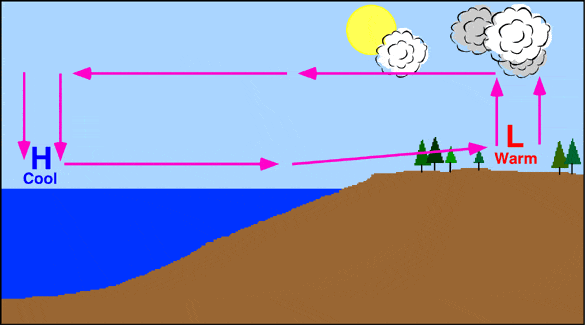
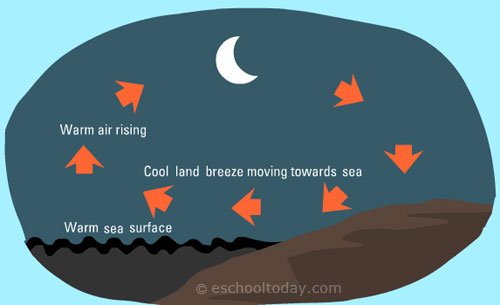
What is the process that causes the events shown in the illustration?
radiation
conduction
convection
weathering

Hurricane Harvey's greatest speed was 134 mph. What eventually weakened Hurricane Harvey?
warm, moist air was no longer available on land
hurricanes don't like land
hurricanes can only last for about a week
hot air sinking from the sky
One of the major ways oceans contribute to weather systems is that the oceans -
provide a diverse habitat for many organisms.
store and transport the Sun’s heat energy.
experience changes in amounts of dissolved salt.
reach depths that can be as much as 12,000 meters.
Most of the water vapor in the atmosphere comes from evaporation of water from oceans. Most of this evaporation occurs where there is the greatest solar radiation, which is -
along the coast of Europe.
around islands in the Pacific.
near the Equator.
at both of the poles.
The majority of heat transfer performed on Earth by oceans is from what region to what other region?
From the Equator to the poles.
From coastal regions to inland.
From North America to South America.
From the Pacific to the Atlantic Ocean.
Which of the following correctly identifies the major source for the energy that creates hurricanes?
Sun's radiation
Ocean currents
Moon's gravity
Earth's rotation
Which of the following is a major way in which oceans contribute to weather systems?
Ocean water has high salinity.
Oceans transfer energy from the Sun.
Most volcanic activity occurs in the ocean.
Oceans have high levels of biodiversity.
Thermal energy from evaporating water drives the weather systems. The regions on Earth that would have the most evaporation are those regions -
near the Equator.
along the coasts of Asia.
near tropical rainforests.
along mountain ranges.

