Wayground logo

Free Printable Worksheets

Font size

S
M
L
XL
Worksheets

Trends of the Periodic Table Test

Total questions: 44

Worksheet time: 22mins

Name
Class
Date
1.

Which atom has an ending electron configuration of 3p3?

a)

B

b)

P

c)

S

d)

As

2.
Electronegativity is
a)
a measure of an atoms ability to attract electrons from another atom
b)
a measure of the energy required to remove an electron from an atom
c)
the size of an atom measured form nuclei to nuclei
d)
an atom that has gained or lost one or more electrons
3.
An ion is
a)
a measure of an atoms ability to attract electrons from another atom
b)
a measure of the energy required to remove an electron from an atom
c)
the size of an atom measured form nuclei to nuclei
d)
an atom that has gained or lost one or more electrons
4.
Atomic radius is
a)
a measure of an atoms ability to attract electrons from another atom
b)
a measure of the energy required to remove an electron from an atom
c)
the size of an atom
d)
an atom that has gained or lost one or more electrons
5.
Ionization energy is
a)
a measure of an atoms ability to attract electrons from another atom
b)
a measure of the energy required to remove an electron from an atom
c)
the size of an atom measured form nuclei to nuclei
d)
an atom that has gained or lost one or more electrons
6.
This scientist is credited with the first periodic table, with elements arranged by atomic mass, and blank spaces for undiscovered elements.
a)
Mendeleev
b)
Moseley
c)
Bohr
d)
Millikan
7.
This scientist is credited with developing the modern periodic table, with elements arranged by atomic number.
a)
Mendeleev
b)
Moseley
c)
Bohr
d)
Rutherford
8.
________________ states that when elements are arranged on the periodic table in order of increasing atomic number, there will be repeating chemical and physical properties
a)
Henry Moseley
b)
Periodic Law
c)
Atomic theory
d)
Law of Periodic Repetitiveness
9.
The atomic number of an element is equal to the number of _____________ in a neutral atom.
a)
energy shells
b)
neutrons
c)
electrons
d)
protons and electrons
10.
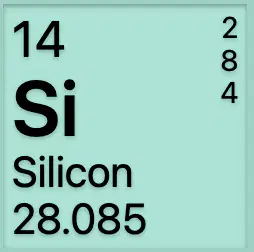
What is the atomic number of silicon?
a)
2,8,4
b)
14
c)
28.085
11.
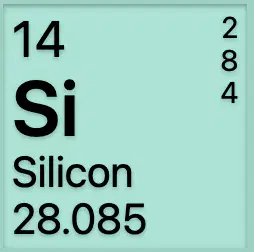
What is the atomic mass of silicon?
a)
2,8,4
b)
14
c)
28.085
12.
Which groups make up the s-block of the periodic table?
a)
1 & 2
b)
13 - 18
c)
3 - 12
d)
1 & 18
13.
Which groups make up the p-block of the periodic table?
a)
1 & 2
b)
13 - 18
c)
3 - 12
d)
1 & 18
14.
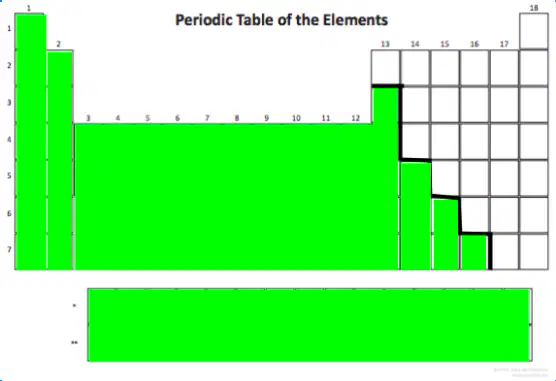
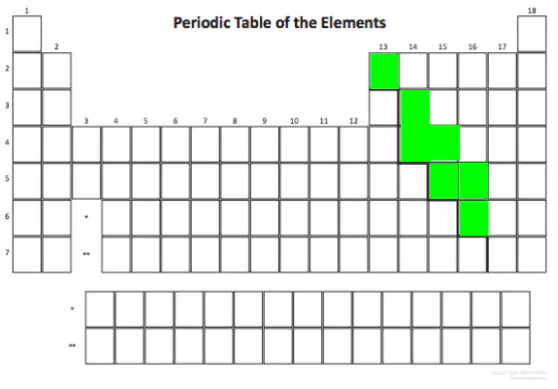
The elements highlighted green are the
a)
metals
b)
non-metals
c)
metalloids (semimetals)
15.
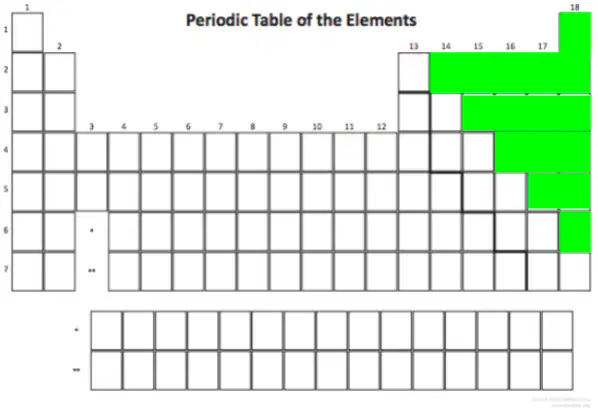
The elements highlighted green are the
a)
metals
b)
non-metals
c)
metalloids (semimetals)
16.
The elements highlighted green are the
a)
metals
b)
non-metals
c)
metalloids (semimetals)
17.
Which element is an alkali metal?
a)

K

b)

Mg

c)

Ti

d)

S

e)

Kr

18.
Which element is a Noble Gas?
a)

Ne

b)

Cl

c)

Fe

d)

Na

e)

Ca

19.
Which element is a halogen?
a)

F

b)

Ar

c)

Ca

d)

H

e)

He

20.
Which element is an alkaline earth metal?
a)

Tl

b)

Ca

c)

Fe

d)

Ar

e)

Na

21.
Which element is a transition metal?
a)

H

b)

Fe

c)

He

d)

Na

e)

Mg

22.

Which atom has a larger atomic radius?

Potassium or Rubidium?

a)
K
b)
Rb
23.

Which atom has the larger radius?

Phosphorus or Argon

a)
P
b)
Ar
24.
Which atom is the largest of all the elements on the periodic table?
a)
Fr
b)

He

c)

H

d)

Og

25.

Which atom has the higher electronegativity?

Fluorine or bromine?

a)
F
b)
Br
26.

Which atom has the higher electronegativity?

Bromine or Gallium?

a)
Br
b)
Ga
27.

Which atom has the higher electronegativity?

Krypton or Selenium

a)
Kr
b)
Se
28.
Which element has the highest overall electronegativity?
a)

F

b)

H

c)

He

d)

Fr

29.

Which atom has the higher ionization energy?

lithium or potassium?

a)
Li
b)
K
30.

Which atom has the higher ionization energy?

Aluminum or sulfur

a)
Al
b)
S
31.
Which element has the highest overall ionization energy?
a)
He
b)

H

c)

F

d)

Fr

32.

How many valence electrons does Xenon contain?

a)
8
b)

7

c)

1

d)

0

33.

How many valence electrons does an atom of Mg contain?

a)
2
b)

1

c)

8

d)

0

34.

How many valence electrons does an atom of Al contain?

a)
3
b)

1

c)

4

d)

0

35.

How many valence electrons does Oxygen contain?

a)
6
b)

5

c)

7

d)

2

36.

What ion will an atom of lithium form?

a)
0
b)
+1
c)
+2
d)
-2
e)
-1
37.

What ion will an atom of Boron form?

a)
+3
b)
+2
c)
+1
d)
0
e)
-1
38.

What ion will an atom of Bromine form?

a)
-1
b)
+3
c)
+2
d)
+1
e)
0
39.

What ion will an atom of Magnesium form?

a)
+2
b)
+3
c)
+1
d)
0
e)
-1
40.

What ion will an atom of Oxygen form?

a)
-2
b)
+3
c)
+2
d)
+1
e)
0
41.

What ion will an atom of Neon form?

a)
0
b)
+3
c)
+2
d)
+1
e)
-1
42.
Which element has the ending electron configuration of 4s2?
a)
Ca
b)
K
c)
Sr
d)
Mg
43.
Which element has the ending electron configuration of 3p3?
a)
N
b)
P
c)
As
d)
S
44.
Which element has the ending electron configuration of 4d3?
a)
Nb
b)
V
c)
Ta
d)
Zr