
Font size
 Worksheets
Week 13: Review for Quiz on Exponential vs Logarithmic Equations
Total questions: 38
Worksheet time: 1hrs 4mins
Rewrite as an exponential:
32=9
23=9
92=3
39=2
Rewrite as a log:
log53=125
log3125=5
log5125=3
log35=125
Rewrite as an exponential:
3x=6
63=x
x3=6
6x=3
Rewrite as a log:
log8x=12
log128=x
log812=x
logx12=8
Convert log(x)=5 to exponential form.
"loge" is the same thing as...
ln(2) = x

What type of function is represented on this table?
Exponential
Logarithmic
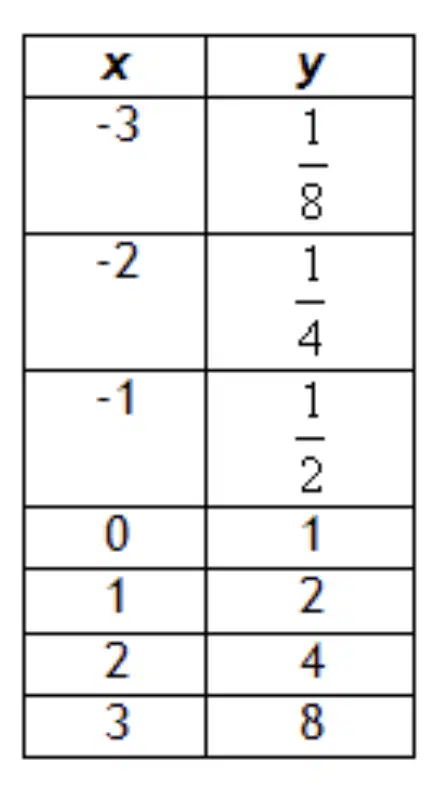
What type of function is represented on this table?
Exponential
Logarithmic
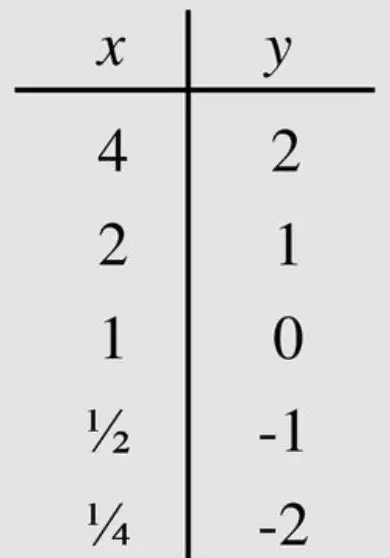
What type of function is represented on this table?
Exponential
Logarithmic
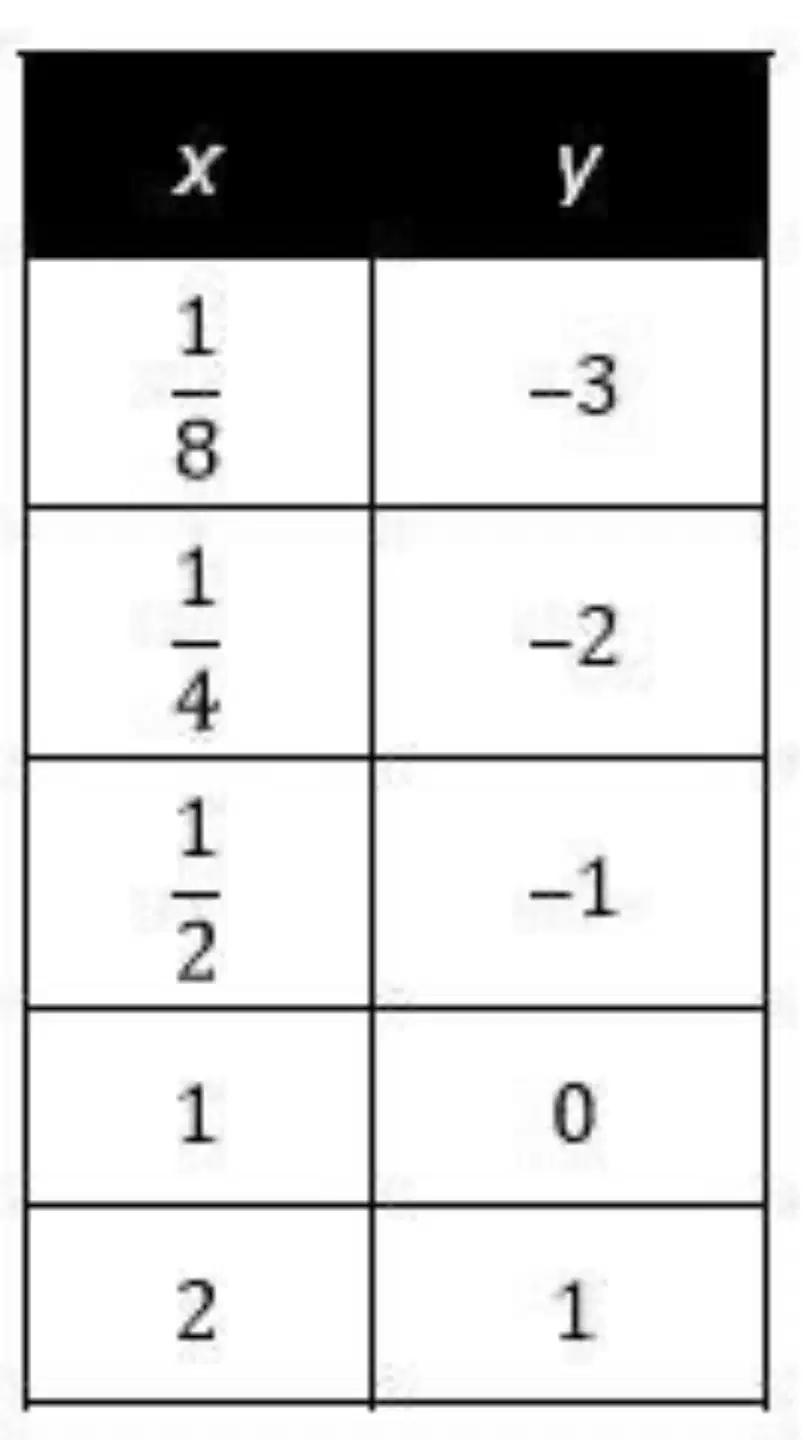
What type of function is represented on this table?
Exponential
Logarithmic
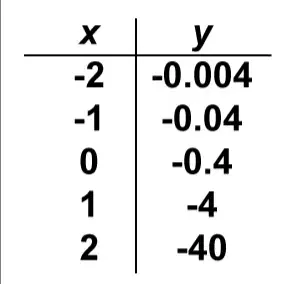
What type of function is represented on this table?
Exponential
Logarithmic
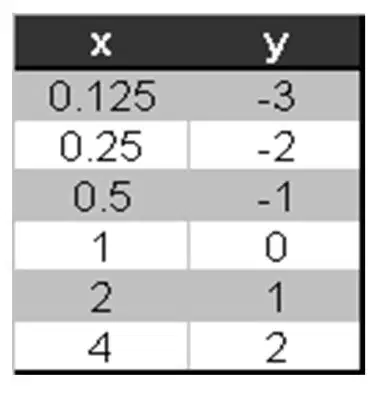
What type of function is represented on this table?
Exponential
Logarithmic
What does a represent in the equation y=a⋅bx ?
the common ratio
the y-intercept
the x-intercept
the exponent
What does b represent in the equation y=a⋅bx ?
the common ratio
the y-intercept
the x-intercept
the exponent

Write the exponential equation that represents the given table.
y=80⋅4x
y=80⋅41x
y=80−60x
y=80+41x
Write the function that models the table.
g(x)=21(16)x
g(x)=16x−2
g(x)=−2x+16
g(x)=16(21)x

Write the exponential equation that represents the given table.
y=5⋅2x
y=10⋅2x
y=5+2x
y=10x+10

Which function models the table?
f(x)=9x−3
f(x)=9(31)x
f(x)=31(9)x
f(x)=−3x+9

Write an equation for the exponential function below.
y= 5(10)x
y= 5(2)x
y= 6(10)x
y= 6(2)x

Write the exponential equation that represents the given graph.
y=12−0.5x
y=12(21)x
y=12(2)x
y=12−6x

Write the exponential equation that represents the given graph.
y=3(4)x
y=3(9)x
y=3+9x
y=3+4x

Determine the exponential equation for the graph.
f(x)=0.5(4)x
f(x)=1(4)x
f(x)=4(0.5)x
f(x)=21(2)x

Which equation matches the graph?
y=6(1.5)x
y=3x+6
y=6(3)x
Write an exponential function in the form y=abx that goes through points (0,4) and (2,324).
y=4(9)x
y=9(4)x
y=2(4)x
y=4(81)x
Write an exponential function in the form y=abx that goes through points (0,9) and (3,72).
y=9(3)x
y=2(9)x
y=9(2)x
y=8(3)x
Write an exponential function in the form y=abx that goes through points (0,10) and (2,160).
y=10(2)x
y=4(10)x
y=16(4)x
y=10(4)x
Write an exponential function in the form y=abx that goes through points (0,3) and (4,48).
y=3(2)x
y=2(2)x
y=2(3)x
y=4(3)x

An exponential function is defined by
f(x)=a(b)x .Select all possible values of b so that f(x) represents exponential growth.
0
101
21
1011
1.3
An exponential function is defined by
f(x)=a(b)x .Select all possible values of b so that f(x) represents exponential decay.
-5
101
21
1011
1.3

Which of the following is an exponential decay model?
y = 3 (1/2)x
y = 1/2 (3)x
y = -2 (2)x
y = -3 (3/2)x

