
Font size
 Worksheets
Nature and Behavior of Gases
Total questions: 10
Worksheet time: 6mins
According to kinetic theory:
Gas particles have volume and experience attractive forces between particles.
solids can physically change position at random.
all matter consists of tiny particles and only those of liquids and gases are in constant motion.
all matter consists of tiny particles that are in constant motion.
The process by which gases move from areas of high concentration to areas of low concentration until the concentration of the gas in the container is uniform is called
diversion
diffusion
differential
division

A helium-filled weather balloon has a volume of 240 L at 99 kPa pressure and a temperature of 0 oC. What is the mass (in grams to 3 significant figures) of the He in the balloon.
(He molar mass = 4.0026 g/mol)
(a)
Gases are compressible because
they are composed of particles.
they are mostly empty space and their container may be shrunk, forcing the particles closer together.
they have mass and take up space.
they form strong bonds with other gas particles.
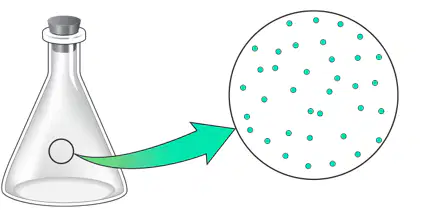
A diagram in a chemistry book shows a magnified view of a flask of air as seen to the left. What do you think is between the dots (the dots represent air molecules)?
air
dust
pollutants
nothing
oxygen
2.00 moles of an ideal gas has a pressure of 5.00 atm at a temperature of 155 oC. Calculate the volume (in L) this would occupy to three significant figures.
(a)
When a gas escapes its container through a tiny hole to an area of lower pressure this is called
effusion
effluent
ineffable
diffusion
The gas that can effuse or diffuse at a higher rate has
the lower molar mass
the higher molar mass
the greater intermolecular attractions
the least intermolecular attractions
Determine the total pressure of a gas mixture that contains oxygen, nitrogen, and helium. The partial pressures are: PO2 = 27.0 kPa, PN2 = 36.8 kPa, and PHe = 15.0 kPa.
14904 kPa
14.9 kPa
42.8 kPa
78.8 kPa
A sample of nitrogen gas has a pressure of 8.49 kPa at 467 K. If the volume does not change, what will the pressure be at 283 K?
14.01 kPa
5.14 kPa
15.56 kPa
1.26 kPa

