
 Worksheets
Solidification and Nucleation Quiz
Total questions: 20
Worksheet time: 10mins
What is the first step of solidification?
Melting
Nucleation
Evaporation
Condensation
During nucleation, what happens to the free energy of the system when a new surface is formed?
It decreases
It remains constant
It increases
It becomes zero
What is the relationship between the radius of a particle and the volume during nucleation?
Volume is proportional to r
Volume is proportional to r^2
Volume is proportional to r^3
Volume is proportional to r^4
What is the effect of a higher degree of undercooling on the likelihood of developing stable nuclei?
It decreases the likelihood
It has no effect
It increases the likelihood
It makes the process impossible
What is homogeneous nucleation?
Nucleation that occurs when nuclei form around impurities
Nucleation that occurs when the degree of undercooling is large enough to form a stable nucleus
Nucleation that occurs at high temperatures
Nucleation that occurs without any undercooling
What is a characteristic of heterogeneous nucleation?
It requires extreme degrees of undercooling
It occurs exclusively in laboratory settings
It reduces the surface energy of the solid-liquid interface
It only occurs at temperatures above 0°C
How does temperature affect the rate of nucleation?
Higher temperatures always increase nucleation rate
Lower temperatures always increase nucleation rate
Undercooling speeds up nucleation, but lower temperatures slow diffusion
Temperature has no effect on nucleation rate
What is grain refinement?
A process to increase grain size by adding heat
A process to create artificial nucleation sites for smaller grain size
A method to remove impurities from the melt
A technique to solidify grains at higher temperatures
What is precipitation hardening also known as?
Grain refinement
Age hardening
Glass-ceramics
Homogeneous nucleation
What is a characteristic of glass-ceramics?
They are formed by rapid cooling
They are shaped in a crystalline state before heat treatment
They are processed in a glassy state before forming crystalline ceramics
They do not require nucleating agents
What is the latent heat of fusion in the context of solidification?
The amount of heat required to raise the temperature of a unit mass by one degree
The amount of heat released by the solidifying crystals
The amount of heat required to melt a solid
The amount of heat absorbed by a liquid
What type of growth occurs when a material is well inoculated and undergoes heterogeneous nucleation?
Dendritic growth
Planar growth
Columnar growth
Equiaxed growth
What is dendritic growth?
Growth that occurs when the material is above the melting temperature
Growth that occurs when the material is poorly inoculated and significantly undercooled
Growth that occurs when the material is well inoculated and not undercooled
Growth that occurs when the material is rapidly cooled
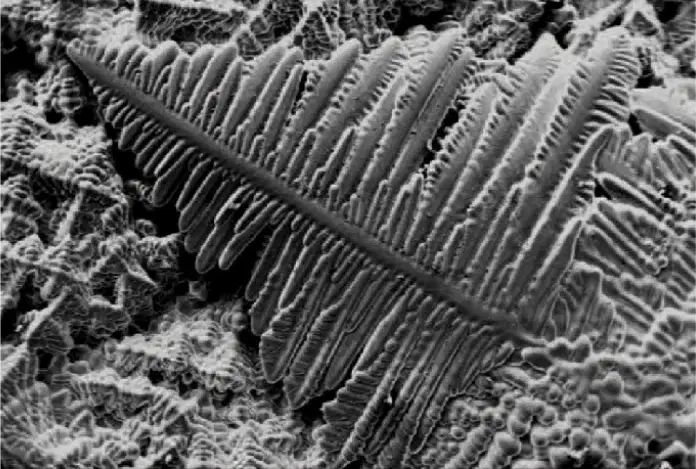
Why are dendrites compared to trees?
Because they grow in a straight line
Because they have a circular shape
Because they have a branching structure
Because they are solid and dense
What is the chill zone?
The area of the casting right next to the mold, made up of small, equiaxed grains
The area of elongated grains in the middle of the casting, growing perpendicular to the mold walls
The area in the center of the casting made up of small, equiaxed grains
What is the columnar zone?
The area of the casting right next to the mold, made up of small, equiaxed grains
The area of elongated grains in the middle of the casting, growing perpendicular to the mold walls
The area in the center of the casting made up of small, equiaxed grains
What is the equiaxed zone?
The area of the casting right next to the mold, made up of small, equiaxed grains
The area of elongated grains in the middle of the casting, growing perpendicular to the mold walls
The area in the center of the casting made up of small, equiaxed grains
What is soldering?
A process done above 450C to join two parts together without melting them
A process done to join two parts together by melting them with or without filler materials
A process done below 450C to join two parts together without melting them
What is brazing?
A process done above 450C to join two parts together without melting them
A process done to join two parts together by melting them with or without filler material
A process done below 450C to join two parts together without melting them
What is welding?
A process done above 450C to join two parts together without melting them
A process done to join two parts together by melting them with or without filler material
A process done below 450C to join two parts together without melting them

