
 Worksheets
Nervous System and Homeostasis Quiz
Total questions: 98
Worksheet time: 49mins
How do the structures and functions of the nervous system work together to maintain homeostasis and respond to stimuli?
By regulating blood sugar levels
By processing and responding to sensory information
By producing hormones
By digesting food
What are the main structures of the Central Nervous System (CNS)?
Brain and spinal cord
Heart and lungs
Liver and kidneys
Muscles and bones
What is the spinal cord continuous with?
Brain stem
Heart
Lungs
Liver
Which of the following is a function of the spinal cord?
Connects brain to nerves
Pumps blood
Filters toxins
Produces hormones
Where is the spinal cord enclosed?
Vertebrae
Skull
Rib cage
Pelvis
What type of path does the spinal cord provide?
2-way path to and from the brain
1-way path to the heart
3-way path to the lungs
4-way path to the liver
What is one of the major roles of the spinal cord?
Major reflex center
Oxygen exchange
Digestion
Hormone production
What is the primary role of the Central Nervous System (CNS)?
Acts as the integration and command center
Transports oxygen in the blood
Produces hormones
Filters waste from the blood
What type of sensory information does the CNS take in?
Only conscious sensory information
Only subconscious sensory information
Both conscious and subconscious sensory information
Neither conscious nor subconscious sensory information
What does the CNS do to maintain homeostasis?
Produces red blood cells
Initiates responses and makes decisions
Breaks down food
Regulates body temperature
What is the Peripheral Nervous System (PNS) composed of?
Only cranial nerves
Only spinal nerves
Spinal and cranial nerves
Only central nerves
How many pairs of spinal nerves are there in the Peripheral Nervous System?
12 pairs
24 pairs
31 pairs
15 pairs
How many pairs of cranial nerves are there in the Peripheral Nervous System?
10 pairs
12 pairs
14 pairs
16 pairs
What are the two main divisions of the Peripheral Nervous System (PNS)?
Central and Peripheral
Sensory (Afferent) and Motor (Efferent)
Somatic and Autonomic
Voluntary and Involuntary
Which part of the Peripheral Nervous System is responsible for voluntary actions?
Sensory (Afferent)
Autonomic (Involuntary)
Somatic (Voluntary)
Central Nervous System
What does the Sensory (Afferent) division of the PNS connect to?
Motor Neurons
Sense Organs
Autonomic System
Somatic System
What does the Somatic Division of the Peripheral Nervous System (PNS) control?
Involuntary actions
Reflexes and voluntary control of skeletal muscles
Cardiac muscles and glands
Sympathetic and parasympathetic systems
Which division of the PNS regulates automatic (involuntary) events?
Somatic Division
Autonomic Division
Central Division
Reflex Division
What are examples of functions controlled by the Autonomic Division?
Skeletal muscles
Reflexes
Smooth muscles, cardiac muscles, glands
Voluntary movements
Into which systems is the Autonomic Division further divided?
Somatic and Central systems
Reflex and Voluntary systems
Sympathetic and Parasympathetic systems
Skeletal and Muscular systems
What is the primary function of the Sympathetic Nervous System?
To conserve energy and relax the body
To mobilize the body during extreme situations
To regulate digestion and sleep
To control voluntary muscle movements
Which of the following is an example of a situation where the Sympathetic Nervous System is activated?
Sleeping
Eating
Exercising
Reading
What is the role of the Parasympathetic Nervous System?
To increase heart rate and blood pressure
To allow the body to unwind and conserve energy
To prepare the body for physical activity
To enhance sensory perception
When is the Parasympathetic Nervous System most active?
During intense physical activity
When the body is at rest and not threatened
During a fight or flight response
While experiencing fear or rage
What is the primary positive ion inside the cell during resting potential?
Sodium (Na+)
Calcium (Ca2+)
Potassium (K+)
Chloride (Cl-)
What is the primary positive ion outside the cell during resting potential?
Potassium (K+)
Sodium (Na+)
Calcium (Ca2+)
Magnesium (Mg2+)
What is the resting membrane potential of a neuron?
-70 mV
-50 mV
-90 mV
-30 mV
What term describes the state of the plasma membrane at rest?
Depolarized
Neutral
Polarized
Hyperpolarized
Which of the following can excite a neuron?
Light
Gravity
Magnetism
Temperature
Which of the following is NOT a factor that excites a neuron?
Pressure
Chemicals
Neurotransmitters
Electricity
What happens to the neuron membrane when a stimulus is applied?
It becomes permanently impermeable
It temporarily changes its permeability
It becomes permanently permeable
It does not change
What is required for an action potential to occur in a neuron?
A weak stimulus and low sodium ion influx
A strong stimulus and high sodium ion influx
A weak stimulus and high sodium ion influx
A strong stimulus and low sodium ion influx
What is the nature of the impulse conduction in neurons?
Partial conduction over the axon
All or none response
Gradual conduction over the axon
Random conduction over the axon
What is the result of the action potential in terms of membrane potential?
Hyperpolarization
Repolarization
Depolarization
Stabilization
What does depolarization activate in a nerve cell?
A nerve impulse or action potential
A muscle contraction
A hormone release
A blood clotting process
What ion flows into the cell during depolarization?
Potassium
Calcium
Sodium
Chloride
What happens to the intracellular matrix during depolarization?
It becomes more negative than positive
It becomes more positive than negative
It remains unchanged
It becomes neutral
What happens to the neuron membrane almost immediately after an action potential?
It becomes permeable to sodium ions again.
It becomes impermeable to sodium ions again.
It becomes permeable to potassium ions.
It becomes impermeable to potassium ions.
What is the role of K+ ions during repolarization?
K+ ions diffuse in to restore the positive charge.
K+ ions diffuse out to restore the negative charge.
K+ ions remain unchanged.
K+ ions diffuse out to increase the positive charge.
When is a neuron unable to conduct another impulse?
During depolarization.
During repolarization.
During hyperpolarization.
During polarization.
What does the sodium-potassium pump do during repolarization?
Pumps excess potassium ions out of the cells.
Pumps excess sodium ions into the cells.
Pumps excess sodium ions out of the cells and brings potassium ions back into the cell.
Pumps excess potassium ions into the cells and sodium ions out.
What is the role of action potential in neurons?
It stores neurotransmitters.
It is a chemical that transfers signals.
It stimulates the release of neurotransmitters.
It receives neurotransmitters from the synapse.
Which of the following is a chemical released by neurons to transfer action potential to other neurons?
Vesicle
Neurotransmitter
Axon
Dendrite
What is the function of vesicles in neurons?
They receive neurotransmitters.
They house neurotransmitters.
They transfer action potential.
They stimulate neurotransmitter release.
Where are receptor sites located in neurons?
On the axon
On the axon terminal
On the post synaptic neuron
On the vesicle
What is the function of the axon terminal in neurons?
It receives neurotransmitters.
It transfers neurotransmitters into the synapse.
It houses neurotransmitters.
It stimulates action potential.
What structure contains receptors that receive neurotransmitters from the synapse?
Axon
Vesicle
Dendrite
Axon terminal
What is the function of the axon in a neuron?
It stores neurotransmitters.
It transfers neurotransmitters into the synapse.
It is where action potential travels down.
It receives neurotransmitters from the synapse.
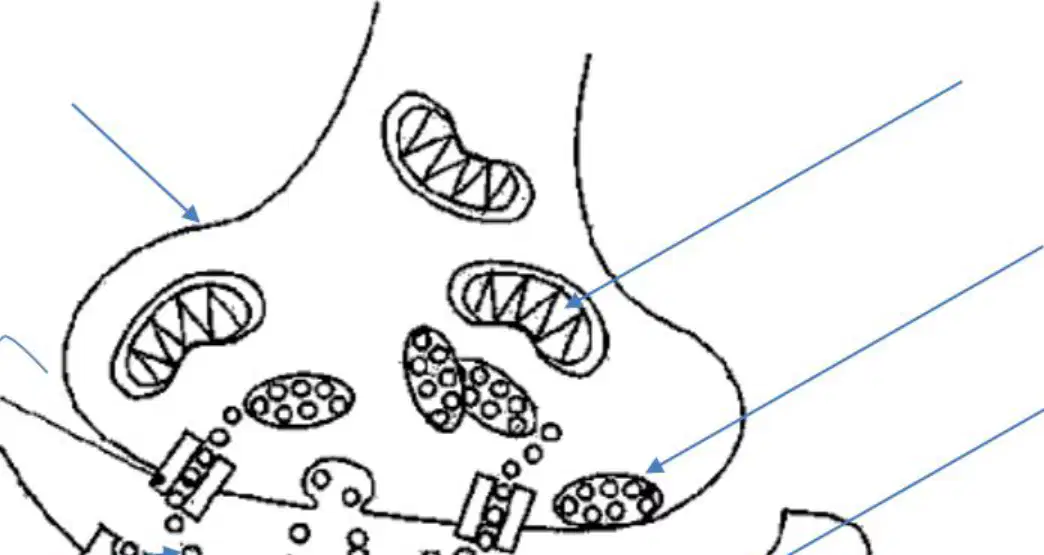
Which part of the diagram is responsible for releasing neurotransmitters?
Mitochondria
Synaptic vesicles
Axon terminal
Dendrite
What are neurotransmitters?
Electrical signals that neurons use to communicate
Chemical messengers that neurons use to communicate
Physical barriers that neurons use to communicate
Magnetic fields that neurons use to communicate
What is the role of excitatory neurotransmitters?
Prevent something from happening
Cause something to happen
Slow down communication
Block chemical signals
What is the role of a reuptake inhibitor in neurotransmission?
Enhances the effects of a neurotransmitter by preventing reuptake
Prevents the effects of a neurotransmitter
Mimics a neurotransmitter
Blocks neurotransmitter receptors
How does an antagonist affect neurotransmitter activity?
Enhances the effects of a neurotransmitter
Prevents the effects of a neurotransmitter
Mimics a neurotransmitter
Increases neurotransmitter production
What is the function of an agonist in relation to neurotransmitters?
Blocks neurotransmitter receptors
Prevents neurotransmitter release
Enhances the effects of a neurotransmitter
Decreases neurotransmitter synthesis
What does it mean when a substance mimics a neurotransmitter?
It blocks the neurotransmitter's effects
It pretends to be a neurotransmitter
It prevents neurotransmitter reuptake
It decreases neurotransmitter production
What is a neurotransmitter?
A type of hormone released in the bloodstream
A chemical substance released at the end of a nerve fiber
A protein that builds muscle fibers
A vitamin essential for brain function
What causes the release of neurotransmitters?
A decrease in body temperature
An action potential sent down the axon
A change in blood pressure
An increase in heart rate
Why are neurotransmitters important?
They help in the digestion of food
They communicate information throughout the brain and body
They regulate the production of red blood cells
They control the growth of hair and nails
Which of the following is NOT a function of neurotransmitters?
Telling the heart to beat
Helping the lungs to breathe
Building muscle tissue
Affecting mood and sleep
What are synaptic vesicles?
Gaps between neurons
Organelles that house neurotransmitters at axon terminal
Types of neurotransmitters
Parts of the dendrite
What is the synapse?
A type of neurotransmitter
A part of the axon
The gap between the axon and the dendrite of another neuron
A type of synaptic vesicle
What happens during reuptake?
Neurotransmitters are released into the synapse
Neurotransmitters are absorbed by the postsynaptic neuron
Neurotransmitters begin getting reabsorbed by the presynaptic neuron
Neurotransmitters are destroyed in the synapse
What can occur if neurotransmitters are not properly absorbed?
Enhanced memory
Increased energy
Disorders such as depression
Improved concentration
What is the function of neurotransmitters in a synapse?
To transmit electrical signals directly
To store energy for the neuron
To carry chemical signals across the synapse
To protect the neuron from damage
Where are neurotransmitters stored before being released into the synapse?
In the dendrite
In vesicles
In the synaptic cleft
In the axon terminal
What happens to neurotransmitters after they bind to receptors on the dendrite?
They are absorbed by the axon
They are destroyed by enzymes
They remain attached indefinitely
They convert into electrical signals
Which of the following is a major neurotransmitter?
Insulin
Dopamine
Hemoglobin
Estrogen
What is the role of excitatory neurotransmitters?
Prevents something from happening
Causes something to happen
Neutralizes chemical reactions
Slows down bodily functions
Which neurotransmitter is known for its inhibitory function?
Glutamate
GABA
Serotonin
Norepinephrine
What is the primary function of Acetylcholine (Ach)?
Inhibits motor neurons
Stimulates motor neurons to control muscle movement
Regulates blood sugar levels
Controls heart rate
What can imbalances in Acetylcholine (Ach) affect?
Vision clarity
Muscle tone and function
Skin sensitivity
Bone density
What type of neurotransmitter is Acetylcholine (Ach)?
Inhibitory
Neutral
Excitatory
Depressive
What is the primary function of dopamine in the brain?
Regulates sleep cycles
Applies to the brain's "reward center"
Controls muscle movement
Maintains body temperature
What feeling is dopamine known to produce?
Sadness
Anger
Extreme happiness
Fear
Dopamine imbalances are linked to which mental health condition?
Depression
Schizophrenia
Anxiety
Bipolar disorder
What can result from the excessive secretion of dopamine?
Improved memory
Addiction
Enhanced focus
Weight loss
What type of neurotransmitter is dopamine?
Excitatory
Inhibitory
Neutral
Stimulatory
What is one of the primary functions of serotonin?
Regulates blood sugar levels
Influences mood, appetite, and sensory perception
Controls muscle movement
Enhances memory retention
Serotonin is highly associated with which mental health condition?
Schizophrenia
Depression
Alzheimer's disease
Parkinson's disease
Which of the following is NOT a condition associated with serotonin imbalance?
Anxiety
Bipolar disorder
Diabetes
Panic attacks
What role does serotonin play in the peripheral nervous system (PNS)?
Stimulates muscle contraction
Inhibits pain responses
Enhances reflex actions
Regulates heart rate
What is one of the functions of norepinephrine/epinephrine in the peripheral nervous system (PNS)?
Regulates digestion
Controls voluntary muscle movement
Part of the "fight or flight" response
Maintains body temperature
Which of the following conditions is associated with an imbalance of norepinephrine/epinephrine?
Diabetes
ADHD
Asthma
Osteoporosis
Norepinephrine/epinephrine can function as which of the following?
Enzyme
Hormone or neurotransmitter
Vitamin
Mineral
What type of effect does norepinephrine/epinephrine have on the body?
Inhibitory
Sedative
Excitatory
Neutral
What is the primary function of GABA in the brain?
Increase fear and anxiety
Reduce fear and anxiety
Enhance memory
Stimulate appetite
Which of the following effects is induced by GABA?
Excitement
Relaxation
Aggression
Hunger
What type of neurotransmitter is GABA?
Excitatory
Inhibitory
Stimulatory
Neutral
Which of the following imbalances is associated with GABA?
Hypertension
Depression
Diabetes
Obesity
What is the primary function of glutamate in the brain?
Inhibitory neurotransmitter
Plays a role in attention, learning, and memory
Regulates blood pressure
Controls muscle movement
Which neurotransmitter does glutamate help balance in the brain?
Dopamine
Serotonin
GABA
Acetylcholine
What type of neurotransmitter is glutamate?
Inhibitory
Excitatory
Modulatory
Neutral
What are some conditions associated with glutamate imbalances?
Depression and anxiety
ADHD, learning disorders, memory loss, schizophrenia
Parkinson's disease and Alzheimer's
Insomnia and fatigue
What is the most common neurotransmitter secreted in the brain?
Serotonin
Dopamine
Glutamate
Acetylcholine
What is the primary function of endorphins?
To increase heart rate
To function as a neurotransmitter for pain relief and pleasure
To regulate blood sugar levels
To enhance memory retention
Endorphins are often referred to as what?
Natural sedative
Natural morphine
Natural stimulant
Natural depressant
What type of neurotransmitter are endorphins classified as?
Excitatory
Inhibitory
Neutral
Stimulatory
What are potential imbalances associated with endorphins?
Anxiety and insomnia
Chronic pain and depression
High blood pressure and fatigue
Increased appetite and weight gain

