
 Worksheets
Quiz: Watershed Project Content Topics
Total questions: 27
Worksheet time: 1hrs 14mins

What do we call an area of land that captures water and drains it to a single body of water?
A watershed
A water tank
A deep valley
An aquifer
What are dead zones?
Areas in the ocean with high oxygen levels
Areas in the ocean with high biodiversity
Areas in the ocean with low oxygen levels
Areas in the ocean with high fish population
What is the main cause of dead zones?
Natural occurrences
Climate change
Industrial pollution
Excessive nutrient pollution from human activities

Which best describes the information in the graph? (Choose the best answer.)
Cities are hotter because the tall buildings stop the wind.
Rural areas are cooler because they have more natural surfaces (increasing evapotranspiration and cooling).
Suburban residential areas are cooler because they have yards, lawns, and parks.
Cities are hotter because the windows on buildings reflect more light back to space.

It is early summer and students measure the temperature of a prairie strip and the artificial turf on a sunny day. What are they most likely to find?
The temperature of the prairie will be lower than the turf temperature due to evaporation.
The temperature of the priairie will be greater than other surfaces because it absorbs a lot of solar energy.
The turf has a dark green color, so it will be cooler than the prairie.
All surfaces will have approximately the same temperature because they get the same amount of sunlight.

Earlier, we learned that one change, Earth's tilt, can have dramatic effects on other parts of the Earth system. In the diagram, which describes the northern hemisphere at position C? (Click on the picture if you need to enlarge it.)

Direct Sunlight, Summer

Direct Sunlight, Winter

Indirect Sunlight, Winter
Fall (neither direct nor indirect sunlight)

Examine the figure (click on it to enlarge it). Analyze the data to put the events in order.
Ice sheets retreat due to warm temps.
With less ice, more surface water is exposed.
The surface water absorbs the sun's energy (instead of reflecting it).
As a result, more warming happens in the area.
More warming causes more sea ice to melt.
precipitation

Choose the most accurate statement about wetlands.
Wetlands are a water source, so they increase the chance of nearby areas flooding.
Wetlands grow algae, which can escape during floods and poison downstream areas.
Wetlands temporarily store water and release it over time, thus slowing erosion and downstream flooding.
Wetlands trap runoff from farms, thus making the entire watershed more polluted.

Which description below best describes how wetlands affect water quality?
Wetlands with algae have lower water quality than wetlands with completely clear water.
Wetland water contains dirt and dark organic acids, so it is usually classified as "low quality" water.
Wetlands decrease the amount of infiltration and increase the amount of runoff. This sends pollutants downstream.
If the soil is saturated, and precipitation increases, there will be
decrease in the amount of runoff
increase in the amount of runoff
decreases in the amount of groundwater
increase in the amount of transpiration
Which processes will cause the water table to rise?
runoff and erosion
precipitation and infiltration
deposition and burial
solidification and condensation

Which processes are label A and C?
Precipitation and condensation
Runoff and infiltration
Evaporation and transpiration
Water table and deposition
Select the location of the letter showing INFILTRATION

What would cause the water table to lower?
High rates of evaporation and transpiration
Low rates of evaporation and transpiration
Increasing amounts of runoff
A heavy rainstorm with a lot of precipitation
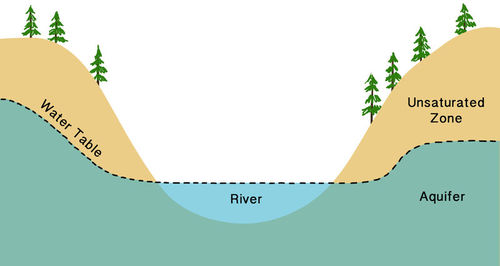
When investigating Ioway Creek, it didn't rain for a long time in the entire region but there was still water in the creek. Why?
Water was pumped from below using pumping wells.
There must of been heavy rains to the north (perhaps in Canada).
Groundwater continued to flow toward the creek from the surrounding soil.
Evaporation from trees resupplied the groundwater.
Water's (a) allows it to form (b) with other water molecules, creating a strong cohesive force that enables the " (c) " action of transpiration, where water molecules (d) from plant leaves and draw more water up the stem from the roots.
The city of Dubuque, Iowa installed (a) to increase the (b) of water in alleys and streets and built (c) upstream to decrease the amount of (d) and stop the costly effects of flooding.
Prairies decrease runoff by (a) the flow of water and directing that water into the (b) . Natural prairies increase the depth of (c) because (d) have deeper root systems than most (e) .
Which of the following best describes the role of nitrates in streams and waterways.
It is a pollutant that should be completely removed from all waterways.
It is a needed nutrient to support the food chains of streams (but too much is a bad thing for most ecosystems).
If very large amounts of nitrates are pumped into waterways, it will support larger and healthier ecosystems.
All nitrates come from farm runoff.

An ecosystem has a moderate amount of algae. Which of the following statements is most accurate.
The water is low-quality because it isn't crystal clear.
The algae is a natural part of a healthy ecosystem, providing food for other living things in the ecosystem.
Algae is toxic in most ecosystems and causes fish to die.
Algae is only present in ecosystems that have large amounts of farm runoff.

Why were trees removed along Ioway Creek at Duff Avenue?
To increase the rate of water flow out of the city of Ames (decreasing flooding).
To allow for more businesses to establish along Duff Avenue.
To slow down the rate of flow of the water, which will cause more water to infiltrate.
To provide more recreational opportunities for the citizens of Ames.

(You can click on the chart to zoom in.) 1. Describe and analyze the data in this chart. How does the data for the last 15 years compare to the data for the previous 45 years? 2. Describe change in the watershed for Ioway Creek that may have caused this change.
For your project, you drew a connections diagram that explained how a solution (or problem) could cause a sequence of changes in the Earth system. Describe your diagram and the claim that you made. What was the initial change? How did it cause a sequence of changes throughout the Earth System?
Reorder the following steps for the creation of "dead zones."
Fertilizer applied to farm fields.
Rain causes erosion of farm soil.
Farm soil and nitrates transported to rivers and then to the Gulf.
Algae feed on nitrates.
When algae die, bacteria feed and create low-oxygen zones.
A school has installed a detention basin. What does it do? (Select multiple correct answers.)
Prevents downstream flooding (it temporarily stores water).
Increases infiltration, which recharges the local groundwater.
Decreases infiltration, which causes more evaporation.
Creates a channel for water to directly flow toward the creeks and rivers.
Joe wants to make a raingarden to decrease the amount of runoff going into the city stormwater system. Which steps should he take?
Build it in a high area of his yard.
Build it in a low area of his yard.
Mix sand into the soil.
Mix clay into the soil.
Cover it completely with rocks.

