
 Worksheets
Untitled Quiz
Total questions: 225
Worksheet time: 4hrs 0mins
select two correct answers that show:
Average speed?
s = d/t
v = s/t
speed = distance/time
velocity = speed/time
Acceleration?
a = (v-u)/t
d = s/t
v = s/t
F= m/a
v = Δϰ/Δt?
average speed
force needed
average velocity
acceleration
Which formulae shows the relationship between Force, mass and acceleration?
W = mxg
F = mxa
p=mxv
ρ=mxV
Which formulae shows the rate in change of mometum?
F= mxa
F= mxv - mxu / t
F= mxg
F= Fxχ
Formula for Power?
ΔE = Fxd
KE = 1/2mxv2
W = ΔE/t
GPE = mxgxh
ΔE = Fxd?
work = force x distance
Power = Work/ time
Pressure = height x density x gravity
Kinetic energy = 1/2 mass x velocity²
Which is the correct formula for energy efficiency?
Efficiency = total input energy / useful energy output x 100
Efficiency = total input energy / useful energy output / 100
Efficiency = total input energy / useful energy output / 100
Efficiency = useful energy output / total input energy. x100
Select the two that show Refractive index of a material
Refractive index = speed of light in vacuum x speed of light in material
Refractive index = speed of light in vacuum / speed of light in material
n = v1 / v2
n = v1 x v2
Select the two that show the relationship between wave speed, frequency and wavelength
c = f x λ
Wave speed = frequency x wavelength
Wave speed = frequency / wavelength
c = f / λ
Two formulae that show the relationship between Current, charge and time
Current = charge x time
current = charge / time
I = Q x t
I = Q / t
Which will calculate the Power (W) in a circuit?
V = I x R
P = I x V
ΔE = I x V x t
I = Q / t
Which is the correct formula for Energy Transferred in a circuit?
ΔE = I x V x t
ΔE = I / V x t
ΔE = I x V / t
ΔE = I x V

Is this..........
Alpha decay
Beta decay

Is this ......
Alpha decay
Beta decay
Which formulae shows Hooke's Law?
F= mg
F= ma
F = kx
GPE = mgh
What does the relationship between mass, gravity and height show?
Resistance in a circuit
Current in a circuit
Gravitational Potential Energy
Extension of a spring
What is the unit of Work?
Newtons
Joules
Metres
Kg
What is the relationship between moment, force and distance? SELECT TWO CORRECT ANSWERS
M = F x d
M = F / d
d = M x F
F = M/d
What do ohms measure?
Current
potential difference
resistance
power
The units of frequency are...
metres
seconds
Hertz
degrees
Light is an example of a transverse wave
True
False
Sound is an example of a transverse wave
True
False
Which of the following statements describes the period of a wave?
Number of waves per second
Distance from crest to crest
Distance from resting position to top of the wave
Time taken to produce one wave
A microwave has a frequency of 300MHz. What is the wavelength of these waves?
1000 m
100 m
10 m
1 m
The period of a wave is 0.1 s. What is the frequency of this wave?
0.1 Hz
1 Hz
10 Hz
100 Hz
The lowest frequency form of visible light is...
Red
Yellow
Green
Violet
The correct order of the EM spectrum is...
R M IR UV V X G
G X UV V M R
R M IR V UV G
R M IR V UV X G
One use of radio waves is...
Broadcasting and communications
Heating
Observing internal structure of objects
Sterilising food and medical equipment
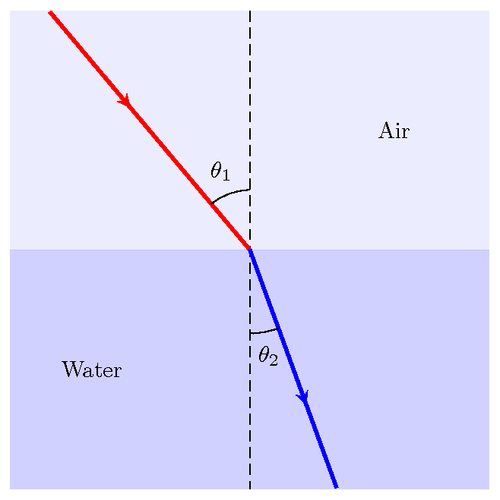
The following image demonstrates...
Reflection
Refraction
Interference
Diffraction

θ1 =35°, θ2=25° What is the refractive index, n, of water?
1.37
1.36
1.35
1.34
20 waves pass a point in 5 s. How is the frequency of these waves?
100 Hz
20 Hz
5 Hz
4 Hz
All waves can be reflected and refracted.
True
False

The critical angle in the diagram is 43 degrees. What is the angle of refraction at the critical angle?
Less than 43
Equal to 43
More than 43 but less than 90
Equal to 90 degrees
The critical angle of a block is 45 degrees. What is the refractive index of this block?
1.39
1.40
1.41
1.42
An example of scalar magnitude is _____.
velocity
mass
acceleration
force
Which statement describes a scalar?
direction

8m
Speed in a specific direction is called _____.
velocity
motion
position
displacement
Is this a scalar quantity or a vector quantity?
A deer running 15 meters per second due west.
Is this a scalar quantity or a vector quantity?
Wind blowing at 20 m/s.
direction
The students are arguing over the differences between speed and velocity. One student says, “Speed is a vector because it describes how fast an object traveling. Velocity is a scalar because it tells how fast and what direction an object is traveling.” Which of the following statements is correct?
The students' understanding of all four terms (speed, velocity, scalar, and vector) is correct.
The students' understanding of all four terms (speed, velocity, scalar, and vector) is incorrect.
The students' understanding of speed and velocity is incorrect but their
understanding of scalar and vector is correct.
The students’ understanding of speed and velocity is correct but their understanding of scalar and vector is incorrect.
How do scalars and vectors differ?
scalers have units
scalers have direction
vectors have units
vectors have direction
7. For winter, a duck flies 10 m/s due to south against a gust of wind with a speed 2.5 m/s. What is the resultant velocity of the duck?
7.5 m/s, north
12.5 m/s, south
7.5 m/s, south
12.5 m/s, north

What is the resultant force?
40 N left
0 N Balalnced
400 N right
40 N right


What is the resultant/ net force?
400 N Up
400 N Down
- 400 N Down
800 N Down

What is the resultant force?
17 N, Left
6N, Right
None of the above
11N, Left

Sound waves of frequency 2.0kHz travel through a substance at a speed of 800m/s. What is the wavelength of the waves?
0.40m
2.5m
400m
1600m
The frequency of a wave is doubled. The speed of the wave does not change. What happens to the wavelength of the wave?
It becomes four times as large.
It does not change.
It doubles.
It halves.
What is the number of wavefronts per second that pass a fixed point?
the amplitude of the wave
the frequency of the wave
the speed of the wave
the wavelength of thewave
What is the frequency of a wave?
the distance that a wavefront travels every second
the distance from one wavefront to the next
the number of wavefronts produced per second
the time taken for a wavefront to pass a certain point
Light enters a glass block at an angle of incidence of 46°. The light refracts at an angle of refraction of 26°. What is the refractive index of the glass?
0.57
0.61
1.64
1.77
A plane mirror is fitted to a wall. Which statement about the image formed by the mirror is correct?
The image is real.
The image is left to right (laterally inverted).
The image is smaller than the object.
The image is upside down.
Which group contains only electromagnetic waves?
light waves, radio waves, γ-rays
light waves, radio waves, sound waves
light waves, sound waves, γ-rays
radio waves, sound waves, γ-rays
How do infra-red waves differ from ultraviolet waves?
Infra-red waves are longitudinal.
Infra-red waves have a lower speed in vacuo (in a vacuum).
Infra-red waves have lower frequencies.
Infra-red waves have smaller wavelengths.
Which list shows electromagnetic waves in order of increasing frequency?
visible light, X-rays, γ-rays
visible light, γ-rays, X-rays
X-rays, γ-rays, visible light
γ-rays, X-rays, visible light
Which statement about ultraviolet waves is correct?
They are used in television remote controllers.
They can be detected by the human eye.
They travel as longitudinal waves.
They have the same speed in a vacuum as radio waves.
What is the correct equation for refractive index
n = sinr / sini
n = sini / sinr
c = sini / sinr
Sinc = sini / sinr
What is the correct equation for acceleration
a = (v - u) / t
a = d / t
a = f x m
What is the correct equation linking force mass and acceleration
F = ma
m = Fa
a = Fm
What is the correct equation linking voltage current and resistance
V = IR
R = VI
I = VR
What is the correct equation linking charge current and time
Q = It
I = Qt
t = QI
What is the correct equation linking density mass and volume
d = m / v
d = m x v
d = v / m
What is the correct equation for gravitational potential energy
m x g x h
m x g / h
m x h / g
What is the correct equation for kinetic energy
1/2 x m x v2
m x v2
1 / 2 x v x m2
What is the correct equation linking speed of a wave frequency and wavelength
v = f x λ
v = f / λ
v = λ / f
What is the correct equation for basic pressure
p = F / A
p = F x A
p = A / F
How do you find the number of neutrons in an element
Mass number - atomic number
Atomic number - mass number
Mass number / atomic number
What is the correct equation for electrical power
P = I x V
P = V / I
P = I / V
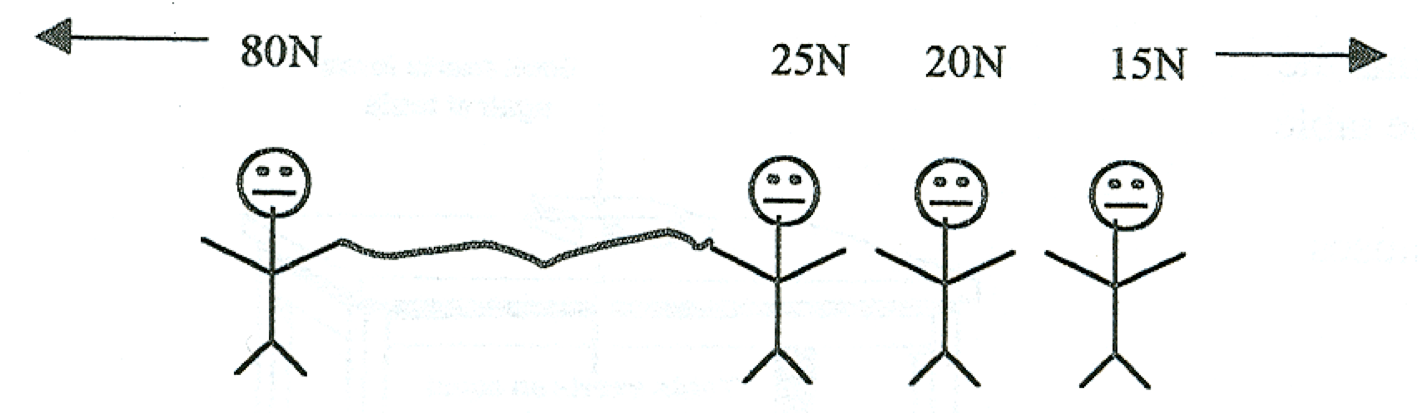
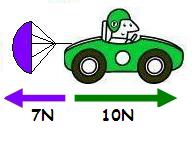
What is the net force?
3 N
3 N, right
17 N, right
3 N, left
What is the unit to MEASURE force?
Kilogram
Meter
Pounds
Newton
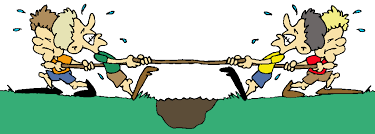
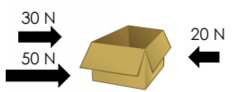

If both forces are going in the same direction you should______ those forces
Add
Subtract
Divide
Multiply
When forces are going in the opposite direction of each other you should do what do find the net force
Subtract
Add
Divide
Multiply
Which is the unit of current?
volts
amps
watts
joules
Which is the unit of voltage?
volts
amps
watts
joules
Complete the sentence: The ring mains consist of three wires: live, neutral and
Mars
ground
earth
mains
Complete the sentence: The role of the neutral wire in a mains circuit is
to carry current from the power station to your home.
to provide a path of least resistance to the ground.
to resist all current flow.
to complete the circuit so that current can flow.
Complete the sentence: The role of the earth wire in a mains circuit is
to protect the user should the appliance develop a fault.
to carry current from the power station to your home.
to resist the flow of current.
to provide an alternating current.
Which of the following is an insulator used in plugs?
copper wiring
brass pins
plastic casing
fixing screws
Where should a switch be placed in a mains circuit?
connected to the earth wire
connected to the live wire
connected to the neutral wire
anywhere in the circuit
Wires in a heating element are said to have high resistance. Why is this?
All the energy carried by the current is delivered to the appliance.
Energy is transferred to the wires as the current passes through so they heat up.
To prevent current flowing and causing the heating element to break.
None of the above.
Which of the following statements defines the term double insulated?
The appliance is insulated against energy transfer and electricity.
The appliance has an earth wire and a plastic casing.
There are two layers of insulation surrounding the cable.
The casing is made from an insulator such as plastic.
Complete the following sentence: Electrical power is defined as
the energy in the circuit.
the rate of flow of charge.
the rate of energy transfer.
the number of electrons in the circuit.
The majority of plugs contain fuses. Which of the following statements is not correct?
The fuse stops current from flowing through the appliance.
The fuse wire contains a piece of wire that melts if the current becomes too high.
The correct rating on the fuse must be used.
The fuse is fitted in the live wire.
Which equation links power, current and voltage?
power = current/voltage
voltage = current/power
power = current × voltage
current = power × voltage
A 1100 W hairdryer is used on the 230 V mains supply. What is the current supplied?
A hairdryer has a curernt of 4.7 A flowing thorugh it. Which fuse would you select for the plug?
A 2 kW kettle is used on a 230 V mains supply. It takes 1 minute 30 seconds to boil. What is the energy delivered to the kettle in this time?
A 60 W bulb is supplied with 36 000 J of energy. How long is the bulb on for?
The mains voltage in the UK is 230 V. What would the current be in a 90 W power cable?
A 60 W light bulb is turned on for 4 hours. How much energy does it require?
It takes roughly 380 kJ to boil a litre of water. How long will it take a 1.8 kW kettle to boil a litre of water?
A power bank can store 5600 J of energy. When connected to a phone of power rating 2.5 W, how long will it take to charge? (Hint: Assume all energy is transferred to the phone.)
What is kinetic energy?
moving energy
potential energy
stored energy
renewable energy
The energy in which store increases as a car moves faster?
Gravitational Potential Energy
Kinetic Energy
Thermal Energy
Kinetic Energy
The energy in which store decreases as a candle burns?
Chemical energy store
Kinetic energy store
Nuclear energy store
The energy in which store increases as an elastic band is stretched?
Gravitational Potential
Chemical
Elastic
Kinetic
_________________ is when energy is transferred because a force moves an object through a distance.
Elastic
Mechanically
By radiation
By heating
_______________ is when energy is transferred due to charge flowing around a circuit.
Electrically
Kinetic
Mechanically
By radiation
________ is when energy is transferred between areas that have different temperatures.
By radiation
By heating
Mechanically
Nuclear
When you eat fruits and vegetables, the energy is stored as ...
a. thermal energy
b. food energy
c. electrical energy
d. chemical energy


Food, fuels and batteries have energy in this energy store
Chemical
Thermal
Gravitational Potential
Elastic

A stretched rubber band has energy in this energy store
Magnetic
Electrostatic
Elastic
Nuclear

Two negatively charged particles which are close together have energy in this energy store
Electrostatic
Magnetic
Nuclear
Elastic

Energy which is transferred by a force moving an object through a distance
Mechanically
Electrically
By Radiation
By Heating

Energy which is transferred by charges moving due to a potential difference (voltage)
Mechanically
Electrically
By Radiation
By Heating

Shooting an arrow from a bow converts ____ into kinetic energy.
Elastic potential energy
Chemical energy
Gravitational potential energy
Thermal energy
A ____ converts chemical energy into kinetic energy?


The correct unit for wavelength is:
Hz
S
m
cm
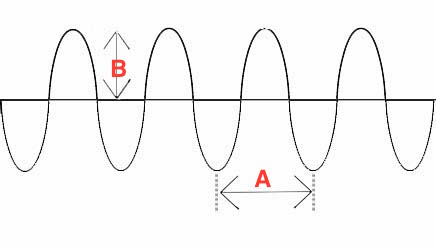
The distance between two troughs in a wave is:
frequency
wavelength
equilibrium
period
A substance (like solid, liquid or gas) that the energy of a wave can travel through
amplitude
compression
medium
frequency
The area of a longitudinal wave where the particles are crowded together.
compression
crest
transverse
medium
The correct unit for wavelength is:
Hz
S
m
cm
The distance between two troughs in a wave is:
frequency
wavelength
equilibrium
period
The highest point on a wave.
frequency
compression
trough
crest
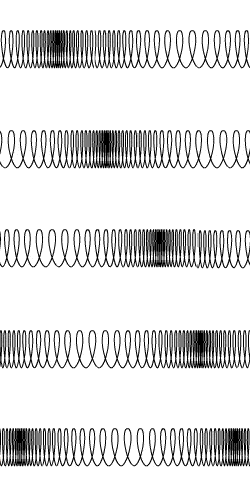

What is frequency measured in?
Milliseconds
Miles
Hertz
Kilograms
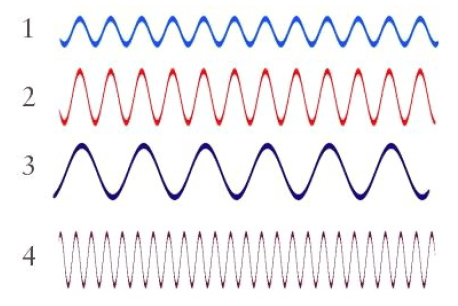
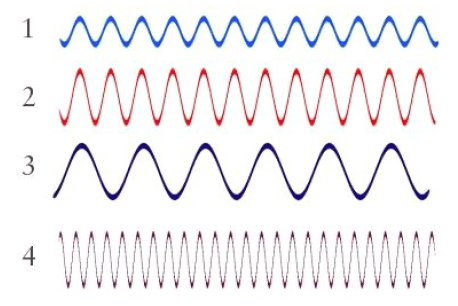

The frequency of a wave is 3.3 Hz. If the wavelength is 7.4 m, how fast is the wave moving?
2.24 m/s
24.4 m/s
0.45 m/s
0.24 m/s

speed(v) =16 m/s
frequency=4 Hz
wavelength ( λ )= ?
4 m
20 m
12 m
64 m

A
B
C
D

A
B
C
D

A
B
C
D

A
B
C
D

A
B
C
D

A
B
C
D

A
B
C
D

A
B
C
D

A
B
C
D

A
B
C
D

A
B
C
D

A
B
C
D

A
B
C
D

A
B
C
D

A
B
C
D

A
B
C
D

A
B
C
D

A
B
C
D

A
B
C
D

A
B
C
D

A
B
C
D

A
B
C
D

A
B
C
D

A
B
C
D
A device that converts mechanical energy into electrical energy
A. electric generator
B. electric motor
C. electromagnetic induction
D. electric meter

The strongest parts of the magnet are ...
fronts
backs
poles
middle

The area around a magnet is called the .....
attraction zone
work area
magnetic field
hot zone

When running a current through a wire, what do the blue lines represent?
The wire spinning
A magnetic field that was created
Electrons leaving
Electricity

What would happen with the magnets in the picture above?
They would repel
Nothing
They would attract
They would repel and then attract
What is the shape of the magnetic field around a current-carrying solenoid?
Circular
Straight
Spiral
Irregular
Motors are devices that convert _____ energy into _____ energy.
chemical; mechanical
mechanical; electrical
electrical; mechanical
potential; kinetic
Electric current is measured in ____________.
Newtons (N)
Amperes (A)
Hertz (Hz)
Volts (V)


To two decimal places, what is the refractive index of the plastic?
What is the angle of refraction at the critical angle?
Less than 43
Equal to 43
More than 43 but less than 90
Equal to 90 degrees

Given that the angle of incidence = 30 degrees
a. Draw a ray diagram, labelling clearly the normal, incident ray, angle of incidence, reflected ray and angle of reflection accurately.
Which is the correct diagam?

If a capital letter R is seen in an ordinary mirror, what does it look like?
A
B
C
D
When light passes from air to water, what happens to the speed of the light?
speeds up
slows down
stays the same


longer wavelength: blue
longer wavelength: red
longer wavelength: blue
longer wavelength: red
MCQ 011
According to the law of reflection, if i = angle of incidence and r = angle of reflection,
i = r
i > r
r > i
i is not equal to r

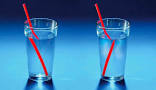
Optical fibre based on the principle of
total internal reflection.
total internal refraction.
diffraction.
interference.
A ray of light travels from air into glass at an incident angle of 30o. Find the angle of refraction. (The refractive index of glass is 1.5)
19.7o
19o
19.5o
19.3o
A ray of light enters air from glass. The angle of incidence is 35o and the angle of refraction is 69o. Find the refractive index of the glass.
1.62
1.63
1.64
1.65
What electromagnetic wave . has . the shortest wavelengths and the highest frequencies?
Gamma Rays
Ultraviolet Rays
Radio Waves
X Rays
What happens to wavelength as the frequency of a wave increases?
increase
stays the same
decreases
becomes faster
The human eye is only capable of seeing which electromagnetic wave?
Infrared Light
Ultraviolet Light
Visible Light
All of the above

What electromagnetic wave do humans emit as heat energy?
infrared light
ultraviolet light
visible light
microwaves
Which of the following is correct in order from lowest to highest energy?
X Rays, Visible Light, Microwave
Ultraviolet, Visible Light, Gamma-Rays
Microwave, Visible Light, Gamma Rays
Which type of electromagnetic wave has the longest wavelength?
visible light
radio waves
ultraviolet waves
gamma rays
Select the two that show Refractive index of a material
Refractive index = speed of light in vacuum x speed of light in material
Refractive index = speed of light in vacuum / speed of light in material
n = v1 / v2
n = v1 x v2
Dispersion of light referred to as________.
Bending of light
Splitting of light in seven colours
Splitting of light in primary colours
Bouncing back of light
the bending of light
refraction
reflection
absorption
transparent

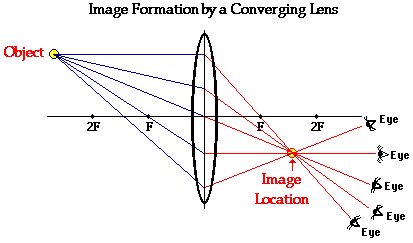


What type of image is formed?
virtual and inverted
virtual and upright
real and upright
real and inverted

What happens above the critical angle?
Diffraction
Reflection
Total Internal Reflection
Refraction

What is the name we give F?
Principle focus
Axis
Focal length
Image

Which words below best describe the image formed?
virtual, inverted, magnified
real, inverted, same size
real, upright, same size
virtual, upright, diminished

Apart from being virtual, what else is this image?
magnified, inverted
magnified, upright
upright, diminished
upright, same size

