wayground logo

Free Printable Worksheets

Font size

S
M
L
XL
Worksheets

untitled

Total questions: 81

Worksheet time: 3hrs 48mins

Name
Class
Date
1.

What is the chemical symbol for the element hydrogen

a)

H

b)

He

c)

h

d)

he

2.
The number at the top of each square on the periodic table is the ...
a)
atomic number
b)
atomic mass
c)
Chemical Symbol
d)
Element Name
3.

The atomic number tells you what?

a)

number of electrons

b)

number of protons

c)

number of neutrons

d)

both electrons and protons in an atom.

4.
Elements which are shiny, conduct electricity and heat are called
a)
metal
b)
nonmetal
c)
metalloid
d)
nonexistent
5.
A proton is....
a)
A negatively charged subatomic particle
b)
A positively charged subatomic particle
c)
A neutrally charged subatomic particle
d)
The only subatomic particle located in the nucleus
6.
The smallest particle of any particular type of matter is known by which of the following terms?
a)
Compound
b)
Atom
c)
Chemical
d)
Element
7.
The subatomic particle with a negative charge is the
a)
electron
b)
proton
c)
neutron
d)
nucleus 
8.

What is the atomic number?

a)

the number of protons

b)

the number of protons and neutrons

c)

the number of neutrons

d)

the number of protons and electrons

9.
What are the smallest states of matter?
a)
Atoms
b)
Elements
c)
Dogs
d)
Cats
10.
Atoms are made up of:
a)
Protons, Neutrons, and Electrons
b)
Nucleus
c)
Orbits
d)
Electron Clouds
11.
Protons and Neutrons make up the __________.
a)
Electrons
b)
Protons
c)
Nucleus
d)
Elements
12.
Electrons are found on the ______________ of the atom.
a)
Outside
b)
inside
13.
Electrons have a ______________ charge.
a)
Positive
b)
Negative
c)
Neutral
14.
How many protons does oxygen have?
a)
8
b)
16
c)
4
15.
How many electrons does oxygen have?
a)
8
b)
16
c)
4
16.
What is the atomic number of oxygen?
a)
8
b)
16
c)
4
17.
What is the atomic mass of oxygen?
a)
O
b)
Oxygen
c)
8
d)
16
18.
What is the name of this element
a)
O
b)
Oxygen
c)
8
d)
16
19.
How many neutrons does oxygen have?
a)
8
b)
16
c)
24
d)
2
20.
The chart that arranges elements by atomic number is:
a)
Atomic Number
b)
Metal
c)
Periodic Table
d)
Chart
21.
A substance that is generally shiny, can be bent, and often conducts heat and electricity is:
a)
Gas
b)
Nonmetal
c)
Metal
d)
Element
22.
A POSITIVE subatomic particle:
a)
Neutron
b)
Electron
c)
Atom
d)
Proton
23.
Which atom has a positive charge?
a)
I
b)
II
c)
III
d)
IV
24.
If two atoms have the same amount of protons, but a different amount of neutrons, they are still the same element.
a)
True
b)
False
25.
An atom has 8 protons and 8 neutrons.  Which of the following is an isotope of this atom?
a)
8 protons and 8 neutrons
b)
9 protons and 8 neutrons
c)
8 protons and 6 neutrons
d)
3 protons and 7 neutrons
26.
How are compounds and elements different?
a)
Elements are metals; compounds are nonmetals
b)
Elements are pure substances; compounds are not
c)
Elements exist as solids, liquids, and gases; compounds are solids
d)
Elements have one kind of atom; compounds have different kinds of atoms
27.

Which atom is being modeled here? (it has 7 protons)

a)

Carbon

b)

Oxygen

c)

Flourine

d)

Nitrogen

28.

Which atom is being modeled here? (it has 7 protons)

a)

Carbon

b)

Oxygen

c)

Flourine

d)

Nitrogen

29.

The atomic weight of Nitrogen is?

a)

14

b)

8

c)

14.01

d)

7

30.

The symbol for Nitrogen is......

a)

N

b)

7

c)

Na

d)

Nitrogen

31.

What is the picture displayed?

a)

atom

b)

element

c)

compound

32.

What is the picture displayed?

a)

compound

b)

element

c)

molecule

33.

Which of the following cannot be broken down into something simpler?

a)

A compound

b)

An element

c)

A mixture

34.
What do we call a chemical substance made up of 2 or more different types atoms bonded together?
a)
formula
b)
atom
c)
subscript
d)
compound
35.

How many Hydrogen atoms are present in H20?

a)

2

b)

4

c)

1

d)

0

36.

The illustration below shows the process of two different substances being combined. Which process does the illustration show?

a)

two pure substances physically combined to form a mixture

b)

two pure substances chemically combined to form a different pure substance

c)

a mixture separated into the components that were originally combined

d)

a solution formed by dissolving a solid in a liquid

37.
What is a compound?
a)
an atom with more electrons than protons
b)
a substance in which the atoms of two or more elements are combined together
c)
an atom with more neutrons than protons
d)
a substance in which the atoms of three or more elements are combined together
38.
a)
Element
b)
Compound
c)
Mixture
39.
a)
Element
b)
Compound
c)
Mixture
40.
a)
Element
b)
Compound
c)
Mixture
41.
a)
Element
b)
Compound
c)
Mixture
42.
a)
Element
b)
Compound
c)
Mixture
43.
a)
Element
b)
Compound
c)
Mixture
44.
a)
Element
b)
Compound
c)
Mixture
45.
a)
Element
b)
Compound
c)
Mixture
46.
a)
Element
b)
Compound
c)
Mixture
47.
a)
Element
b)
Compound
c)
Mixture
48.
a)
Element
b)
Compound
c)
Mixture
49.
a)
Element
b)
Compound
c)
Mixture
50.
a)
Element
b)
Compound
c)
Mixture
51.
Adding or subtracting neutrons (charge = 0, mass = 1) makes the element change into an...
a)
ion
b)
mixture
c)
isotope
d)
neutral atom
52.
The atomic number is equal to _.
a)
the number of protons and electrons
b)
the number of neutrons only
c)
the total number of protons and neutrons
d)
the number of protons neutrons and electrons
53.
What is the charge on a lithium atom that looses 1 electron?
a)
+1
b)
0
c)
-1
d)
-2
54.
How many neutrons does B (Boron) contain?
a)
5
b)
11
c)
6
d)
10.811
55.

An atom that has gained or lost electrons in an attempt to become stable/bond with another atom.

a)

Normal/Neutral Atom

b)

Ion

c)

Isotope

56.

If an atom has 9 protons and 10 electrons it has a charge of ____.

a)

0

b)

-1

c)

+1

d)

-2

57.

If an atom has 4 protons and 2 electrons it has a charge of ____.

a)

0

b)

-2

c)

+2

d)

+1

58.

If an atom has a charge of +3 and an atomic number of 5 it should have _______ electrons.

a)

1

b)

2

c)

3

d)

4

59.

Ionic bonds are formed when electrons get

a)

Shared between two atoms

b)

Removed from both atoms

c)

Transferred from one atom to another

d)

Added to both atoms

60.

Ionic bonds typically form between

a)

A metal and a nonmetal

b)

Two nonmetals

c)

Two metals

d)

A metalloid and a metal

61.

Why do elements form chemical bonds?

a)

Because they're friendly

b)

To create a new element

c)

To become stable

d)

Because they all need to gain more electrons

62.
What two types of atoms make a covalent bond?
a)
2 Nonmetals
b)
1 Nonmetal and 1 Metal
c)
2 Metals
d)
2 Noble Gases
63.
How are covalent bonds explained?
a)
When one atom takes the other atom's electron
b)
When the atom shares an electron with an another atom
c)
When the two nucleus merge
d)
When the neutrons leave the nucleus
64.

Moseley re-ordered Mendeleev's Periodic Table using _?_.

a)

atomic weight

b)

atomic mass

c)

valence number

d)

atomic number

65.

The vertical (up and down) columns in the Periodic Table are called

a)

groups

b)

towers

c)

periods

d)

atomic numbers

66.
The Modern Periodic Table of Elements is arranged by
a)
atomic mass
b)
atomic number
c)
valence electrons
d)
number of isotopes
67.
Sodium (Na) is found in group 
a)
1
b)
2
c)
3
d)
4
68.

UP and DOWN columns on the periodic table are

a)

groups

b)

periods

69.

Which elements have properties in common?

a)

elements in a group

b)

elements in a period

70.

Which elements have 1 valence electron?

a)

period 1

b)

group 1

c)

group 4

71.

Which of the following is a property of metals?

a)

Poor conductors of heat and electricity

b)

Insulators of heat and electricity

c)

Non-reactive with other elements

d)

Good conductors of heat and electricity

72.

Which of the following is a property of nonmetals?

a)

Good conductors of heat and electricity

b)

Highly reactive with other elements

c)

Have high melting and boiling points

d)

Poor conductors of heat and electricity

73.

Which of the following elements is a nonmetal?

a)

oxygen

b)

iron

c)

sodium

d)

carbon

74.

Which of the following elements is a metal?

a)

Copper

b)

Oxygen

c)

Iron

d)

Gold

75.

Which of the following is a physical property of nonmetals?

a)

Poor conductors of heat and electricity

b)

Malleable and ductile

c)

Good conductors of heat and electricity

d)

High melting and boiling points

76.

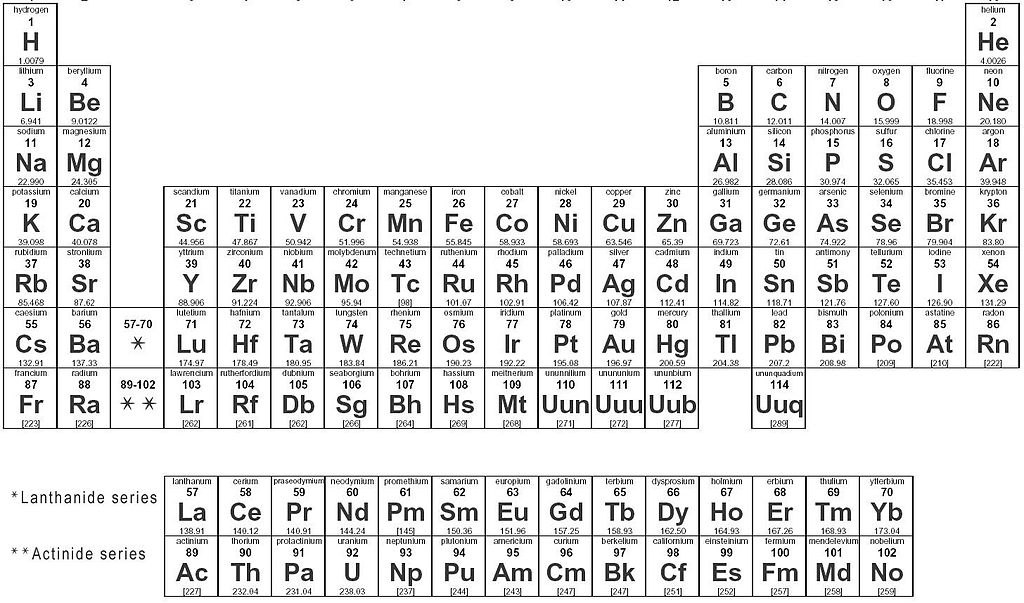
Which of the following is a characteristic of metals?

a)

Rough, soft, poor conductors of heat and electricity
b)

Transparent, flexible, good insulators of heat and electricity

c)

Shiny, malleable, good conductors of heat and electricity

d)

Dull, brittle, poor conductors of heat and electricity

77.
What side of the periodic table are nonmetals on?
a)
left
b)
right 
c)
top
d)
bottom
78.
What side of the periodic table are metals on?
a)
left
b)
right
c)
top
d)
bottom
79.
Is gold metal or nonmetal?
a)
metal
b)
nonmetal
80.
If a material can easily be drawn into the shape of a wire, it is
a)
Ductile
b)
Magnetic
c)
Malleable
d)
Reactive
81.
All of these properties describe metals EXCEPT...
a)
malleable
b)
conductors
c)
brittle 
d)
luster