Font size
 Worksheets
Y8 Electricity
Total questions: 10
Worksheet time: 13mins
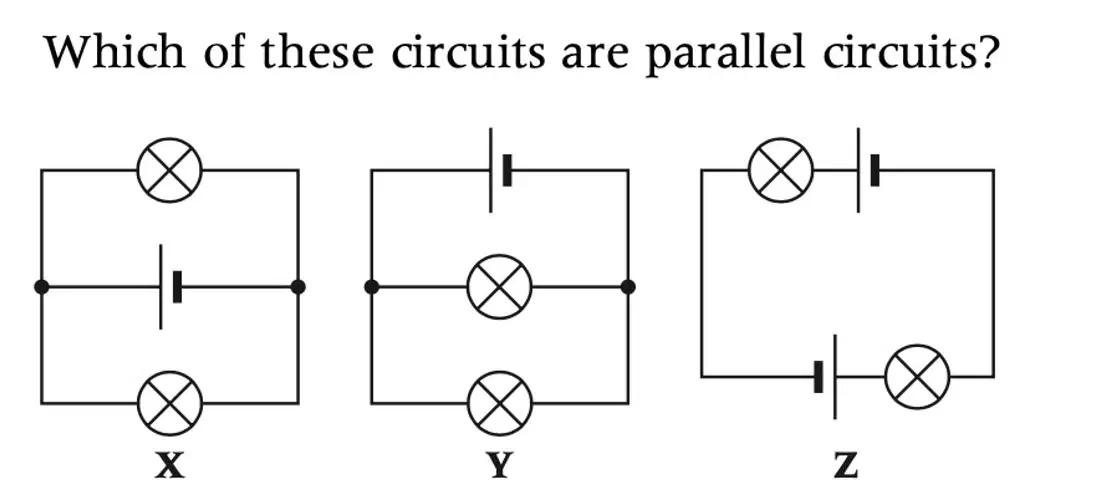
Which of these circuits are parallel circuits?
A: X and Y only
B: X and Z only
C: Y and Z only
D: All of them
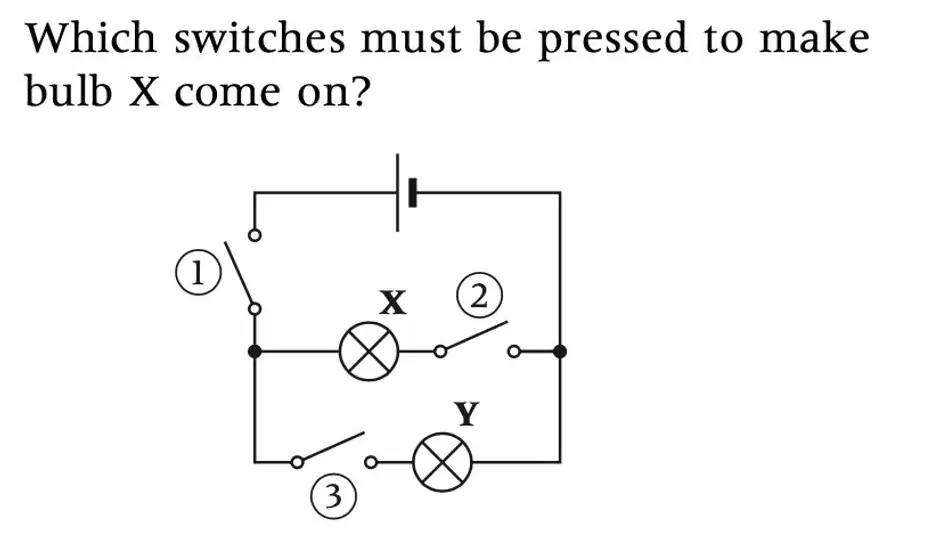
Which switches must be pressed for bulb X to come on?
A: All three of them
B: 1 and 2 only
C: 1 and 3 only
D: 2 and 3 only
Parallel circuits are used for house lights:
A: so they can be switched on and off together
B: so you know when one breaks, because all the others go off
C: so they use a bigger current
D: so they can all be switched on and off separately
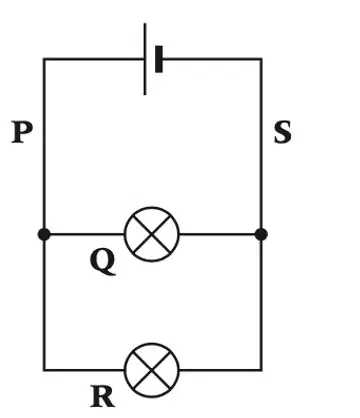
Which of these statements is not true?
A: The current at Q and R add up to give the current at S
B: The current is the same at P and S
C: The currents is the same at Q and R
The current is the same at P and Q
What is the rule for current in a parallel circuit?
The current is the same everywhere in the circuit
The total current in a parallel circuit is the sum of the currents flowing through each parallel branch.
The total current is divided equally for each branch
There is no rule it's always different
What moves in wires to give a current?
Electric waves
Neutrons
Protons
Electrons
Why do bulbs light up when the charges move through them?
How is an ammeter connected into the circuit?
Parallel or in series, it doesn't matter
Parallel
In series
Not sure
Explain what happens to the current when we put additional components in a series circuit?
Draw a parallel circuit which has a battery, 3 bulbs, an ammeter which measures the total current in the circuit and a second ammeter which measures the current on one of the branches.