wayground logo

Free Printable Worksheets

Font size

S
M
L
XL
Worksheets

TCAP Review: Topics 4 & 5

Total questions: 77

Worksheet time: 45mins
Name
Class
Date
1.
The primary group backing the inclusion of the Bill of Rights into the US Constitution were the…
a)
Federalists
b)
Whigs
c)
Anti-Federalists
d)
Patriots
2.
20. After the Revolution, farmers had to borrow money for agricultural supplies (many who were veterans of the American Revolution and had not been paid for their efforts). Which event did farmers attack courthouses and prevented states from taking land from farmers who couldn't pay their debts?
a)
American Revolution
b)
Shays Rebellion
c)
The War of 1812
d)
Washington's Squabble
3.
Strict constructionists, or Anti Federalists, believed that
a)
if the Constitution doesn’t forbid it, then government can do it
b)
Government can only do what the Constitution explicitly (clearly) says
c)
The Supreme Court has the final say on the Constitution
d)
a Bill of Rights was not necessary
4.
Which document guarantees freedom of speech, right to bear arms, and protection from unreasonable search and seizure?
a)
Declaration of Independence
b)
Bill of Rights
c)
Albany Plan of Union
d)
Federalists Papers
5.
The excerpt is from the United States Constitution. Which principle of government is most evident in this source? The Congress, whenever two thirds of both houses shall deem it necessary, shall propose amendments to this Constitution . . . which . . . shall be valid to all intents and purposes, as part of this Constitution, when ratified by the legislatures of three fourths of the several states. — Article 5, United States Constitution
a)
Popular Sovereignty
b)
Judicial Review
c)
Individual Rights
d)
Federalism
6.
This law set up a system for mapping and dividing western lands within the NW Territories.
a)
Northwest Ordinance of 1787
b)
The Declaration Independence
c)
The Land Ordinance of 1785
d)
Articles of Confederation
7.
This is made up of a Preamble (introduction), Articles (7) and Amendments (27)
a)
Appeals Process
b)
Declaration of Independence
c)
Constitution
d)
Bill of Rights
8.
Why is James Madison known as the Father of the Constitution?
a)
His ideas about democratic government influenced the writing of the Constitution.
b)
He wrote the Declaration of Independence.
c)
He wrote the Anti-Federalists papers protecting the rights of the states
d)
He developed the Great Compromise.
9.
Which Amendment protects people against unwarranted searches and seizures
a)
1
b)
2
c)
3
d)
4
10.
Read Chief John Marshall's opinion in the case of Marbury v. Madison (1802) "It is emphatically the province and duty of the Judicial Department to say what the law is. Those who apply the rule to particular cases must , of necessity, expound (explain) and interpret that rule if two laws conflict with each other, the Courts must decide on the operation of each. So, if a law be in opposition to the Constitution, if both the law and the Constitution apply to a particular case, so that the Court must either decide that case conformably (corresponds) to the law, the Court must determine which of these conflicting rules governs the case..." How does Chief Justice Marshall's opinion reflect the role of the judicial branch in government?
a)
His opinion confirms that the branch should disregard laws in order to strictly follow the content of the Constitution.
b)
His opinion maintains that the judicial branch shall confer with the other branches in its interpretation of the laws.
c)
His opinion gives power to the judicial branch to declare two opposing laws as equally constitutional on their own merits.
d)
His opinion demonstrates the need for the jucdical branch to decide how laws are applied on a case-by-case basis.
11.
What branch of government enforce/executes laws.
a)
Legislative branch
b)
Executive Branch
c)
Judicial Branch
d)
Parliament
12.
5. How many branches of government are there?
a)
6
b)
5
c)
4
d)
3
13.
Newspaper headlines 1. Taxes Increase to Support the Military 2. Treaty Agreed with Foreign Nation 3. Postal System Created! 4. Guidelines for Statehood Made Which describes an action Congress was UNABLE to accomplish under the Articles of Confederation?
a)
1
b)
2
c)
3
d)
4
14.
Marbury v Madison is???
a)
Leader of the House of Representatives
b)
who elects President and Vice-President
c)
court case that established judicial review to determine if law/case is constitutional
d)
Supreme Court
15.
Nine members serving a life term
a)
Supreme Court
b)
How many terms a President serves according to the 22nd amendment
c)
powers of the President
d)
Leader of the Executive Branch
16.
10. Having the right to trial by jury in a civil case
a)
7th Amendment
b)
10th Amendment
c)
9th Amendment
d)
2nd Amendment
17.
Serves a 2-year term, 25 years old, citizen of state 7 years, and seat is determined by state population.
a)
Senate
b)
House of Representatives
c)
Speaker of the House
d)
House of Pancakes
18.
Who elects the president and the Vice-President?
a)
people of US
b)
Supreme Court
c)
Electoral College
d)
House of Representatives
19.
What are the 2 houses of Congress?
a)
Senate and the President
b)
Vice-President and the Supreme Court
c)
President and Vice President
d)
House of Representatives and the Senate
20.
Which are the powers of Congress?
a)
appointing ambassadors
b)
printing money
c)
declaring war
d)
judicial review
e)
setting taxes
21.
15. What article contains the Amendment process?
a)
1
b)
2
c)
3
d)
4
e)
5
22.
Who is leader of the Executive Branch?
a)
President
b)
Speaker of the House
c)
Senate Majority leader
d)
Chief Justice of the Supreme Court
23.
Serves 6-year term, must be 30, and resident of US 9 years.
a)
Representative
b)
Senator
c)
President
d)
Supreme Court Justice
24.
Protects against cruel and unusual punishment.
a)
7th Amendment
b)
8th Amendment
c)
9th Amendment
d)
10th Amendment
25.
Supreme Court determines the constitutionality of a law. This is ______?
a)
jury selection
b)
judicial review
c)
court order
d)
search warrant
26.
20. The Executive Branch has authority to execute laws and the President is commander in chief.
a)
True
b)
False
27.
Which branch of government interprets the laws?
a)
Executive Branch
b)
Legislative Branch
c)
Judicial Branch
d)
Sycamore Branch
28.
The Three-Fifths Compromise resolved the issue over whether ?
a)
slavery was beneficial to the Southern economy.
b)
exnlsved people would be granted the right to vote.
c)
slavery should be allowed to continue in the Southern states.
d)
enslaved people would be counted toward a state's population total .
29.
Why is it important for people to serve on juries when called to do so? Serving on a jury _______?
a)
protects the rights of someone accused of a crime
b)
ensures that lawyers provide adequate counsel to all defendants
c)
helps prevent a defendant form receiving a punishment considered cruel and unusual.
d)
provides all Americans with an opportunity to fulfill at least one of their civic duties.
30.
25. The power of the Supreme Court to decide if laws are unconstitutional was firmly established in the 1803 case Marbury v. Madison, but the need for this power of the judicial review was first discussed in the ___?
a)
Bill of Rights
b)
Federalist Papers
c)
AntiFederalist Papers
d)
Article of Confederation
31.
What prompted the call to rewrite the Articles of Confederation?
a)
Americans wanted to win independence by unifying the nation.
b)
Limitations on the central government led to an economic downturn.
c)
The country needed a national court system to deal with uprising colonists.
d)
The nation's westward expansion made it necessary to modify the document.
32.
What effect did the Three-Fifths Compromise have on southern states?
a)
It helped increase the number of slaves traded.
b)
It gave the South the power to out vote the North.
c)
It limited the number of states that allowed slavery.
d)
It gave those states more representation in Congress.
33.
Which of the following groups gained greater political rights with amendments were added to the Constitution?
a)
American Indians
b)
African Americans
c)
Asian Americans
d)
Hispanic Americans
34.
Read the chart below. Northwest Ordinance of 1787 a. Established guidelines for new territories b. Protected individual freedoms c. Free-Public Education (Public Schooling) d. ?????? Which BEST completes the chart?
a)
prohibited the use of slaves
b)
created new private schools
c)
used the income tax system
d)
prohibited private land ownership
35.
30. How did the Great Compromise reconcile the Virginia and New Jersey Plans for organizing the legislative branch of government? It established____?
a)
one house, the Congress, and each state would be allowed two members, no matter how large or small it was.
b)
one house the Congress, and the number of representatives from each state would be determined by the size of the state.
c)
two houses, the House of Representatives and the Senate, and the number of representatives in each house would be determined by the size of the state.
d)
two houses, the House of Representatives where state size determined the number of representatives, and the Senate where each state would have only two senators no matter what its size.
e)
36.
How does the Constitution reflect the principle of popular sovereignty?
a)
by limiting the amount of power of the government.
b)
by placing protections on the civil rights of the nation's citizens
c)
by implementing safeguards against the abuse of power.
d)
by allowing the people to choose their representatives.
37.
How did the Federalists Papers generate support for ratifying the Constitution? by explaining how the
a)
Constitution would protect states' rights.
b)
national government would weaken the states.
c)
Constitution would require a bill of rights.
d)
government would not function without the Constitution.
38.
Why did the Great Compromise establish a two-house legislature?
a)
to fairly represent all states
b)
to allow for population growth
c)
to provide checks and balances
d)
to prevent unconstitutional laws
39.
_____ may serve 2 four-year terms (Amendment 22), must be 35 years, state resident for 14 years, and a natural born citizen.
a)
President
b)
Representative
c)
Senator
d)
Supreme Court Justice
40.
35. Read the excerpt from Article II of the Articles of Confederation. "Each state retains its sovereignty, freedom and independence, and every Power, Jurisdiction and right, which is not by this confederation expressly delegated to the United States, in Congress assembled." According to the excerpt above, how did the Articles of Confederation define Congress' role? Congress would?
a)
be required to approve the laws of each state.
b)
retain only the specific powers it was delegated by the Articles.
c)
oversee the sovereignty of each state in accordance to the Articles.
d)
maintain legal jurisdiction over the government of each state.
41.
Which statement below best characterized what these Americans are doing?
a)
They are demonstrating citizens'' responsibility to follow laws and rules.
b)
They are demonstrating citizens' responsibility to treat others with respect and courtesy.
c)
They are exercising citizens' right to assemble peacefully.
d)
They are exercising citizens' right to participate in their community.
42.
*Trial by jury *Freedom of religion *Free use of waterways *Fair treatment in the courts *Practice of Slavery Outlawed *Free-Public Education The list above contains rights guaranteed to settlers in the west by the _____?
a)
US Constitution
b)
Northwest Ordinance
c)
Article of Confederation
d)
Declaration of Independence
43.
How did the Great Compromise reconcile the Virginia and New Jersey Plans for organizing the legislative branch of government?
a)
It established on house, the Congress, and each state would be allowed two members no matter how large or small it was.
b)
It established one house, the Congress, and the number of representatives from each state would be determined by the size of the state.
c)
It established two houses, the House of Representatives and the Senate, and number of representatives in each house would be determined by the size of the state.
d)
It established two houses, the House of Representatives, where state size determined number of representatives, and the Senate, where each states would have only two senators no matter what its size.
44.
Which statement BEST describes the role George Washington played at the Constitutional Convention?
a)
He argued in favor of a weak central government and greater authority for the states.
b)
He proposed a bicameral legislature to appease small and large states.
c)
He presided over the meeting and inspired delegates to create a strong chief executive.
d)
He proposed a system for counting slaves for voting representatives/
45.
40. Read the following. Section 8 clauses 1-3 1. The Congress shall have the Power To lay and collect Taxes, Duties, Imposts and Excises, to pay the Debts and provide for the common defence and general Welfare of the United States, but all Duties, Imposts and Excises shall be uniform throughout the United States 2. To borrow Money on the credit of the United States 3. To regulate Commerce with foreign Nations, and among the several States, and with the Indian Tribes -Article 1, The United States Constitution The Supreme Court's interpretation of the clauses in the Constitution increased congressional power by?
a)
enabling the federal government to increase military spending
b)
creating a federal agency to collect taxes from the states
c)
authorizing the federal regulation of interstate commerce
d)
allowing the federal government to issue money to the states
46.
Which quotation expresses an opinion of a Federalist?
a)
"One general government...would not be so compelled to attend to various local concerns and wants."-Samuel Bryan
b)
"Any system...which appoints a legislature, without any reservation of the rights of individuals, surrenders all power."-James Winthrop
c)
"There is no declaration of any kind for preserving the liberty of the press."-George Mason
d)
"I would propose...that...the national Government should (possess) positive and complete authority in all cases which shall require uniformity."-James Madison
47.
Which branch of government creates/writes laws?
a)
Legislative Branch
b)
Executive Branch
c)
Judicial Branch
d)
Parliament
48.

1. Who went on the expedition to explore the Louisiana Territory? (Check all that apply.)`Pick only 3. (Do not select the one who traveled to Sante Fe, NM. )

a)

Meriwether Lewis

b)

Sacagawea

c)

William Clark

d)

Zebulon Pike

49.
45. The Bill of Rights addressed a grievance against the king by ___?
a)
forbidding the right to trial by jury.
b)
protecting the individual right to freedom of religion
c)
protecting the individual right to freedom of speech
d)
forbidding the government from quartering troops in people's homes
50.
First Amendment Rights -Freedom of religion -Freedom of speech -Freedom of the press -Right to assemble peacefully -Right to petition the government Based of these First Amendment rights, one understands that the U.S. Constitution values___?
a)
the rights of children
b)
the rights of the military
c)
the rights of those elected to power
d)
the rights of individuals
51.

Which of President Jefferson's actions did NOT reflect his belief that the federal government had only those powers spelled out in the Constitution

a)


the cutting of federal spending

b)


the purchase of the Louisiana Territory

c)

the elimination of the whiskey tax

d)


the reduction in the size of US Army

52.
Which of the constitutional principles listed was Madison describing and defending in the quotation below? "In the compound republic of America, the power . . . is first divided between two distinct governments. . . . The different governments will control each other, at the same time that each will be controlled by itself." —James Madison, Federalist No. 51, 1788
a)
Popular Sovereignty
b)
Federalism
c)
Judicial Review
d)
Checks & Balances
53.
How many goals of the Constitution does the Preamble list?
a)
27
b)
17
c)
6
d)
9
54.
Which of the following is an example of checks and balances at work?
a)
The people choose not to re-elect a President whose policies they dislike.
b)
The Federal Government passes a law that overrides similar laws in several States.
c)
Congress removes from the bench a federal judge who has accepted a bribe.
d)
A bill passed by the House is vetoed by the Senate.
55.
How does the U.S. Constitution reflect the principle of federalism?
a)
It separates the government into three branches.
b)
It states that government only has certain powers.
c)
It states that people have the right to change the government.
d)
It divides power between the national government and the states.
56.

This list provides examples of –

a)

topics discussed during the Second Constitutional Convention

b)


issues leading to the ratification of the first constitutional amendments

c)

weaknesses of the government under the Articles of Confederation

d)


domestic issues faced by the leaders of the new republic

57.

Based on the information, what laws are being described below?

a)

The Alien and Sedition Acts

b)

The XYZ Affair

c)

The Kentucky and Virginia Resolutions

d)

The Bill of Rights

58.

Look at the image and answer the following question.

a)

A.

b)

B.

c)

C.

d)

D.

59.

Identify three impacts of the Lewis and Clark Expedition on American history:

a)

Recorded plants, animals, and Native tribes encountered.


b)


Produced an accurate route to the Pacific Ocean

c)

Opened up new territory for fur and lumber trade

d)

Created a British claim on territory within the Louisiana Purchase.

e)

Determined how the territories would be split into states.

60.

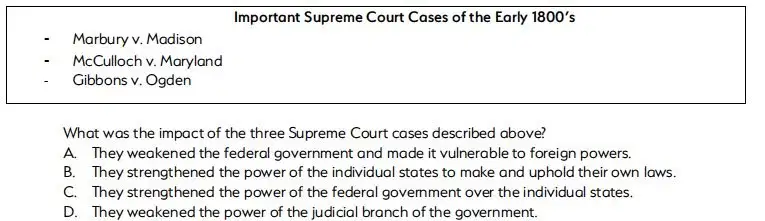
The McCulloch v. Maryland decision impacted the power of the federal government by saying __________

a)


the federal government should pay taxes, just like everyone else.

b)

states could not tax the federal government.

c)


it could only tax states that allowed themselves to be taxed by the U.S. government.

d)


only federal banks would survive.

61.

Read the excerpt: “Europe has a set of primary interests which to us have none; or a very remote relation. Hence she must be engaged in frequent controversies, the causes of which are essentially foreign to our concerns. . . . Why, by interweaving our destiny with that of any part of Europe, entangle our peace and prosperity in the toils of European ambition. . .?” -George Washington, Farewell Address Which of the following statements BEST summarizes Washington’s viewpoint on American foreign policy as expressed in the excerpt?

a)


The United States can take advantage of Europe’s ambition.

b)


Europe’s interests are similar to those of the United States and should be supported if they are threatened.

c)

The United States should limit interaction with Europe to commerce.

d)

The United States should not become involved in European politics.

62.

Which is the best example of an early U.S. struggle to define domestic authority of the central government? (Think A.O.C. vs. The New Constitution)

a)


The XYZ Affair

b)


The Barbary Wars

c)


The Whiskey Rebellion

d)


The War of 1812

63.

Match the following

a)

1st

1.

Freedom of religion, speech, press, right to assemble, and petition

b)

4th

2.

Must have reasonable doubt and a warrant to search

c)

5th

3.

Right to remain silent, right to due process

d)

8th

4.

Prevents against cruel and unusual punishment

e)

2nd

5.

Right to bear arms

64.

The Monroe Doctrine (1823) established the U.S. foreign policy that

a)


led directly to the Civil War

b)

encouraged expansion into East Asia

c)

provided foreign aid to developing nations

d)

opposed creation of new European colonies in Latin America

65-69.

The First Barbary War: A Turning Point in U.S. History

The First Barbary War, fought from 1801 to 1805, was a significant conflict between the United States and the Barbary States of North Africa. The primary cause of the war was the demand for tribute by the Barbary pirates, who threatened American merchant ships in the Mediterranean Sea. The U.S. government, under President Thomas Jefferson, refused to pay these tributes, leading to increased tensions and eventual conflict. This war marked the first time the United States engaged in a military conflict overseas, setting a precedent for future foreign policy decisions.

Key battles and events during the First Barbary War included the blockade of Tripoli and the daring raid on the harbor by Lieutenant Stephen Decatur. The U.S. Navy played a crucial role in these operations, showcasing its growing strength and capability. The capture of the USS Philadelphia by the pirates was a notable event, but its subsequent destruction by American forces was a significant morale booster. These actions demonstrated the determination of the United States to protect its interests and citizens abroad.

The Treaty of Peace, signed in 1805, ended the First Barbary War and resulted in the release of American prisoners. The treaty also required the Barbary States to cease their demands for tribute, although sporadic conflicts continued in the following years. This treaty was a diplomatic victory for the United States, as it established the nation's resolve to stand against piracy and coercion. The successful conclusion of the war bolstered American confidence and international standing.

The impact of the First Barbary War on U.S. foreign policy was profound, as it highlighted the importance of a strong naval presence. The conflict underscored the need for the United States to protect its maritime interests and assert its sovereignty on the global stage. The experience gained during the war influenced future naval strategies and contributed to the development of a more robust and capable U.S. Navy. The Barbary pirates' influence waned as a result, marking a shift in power dynamics in the Mediterranean region.

65.

What was the primary cause of the First Barbary War?

a)

Demand for tribute by the Barbary pirates

b)

Territorial disputes

c)

Religious differences

d)

Trade disagreements

66.

Who was the U.S. President during the First Barbary War?

a)

Thomas Jefferson

b)

George Washington

c)

John Adams

d)

James Madison

67.

Which event marked a significant morale booster for the United States during the First Barbary War?

a)

Destruction of the USS Philadelphia

b)

Blockade of Tripoli

c)

Raid on the harbor by Lieutenant Stephen Decatur

d)

Signing of the Treaty of Peace

68.

What was the outcome of the Treaty of Peace in 1805?

a)

Release of American prisoners and cessation of tribute demands

b)

Annexation of Barbary States

c)

Continued tribute payments

d)

Expansion of U.S. territory

69.

How did the First Barbary War impact U.S. foreign policy?

a)

Highlighted the importance of a strong naval presence

b)

Led to isolationism

c)

Encouraged alliances with European powers

d)

Reduced military spending

70.

Devotion to one's country (a)   or the belief that your country is superior, without question or doubt
71.


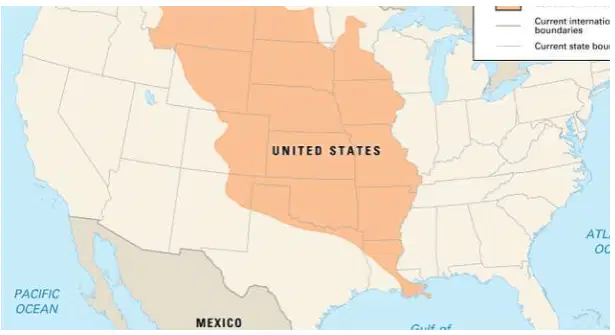
In the picture below, name the land acquired from France in 1803 that doubled the size of the nation at that time.

a)

Gadsden Purchase

b)

Louisiana Purchase

c)

Monroe Doctrine

d)

Adams-Onis Treaty

72.

Which territory did the United States acquire from Spain as a result of the Adams-Onís Treaty in 1819?

a)

South Carolina

b)

Louisiana Purchase

c)

Georgia

d)

Florida

73.

These future presidents became national heroes from their victories during the War of 1812 at the Battle of Tippecanoe & the Battle of New Orleans

a)

William Henry Harrison & Andrew Jackson

b)

James Monroe & James Madison

c)

Andrew Jackson and George Washington

d)

John Adams and William Henry Harrison

74.

Who or what was XYZ?

a)

the ship American diplomats took to France.

b)

French officials who met with American diplomats in Paris.

c)

American code for war

d)

John Adams and his diplomats that went to France with him

75.

How did the Embargo Act of 1807, enacted by President Thomas Jefferson, attempt to respond to British and French interference with American trade during the Napoleonic Wars, and what were the primary economic consequences of this act for the United States?

a)


There were no economic consequences

b)

America's economy saw record heights in profit

c)

America suffered a depression due to drop in revenue that came from annual exports

d)

Great Britain and France suffered greater economic loss compared to the United States

76.

This is an excerpt from a document written in 1796. “We the People of the territory of the U.S. south of the river Ohio… do ordain and establish the following constitution or form of government, and do mutually agree with each other to form ourselves into a free and independent State by the name of the State of Tennessee.” This document is representative of what event?

a)


Election of William Blount as territorial governor of the Southwest Territory.

b)

The signing of the Treaty of Holston between the Cherokee and white settlers.

c)

The admittance of Tennessee as the 16th state in the U.S

d)

The establishment of Rocky Mount as the territory’s first capital.
77.

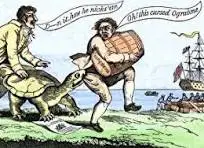
Passed by the United States Congress; Signed President Thomas Jefferson on December 22, 1807; Stopped American ships from trading in foreign ports

a)

The Townshend Act

b)

The Treaty of Ghent

c)

The Embargo Act

d)

The Louisiana Purchase

78.

The ___ __ ____which lasted from June 18, 1812 to February 18, 1815, was fought over issues that continued to plague relations between the United States and Britain after the Revolutionary War, like impressment of American sailors and trade restrictions on American shipping.

a)

Battle of New Orleans

b)

American Revolutionary War

c)

War of 1814

d)

War of 1812

79.

How did Jefferson’s views differ from Hamilton’s? Choose the TWO correct answers.

a)

Jefferson wanted a smaller federal government.

b)

Jefferson wanted close ties with Britain rather than France.

c)

Jefferson opposed the Bank of the United States.

d)

Jefferson supported policies that favored business leaders.

80.

What were TWO of the causes of the War of 1812?*

a)

Britain banning trade with the United States

b)

Britain seizing American ships.

c)

Britain arming American Indians

d)

Britain attacking New Orleans

81.

What is the main purpose of the system of checks and balances in the United States government?

a)

To ensure states have more power than the federal government

b)

To prevent any one branch from becoming too powerful

c)

To give Congress control over the Supreme Court

d)

To allow the President to make laws