
 Worksheets
Y9 Bonding Revision
Total questions: 113
Worksheet time: 1hrs 17mins


Which of the following names matches the chemical formula N2O3?
Dinitrogen triople oxide
Nitrogen oxide
Dinitrogen trioxide
Trioxide nitrogen
What is the correct chemical formula for phosphorus trihydride?
P2H3
P4H2
PH3
P3H3
Which of the following is the chemical formula for sulfur hexachloride?
SCl6
S6Cl
S6Cl6
S1Cl6
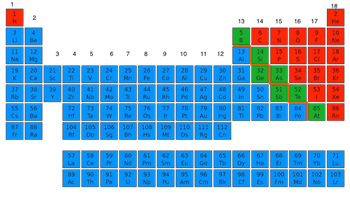

What usually forms the negative ion?
nonmetals
metal
none
Simple molecular molecules generally have
low melting and boiling points
high melting and boiling points
ionic bonds
metallic bonds
Which structures conduct electricity as a liquid but not as a solid?
Metallic
Covalent
Ionic
All of the above
Which structure has a sea of free electrons?
Ionic
Covalent
Metallic
All of the above

Covalent bonds are formed between...
two or more metal atoms
two or more non-metal atoms
a metal and a non-metal atom
Covalent bonds are formed when electrons are transferred between atoms.
True
False
Atoms can only share electrons in the (a) shell.
Fluorine is a diatomic molecule. Fluorine is in Group 7. How many electrons are shared in this covalent bond?
(a)
Oxygen is a diatomic molecule. Oxygen is in Group 6. How many electrons are shared in this covalent bond?
(a)

The structure of ammonia is shown in the diagram. What is the formula for ammonia?
NH3
HN3
N3H
HN3
What are the disadvantages of using displayed formulae, like the one shown?
The 3D structure of the molecule is not shown.
They can show how atoms are bonded in large molecules.
They do not show which atom each electron comes from.
They can be used to find the structural formula of the molecule.
Select the properties of simple covalent substances.
Low melting and boiling points.
High melting and boiling points.
Do not conduct electricity.
Good conductors of electricity.
Why do simple covalent substances not conduct electricity?
They have low melting points.
They have low boiling points.
There are no delocalised electrons or free ions to carry the charge.
The molecules are too large.
Covalent structures have low melting and boiling points because it does not take much energy to break the _____ intermolecular forces.
weak
strong
What is it called if there are two-pairs of electrons being shared?
Single covalent bond
Double covalent bond
Triple covalent bond
None of the above
What is it called if there is one-pair of electrons being shared?
Single covalent bond
Double covalent bond
Triple covalent bond
None of the above

How many electrons are bonded to the C atom on the left?
(a)

How many electrons are there surrounding/bonded to the P atom?
(a)

How many electrons are bonded to the S atom in the above structure of methane-sulphonic acid?
(a)
Which 2 of the following technologies are currently made using nanotechology?
odor-free socks
vegetarian meatballs
vaccinations
wrinkle-resistant fabrics

What is nanotechnology?
Study and manipulation of technology that is micro sized
Study and manipulation of matter that is small but can still be seen by the human eyes
Study and manipulation of matter at a scale of 1-100 nano meters
Study and manipulation of matter that moves at a speed measured in nano seconds

Why the properties of nanomaterials are different significantly compared to bulk materials?
Increased relative surface area
Decreased relative surface area
Increased lattice parameters
Lower down the melting temperature
Which of the following is an alloy?
stainless steel
chromium
nickel
lead
Metallic bonding is...
a type of covalent bond.
a type of ionic bond.
an attraction between positive ions and a sea of delocalised electrons.
Which of these are considered properties of metals? (choose ALL that apply)
brittleness
low melting point
luster (shininess)
malleability
ductility

Name some household appliances that are made of metal. Why are metals chosen to make these appliances?
Which of these are properties of metals?
ductile and malleable
low melting or boil point
high melting/boiling point
conduct electricity
soluble in water
what charge do the metal ions have in metallic bonding?
negative
positive
neutral
what one word/phrase describes the electrons in metallic bonding
delocalised
swimming
sea of electrons
fixed
flying
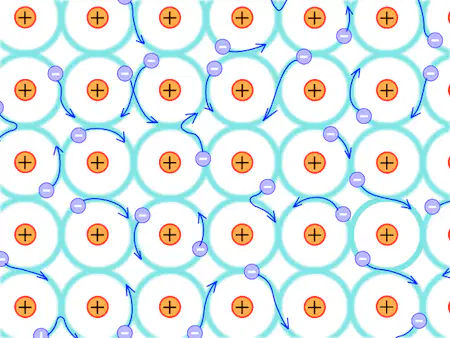
Why do the electrons in metals move about freely?
There are overlapping orbitals that allow outer electrons of atoms to move about freely throughout the entire
Electrons are repelled
Bonds are broken between electrons and cations
Draw the structure of a metal.

Metals have (a) melting and boiling points because of the (b) electrostatic forces of between (c) ions and (d) electrons. A (e) amount of energy is required to break these forces.
Metals are good conductors of heat...
because they are shiny and reflect heat.
because the absorb heat.
the electrons are delocalised and able to move, colliding with cations to transfer themal energy.
because the cations can move freely to transfer thermal energy.
Why do metallic compounds conduct electricity as solids?
core electrons are mobile, allowing electricity to flow through the metal
valence electrons are mobile, allowing electricity to flow through the metal
protons are mobile, allowing electricity to flow through the metal
the metal cations are mobile, allowing electricity to flow through the metal


Metals are (a) because when a metal is hit, the metallic layers (b) each other. The (c) electrons (d) along with the cations. The metallic bond (e) break.
Which name is given to mixtures of metals?
Alloys
Compounds
Ores
Salts
Which two elements form an alloy when heated together?
Chlorine and Hydrogen
Chlorine and zinc
Copper and hydrogen
Copper and zinc

Which diagram represents an alloy?
A
B
C
D
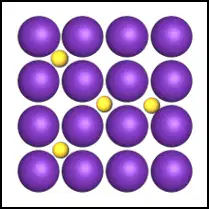
What type of alloy does the diagram represent?
interstitial
substitution
Why are metals malleable?
They are shiny
The electrons are held tightly within the lattice structure making it strong
The electrons are delocalized and able to move between the atoms
The electrons are shared between two metal ions and this holds the atoms together
What is the name of the compound with the chemical formula CrCl3 ?
chromium (III) chlorate
chromium trichloride
chromium(II) chloride
chromium(III) chloride
What is the correct chemical formula for sodium sulfate?
NaSO4
Na2SO4
Na(SO4)2
Na2(SO4)2
A formula unit can best be described as
the chemical formula for an ionic compound
a charged group of covalently bonded atoms
the chemical formula for a molecule
the arrangement of ions in an ioinc crystal
Which of the following pairs of elements would NOT react to form an IONIC compound?
sulfur and phosphorus
sodium and iodine
iron and oxygen
aluminum and bromine
How are compounds with metallic bonds similar to ionic compounds?
Both tend to have double and triple bonds.
Both tend to have low boiling point
Both tend to have poor conductivity.
Both tend to have high melting points.
Which of the following would have the lowest melting point?
MgCl2
Al2O3
CO2
AlP
Nonmetals tend to form ions by
destroying electrons
gaining electrons
losing electrons
sharing electrons

