
 Worksheets
Review Unit 5 Chemical Reactions
Total questions: 50
Worksheet time: 4hrs 10mins
The law of conservation of mass was established by ___, in the late 18th century.
Albert Einstein
Amedeo Avogadro
John Dalton
Antoine Lavoisier
Neils Bohr
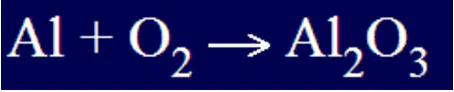
Chemical formulas on the left side are called __.
reactants
products
oxidizers
reducers
Chemical formulas on the right side are called __.
reactants
products
oxidizers
reducers

The __ shows the direction of the reaction
coefficient
subscript
arrow
plus symbol
state of matter

The large numbers in front of the chemical formulas are called?
coefficients
products
subscripts
yeilds
state of matter
The small numbers written slightly below of the chemical formulas are called?
coefficients
products
subscripts
yeilds
state of matter
What do the (g) and (l) mean in the chemical equation?
coefficients
products
subscripts
yeilds
state of matter

What type of chemical reaction is shown?
synthesis
combustion
single replacement
decomposition
acid-base neutralization

What type of chemical reaction is shown?
synthesis
decomposition
combustion
single replacement
double replacement
Which of the reactions below are synthesis reactions? Two answers


What type of reaction is shown?
Synthesis
Combustion
Single replacement
Double replacement
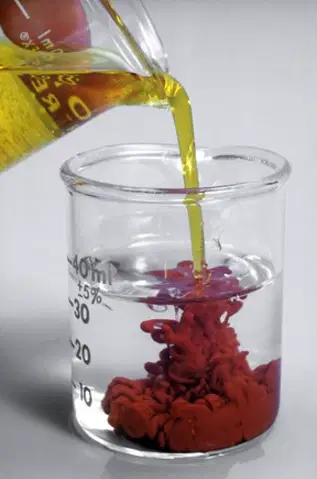
What type of reaction has taken place? Silver nitrate and sodium chromate react and a reddish-brown solid forms.
acid-base reaction
decomposition reaction
combustion reaction
precipitation reaction

What type of chemical reaction is shown?
synthesis
decomposition
combustion
single replacement
double replacement

What type of chemical reaction is shown?
synthesis
decomposition
precipitate
acid-base (neutralization)
combustion

Which of the elements in the following reaction has been reduced?
Zinc
Hydrogen
Both Hydrogen and Zinc
Neither Hydrogen nor Zinc

Which is the change in the oxidation number of sulfur in the reaction shown?
0
+3
+4
+8
Which of the following is a characteristic of a combustion reaction?
Formation of a precipitate
Absorption of heat
Formation of a gas
Release of heat and light


The Law of Conservation of Mass states Matter is NEITHER created nor destroyed.
True
False

The Law of Conservation of Mass states that the total mass of the reactants should be
More than the mass of the products
Equal to the mass of the products
Ignored during the reaction
Less than the mass of the products

This is the decomposition reaction of hydrogen peroxide. According to the law of conservation of mass, if you start with 40g of hydrogen peroxide you should end up with _____g of water and oxygen combined.
10
20
30
40
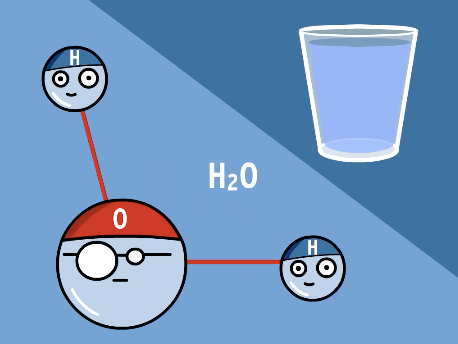
4 grams of hydrogen and 32 grams of oxygen will combine to form:
36 grams of water
28 grams of hydroxide
32 grams of oxygen
36 grams of deuterium


Is the chemical equation here balanced?
Yes
No

When balanced, the correct coefficients for the equation are:
2, 1, 3, 1
1, 2, 1, 2
1, 2, 2, 1
2, 1, 1, 2

When balanced, the correct coefficients for the equation are:
3, 1, 2, 1
1, 2, 3, 4
2, 1, 2, 1
1, 2, 1, 1


To balance this equation, what coefficient belongs in the red box?
3
2
1
0

Identify the type of chemical reaction
Synthesis
Decomposition
Single replacement
Double replacement
Combustion

Identify the type of chemical reaction
Synthesis
Decomposition
Single replacement
Double replacement
Combustion
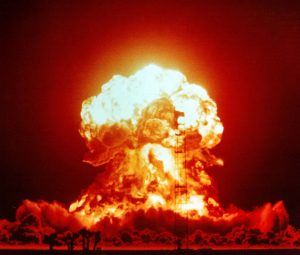

What type of reaction is this?
2NaHCO3 --> Na2CO3 + H2O + CO2
Single Replacement
Combustion
Decomposition
Synthesis

What type of reaction is this?
CH4 + 2O2 --> 2H2O + CO2
Combustion
Synthesis
Double Replacement
Single Replacement

Identify the following process: We light a matchstick.
Physical change
Chemical change

What type of reaction is this?
4 Fe + 3 O2 --> 2 Fe2O3
Synthesis
Combustion
Single Replacement
Decomposition
What is the oxidation number for 'K' in KCl?
-1
+1
0
-2
What is the oxidation state of H in H2?
+2
+1
0
None of the above
What is the oxidation number of H in H2O?
-1
+1
+2
-2
What is the oxidation number for Oxygen?
+1
+2
-1
-2
What is the oxidation number for elements in Group 2?
+1
+2
-1
-2
Give the oxidation number of Nitrogen and Oxygen in N2O molecule.
Nitrogen +1, Oxygen -2
Nitrogen -1, Oxygen -2
Nitrogen +2, Oxygen -2
Nitrogen -3, Oxygen -2
What is the oxidation number of chlorine in HClO?
0
-1
+1
+5
What is the oxidation state of Cu in Cu2+?
-1
-2
+2
0
What is the oxidation number of chlorine in KCl?
+1
-1
+5
+7

