
 Worksheets
2nd Form chemistry: Units 1-3
Total questions: 40
Worksheet time: 24mins
What are the nine hazard symbols used for?
Identifying safe substances
Recognizing hazardous substances
Labeling food items
Marking non-hazardous areas.
What is the importance of working sensibly and safely in the laboratory?
To save time
To prevent accidents
To increase costs
To reduce efficiency.
How are elements organized in the Periodic Table?
By color
By size
By atomic number
By weight
Describe the typical properties of metals.
Brittle and dull
Shiny and conductive
Soft and non-conductive
Light and non-reactive
Metals are found on the...
Left-hand side of the Periodic Table
Right-hand side of the Periodic Table
What is the definition of a molecule?
A single atom
2 or more atoms chemically bonded together
2 or more elements chemically bonded together
2 or more atoms that are not chemically bonded together
Which of the following is a compound?
Oxygen
Water
Iron
Hydrogen
Fill in the blank: A mixture can be separated by ______ methods such as filtration and distillation.
A) Chemical
B) Physical
C) Biological
D) Electrical
What is the difference between a physical process and a chemical reaction?
Physical processes change the chemical structure, whereas chemical reactions do not.
Chemical reactions involve a new product being formed, whereas physical processes do not.
Physical processes are irreversible, whereas chemical reactions are reversible.
Chemical reactions do not produce new substances, whereas physical processes do.
Fill in the blank: Reactants are substances that ______ in a chemical reaction.
A) Are produced
B) Remain unchanged
C) Are used
D) Are catalysts
Fill in the blank: The conservation of mass states that the total mass of reactants is ______ the total mass of products.
Greater than
Less than
Equal to
Unrelated to
Fill in the blank: A simple word equation for a reaction includes the ______ and products.
A) Reactants
B) Catalysts
C) Mixtures
D) Elements
Finish the word equation:
Magnesium + Oxygen -->
(a)
Finish the word equation:
iron + sulfur -->
(a)
Define "element".
A substance that consists of only one type of atom.
A substance that can be broken down into simpler substances.
A substance that consists of two or more atoms that are chemically combined.
It is a mixture of different atoms.
Which of the following is an example of a physical change?
Melting ice
Cooking an egg
Rusting iron
Burning wood
Which of the following is an example of a chemical change?
Burning paper
Freezing water
Boiling water
Breaking glass
Which element is in Group 2 Period 3?
Al
Ca
B
Mg
Which element is in Group 5 Period 4
Ge
Sb
As
Sn

What does this symbol warn us about?
Health hazard
Lung disease
Irritant
Corrosive

What does this symbol mean if found as a label on a substance?
Flamable
Flammable
Set this on fire
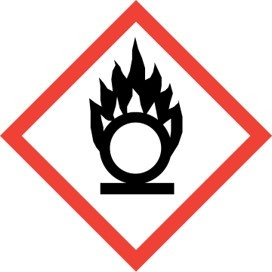
What does this symbol stand for?
Flammable
Oxidising
Non-flammable
Explosive
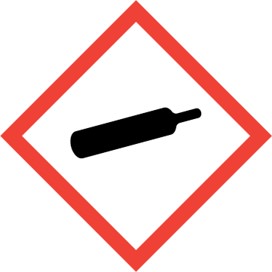
What does this symbol stand for?
Flammable
Oxidising
Gas under pressure
Explosive

What does this symbol stand for?
Flammable
Oxidising
Irritant
Corrosive

What does this symbol stand for?
Flammable
Toxic
Deadly
Corrosive

What does this symbol warn us of?
Danger
Alert
Toxic
Irritant/harmful
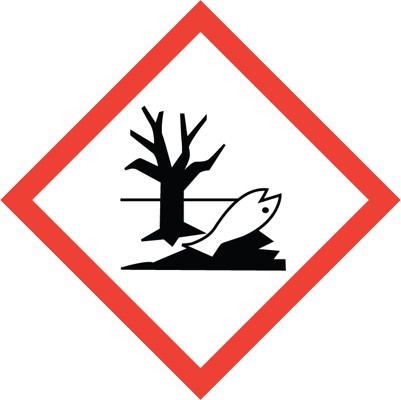
This symbol tell us the chemical it is labelling is:
Harmful to the environment
Dangerous
Toxic
Poisonous

This symbol tell us the chemical it is labelling is:
Harmful to the environment
A pressurised container
Explosive
Corrosive
Contains two or more types of atoms combined/bonded
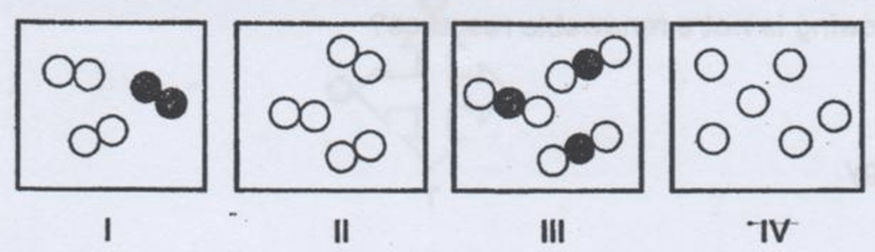
In the diagrams provided, the circles of different colors represent the atoms of different elements. Which diagram represents a mixture?
I
II
III
IV

Which of the following represents a compound?
Diagram (a)
Diagram (b)
Diagram (c)
All of the diagrams represent the parts of a compound.

Which diagram represents an element?
Diagram (a)
Diagram (b)
Diagram (c)
None of the diagrams represent the parts of an element.

What type of matter is shown in this particle diagram?
Element
Compound
Mixture of Elements
Mixture of Compounds
Mixture of Elements and Compounds

What type of matter is shown in this particle diagram?
Element
Compound
Mixture of Elements
Mixture of Compounds
Mixture of Elements and Compounds

What type of matter is shown in this particle diagram?
Element
Compound
Mixture of Elements
Mixture of Compounds
Mixture of Elements and Compounds

What type of matter is shown in this particle diagram?
Element
Compound
Mixture of Elements
Mixture of Compounds
Mixture of Elements and Compounds

What type of matter is shown in this particle diagram?
Element
Compound
Mixture of Elements
Mixture of Compounds
Mixture of Elements and Compounds
Which is the best description of one particle of table salt (NaCl)?
mixture
compound
element

What does this illustrate
Elements
Compunds
Mixture of Elements and Compunds
Mixture of Compounds

