
 Worksheets
G12 Plant gas exchange
Total questions: 22
Worksheet time: 15mins
How does most of the water needed by the plant get into its leaves?
It enters through the stomata
The roots absorb it and then it travels up the stem
It's made during a chemical reaction in the leaf
The flowers capture water and deliver it to the leaves

Identify structure 3 in the diagram
Waxy cuticle
Palisade mesophyll
Upper epidermis
Guard cell
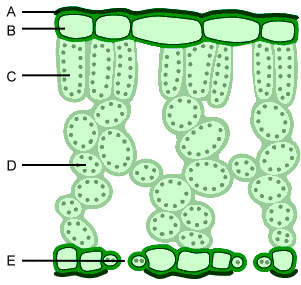
What is letter "D" pointing to?
upper epidermis
palisade mesophyll
spongy mesophyll
bundle sheath

Which number is pointing to the xylem of the leaf?
3
4
5
6
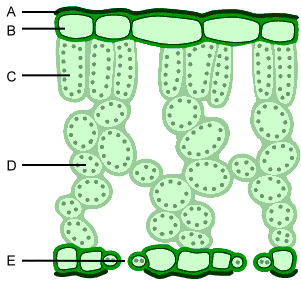
Which of the following is pointing to the "guard cell"?
B
C
D
E
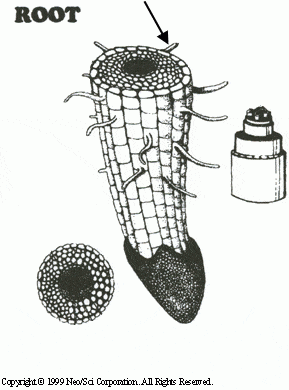

The figure below shows a drawing of a light microscope image. The image is a cross-section taken from the stem of dicotyledonous plant. Identify tissue G.
(a)
The figure below shows a drawing of a light microscope image. The image is a cross-section taken from the stem of dicotyledonous plant. Identify tissue F.
(a)
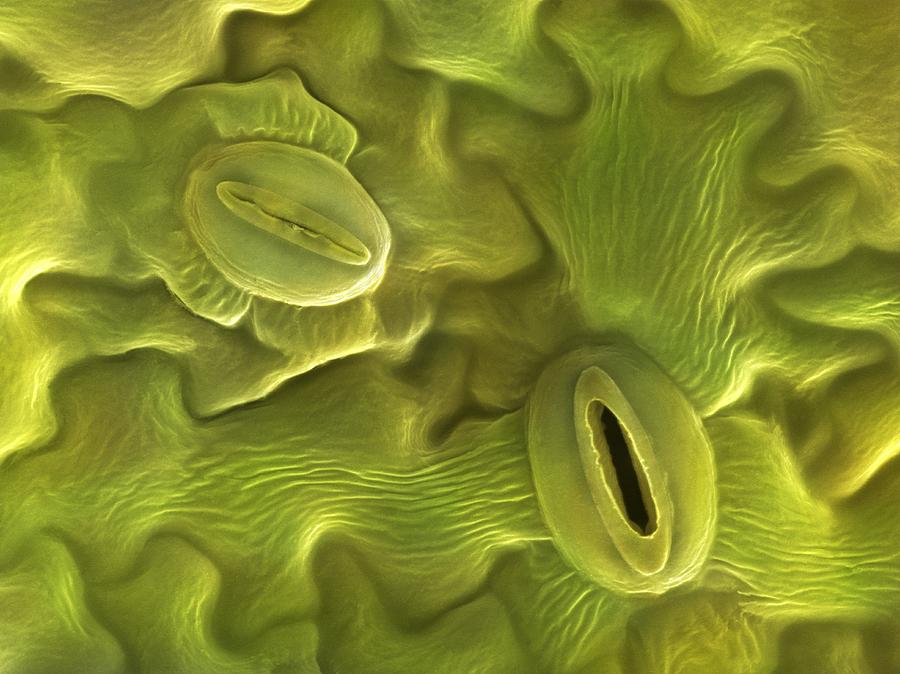
What is the main function of stomata in plant leaves?
Regulate water flow
Control gas exchange
Absorb sunlight
Store nutrients
Which part of the leaf consists of xylem and phloem?
vascular bundle
bundle sheath
palisade mesophyll
spongy mesophyll
What is the role of the spongy mesophyll layer in a leaf?
Photosynthesis
Gas exchange
Water absorption
Support structure
The vascular tissue which transports sugar (food) in both directions within the leaf is the
xylem
phloem
bundle sheath
chloroplast
What is it called when water sticks to water?
Cohesion
Adhesion
Capillary Action
Xylem

Recall what the pathway of water from roots to leaves is called.
Respiration
Translocation
Transpiration stream
Evaporation

Phloem tubes transport substances..
From the roots to the stem and leaves
From the leaves to the rest of the plant
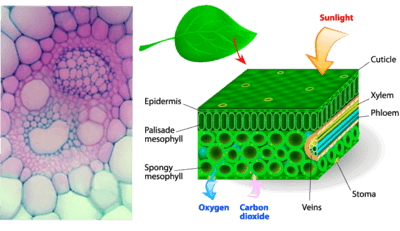
Recall that the movement of food in the phloem is called.
Translocation
Transpiration stream
Evaporation
Respiration

