
Font size
 Worksheets
Y08 Electricity Review
Total questions: 38
Worksheet time: 6hrs 20mins
A circuit has a potential difference of 24 V and a total resistance of 8 Ω. What is the current flowing through the circuit?
2 A
3 A
4 A
5 A
If a circuit has a resistance of 15 Ω and a current of 2 A, what is the potential difference across the circuit?
20 V
25 V
30 V
35 V
Which statement describes the current in a series circuit?
The current varies at different points in the circuit.
The current is the same throughout the circuit.
The current decreases as it passes through each component.
The current increases at each component.
Which statement describes the voltage in a series circuit?
The voltage is the same across each component.
The total voltage is the sum of the voltages across each component.
The voltage increases at each component.
The voltage decreases uniformly across the circuit.
If the length of a wire is doubled, what happens to its resistance?
The resistance is halved.
The resistance stays the same.
The resistance doubles.
The resistance quadruples.
If the thickness of a wire is increased, what happens to its resistance?
The resistance decreases.
The resistance stays the same.
The resistance increases.
What happens when you rub two materials together?
They become colder.
They create friction.
They glow in the dark.
What happens when opposite magnetic poles are near each other?
They repel
They attract
They have no effect
Why does your hair stand on end when you touch a Van de Graaff generator?
The hair becomes wet
Each strand gains the same electric charge and repels each other
The generator creates a magnetic field
What are the main components of an atom's nucleus?
Electrons and protons
Protons and neutrons
Electrons and neutrons
Neutrons
How does the brightness of bulbs in a parallel circuit compare to each other?
All bulbs have the same brightness regardless of their position.
The first bulb is brighter than the others.
Bulbs get dimmer the further they are from the power source.
The last bulb is brighter than the others
If an object gains electrons, what type of charge does it acquire?
Positive charge
Negative charge
Neutral charge
After rubbing a balloon on your hair, what happens to the electrons?
Electrons are transferred from the balloon to the hair, charging the hair positively.
Electrons are transferred from the hair to the balloon, charging the balloon negatively.
Electrons remain evenly distributed, leaving both the balloon and hair neutral.
Nothing
When two insulating materials are rubbed together, what causes one material to become positively charged?
It gains electrons from the other material.
It loses electrons to the other material.
It gains protons from the other material.
A ruler and a balloon both have a positive charge. Which of the following will happen as the ruler is brought closer to the balloon?
They will attract more strongly.
They will attract more weakly.
They will repel more weakly.
They will repel more strongly.
When a glass rod is rubbed with silk, what happens to the charges on the glass rod and the silk, and what effect occurs between them?
The same charges, they repel
Opposite charges, they attract
The same charges, they attract
Opposite charges, they repel
Suppose you have two positively charged plastic rods. Do they repel or attract each other?
Repel
Attract
A circuit contains a cell, a lamp, an ammeter and a voltmeter. The current flowing in the circuit is 3 A and the potential difference across the lamp is 6 V.
5 Ω
3.0 Ω
6.0 Ω
2.0 Ω
In a circuit, the meter readings show a current of 4.0 A and a voltage of 8.0 V across a resistor. What is the resistance of the resistor?
0.5 Ω
2.0 Ω
4.0 Ω
12.0 Ω
What is the primary purpose of a Van de Graaff generator?
To produce magnetic fields
To generate static electricity
To create sound waves
To convert AC to DC
What is the unit of electric current?
Volt
Ohm
Ampere
Watt
Which of the following materials is a good conductor of electricity?
Rubber
Glass
Copper
Wood
Which of the following materials is a good insulator of electricity?
Silver
Aluminum
Plastic
Copper
What is the primary function of a fuse in an electrical circuit?
To increase voltage
To regulate current flow
To protect the circuit by breaking it when current is too high
To reduce resistance
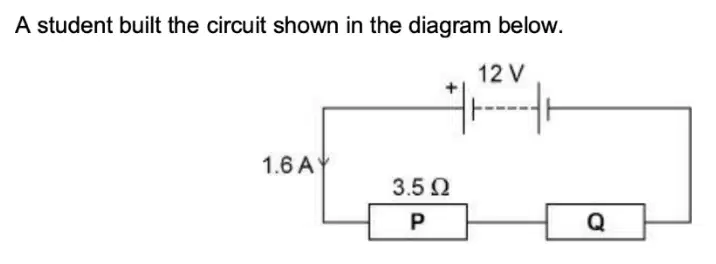
Calculate the total resistance of the circuit in the diagram above
7.5 Ohms
3 Ohms
17 Ohms
1.6 Ohms
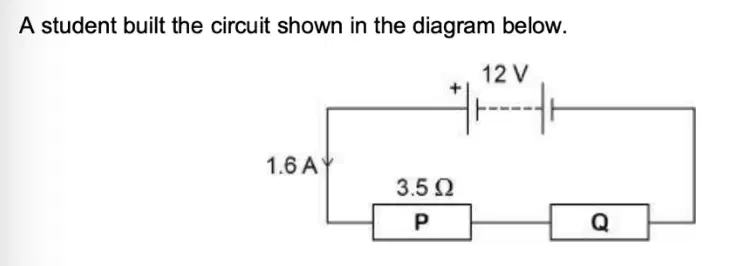
The resistance of P is 3.5 Ohms. Calculate the resistance of Q.
6.5 Ohms
3.5 Ohms
4 Ohms
2 Ohms
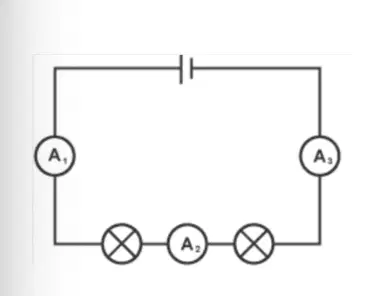
What are the readings on ammeters 𝐴2 and 𝐴3 if the reading on A1 is 0.5 amps?
0.25 Amps
1 Amps
6 Amps
0.5 Amps
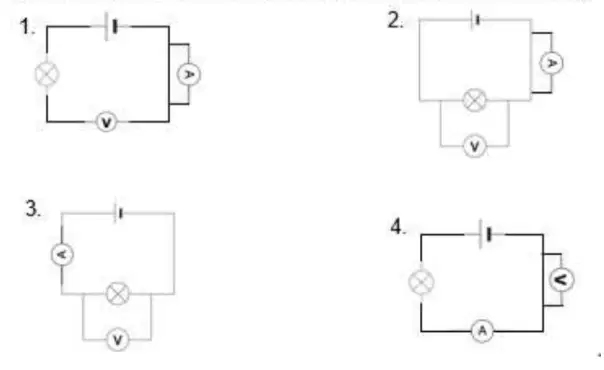
Which of these shows an ammeter and voltmeter connected correctly to the circuit?
1
2
3
4
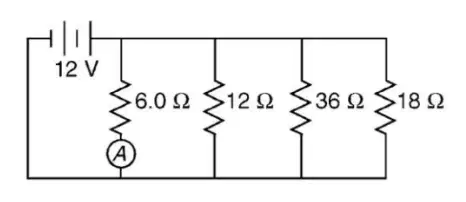
The diagram represents an electric circuit consisting of four resistors and a 12-volt battery.
Calculate the total resistance of the circuit shown.
(a)
The diagram represents an electric circuit consisting of four resistors and a 12-volt battery.
What is the current measured by the ammeter (A) shown in the diagram?
(a)
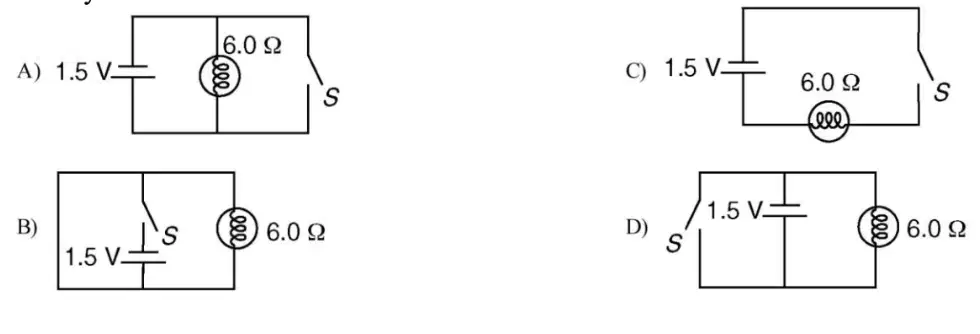
A 6.0 Ohm lamp requires 0.25 amps of current to operate. In which circuit below would the lap operate correctly when switch S is closed?
A
B
C
D
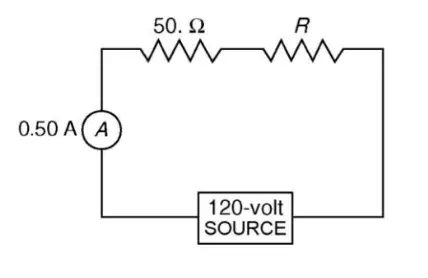
A 50-ohm resistor, an unknown resistor (R), a 120-volt source, and an ammeter are connected in a complete circuit. The ammeter reads 0.50 amps.
Calculate the total resistance of the circuit shown.
(a)
A 50-ohm resistor, an unknown resistor (R), a 120-volt source, and an ammeter are connected in a complete circuit. The ammeter reads 0.50 amps.
Determine the resistance of resistor R shown in the diagram.
(a)
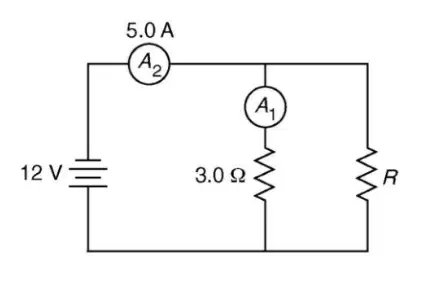
A 3.0 Ohm resistor, an unknown resistor (R) and two ammeters (A1 and A2) are connected as shown in the diagram with a 12 volt source. Ammeter A2 reads a current of 5.0 Amps.
Determine the total resistance of the circuit.
(a)
A 3.0 Ohm resistor, an unknown resistor (R) and two ammeters (A1 and A2) are connected as shown in the diagram with a 12 volt source. Ammeter A2 reads a current of 5.0 Amps.
Calculate the current measured by ammeter A1 in the diagram.
(a)
A 3.0 Ohm resistor, an unknown resistor (R) and two ammeters (A1 and A2) are connected as shown in the diagram with a 12 volt source. Ammeter A2 reads a current of 5.0 Amps.
Calculate the resistance of the unknown resistor (R) in the diagram.
(a)
Determine the total resistance of two resistors of 12 Ohms and 18 Ohms when they are connected in series.
(a)
Determine the total resistance of two resistors of 12 Ohms and 18 Ohms when they are connected in parallel.
(a)

