
 Worksheets
Knife Skills and Techniques Quiz
Total questions: 34
Worksheet time: 6hrs 40mins
Which knife is specifically designed for separating raw meat from the bone?
Chef's knife
Boning knife
Paring knife
Cleaver
What is the primary use of a serrated slicer?
Chopping vegetables
Slicing cooked meat
Slicing breads and cakes
Peeling fruits
Identify the knife that is typically used to fabricate raw meat and is also known as a scimitar.
Butcher knife
Fillet knife
Cheese knife
Steak knife
Match the following knives with their best-suited use for cutting fish fillets.
Cleaver
Chopping through bones
Fillet knife
Cutting fish fillets
Boning knife
Separating meat from bones
Slicer
Slicing cooked meats
What is the length range of a typical chef's knife blade?
2 to 4 inches
6 to 14 inches
8 to 14 inches
10 to 16 inches
Which tool, although not technically a knife, is used for peeling vegetables?
Paring knife
Vegetable peeler
Cheese knife
Butter knife
Match the following kitchen tools with their primary functions.
Slicing bread
Bread knife
Chopping vegetables and meat, including bones
Cleaver
Spreading butter
Butter knife
Trimming fruits
Paring knife
Match the following knives with their characteristics.
Butter knife
Characterized by a blunt-edge blade and used for spreading
Paring knife
Small knife used for peeling and other small tasks
Fillet knife
Knife with a flexible blade used for filleting fish
Slicer
Long knife used for slicing cooked meats
What is the measurement of a fine julienne cut?
1/8 inch × 1/8 inch × 221 inches
1/16 inch × 1/16 inch × 2 inches
1/4 inch × 1/4 inch × 3 inches
1/2 inch × 1/2 inch × 4 inches
Which knife is used for trimming and paring vegetables and fruits?
Chef's knife
Paring knife
Slicer
Cleaver
The main purpose of a cheese knife is (a)
Which knife is used for slicing cooked meat and can have a blade as long as 14 inches?
Slicer
Boning knife
Fillet knife
Cleaver
Match the following kitchen tasks with the appropriate knife.
Cutting fish fillets
Fillet knife
Cutting beef steaks from the loin
Steak knife
Spreading butter
Butter knife
Chopping vegetables
Chef's knife
Match the following knife cuts with their descriptions.
Mince
Cut into very small pieces, often used for garlic or herbs.
Julienne
Cut into long, thin strips measuring 1/8 inch × 1/8 inch × 2 1/2 inches.
Fine Julienne
Cut into even thinner strips than julienne, typically 1/16 inch × 1/16 inch × 2 inches.
Peel
Remove the outer skin or layer from fruits or vegetables.
Match the following culinary terms with their meanings.
Remove the outer covering or skin
Peel
Cut up or grind
Mince
Slice into thin pieces
Julienne
Chop into large chunks
Cubing
The primary function of a cleaver in the kitchen is (a) .
Which knife is ideal for making precise cuts and garnishes?
Boning knife
Paring knife
Cleaver
Chef's knife
A _____ knife is a safe knife.
Dull
Small
Large
Sharp
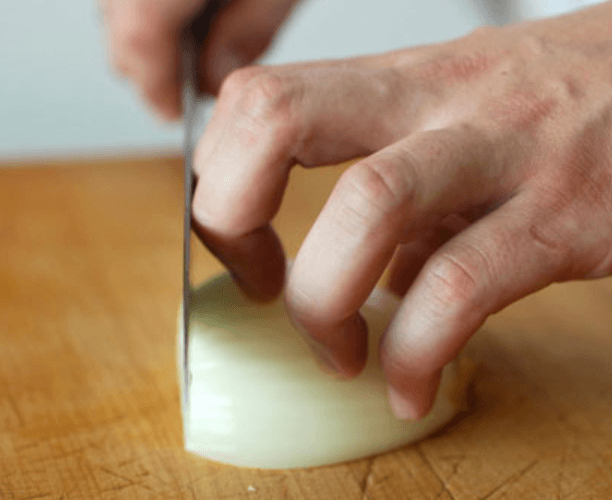
use the _________ technique to protect fingers while cutting foods.
Claw grip
flat fingers
Nuckle grip
Palm grip
Never put knives in __________.
Hot water
Soapy Water
Cold Water
the dishwasher

True or false: a mince is smaller than a course chop.
True
False
Which type of cut has a specific, measurable size?
Precision Cuts
Common Cuts
When using a knife, you should always cut _____________
away from yourself and others.
toward yourself and others.
down.
up.

If a knife is falling, you should ________________.
not try to catch it.
always try to catch it.
grab it with both hands.
When carrying a knife, point the tip of the knife down, next to your side while letting others know you are holding a knife.
True
False

Knives should only be used for
cutting
puncturing
opening
The most versatile knife in the kitchen...
chef knife
paring knife
utility knife
serrated knife
Match the following knives with their uses.
Utility knife
General purpose cutting
Parring knife
Peeling and trimming
Serrated or Bread knife
Cutting breads and pastries
Chef's knife
Chopping and slicing

Match the following actions with the appropriate responses if a knife is falling off the table.
Try to catch it so it won't break
Prevent damage to the knife
Let it fall and get another knife
Replace the fallen knife
Jump back out of the way so not to get hurt
Avoid injury
Use the right knife and it won't fall
Ensure stability
Always use a cutting board when using a knife
True
False
Sometimes
Never
The two main parts of a knife are (a) and (b) .
The part of the knife used for slicing, carving, and making precise cuts is the (a) .
What is the purpose of the bolster in a knife?
To aid in cutting through tough foods
To hold the handle to the tang
To provide an area for holding and guiding the knife
To connect the blade to the handle
What is the tang of a knife?
The widest part of the blade
The metal that continues from the blade through the handle
The cutting surface of the knife
The end of the handle

