
 Worksheets
Quiz 3
Total questions: 11
Worksheet time: 6mins

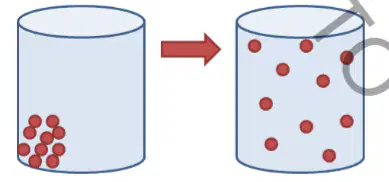
The balloons pictured below escaped from the balloon seller in the park. Each balloon is filled with the same volume of different gases at STP. The identities of the four gases inside the balloons are listed below. IDENTIFY the gas that is most likely to be inside balloon #2.
H2
He
CO2
N2

The Galveston Bay area sea surface temperature has increased over 10% between 2010 and 2020. Which of the following answers is the most likely effect on the amount of oxygen gas dissolved in the bay water?
The amount of dissolved oxygen will increase because higher temperatures allow more gas to remain dissolved in water.
The amount of dissolved oxygen will decrease because higher temperatures allow less gas to remain dissolved in water.
The amount of dissolved oxygen will remain unchanged because temperature does not affect gas solubility.
The amount of dissolved oxygen will decrease because higher temperatures cause oxygen gas molecules to have lower average kinetic energy.

A closed container is filled with a mixture of Xe(g) and SO₂(g), such that it is 20% Xe(g) by volume. The volume and temperature remain constant, and the total pressure inside the container is 4 atm. CALCULATE the partial pressure of SO₂ inside the container.
0.8 atm
3.2 atm
5.0 atm
20 atm

Consider two identical flasks, one containing 2.0 mol of O₂(g) at 175 K and the other containing 2.0 mol of O₂(g) at 425 K. Based on the information given, which of the following statements is TRUE?
The rate at which O₂(g) molecules collide with the flask walls is higher in flask 1 than in flask 2.
The pressure exerted by the O₂(g) is the same in both flasks.
The average speed of the O₂(g) molecules is lower in flask 1 than in flask 2.
The average kinetic energy of the O₂(g) molecules is the same in both flasks.

Which graph BEST REPRESENTS the relationship between pressure (P) and temperature (T) of a gas when the number of moles (n) and volume (V) are held constant?
Graph A
Graph B
Graph C
Graph D

Which of the following would DECREASE the pressure of the gas in this container?
Move the piston down to the bottom of the rigid container.
Move the piston closer to the opening of the rigid container.
Without changing the position of the piston, add 0.5 mol of the gas into the rigid container.
Without changing the position of the piston, place the rigid container in a hot water bath.

Which of the following would accurately solve for the final temperature (T₂) of the argon gas?
T₁/3
T₁/6
T₁
3T₁
A piece of dry ice, CO₂(s), is placed into an evacuated 2.00 L rigid container and allowed to fully phase change from solid form into CO₂(g). Once all solid CO₂(s) has completely changed into CO₂(g), the pressure inside the container is 5.60 atm at 25°C. IDENTIFY the setup that will correctly calculate the number of moles of CO₂(g) in the container after all solid has phase changed into a gas.
(0.08206 L·atm/mol·K)(25°C) / (5.60 atm)(2.00 L)
(5.60 atm)(2.00 L) / (0.08206 L·atm/mol·K)(25°C)
(0.08206 L·atm/mol·K)(298 K) / (5.60 atm)(2.00 L)
(5.60 atm)(2.00 L) / (0.08206 L·atm/mol·K)(298 K)
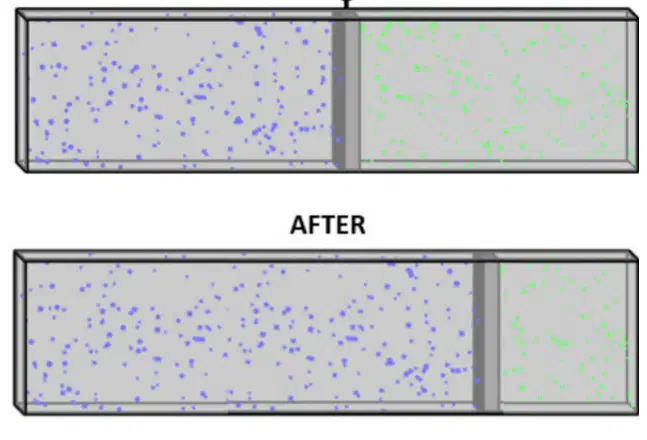
Two samples of gas of unknown pressures are separated by a frictionless piston held in place by a pin. When the pin is removed, the piston moves based on the pressure exerted by both gases. The initial state of the piston before the pin is removed and the final state of the piston after the pin is removed is shown in the pair of diagrams provided. Which model of the gas apparatus below shows the MOST ACCURATE FORCE ARROWS that caused the piston to move due to the pressures of each gas?
Diagram with green arrow pointing right.
Diagram with blue arrow pointing right.
Diagram with blue arrow pointing right and green arrow pointing left.
Diagram with green arrow pointing left.
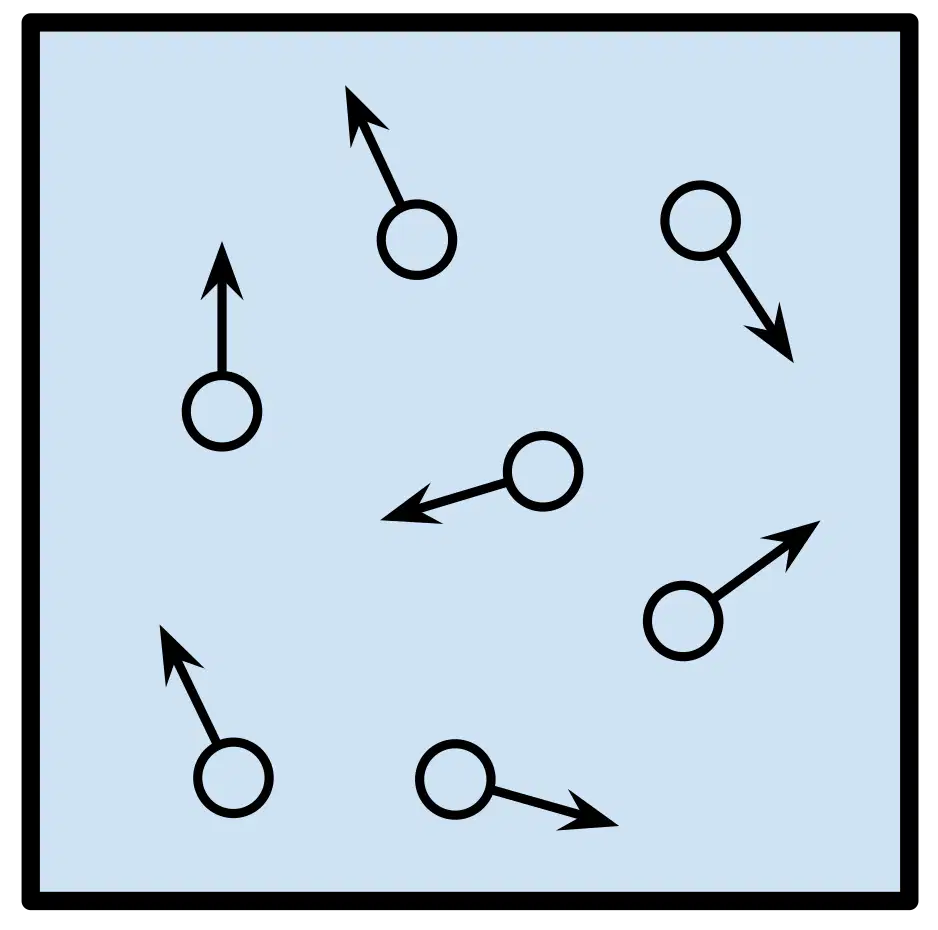
The following diagram represents a sealed, rigid container filled with gas particles. The arrows represent the relative velocity of each particle.
What would a student need to do to change the properties of the gas that would decrease the pressure inside the container?
Decrease the temperature
Increase the number of moles
Decrease the volume
Increase the volume
A sample of neon gas has a volume of 3.4 liters at STP (T=273 K, P=1 atm) calculate the mass of the Ne (gas) sample.
0.152 g
3.06 g
7.52 x 10^-3 g
1.54 x 10^3 g

