
 Worksheets
CH373 Quiz 4 Review
Total questions: 27
Worksheet time: 26mins
Which of the following DNA sequences would have the highest Tm if paired with its complement?
5’-ATAGGCACCGTA-3’
5’-TATAGC-3’
5’GCATTTAGCATTT-3’
5’-GCGCAT-3’
During an experiment where you are observing a colony of E. coli over several generations, you introduce a high concentration 5-azaC, a DNA methylase inhibitor. As more generations pass, which of the following effects are you most likely to observe?
Total colony destruction
Increase in the number of DNA mutations
Immediate uncontrolled growth
Ability to uptake lactose in the presence of glucose
You are a scientist in the early 20th century looking for a natural existing antibiotic that targets prokaryotes infecting a human. You find 4 different substances that each inhibit a different target. Which of the following molecules would you want to use?
Chloramphenicol, which disrupts the 60S subunit of the ribosome
Colchicine, which inhibits microtubule formation
Puromycin, which inhibits protein synthesis by mimicking aminoacyl-tRNA
Kanamycin, which blocks the 30S subunit of the ribosome
What would happen if you removed single-stranded binding proteins from a cell during DNA replication?
Okazaki Fragments would become longer
DNA polymerase will not be able to bind to DNA
Helicase would unwind the DNA more efficiently
The leading strand would be synthesized discontinuously
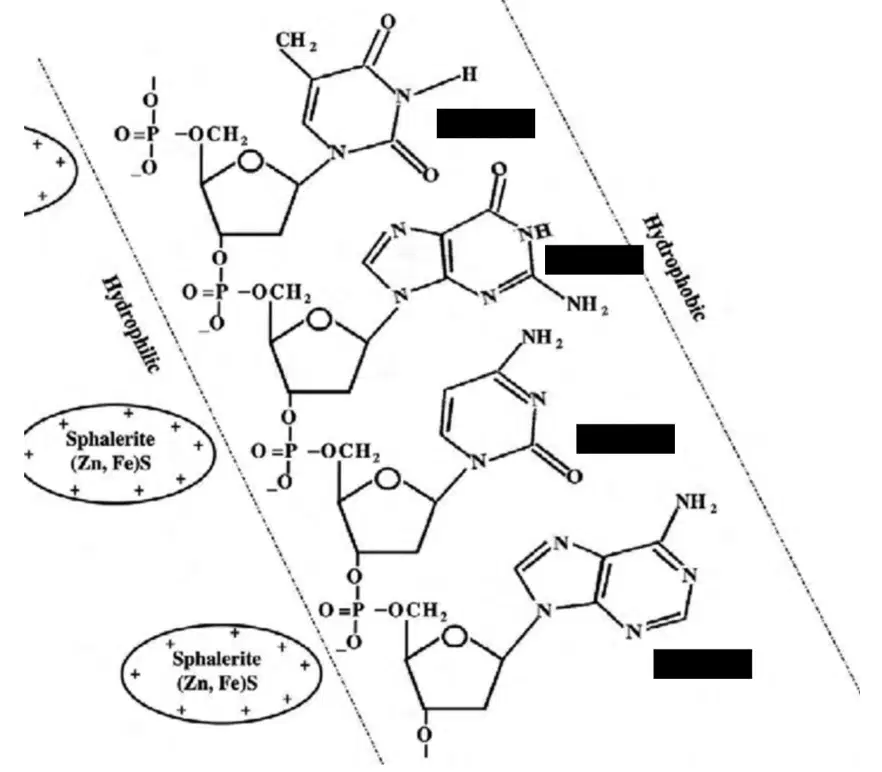
What is the sequence of the image above?
5’-ACGT-3’
5’-TGCA-3’
5’-ACGT-3’
5’-GTAC-3’
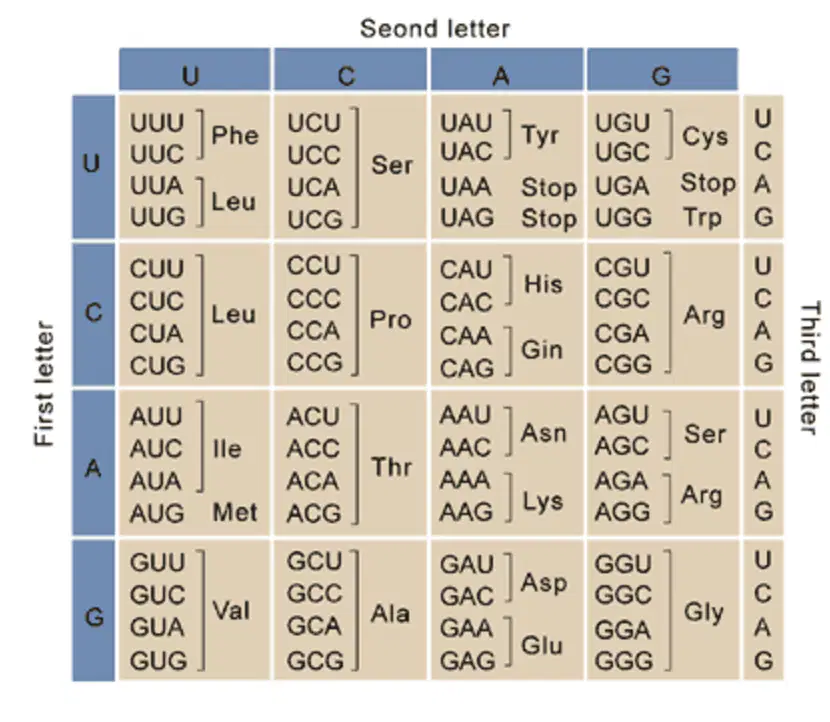
You have just found an endogenous mRNA that codes for a protein capable of fluorescing under blue light. The sequence of the mRNA is as follows: 5’…GAUGUUAAGGGCC…3’. What is the 3rd amino acid in this protein?
Serine
Arginine
Lysine
Leucine
In a cell, a mutation prevents RNA Polymerase II from functioning. Which of the following would be the most immediate consequence of this mutation?
Accumulation of unprocessed rRNA.
Inability to synthesize mRNA for protein production.
Lack of tRNA for translation.
Decrease in ribosomal subunit formation.
Which of the following statements is the most accurate comparison between how prokaryotes and eukaryotes initiate protein synthesis?
Bacteria use a Shine-Dalgarno sequence for rapid initiation, while eukaryotes require a 5' cap and scanning for the start codon, providing more regulation.
Bacteria initiate translation directly at the start codon, while eukaryotes use a complex set of factors, including the 5' cap and ribosome scanning.
Both bacteria and eukaryotes use the same mechanism of translation initiation, involving ribosome binding only at the start codon.
Both bacteria and eukaryotes initiate translation by recognizing the Shine-Dalgarno sequence, ensuring similar efficiency in protein synthesis.
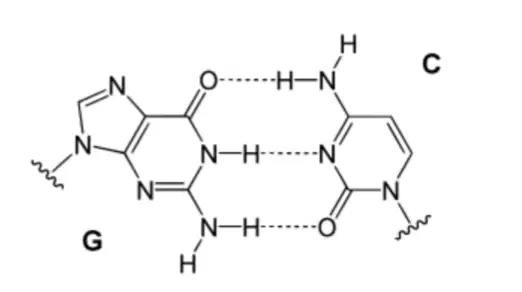
For the shown H-bonds between the bases C and G, which of the following statements is correct?
Cytosine provides 1 donor and 2 acceptors; guanine provides 2 donors and 1 acceptor.
Cytosine provides 2 donors and 1 acceptor; guanine provides 1 donor and 2 acceptors.
Cytosine provides 2 donors and 1 acceptor; guanine provides 2 donors and 2 acceptors.
Cytosine provides 1 donor and 1 acceptor; guanine provides 2 donors and 1 acceptor.
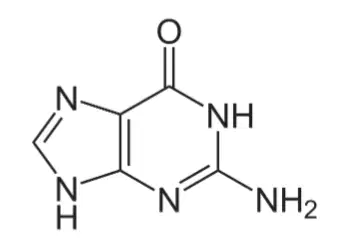
What is the nucleic acid base, and at what position is the carbonyl carbon in the base?
Adenine; Carbonyl carbon at position 6.
Guanine; Carbonyl carbon at position 6.
Adenine; Carbonyl carbon at position 2.
Guanine; Carbonyl carbon at position 2.
In the process of tRNA charging, aminoacyl-tRNA synthetases catalyze the attachment of an amino acid to its corresponding tRNA. Which of the following correctly describes the key steps and energetics of this process?
The amino acid is first activated by ATP hydrolysis to form an aminoacyl-AMP intermediate, which is then transferred to the tRNA, using the energy derived from the hydrolysis of the pyrophosphate formed in the first step.
The amino acid is directly attached to the tRNA without any energy investment, and the reaction proceeds via a direct exchange of nucleotides.
ATP hydrolysis is only required for the transfer of the amino acid from the tRNA to the ribosome, not for the charging process itself.
The tRNA is initially charged using GTP, which is hydrolyzed to form the aminoacyl-tRNA complex before translation begins.
What is a likely outcome if telomerase activity is hindered in somatic cells, such as in aging tissues or during the progression of certain diseases?
Telomeres would shorten progressively with each cell division, eventually leading to cell senescence or apoptosis.
The cell would undergo excessive DNA repair, leading to increased mutation rates and genomic instability.
The cell would experience faster DNA replication, increasing the rate of cell division and potentially contributing to cancer development.
Telomeres would lengthen unnaturally, causing the cell to become immortal and potentially forming tumors.
Which of the following is true about the sugar in DNA?
It is ribose with a hydroxyl group at the 2' carbon.
It is deoxyribose with a hydrogen at the 2' carbon.
It contains a hydroxyl group at the 3' and 5' carbons.
Both b and c are correct.
Match the RNA type to the correct RNA polymerase:
mRNA: RNA polymerase I, tRNA: RNA polymerase II, rRNA: RNA polymerase III
mRNA: RNA polymerase II, tRNA: RNA polymerase I, rRNA: RNA polymerase III
mRNA: RNA polymerase II, tRNA: RNA polymerase III, rRNA: RNA polymerase I
mRNA: RNA polymerase III, tRNA: RNA polymerase I, rRNA: RNA polymerase II
Which of the following statements accurately describes DNA supercoiling?
Supercoiling can happen in prokaryotes and eukaryotes
DNA supercoiling is the process of adding histone proteins to DNA, leading to chromatin condensation.
Supercoiling results in a change in the torsional strain in DNA.
Topoisomerase enzymes catalyze the addition of phosphate groups to DNA, causing changes in its supercoiled structure.
Which of the following does NOT contribute to the accuracy of translation?
Editing site of aminoacyl-tRNA synthetase
Translation release factors
Recognition of incoming-tRNA’s anticodon by the codon on the mRNA
Faster GTP hydrolysis in EF-Tu bound to the correct tRNA
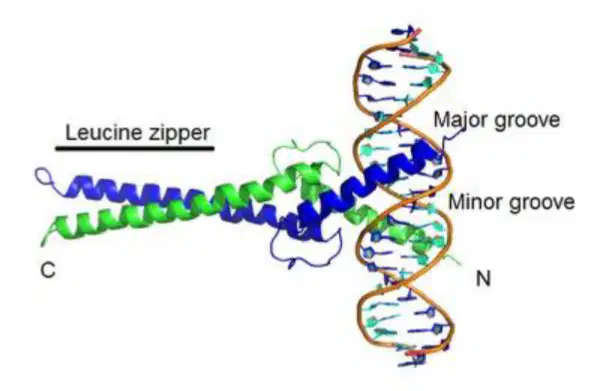
Leucine zippers are structural motifs found in DNA-binding proteins. Where would you expect a leucine zipper to best bind in B-form DNA? (select all)
Leucine zippers would bind to the narrow minor groove of B-form DNA.
Leucine zippers would bind to the sugar-phosphate backbone of B-form DNA.
Leucine zippers would bind to the wide major groove of B-form DNA.
Leucine zippers would bind equally well to the sugar-phosphate backbone and wide major groove of B-form DNA.
Processivity of a polymerase refers to:
Whether the polymerase can process the 5’ end of the synthesized molecule
How long a poly-A tail can be formed
The efficiency in editing
How many nucleotides can be polymerized until the enzyme dissociates
Which of the following processes does not require ATP or GTP hydrolysis as a source of energy to drive the process?
Stem loop-dependent termination of transcription
Unwinding DNA by helicase
Formation of charged-tRNA
Translocation of ribosome by EF-G
Which of the following changes could cause an increase in DNA transcription?
Increase in DNA methylation that interferes with the binding of a transcription factor
Loss of hairpin (G) quartets
Increase in HAT (histone acetyltransferase) activity
Increase in telomerase activity
Which of the following changes increases Tm of DNA?
Decreasing Mg2+ - phosphate salt bridges
Increasing the ionic strength of the solution
Decreasing the pH to 3.5
Increasing the number of AT base pairs relative to GC base pairs
A DNA segment has the following coding strand: 5’GTACGTGCGCGCAGCGTAGCACTACAT3’, what is the corresponding RNA sequence?
5’CATGCACGCGCGTCGCATCGTGATGTA3’
5’AUUGAUGGUCUACGCUCGGCGCAGUAC3’
5’ATCATCACGATGCGACGCGCTGTCATG3’
5’GUACGUGCGCGCAGCGUAGCACUACA3’
Which of the following statements accurately distinguishes between a nucleoside and a nucleotide?
A nucleotide consists of a sugar, a nitrogenous base, and one or more phosphate groups, while a nucleoside contains only a sugar and a nitrogenous base.
A nucleoside consists of a sugar, a nitrogenous base, and one or more phosphate groups, while a nucleotide contains only a sugar and a nitrogenous base.
Both nucleoside and nucleotide consist of a sugar, a nitrogenous base, and one or more phosphate groups.
A nucleotide is only found in DNA, while a nucleoside is only found in RNA.
What transcription mistake may not lead to a translation error given the following mRNA sequence 5’AUGCGAUGCCCU3’?
Point mutation at the 6th nucleotide
Point mutation at the 5th nucleotide
Deletion of the first nucleotide
Insertion after the 3rd nucleotide
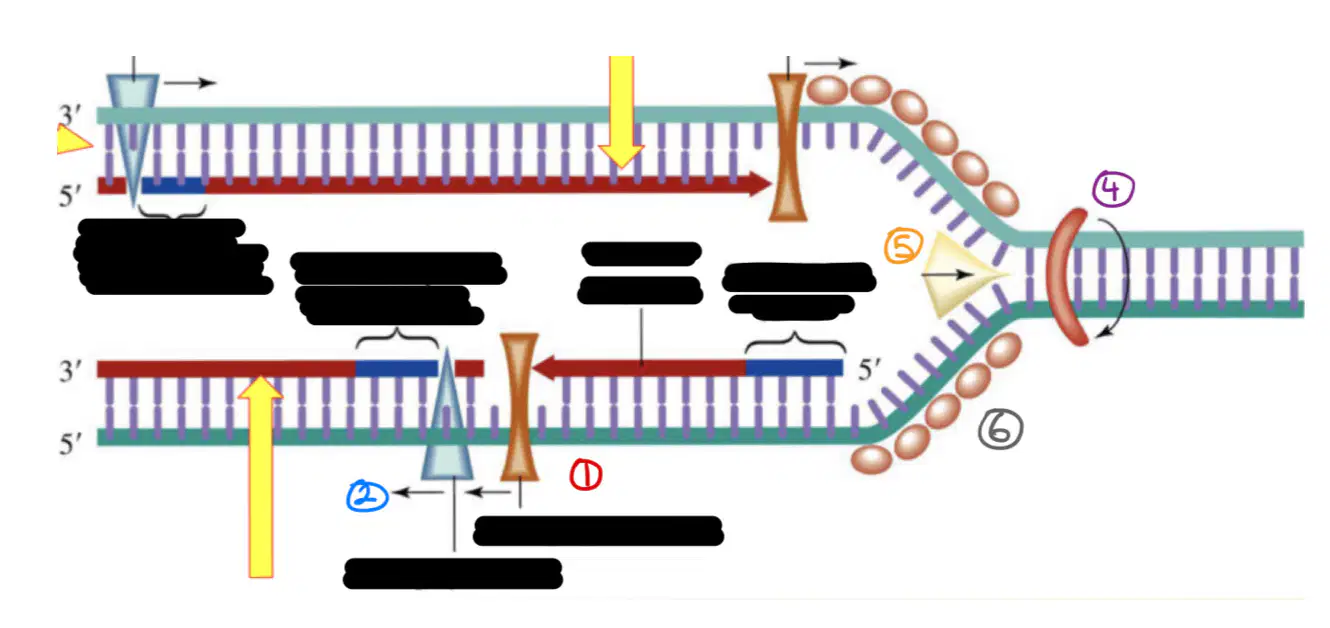
What is the protein labeled “2” in blue?
DNA polymerase III
Single-stranded binding protein
DNA polymerase I
Ligase
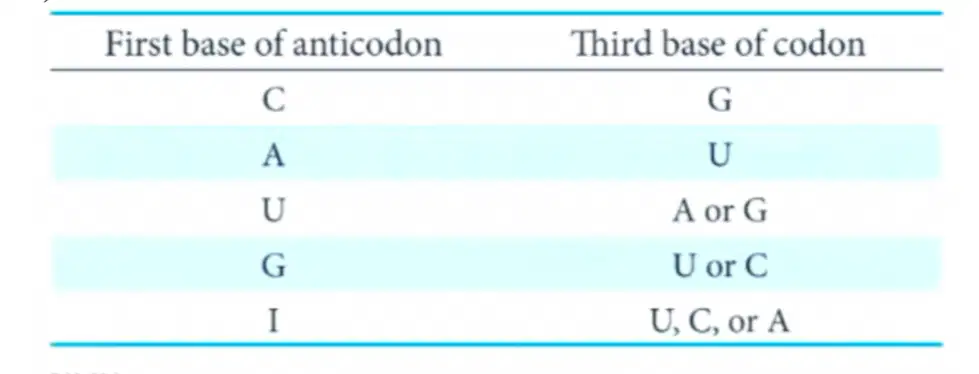
An anticodon strand reads 5’ IUA 3’. Pick the possible codon sequences that match the anticodon. (Select all)
5’ UAU 3’
5’ UAC 3’
5’ UAG 3’
5’ UAA 3’
Use calculator: A piece of dsDNA has 250 residues, of which Adenine composes 28%. How many GC pairs are in this piece of DNA?
110
88
90
55

