
Font size
 Worksheets
5th Grade Q1 Science Assessment
Total questions: 39
Worksheet time: 20mins

A student's data table is shown. The table lists the distance of four stars from Earth. The four stars are of similar mass and are in the same life cycle stage. Each distance in the table is given in light-years. A light-year contains millions of kilometers.
When the student observes the night sky, which two stars will appear the brightest?
1 and 3
2 and 3
3 and 4
2 and 4
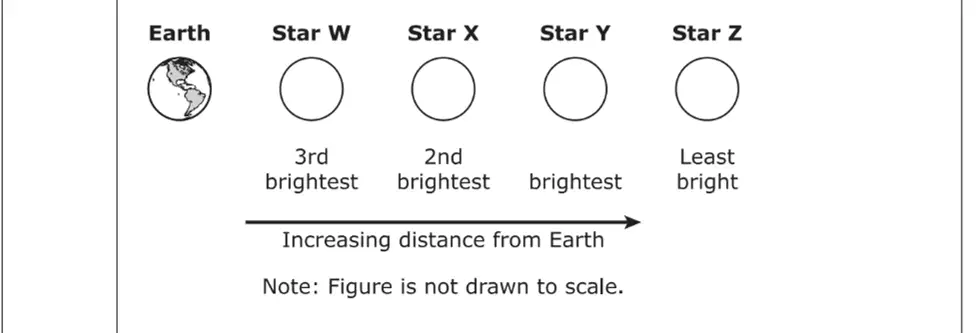
Students are learning about the difference between how bright stars appear to be when viewed from Earth and how bright stars actually are. The students draw four stars at different distances from Earth. The stars are labeled by how bright they actually are, not by how bright they appear to be when viewed from Earth. The students want to know how bright these stars appear to be from Earth’s point of view. Which two statements are true based on the actual brightness of the stars?
M. It is possible that Star W could appear brighter than Star X.
P. It is possible that Star X could appear dimmer than Star Z.
R. It is possible that Star Y could appear brighter than Star X.
S. It is possible that Star Y could appear dimmer than Star Z.
T. It is possible that Star Z could appear brighter than Star W.
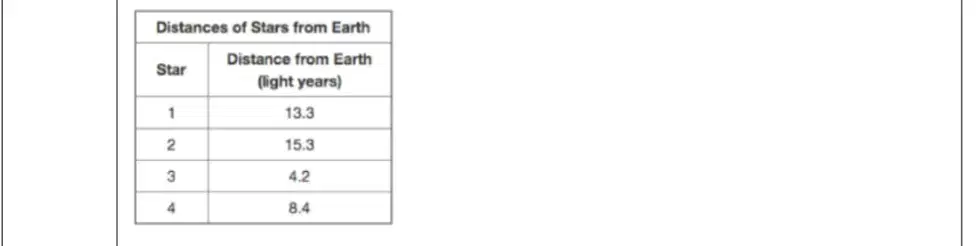
Rena is studying four stars that are about the same actual size. She made this table showing the distances of four stars from Earth. Which star would appear to be largest when viewed from Earth?
Star 1
Star 2
Star 3
Star 4
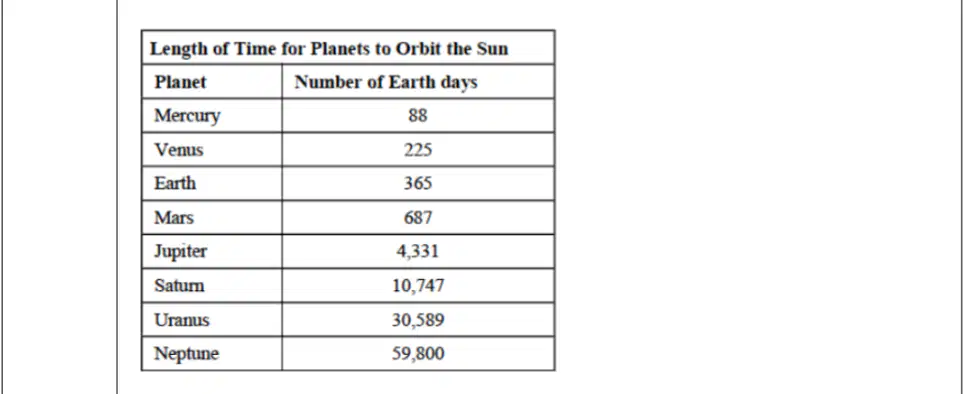
The table shows the length of time it takes the planets in our solar system to orbit the sun. Which statement is the best explanation for the data in the table?
The inner planets move much more quickly than the outer planets.
Solar energy makes the inner planets orbit more quickly than the outer planets.
The orbital paths of the outer planets are longer than those of the inner planets.
The greater number of moons around the outer planets slow their orbits.
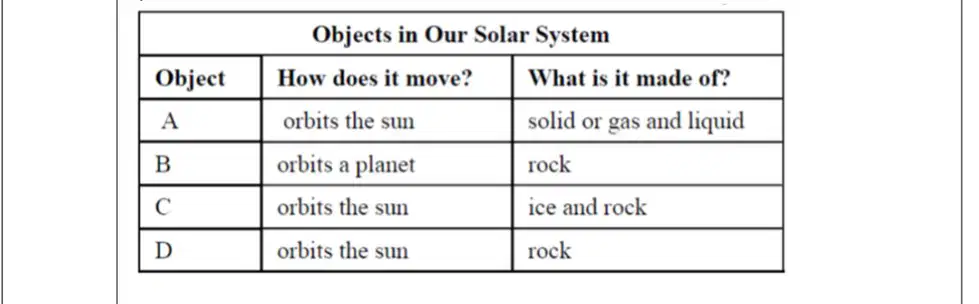
This table includes the characteristics of some of the objects found in our solar system.
A
B
C
D
Which can be used to tell scientists about the surface temperature of a star?
size
mass
color
brightness
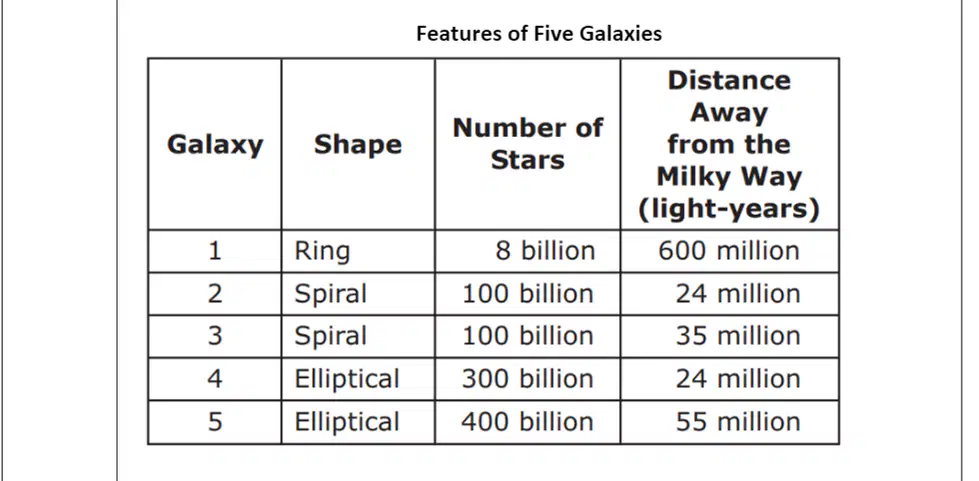
The Milky Way is a spiral galaxy with more than 100 billion stars. Students compare the Milky Way to a data table that lists features of five other galaxies. The distance of each galaxy from the Milky Way is given in light-years. A light-year contains millions of kilometers. Based on this data table, which galaxies are most likely the same type as the Milky Way galaxy?
Galaxy 2 and Galaxy 4, because they are both the same distance from the Milky Way galaxy
Galaxy 2 and Galaxy 3, because they have the same shape as the Milky Way galaxy
Galaxy 4 and Galaxy 5, because they have a similar number of stars as the Milky Way galaxy
Galaxy 1 and Galaxy 5, because they are the galaxies farthest from the Milky Way galaxy
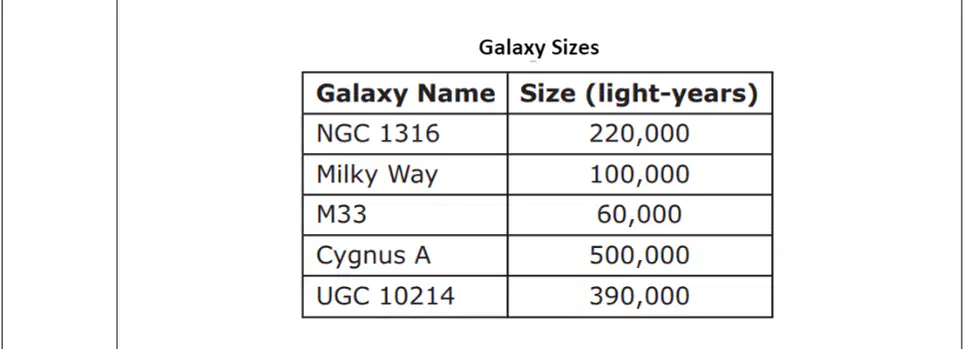
The size of a galaxy is determined by measuring the distance across the widest part. The sizes of some galaxies are given in the table. There are many other galaxies, larger and smaller than the Milky Way, that are not included in the table. Based on the data, which statement correctly compares the Milky Way to other galaxies?
A. The Milky Way galaxy is the fourth-largest galaxy in the universe.
B. The Milky Way galaxy is not one of the largest galaxies in the universe.
C. The galaxies in the universe do not get any smaller than the size of the Milky Way.
D. The galaxies in the universe do not get any bigger than twice the size of the Milky Way.
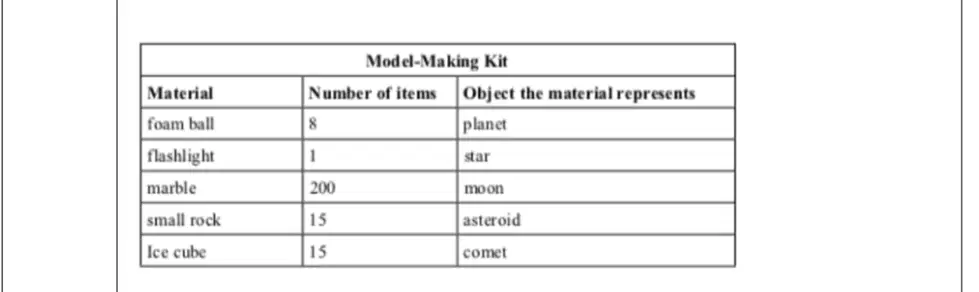
Students were given a kit containing model-making materials. The materials provided in the kit are listed in the table. What can be modeled using most of the materials provided in the kit?
a. the asteroid belt
b. the Milky Way Galaxy
c. our solar system
d. a comet trail
Which is a huge collection of stars?
a galaxy
a planet
a universe
a constellation

This diagram shows the eight planets and one dwarf planet in the solar system. Which object in the solar system is considered a dwarf planet?
Mercury
Mars
Pluto
Neptune
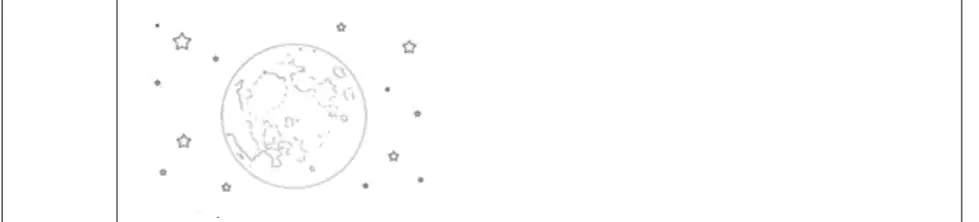
Unlike Earth, the Moon has no ______.
gravity
atmosphere
surface
landforms

Based on the sketches and table, which object is most likely a planet?
Object 1
Object 2
Object 3
Object 4
Object 5

Which object is most likely a moon based on the characteristics shown?
Object 1
Object 2
Object 3
Object 4
Object 5
Students observe the information for Object 2. Which conclusion is correct based on the object’s shape, composition, and orbit?
Object 2 is a moon.
Object 2 is an asteroid.
Object 2 is an inner planet.
Object 2 is an outer planet.
A student concludes that Object 4 is a comet. Which information best supports this conclusion?
Object 4 has a tail and is composed of ice.
Object 4 has craters on it like an asteroid has.
Object 4 has less mass than the sun.
Object 4 is not composed of gases.
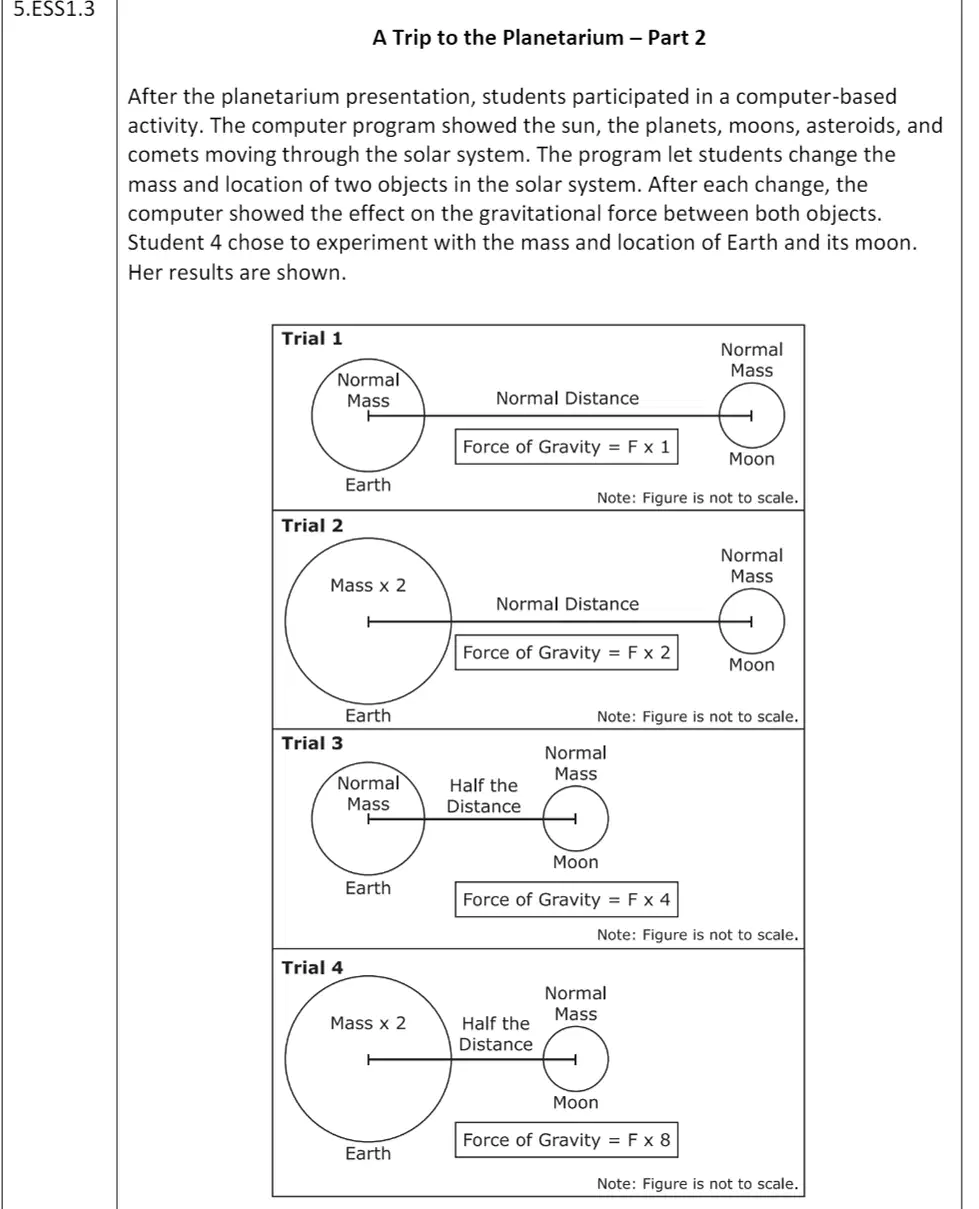
Students observe the planets on the computer screen. They note that the outer planets move more slowly and have a larger orbit than the inner planets. Which question is best answered with this information?
Why do outer planets have a larger orbit?
How does mass affect gravitational force?
Why do inner planets move faster?
What is the relationship between distance and gravitational force?
Which is an object in the solar system that is a frozen mass of ice and dust?
an asteroid
a comet
a moon
a planet
What do comets and asteroids have in common?
Comets and asteroids both have atmospheres.
Comets and asteroids both have flat shapes.
Comets and asteroids are made of ice.
Comets and asteroids both orbit the sun.
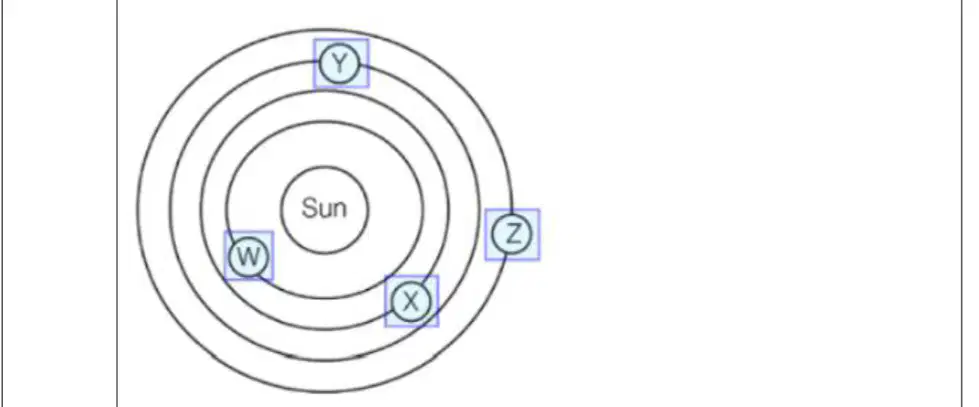
Trey made this model of the inner solar system.
W
X
Y
Z
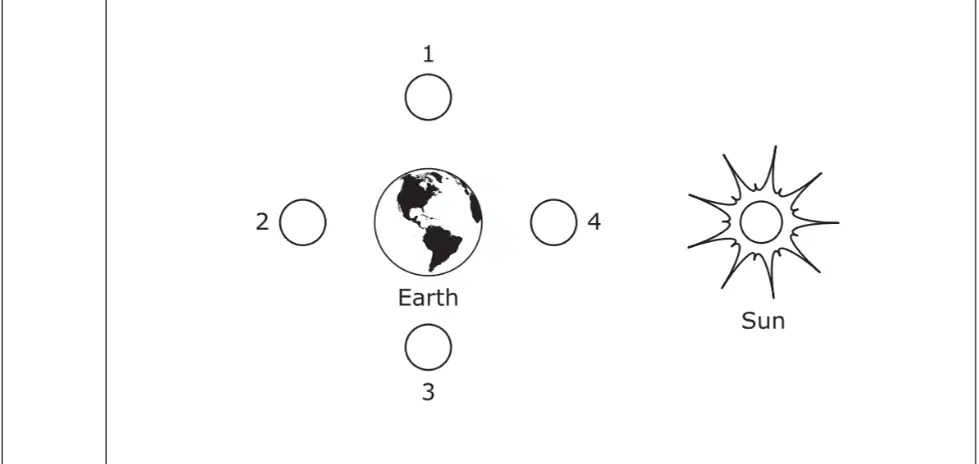
The model represents the sun-Earth-moon system. The numbers represent four positions of the moon in its orbit around Earth. Which number represents the location of the moon when it is in the new moon phase?
1
2
3
4
Which of this best describes the positions of the sun, the moon, and Earth during a solar eclipse?
The sun, the moon, and Earth are in a straight line, and the moon is between the sun and Earth.
The sun, the moon, and Earth are in a straight line, and the sun is between the moon and Earth.
The sun and Earth are in a straight line. The moon is not in a line but is at an angle between Earth and the sun.
The sun and Earth are in a straight line. The moon is not in a line but is at an angle on the side of Earth away from the sun.

Philip notices that the night sky is not as dark as it was early in the week. Choose the moon phase that follows the waning crescent moon.
A. [Image A]
B. [Image B]
C. [Image C]
D. [Image D]
Use the word bank to complete the chart. The table shows the moon phases during the month of April. Write the moon phase for the last two days in the table. Day 27 is (a) .
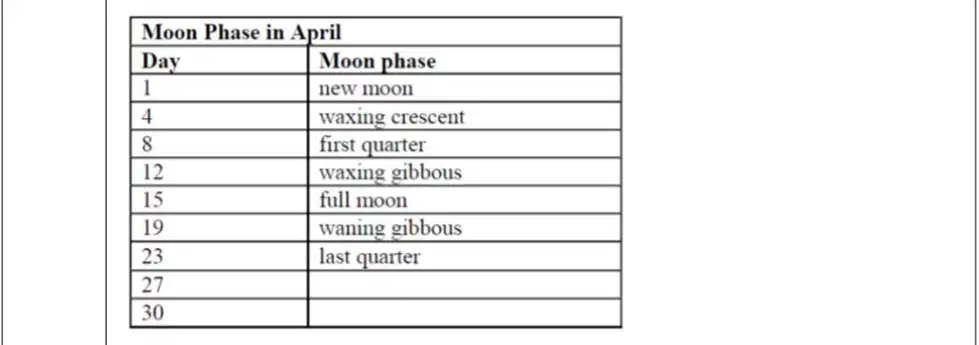
Use the word bank to complete the chart. The table shows the moon phases during the month of April. Write the moon phase for the last two days in the table. Day 30 is (a) .
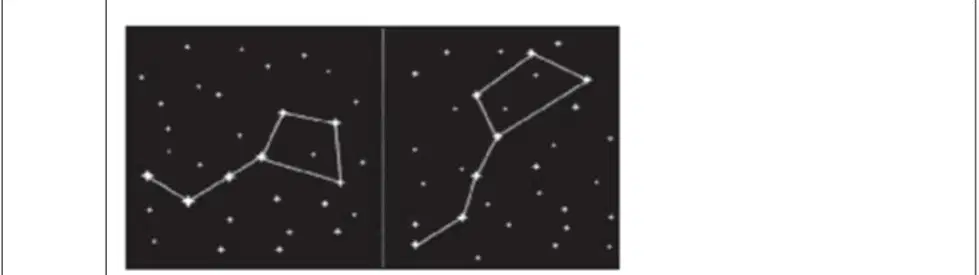
Below are two different views of the Big Dipper. The Big Dipper is an example of a pattern called _____.
convection
constellation
conflagration
communication

Based on the location of the dot on the foam ball, what is the reason for the difference in the seasons between December and June?
Earth is closer to the sun in December and farther away in June.
Earth is tilted toward the sun in June and away from the sun in December.
Earth rotates more slowly in December than in June.
Earth rotates more quickly in June than in December.
Which statement correctly describes how the number of daylight hours is different at different times of the year in Tennessee?
The number of daylight hours is greater in December than it is in March.
The number of daylight hours is greater in June than it is in December.
The number of daylight hours is greater in September than it is in June.
The number of daylight hours is greater in March than it is in September.
Which seasons are the correct labels for one of the dates on the model?
September 21: winter in the Northern Hemisphere, spring in the Southern Hemisphere
December 21: winter in the Northern Hemisphere, summer in the Southern Hemisphere
June 21: spring in the Northern Hemisphere, summer in the Southern Hemisphere
March 21: spring in the Northern Hemisphere, spring in the Southern Hemisphere
Jayne created the model shown. The X on the globe represents a city. What pattern is Jackie able to show with her model?
The spinning globe shows how the sun appears to rise and set.
The light shows how Earth revolves around the sun.
The stationary globe shows the different moon phases.
The light shows the lengths of shadows at different periods in the day.
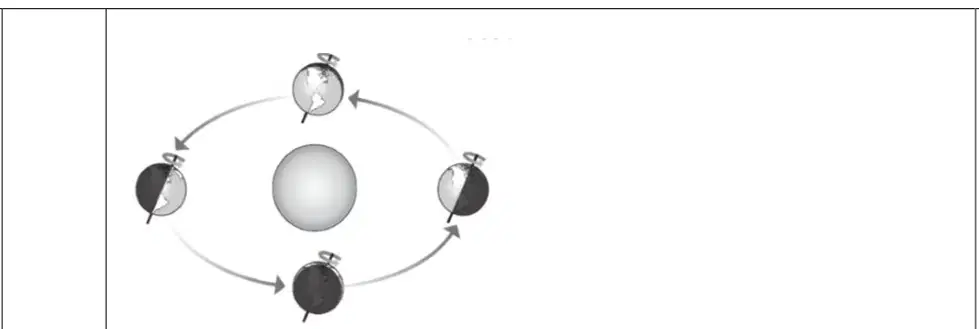
The diagram shows the patterns of (a) .

Jayne created the model shown. The X on the globe represents a city. Choose the words to complete the sentence. When the globe rotates halfway around, the city marked with an X will (a) .
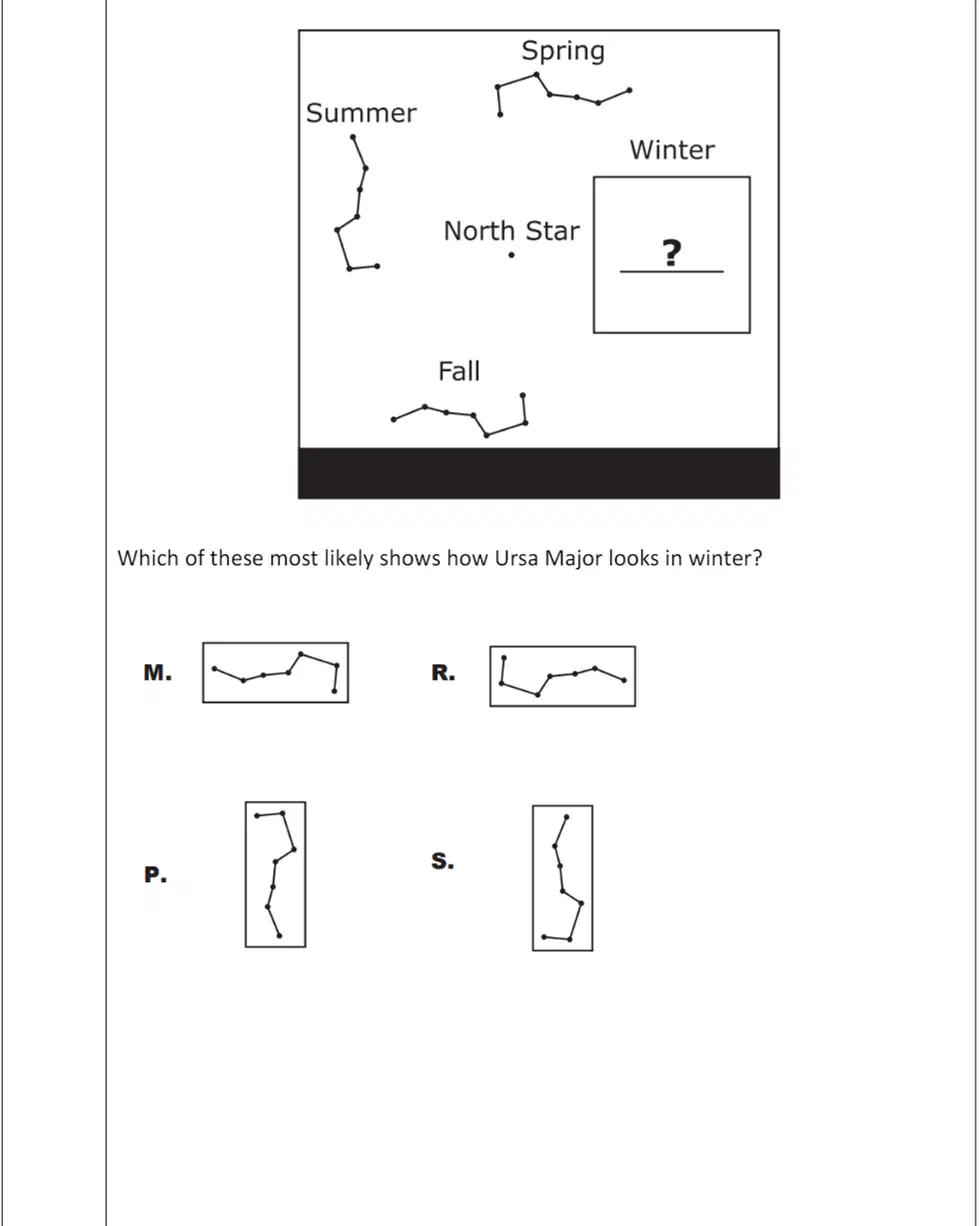
A student uses binoculars to observe how Ursa Major looks in the sky during different seasons of the year. Which of these most likely shows how Ursa Major looks in winter?
M.
R.
P.
S.
Students studying constellations noticed that some constellations, like the Big Dipper, can be seen in the Tennessee night sky all year long. Other constellations can be seen only during certain parts of the year. One of the students explained why some constellations can be seen only during certain parts of the year. 1. All stars appear to revolve around the North Star in the night sky. 2. The Big Dipper is close to the North Star, so it appears to move in a small circle around the North Star and stays above the horizon all year long. 3. Some constellations revolve farther away from the North Star than the Big Dipper does. 4. Since they are farther away, some constellations appear to move in a large circle around the North Star. 5. These circles are so large that part of them goes below the horizon. 6. Therefore, some constellations stay below the horizon at night during certain parts of the year. Which part of the student’s explanation best describes why some constellations stay below the horizon at night?
Statement 1
Statement 2
Statement 3
Statement 5
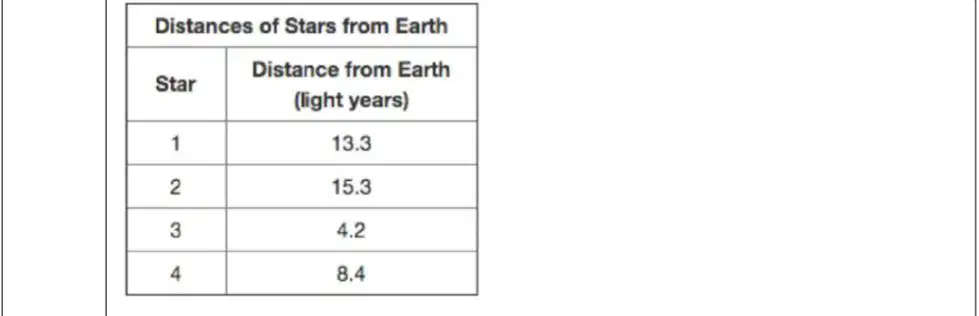
Rena is studying four stars that are about the same actual size. She made this table showing the distances of four stars from Earth.
Star 1
Star 2
Star 3
Star 4
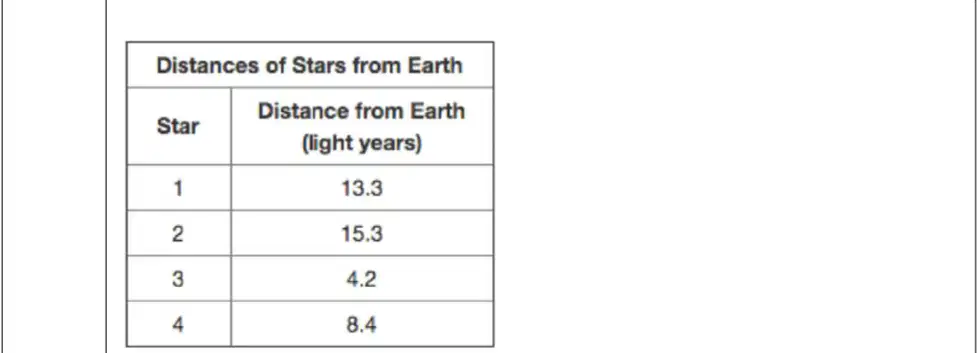
Rena is studying four stars that are about the same actual size. She made this table showing the distances of four stars from Earth. Which star would have the greatest apparent brightness?
1
2
3
4
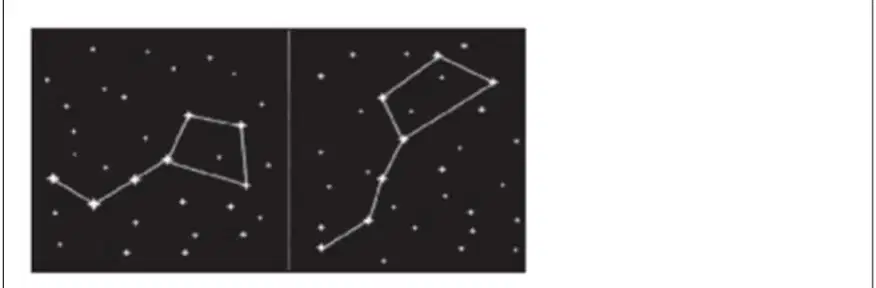
The picture on the right is known as:
Ursa major
Ursa minor
Polaris
The Little Dipper
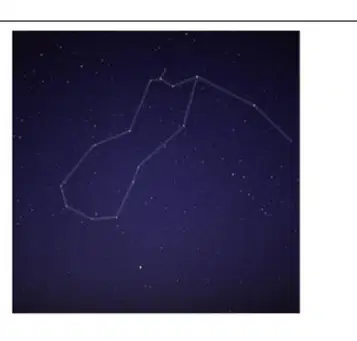
What is the name of the constellation pictured above?
Orion
The Big Dipper
Aquarius
Cancer
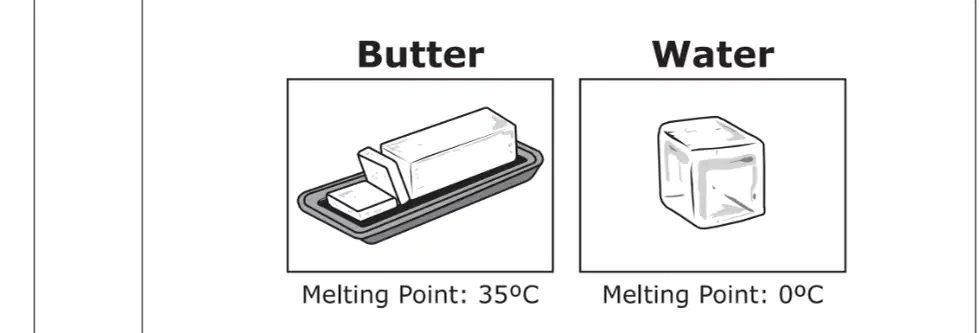
The pictures show butter and water in solid states. The melting point of each substance is shown. Students put solid butter and solid water on a table. The air temperature around the table is 20°C. Which statement describes the most likely state of each substance after 2 hours?
The butter and water will both remain solids.
The butter and water will both become liquids.
The butter will remain a solid, and the water will become a liquid.
The butter will become a liquid, and the water will remain a solid.

