
 Worksheets
Sustainable cities 1 year 9
Total questions: 123
Worksheet time: 1hrs 21mins
What is the definition of sustainable?
Actions that meet the needs of today, regardless of future generations
Actions that meet the needs of today, without reducing the ability of future generations to meet their needs.
Actions that meet the needs of future generations but do not meet today's needs
Actions that do not meet the needs of people
Which of these are types of sustainability? (3)
Social
Political
Economic
Environmental
Transport
Which of these is a social sustainability example?
Rivers are kept clear and clean of waste and pollution
There are enough schools and doctors
There are lots of well-paid jobs in energy development
Which of these is an economic sustainability example?
Rivers are kept clear and clean of waste and pollution
There are enough schools and doctors
There are lots of well-paid jobs in energy development
Which of these is an environmental sustainability example?
Rivers are kept clear and clean of waste and pollution
There are enough schools and doctors
There are lots of well-paid jobs in energy development
Select 2 cities which were in the top 10 most sustainable cities list for 2018
Stockholm
Vienna
New York
Paris
Which city was ranked number 1 in the 2018 most sustainable cities list 2018?
Edinburgh
London
Munich
Zurich
Tianjin is located in what country?
Japan
China
Bangladesh
India
How many people are expected to live in Asia-Pacific cities by 2030?
1.3 million
1.3 billion
2.6 million
2.6 billion
Examples of renewable energy sources include:
Bioethanol, natural gas, petroleum
Geothermal, wind, solar
Hydroelectricity, coal, nuclear
What are the key elements of a sustainable city?
Efficient public transportation, renewable energy sources, green spaces, waste management, and sustainable urban planning
More highways and roads
Increased use of fossil fuels
Cutting down all trees for development
Explain the concept of urban sprawl and its impact on the environment.
Urban sprawl is the controlled expansion of urban areas, leading to reduced pollution and preservation of natural habitats.
Urban sprawl is the expansion of rural areas, leading to decreased pollution and increased access to natural resources.
Urban sprawl is the planned expansion of urban areas, leading to improved air quality and conservation of resources.
Urban sprawl is the uncontrolled expansion of urban areas, leading to increased pollution, loss of natural habitats, and strain on resources.
How can green spaces and parks contribute to building sustainable cities?
By creating more opportunities for industrial development
By increasing traffic congestion and pollution
By providing areas for recreation, improving air quality, reducing urban heat island effect, managing stormwater, and promoting biodiversity.
By contributing to the loss of natural habitats
Discuss the importance of public transportation in sustainable cities.
Public transportation reduces traffic congestion, air pollution, and carbon emissions in cities, making them more sustainable.
Public transportation increases traffic congestion and air pollution in cities
Public transportation is not important for sustainable cities
Public transportation has no impact on reducing carbon emissions in cities
What are some strategies to reduce energy consumption in urban areas?
Promoting the use of single-use plastics
Building more highways and roads
Encouraging the use of coal-powered plants
Promoting energy-efficient building designs, implementing public transportation systems, encouraging the use of renewable energy sources, and promoting energy conservation practices.
Explain the concept of mixed-use development and its role in sustainable cities.
Mixed-use development only benefits a small portion of the population and is not relevant to sustainable cities.
Mixed-use development promotes walkability, reduces the need for car travel, and creates a more sustainable and vibrant urban environment.
Mixed-use development has no impact on walkability and car travel in cities.
Mixed-use development increases the need for car travel and creates a less sustainable urban environment.
How can sustainable water management contribute to building sustainable cities?
By encouraging overuse of water resources
By promoting deforestation and soil erosion
By increasing water pollution and wastage
By ensuring efficient use of water resources, reducing water pollution, and promoting water conservation.
Discuss the concept of urban renewal and its impact on the sustainability of cities.
Urban renewal is a process of revitalizing urban areas through infrastructure and housing improvements, aiming to enhance the sustainability of cities.
Urban renewal only focuses on improving rural areas, not urban ones.
Urban renewal has no impact on the sustainability of cities.
Urban renewal is a process of demolishing urban areas to make space for more industrial buildings.
What are the challenges in implementing sustainable practices in developing cities?
Lack of resources, infrastructure, and funding
Lack of interest from the community
Too much government regulation
Abundance of resources and funding
Explain the concept of smart cities and their role in building sustainable urban areas.
Smart cities have no impact on the sustainability of urban areas
Smart cities rely on outdated technology and have no relevance in modern urban development
Smart cities use technology and data to improve efficiency, sustainability, and quality of life for residents. They play a crucial role in building sustainable urban areas by integrating renewable energy, efficient transportation, waste management, and smart infrastructure.
Smart cities are focused on increasing pollution and waste in urban areas
Which of the following cities is considered a sustainable city?
Egypt
France
America
Germany
Identify the importance of studying sustainable cities
Improving the quality of life
Organizing street networks
Upgrading social life
Energy saving
Clarify the criteria for achieving sustainability
economic criteria
urban standards
social norms
There are no clear criteria
Energy saving is one of the sustainable development goals
Yes
No
Sustainable cities maintain air quality through
Reducing gas emissions from cars
Wind energy employment
Conservation of renewable resources
Which of the following means is considered within sustainable mobility?
Walking
the cars
Cycling
Public transport
taxi
Name a book that talks about sustainable cities
(a)
Sustainable development includes:
sustainable transport
sustainable community
sustainable government
Both of the above
What is the term for a city that uses technology and data to improve the quality of life for its citizens?
High-tech city
Smart city
Futuristic city
Green city
What is the term for energy that comes from sources that are naturally regenerated, like wind or solar power?
Clean energy
Renewable energy
Fossil fuels
Non-renewable energy
What do we call the process of designing and managing the physical layout of a city?
Urbanization
Urban development
Urban planning
Urban design
What is the term for vehicles that can drive themselves without human intervention?
Self-driving cars
Autonomous vehicles
Smart cars
Hybrid cars
What is the term for the ability that allow machines to do tasks that normally require human intelligence, like visual recognition or virtual assistance?
Robotics
Automation
Artificial intelligence
Machine learning
What do we call the parts of a city that are covered in vegetation, like parks or gardens?
a) Green spaces
Green infrastructure
Urban forests
Eco-parks
What is the term for a city that is designed to minimize its impact on the environment and maximize its use of renewable resources?
Sustainable city
Green city
Eco-city
Carbon-neutral city
What is the term for the total amount of greenhouse gas emissions that a person, organization, or product is responsible for?
Carbon footprint
Greenhouse gas effect
Climate change impact
Environmental impact
What is the term for the physical structures that are needed to support a city's operations, like roads, buildings, and utilities?
Infrastructure
Superstructure
Urban network
Civic amenities
What is the term for something that is very new and different, and represents a break from traditional ways of doing things?
Innovative
Avant-garde
Progressive
Groundbreaking
What is the abbreviation for The Central Business Districts?
The City
CBD
What is the abbreviation for The Central Business Districts?
The City
CBD
What is the abbreviation for The Central Business Districts?
The City
CBD
What is the abbreviation for The Central Business Districts?
The City
CBD
What is not a section of the Egan wheel?
Housing
Farming
Governance
Services
Examples of renewable energy sources include:
Bioethanol, natural gas, petroleum
Geothermal, wind, solar
Hydroelectricity, coal, nuclear
Which does not contribute to a more sustainable transport system within a city?
Bicycle lanes
Congestion charge
Higher speed limit
Rapid transport system
Which gas causes global warming?
Nitrogen dioxide
Ozone
Carbon dioxide
Hydrogen
About a quarter of the UK’s carbon emissions come from homes.
True
False
Land on which there have already been buildings is referred to as...
Historic centre
Redevelopment area
Industrial zone
Brownfield site
On the Egan wheel “Equity” is about...
Everyone having access to services
Value of shares issued by a company
Money value of a property after debts have been subtracted
“Food miles” refers to...
Distance to the nearest food store
How much money is made by foreign food producers
distance food is transported from production to the consumer
Size of fields needed for food production
What is not a benefit of green roofs...
Helps control temperature of a building
Cheaper than building materials and low maintenance
Helps reduce rapid storm water
Increases biodiversity
Sustainable communities do not promote social cohesion and inclusion.
True
False
The Egan wheel is divided into ____? aspects.
12
6
8
10
What is not a section of the Egan wheel?
Housing
Farming
Governance
Services
a city that uses clean energy
a city that reduces the pollution that they generate
a city that recycles, reuses and reduces
all are correct
Which is not a characteristic of a city?
High Population Density
Lack of Infrastructure
Built-up area
Large Population Size
Identify the PUSH factor for why people may engage in Rural-Urban migration.
Lack of job opportunities in Rural areas
Exciting city life in Urban areas
Many medical facilities like hospitals in Rural areas
Many educational facilities in the Urban areas
Which case study you learnt helps to reduce water pollution?
Beijing, China
Japan
Kranji, Singapore
Long Island, New York
Which student's answer is the most appropriate for this question, "Describe water pollution in cities." (1m)
cause people to be sick when they drink the water
contaminated water is full of rubbish and sewage waste
caused by broken sewage system
Which of the following does not help to improve the quality of life of people?
Air and water for all
Catering for different needs in the population
More transport routes
Technological Innovation

Which problem in the photo is the city trying to tackle?
Water pollution
Ageing population
Safe housing
Proper sanitation
What are the guiding principles for questions describing changes and trends?
(Clue: DID - what does it stand for)
Describe, Infer, Direction
Describe, Interpret, Data
Data, Intensity, Describe
Direction, Intensity, Data
_____-_____ migration refers to people moving from a/an rural area to a/an urban area.
(a)
Which problem is NOT commonly faced in cities?
Poor Sanitation
Competition for Land
Competition for Water Supply
Air Pollution
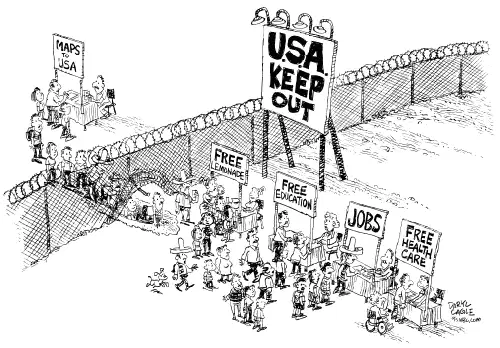
People are seen migrating across the borders. What factors of migration are at play in this cartoon?
Pull Factors
Push Factors
What share of the world’s population lives in megacities (cities with at least 10 million people)?
Around 8%
Around 28%
Around 48%
Today, more than 5 times more people live in towns and cities than in 1950. What happened to the rural population?
Almost halved
Stayed about the same
Almost doubled
How much of the world’s total land surface has some physical infrastructure built on it, like houses or roads (excluding farm land)?
Less than 5%
Around 15%
More than 25%
In 2020, there were around 68 cities in Africa with more than 1 million inhabitants. How many cities of this size will there be in Africa in 2030, according to UN experts?
Fewer than 60
Around 70
More than 90
Megacities are cities with more than 10 million inhabitants. What share of the world's population is expected to live in megacities in 2030?
Around 9%
Around 39%
Around 68%
Since 1990, roughly 2 million people were made temporarily homeless in Europe due to natural disasters. The number for Asia during the same period was...
Roughly the same
5 times more
50 times more
Solar and wind energy can also be exploited to provide ______
Electricity
Water
Flying potion
Sand
A city needs if it is to be sustainable good use of ______ resources.
Renewable
New
Old
Cold
To create efficient transport networks or to build new public ______ systems.
Transports
Airways
Land
Water
________ including carbon dioxide are produced in manufacturing solar panels.
Green houses gases
Blue houses gases
White houses gases
Wind house gases
Using tall buildings to create shade and structures to capture cooling winds help reduce energy from _______
Fossil fuels
Water
Food
Glucose
TRUE or FALSE, mega cities are found on every continent except for Antarctica?
FALSE
TRUE

According to the World Population Review, of the Top 10 cities in the world by population...
all 10 are in Asia
6 are in Asia
7 are in Asia
9 are in Asia

How many African cities are in the World's Top 10 by population?
none
1
2
3
How many Indian cities are in the World's Top 10 by population?
none
1
2
3
How many South American cities are in the World's Top 10 by population?
none
1
2
3

In what African megacity would you find this infamous floating slum?
Kinshasa
Cairo
Lagos
Dhaka

The Eko Atlantic is an ambitious housing development which plans to construct 500,000 homes on 10km2 of reclaimed land. Where would you find this development?
Sao Paulo
Rio de Janeiro
Delhi
Lagos
Lima, Jakarta, Rio, Sao Paulo, Kinshasa and Buenos Aires are...
the 6 megacities found in the western hemisphere
the 6 megacities found in the southern hemisphere
the 6 megacities found in the eastern hemisphere
A megacity is defined as
an urban agglomeration of 10 million or more found exclusively in the developed world.
an urban agglomeration of 10 million or more found exclusively in the developing world.

'Slumdog millionaire' was a highly successful 2008 film depicting slum life in which Indian megacity?
Mumbai
Delhi
Kolkata
Chennai

Which megacity do you think this might be?
Dhaka
Rio
Cairo
Lagos
What are the 6 megacity challenges as identified in the HSC syllabus?
1) housing; 2) traffic infrastructure; 3) water & power; 4) sanitation; 5) employment; 6) other social and health issues
1) housing; 2) traffic infrastructure; 3) crime; 4) sanitation; 5) corruption 6) other social and health issues
1) housing; 2) proliferation of slums; 3) water & power; 4) sanitation; 5) employment; 6) low living standards
Fill in the 3 missing words, in order, from the following HSC syllabus dot point:
STUDENTS LEARN ABOUT: the responses to these challenges such as self-help ________________, community self government, cooperation from _____________, urban protest and the operations of _______________ economies.
projects; NGOs; informal
initiatives; governments; informal
projects; governments; formal
Which of the following statements is TRUE about megacities:
They are all found in the northern hemisphere
They are all found in the continents of Asia and Africa
They are all found in the mid latitudes .
They are all characterised by over-urbanisation
Which megacity is suffering from lowering levels of the INDUS RIVER, the city's main water source?
Delhi
Dhaka
Karachi
Lagos
Hoy No Circula is a well known, yet flawed response to traffic and congestion in which mega city of 20 million plus people?
Mexico City
Sao Paulo
Rio de Janeiro
Lima

"Alianca pela Agua" is an alliance of 30 NGOs formed to combat water shortages in which South American megacity?
Mexico City
Sao Paulo
Bogota
Caracas
Which 3 nations are set to absorb one billion new city dwellers by 2050?
Mexico; Bangladesh; Egypt
China; India; Nigeria
Pakistan; Indonesia; Brazil
Russia; Ethiopia; Philippines

What is Dhaka's most infamous and large slum?
Kamrangirchar
Kimchi
Kalimera
Khanimrancricketer
Which bank provides lines of credit to Dhaka's most impoverished residents and has 8.8 million borrowers?
Grameen Bank
Gavaskar Bank
Ghandi Bank
Greenfields Bank
TRUE or FALSE, mega cities are found on every continent except for Antarctica?
FALSE
TRUE
Which city is not a Megacity?
Jakarta
Beijing
Sydney
Cairo
Sydney is NOT considered a megacity because...
It is in Australia
Its population is only 4.4 million
It is a coastal city
It is a world city
Megacities have a population of ...?
Over 9,000
Over 10 million
Over 50 million
Over 100 million
Where are the majority of megacities located?
Africa
Europe
Asia
The Americas
Which of the following cities was already a megacity in 1950?
Shanghai
Dhaka
Java
Tokyo
Where is the fastest population growth happening in the world?
America
Australia
Europe
Asia
a term used to describe a built up area such as a town or a city
urban
urbanisation
rural
internal migration
the process of social and economic change that takes place as increasing numbers of people move from rural areas (eg farms) to urban areas (eg cities)
urbanisation
urban
push factor
pull factor
a term used to describe an area located outside cities and towns, such as farming or agricultural areas
rural
internal migration
external migration
urban
negative factor that pushes people away from a certain place.
push factor
pull factor
international migration
refugee
positive factor that pulls people to a certain place
pull factor
push factor
internal migration
international migration
the movement of people within a region or country
internal migration
international migration
refugee
population density
a measurement of the number of individuals per unit area (eg 150 people per square kilometre)
population density
population
rural
urbanisation

Name a country that has the highest amount of deaths due to air pollution.
Madagascar
Turkey
Indonesia
China


