
 Worksheets
Fall 2024- Semester Final Exam US History Study Guide
Total questions: 46
Worksheet time: 23mins
On October 24, 1929, the day known as ______________, the stock market suffered a sharp decline because stocks were being sold at a rapid pace.
Black Thursday
Black Friday
The Date That Will Live in Infamy
The Date of Destiny
The members of the Bonus Army were World War I veterans who marched on Washington in 1932, seeking the approval of legislation that would grant them a $1,000 bonus. What was their other name?
Bonus Veterans
Bonus Hobos
Bonus Marchers
Bonus Claimants
Many farmers could not pay their mortgages in the early 1930s, so creditors did what to almost a million farms?
Foreclosed the farms
Burned the farms
Replaced the farmer
Killed the livestock
Some homeless people, called ___________, sneaked into open freight cars on trains to travel across the country.
Vagabonds
Thugs
Hobos
Hoovers
What was the impact of the Dust Bowl refugees in California?
Their wages increased.
They brought money to the state.
Their methods caused dust.
They caused more problems.
A common goal of the New Deal relief programs was
to increase the demand for consumer goods.
to allow families to accumulate their savings.
to create jobs for unemployed Americans.
to let risky banks fail without harming taxpayers.
Which of the following was NOT an effect of the Great Depression on many Americans?
People found work in agriculture.
People lived in shantytowns.
People went hungry.
People were unemployed.
What made the Committee for Industrial Organization (CIO) different from earlier unions?
It pursued a capitalist policy of trying to benefit both workers and employers.
It was based on negotiation and arbitration instead of strikes and boycotts.
It united both skilled and unskilled workers in each industry.
It had the support of the federal government in its fight for better working conditions.
What were two objectives of the banking regulations of Roosevelt's administration? Select all that apply
ensure fair competition among large banks
increase consumer confidence in the banking system
prevent ordinary people from losing their savings
allow risky banks to fail without harming taxpayers
Roosevelt's 'fireside chats' primarily helped the United States by increasing
morale in wartime.
entrepreneurial spirit.
public confidence.
government transparency.
Roosevelt's attempts to "Pack the Court" were hindered because it was ruled that this plan...?
gives Congress control over the judicial branch.
violates the constitutional principle of checks and balances.
follows the framers' wishes for an independent court.
maintains the idea of three clearly separate branches of government.
What was the main objective of the Agricultural Adjustment Act (AAA) during the Great Depression?
Increase agricultural exports to foreign countries.
Reduce crop surplus and increase the value of crops.
Promote urban agriculture initiatives.
Provide free land to unemployed farmers.
Which New Deal program was designed to provide electricity to rural areas?
Rural Electrification Administration (REA).
National Recovery Administration (NRA).
Public Works Administration (PWA).
Federal Housing Administration (FHA).
What event marked the beginning of the Great Depression in the United States?
The signing of the Smoot-Hawley Tariff Act.
The collapse of the stock market in 1929.
The election of Franklin D. Roosevelt.
The Dust Bowl disaster.
What was the main purpose of the Civilian Conservation Corps (CCC) during the Great Depression?
Provide financial aid to struggling businesses.
Create environmental conservation jobs for young people.
Offer vocational training to unemployed youth.
Support farmers with crop subsidies.
Which of the following was a key feature of the Social Security Act of 1935?
It provided unemployment insurance.
It guaranteed health insurance for all citizens.
It offered free education to all children.
It established a minimum wage for workers.
Which of the following was NOT a significant change in the U.S. economy during the Great Depression?
a. A shift towards a more regulated financial system
b. Greater government involvement in the economy
c. A rapid recovery of the stock market by 1931
d. The implementation of social welfare programs
What was the main purpose of establishing the Federal Deposit Insurance Corporation (FDIC) during the Great Depression?
a. Regulate the stock market
b. Provide loans to bankrupt businesses
c. Insure bank deposits and restore public confidence in the banking system
d. Collect taxes more efficiently
How did the Securities and Exchange Commission (SEC) intend to prevent future economic crises?
a. Controlling interest rates
b. Regulating and supervising the stock markets
c. Printing more currency
d. Directly managing large corporations
Which of the following was NOT a major concern that led to the creation of the FDIC and the SEC?
a. Bank runs and mass withdrawals
b. Lack of transparency in financial markets
c. Overproduction of agricultural products
d. Loss of public confidence in financial institutions
During World War II, Iwo Jima was an important target for the U.S. military because
U.S. planes could bomb Japan from there.
the main Japanese naval force was stationed there.
the Japanese were using it as a base to attack the U.S. fleet.
the islands were an important link in Japanese supply lines.
The Lend-Lease Act was an important piece of legislation that allowed
the United States to provide military aid to Great Britain.
American citizens to serve in the Spanish army.
the United States to officially enter World War II.
Many American factories met the needs of World War II
by allowing employees to join unions.
by increasing the production of consumer goods to speed up an economic recovery.
by producing military materials.
by stopping the sale of goods to Britain.
World War II began in Europe after
Germany invaded Poland.
Japan bombed Pearl Harbor.
the Soviet Union invaded Eastern Europe.
The "cash-and-carry" policy and the "Destroyers for Bases" agreement of World War II signify
America maintaining neutrality.
America supporting the Allies.
America favoring the Axis Powers.
America supporting both sides of the war.
During World War II, which group of Americans on the West Coast was forced to leave their homes and relocated to internment camps?
Japanese Americans
German Americans
Mexican Americans
Italian Americans
The policy of appeasement was designed to
prevent the buildup of aggressive military forces.
avoid war by making concessions to dictators.
ensure that democratic countries remained safe from invasion.
guarantee free trade across the Pacific Ocean.
The "zoot suit" riots are associated with
the civil rights movement of African Americans.
discrimination against Japanese Americans.
racism against Mexican Americans
When World War II began in Europe, the first reaction of the United States was
to declare neutrality.
to officially ally with Great Britain.
to cut off trade with Germany.
to declare war on Germany.
Many Americans wanted the country to remain neutral because
they knew the U.S. still had unpaid debts from World War I.
they were not concerned about Hitler.
they supported dictatorships.
they thought Germany would be easily defeated.
What led to the rise of the fascist dictator of Italy, Benito Mussolini?
a desire to build unions
the fear that communists would overthrow the government
the preference for a weaker centralized government
Why did European representatives use the policy of appeasement when dealing with Hitler?
They wanted Hitler to be an ally rather than an enemy.
They thought that if they gave Hitler what he wanted, they could avoid war with Germany.
They wanted to help Germany acquire more territory.
The Nazis promoted anti-Jewish violence on Kristallnacht by
broadcasting propaganda about the Jews.
organizing attacks against the Jews.
printing anti-Semitic materials.
paying citizens to destroy Jewish businesses.
The main objective of the Nuremberg Laws was
to protect the welfare of the Jews.
to strip Jews of their civil rights.
to hold the Nazis accountable for the Night of Broken Glass.
to institute martial law.
What “final solution” did the Nazis decide on at the Wannsee Conference?
gather European Jews and send them to concentration and extermination camps
force Jews to emigrate from their home countries in Europe to other places
arrest all Jews and keep them in prisons
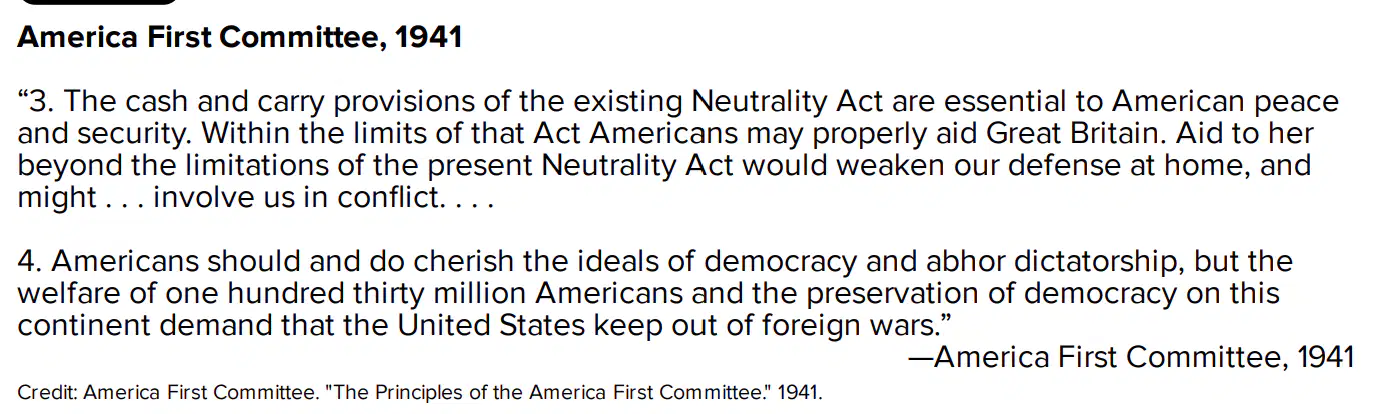
This excerpt from an America First Committee pamphlet implies that the group supported aid to Britain because
they had feelings of loyalty towards Britain.
they felt threatened if they did not.
they thought the aid would benefit U.S. security.
they sought greater involvement in foreign affairs.
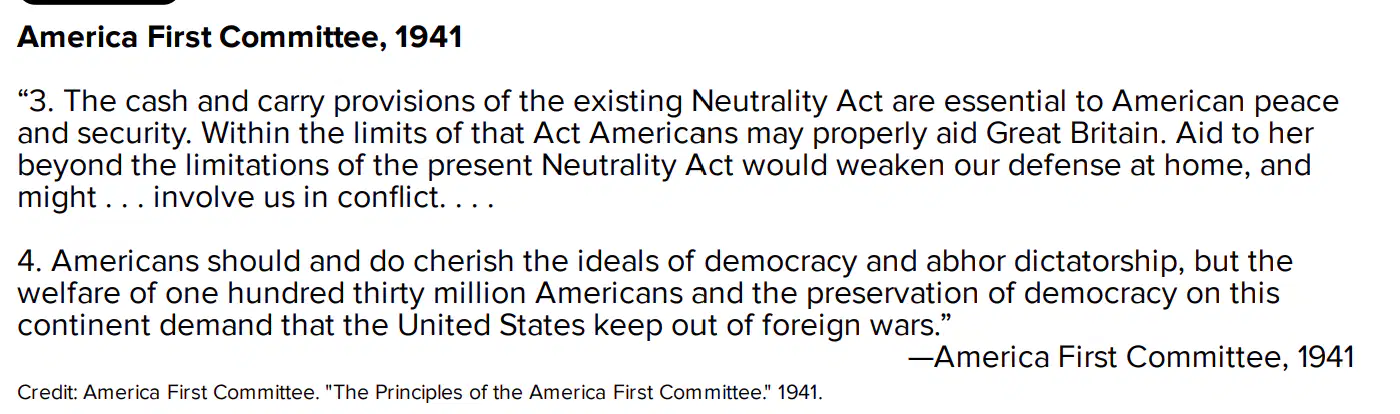
How did the America First Committee feel about U.S. neutrality?
They felt the conditions of the Neutrality Act were flawed.
They felt neutrality was necessary to protect the country's citizens and its democracy.
They felt neutrality was cowardly.
What was one of the effects of Japan's attack on Pearl Harbor?
The number of men enlisted in the U.S. Army grew by 60,000.
President Roosevelt faced opposition from Congress to declare war on Japan.
Italy became an ally of the United States.
One of the objectives of the declaration was
global
was
was
was
Why were the messages sent by the Navajo "code talkers" so difficult to decipher?
The code talkers invented their own new language.
The language had no written alphabet and few speakers.
The language was similar to Japanese.
The words were difficult to hear clearly.
The Battle of Midway marked a turning point for the Allies by
freeing the Chinese to fight.
stopping the Japanese advance.
recapturing the Philippines.
destroying the Japanese navy.

General Eisenhower's opinion on the imminent D-Day invasion was largely influenced by
the military superiority of the Allies.
his past military defeats.
the strength of the German forces.
the lack of support on the home front.
The details in the passage show that Eisenhower wanted to
warn Americans at home about the impending invasion.
alert the D-Day troops about German military strengths.
project a sense of confidence in the D-Day landings.
raise the possibility that defeat on D-Day could happen.
How did women's roles change during the war?
Women received the same salary.
Women were recruited into the army.
Women were encouraged to work outside the home.
What was one result of Executive Order 9066?
Federal loans were distributed to businesses that wanted to convert their production to war.
Wages and prices of certain materials were regulated.
Discrimination in defense industries and government was prohibited.
People of Japanese descent were sent to detention camps.
Why did the Allies choose Italy as the first European country to invade?
Italy was easy to reach by water.
Winston Churchill believed Italy would surrender easily.
They considered Italy the greatest threat.
They wanted to capture Mussolini.

