
Font size
 Worksheets
Periodic Table TEST
Total questions: 36
Worksheet time: 53mins

Which halogen is found in period 4?
Krypton (Kr)
Xenon (Xe)
Bromine (Br)
Iodine (I)
A unique number for each element that equals the number of protons in an atom of that element
element name
element symbol
atomic number
atomic mass

These elements are inert gases.
Halogen family
Noble gases
Carbon family
Nitrogen family

What is the name of group number 2?
transition metals
halogens
metaloids
alkaline earth metals

Valence electrons are...

The groups of the periodic table tell us:


Elements in the same group or family have _____________.
the same number of valence electrons and different properties.
the same number of valence electrons and similar properties
different number of valence electrons and similar properties.
different number of valence electrons and different properties.

Which class of elements are malleable, ductile, shiny when clean and polished, good conductors of heat and electricity, and reacts with acids to form hydrogen gas?
metals
nonmetals
metalloids
ions

This element has two valence electrons and two energy levels?
Beryllium (Be)
Lithium (Li)
Zinc (Zn)
Calcium (Ca)

Elements which are dull, brittle, and poor conductors of electricity and heat are called...
metals
nonmetals
metalloids

Which of these best explains the reasoning behind the trend in radius as you go across a period?
As you go across a period, more energy levels are added, which shrinks the atom.
The added electrons in the nucleus give the atom a negative charge, which shrinks the atom.
The added protons in the nucleus pull the electrons closer to them, which shrinks the atom.
All of the above

As you move down the periodic table atoms get ________. This is because ____________.
Bigger; the electrons are in higher energy levels
Bigger; the electrons are in lower energy levels.
Bigger; there is greater nuclear force
Smaller; there is greater nuclear force

Arrange the following in order of increasing atomic radius.
Boron
Aluminum
Gallium
Indium
Thallium

Place the following in order from largest to smallest atomic radius.
Silver
Cadmium
Copper
Zinc
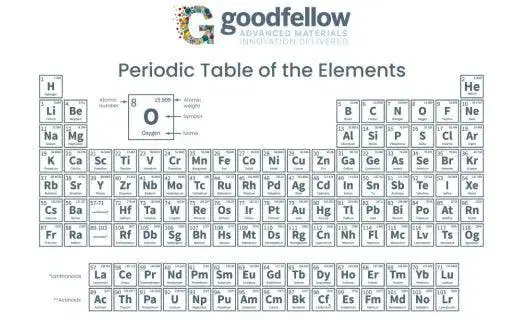
Which element has the highest electronegativity value?
Hydrogen
Oxygen
Fluorine
Nitrogen

Compare the electronegativity values of sodium (Na) and chlorine (Cl). Which statement is correct?
Sodium has a higher electronegativity than chlorine.
Chlorine has a higher electronegativity than sodium.
Both have the same electronegativity.
Electronegativity cannot be compared between these elements.

Which element has the highest electronegativity?
What is added to an atom when you go down a group?
Energy levels
Protons

Which atom is the most electronegative?
Oxygen
Nitrogen
Carbon
Which atom is the least electronegative?
Calcium
Magnesium
Beryllium

What is a cation?
A negative ion formed from the gaining of electrons.
A positive ion formed from the gaining of electrons.
A negative ion formed from the loss of electrons.
A positive ion formed from the loss of electrons.
What is an anion?
A negative ion formed from the gaining of electrons.
A positive ion formed from the gaining of electrons.
A negative ion formed from the loss of electrons.
A positive ion formed from the loss of electrons.
Which ion has the smaller radius?
Ba
Ba+1
Which is larger:
P or P-3 ?
P because it is the neutral atom.
P-3 because it lost 3 electrons.
P-3 because it gained 3 electrons.
They are the same size since they are both P.
Which is the larger atom: F-1, Cl-1, Br-1?
F-1
Cl-1
Br-1
they are all the same size since they are all anions
Which of the following statements are true?
For metallic elements, the ionic radius > the atomic radius
For metallic elements, the ionic radius < the atomic radius
For nonmetallic elements, the atomic radius > ionic radius
For nonmetallic elements, the atomic radius < ionic radius
The different size between Cl and Cl- is because
They have different effective nuclear charge
They have different number of shells
Cl- has stronger electron repulsion
Cl has stronger electron repulsion
Which ion has the smallest radius?
O2-
S2-
Se2-
Te2-
The two most reactive group/groups on the periodic table are
(select two)
alkaline earth metals
alkaline metals
halogens
oxygen group
Categorize the elements as Representative Elements, Transition Metals, or Inner Transition Metals.
Oxygen
Neon
Barium
Lead
Molybdenium
Copper
Uranium
Plutonium
Gold

