Worksheets
GP 1 - Q2 - Reviewer
Total questions: 60
Worksheet time: 22mins
When would a force applied to a rigid body lead to zero torque?
When the force is directed towards or away from the axis of rotation.
When the force is applied perpendicular to the lever arm
When the force is a gravitational force
When the force is a normal force
If an object is moving in a circle of radius r with a constant speed v, what is its angular velocity?
Hint: v = rω
v2 / r
vr
v / r
r / v
A disk rotates with an angular speed (ω). What is the magnitude of the tangential velocity (v) of a point on the disk located a distance (r) away from the axis of rotation?
ωr
rω
ωr
ω2r

What is happening to the ice skater as she brings her leg closer to her torso?
Hint: α = τ / I
and
I = Σmiri2
Decreased angular velocity, decreased moment of inertia
Decreased angular velocity, increased moment of inertia
Increased angular velocity, increased moment of inertia
Increased angular velocity, decreased moment of inertia

The graph above shows the angular velocity (ω) of an object with respect to time.
During which time intervals is there a net torque (τnet) on the object? Select all that apply.
0-2s
2-6s
6-8s
8-10s

A force (F) is applied to a wrench to turn a bolt. The moment of inertia (I) is given for the different bolts.
Which of the following bolts has the greatest angular acceleration (α)?
Hint: α = τ / I = F⟂r / I
F
A
B
E
C
A force (F) is applied to a wrench to turn a bolt. The moment of inertia is given for each bolt.
Which of the following bolts has the greatest torque? Select all that apply.
Hint: τ = F⟂r
E
B
C
D
F

What happens to his moment of inertia (I) when the figure skater brings in his arms?
Hint: I = Σmiri2
His moment of inertia increases
His moment of inertia decreases
He has no effect on his own moment of inertia
The gravitational attraction between an object near the Earth's surface and the Earth.
normal force
weight
friction
tension
Formula for getting the weight, or gravitational force, of objects near the Earth's surface.
w = m/g
w =mg2
w = mg/2
w = mg

As the Earth pulls on the ball with force magnitude mg,
The ball also pulls on the Earth with force magnitude mg
The ball also pulls on the Earth with a much lesser force magnitude
The ball doesn't pull on the Earth at all.
The ball pulls with a much greater force on the Earth
Who discovered the Law of Gravitation?
Thomas Edison
Albert Einstein
Isaac Newton
Galileo Galilei
Which of the following statements is most true about Newton's law of gravitation?
It is a force that objects with big mass apply on objects with much smaller masses.
It is a force that exists between any two bodies with mass
It is a force that exists between planets, stars and other heavenly bodies.
It is a force that pushes objects around a circle in orbit.
The gravitational force
can be attractive or repulsive
is tangential to the orbital path
is always repulsive
Is always attractive

The gravitational force between the Sun and the Earth
points away from each other
points toward each other
for the sun, pointing upwards; for the earth, pointing downwards
only the sun exerts a gravitational force on the Earth

What happens when the gravitational Force between the Earth and the Sun is suddenly removed?
The Earth will crash towards the sun
The Earth will follow a linear path directed South in this picture
The Earth will continue to follow a circular path
The Earth will follow a linear path directed West in this picture

Why is the gravitational force between Earth-moon different from the gravitational force between Sun-Earth
because the combined mass of moon and Earth is smaller
because the distance between mass and moon is smaller
both statements above are correct
because the Earth is not radiating energy
Which of the following is true about the Fg between two masses?
Fg ∝ m1m2/r
Fg ∝ r/m1m2
Fg ∝ (m1 + m2)/r
Fg ∝ m1m2/r2

Assuming circular orbit, how is the Earth's velocity v related to the radius of orbit r?
v = rα
v = rω
v = r/α
v = r/ω
Which type of harmonic motion refers to oscillatory motion with decreasing amplitude?
critically damped
overdamped
simple
underdamped
What does a wave carry with it as it travels through a medium?
particles
wind
energy
water
In the equation,
Fs=−kx , Fs means:Static Force
Dynamic Force
Restoring Force
Normal Force
At which position is the speed of a particle executing SHM greatest?
It's extreme position
at its equilibrium position
at its maximum displacement
somewhere between amplitude and equilibrium position
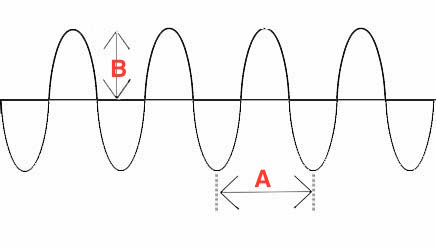
Which diagram below does not represent a periodic wave?


The wavelength of a sinusoidal wave divided by the speed of propagation refers to what quantity?
angular frequency
frequency
period
wave
A/an ___________ is a wave in which the disturbance is parallel to the direction of propagation.
longitudinal wave
transverse wave
aperiodic wave
seismic wave
Angular frequency is commonly express in __________.
meters per second
radians per second squared
meters per second squared
radians per second
The wave speed of a wave in terms of its wavelength λ and period, T is:
v=λT
v=λT2
v=Tλ
v=λT
Two progressive waves of the same amplitude and frequency travelling in opposite directions along the same path in the same medium produce:
beats
resonance
standing waves
interference
Which property of wave motion distinguish a progressive wave from standing wave:
amplitude
frequency of vibration
propagation of energy
direction of vibration

The ratio of force, acting perpendicular to the area, on which it acts known as…
Friction
Pressure
Force
Density
Which term defined as the sum of forces due to fluid pressure.
Buoyant force
net force
Resultant force
Pressure
Which fluid principle states that, a change in pressure at any point in a confined fluid is transmitted in all directions throughout the fluid?
Archimedes’
Bernoulli’s
Buoyant
Pascal’s
Which fluid mechanics principle states that, a fluid exerts an upward buoyant force on a immersed object the same in magnitude to the weight of the volume of fluid displaced by the object?
Archimedes’
Bernoulli’s
Buoyancy
Pascal’s

The vessels shown below all contain water to the same height. Rank them according to the pressure exerted by the water on the vessel bottoms, least to greatest.
3, 4, 2, 1
4, 3, 2, 1
2, 3, 4, 1
All pressures are the same
A loaded ship passes from a lake (fresh water) to the ocean (saltwater). Saltwater is more dense than fresh water and as a result the ship will:
ride higher in the water
settle lower in the water
ride at the same level in the water
experience an increase in buoyant force
Which fluid mechanics principle explained in terms of the law of conservation of energy?
Archimedes’
Bernoulli’s
Pascal’s
Poiseuille’s
Bernoulli’s principle is widely used in our daily life. Among the choices, below what is NOT an example of Bernoulli’s principle?
Aircraft
Baseball
Hydraulic Jack
Sailing
What is the purpose of using temperature in science?
to make science interesting
to quantify data
because the word hot does not translate
cold can mean hot in other countries
What does temperature measure?
the amount of friction in a system
the amount of heat energy available for work in a system
the amount of work done by a system
the amount of jewels in a system
Heat will flow from ________ to _________.
top to bottom
bottom to top
hot to cool
cold to hot
Heat will continue to flow until a system has reached __________.
Thermal equilibrium
10 degrees celsius
maximum volume
atmospheric pressure
Heat is a transfer of energy of one object to another because of a difference in temperature.
True
False

For an ideal gas several assumptions are made about the particles including
they collide elastically with each other and the container wall
they experience significant intermolecular forces
the volume they occupy as individual particles is insignificant compared to the volume of the container
there are a very large number of particles inside the container

In the equation of state for an ideal gas pV = nRT
n = number of particles in the gas
p = pressure of the gas
R = the molar gas constant 8.31 JK-1mol-1
T = temperature in degrees celcius
For an ideal gas at constant temperature and density ρ what effect would doubling the density have on the mean square speed?
none
mean square speed would double
mean square speed would halve
mean square speed would quadruple
For an ideal gas at constant temperature and pressure p at volume V, what affect would halving the pressure have on the volume?
volume would double
volume would halve
volume would triple
none
How many atoms are there in a mole of helium gas?
6.02 × 10¹³
6.02 × 10²³
1.20 × 10¹⁴
1.20 × 1024
The following gases are at the same temperature. Which molecule will have the slowest r.m.s. speed?
hydrogen
carbon dioxide
oxygen
helium
If an ideal gas is compressed isothermally, which of
the following statements is true?
Energy is transferred to the gas by heat.
No work is done on the gas.
The temperature of the gas increases.
The internal energy of the gas remains constant.
None of those statements is true
What is the equation for the first law of thermodynamics?
ΔU=Q−W
Q=ΔU+W
W=Q−ΔU
W=ΔU−Q
A Carnot engine operates between 200°C and 20°C. Its maximum possible efficiency is
90%
100%
38%
24%
72%
Which of the following would most likely lead to a spontaneous reaction.
A high negative enthalpy.
A low negative enthalpy.
A high positive enthalpy.
A low positive enthalpy.
What information do we need to perform a calculation of Gibbs Free Energy?
Enthalpy of the reaction.
Entropy of the reaction.
The temperature of the reaction in Kelvin.
All of the above are needed.
Entropy is a measure of
accuracy
precision
the disorder of a system
the attraction of a nucleus for an electron