
 Worksheets
G5 EoT1 Review
Total questions: 15
Worksheet time: 3hrs 30mins
1. You are designing a bridge. List three possible materials you could use and compare their strengths and weaknesses based on cost, weight, and durability.
Materials: 1. Steel - Strength: High, Cost: High, Weight: Heavy, Durability: Very High; 2. Concrete - Strength: Moderate, Cost: Moderate, Weight: Heavy, Durability: High; 3. Wood - Strength: Low, Cost: Low, Weight: Light, Durability: Moderate.
Glass - Strength: Moderate, Cost: High, Weight: Heavy, Durability: Low
Plastic - Strength: Very Low, Cost: Very Low, Weight: Light, Durability: Very Low
Aluminum - Strength: Low, Cost: High, Weight: Light, Durability: Low
2. In a science experiment, you want to test how different types of soil affect plant growth. What variables will you control, and why is it important to control them?
Planting depth of the seeds
Control variables include water supply, light exposure, temperature, and type of plant.
Nutrient content of the soil
Soil pH levels
3. A plant is growing in a pot. If you measure its height over a month and find it grew 5 cm, what materials did it likely use from air and water to grow?
Carbon dioxide and water
Minerals and salts
Oxygen and nitrogen
Glucose and sunlight
4. Create a model that shows how water moves from the soil to a plant and then to the atmosphere. What are the key components of your model?
Key components: Soil, Roots, Xylem, Leaves, Stomata, Atmosphere
Soil, Roots, Phloem, Leaves, Stomata, Groundwater
Sand, Roots, Xylem, Leaves, Clouds, Atmosphere
Soil, Roots, Xylem, Flowers, Stomata, Rain
5. If a rabbit eats grass, what energy transformation occurs? Describe how the energy from the sun is involved in this process.
The energy transformation is from thermal energy in the rabbit to electrical energy in the grass.
The energy transformation is from solar energy directly to kinetic energy in the rabbit.
The energy transformation is from kinetic energy in the rabbit to potential energy in the grass.
The energy transformation is from chemical energy in grass to kinetic and thermal energy in the rabbit.
6. You drop two balls of different weights from the same height. How will gravity affect both balls considering there is no air-resistance?
Both balls will hit the ground at the same time.
The lighter ball will bounce higher than the heavier ball.
The heavier ball will hit the ground first.
Both balls will float in the air indefinitely.
9. If you were to create a model of a food chain, what would it look like? Include plants, animals, and decomposers in your model.
Plants -> Carnivores -> Herbivores -> Decomposers
Herbivores -> Decomposers -> Plants -> Carnivores
Carnivores -> Plants -> Decomposers -> Herbivores
Plants -> Herbivores -> Carnivores -> Decomposers
10. You are testing how temperature affects the rate of photosynthesis in plants. What data would you collect, and how would you ensure your test is fair?
Measure the height of plants at various temperatures.
Collect data on the rate of photosynthesis at different temperatures while keeping other variables constant.
Record the amount of water used for irrigation during the experiment.
Collect data on the color of leaves at different temperatures.
11. A scientist claims that all energy in food comes from the sun. What evidence can you provide to support this claim?
The sun has no role in the energy content of food.
Most energy in food comes from the sun, but not all.
All energy in food is produced by plants alone.
Energy in food is solely derived from minerals in the soil.
13. In an experiment, you find that plants grow better in sunlight than in shade. What conclusions can you draw about the importance of sunlight for plant growth?
Sunlight is important for plant growth as it enhances photosynthesis, leading to better growth compared to shade.
Sunlight has no effect on plant growth whatsoever.
Plants grow better in shade due to reduced light exposure.
Plants thrive equally in both sunlight and shade.
14. You have a model of the water cycle. Describe how matter moves among plants, animals, and the environment in your model.
Matter only moves through photosynthesis and respiration.
Matter moves through evaporation, condensation, precipitation, absorption by plants, consumption by animals, and return to the environment.
Water is only absorbed by animals and not by plants.
Matter does not return to the environment after being consumed.
15. If you were to measure the gravitational force on a feather and a rock, what would you expect to find, and why?
Both the feather and the rock experience the same gravitational force because they fall at the same rate.
The gravitational force on the feather is greater than that on the rock due to its lighter weight.
The gravitational force on the feather is equal to that on the rock because they are both made of the same material.
The gravitational force on the rock is greater than that on the feather due to its larger mass.

The table below shows the weight of a baby rabbit at different ages. Some information is missing. Look at the pattern in the data and choose the correct weight for the rabbit at 6 and 12 weeks.
375 grams and 725 grams
375 grams and 750 grams
400 grams and 750 grams
400 grams and 800 grams
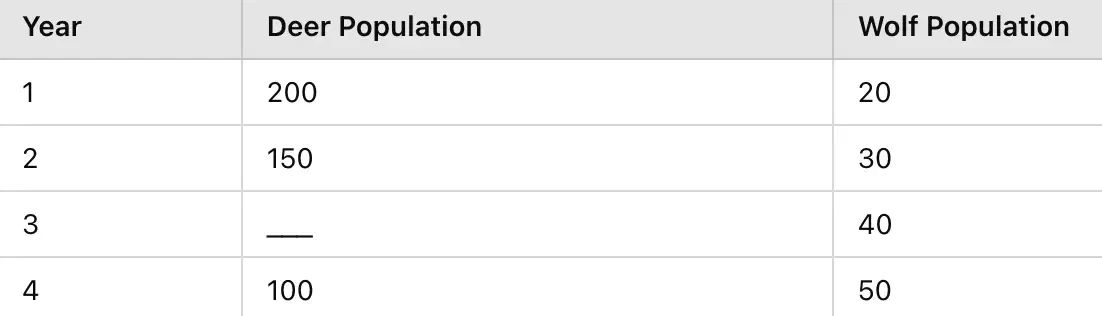
The table below shows the population of different species in an ecosystem over time. Some information is missing. Look at the pattern in the data and choose the correct population for Deer in Year 3.
175
100
125
50
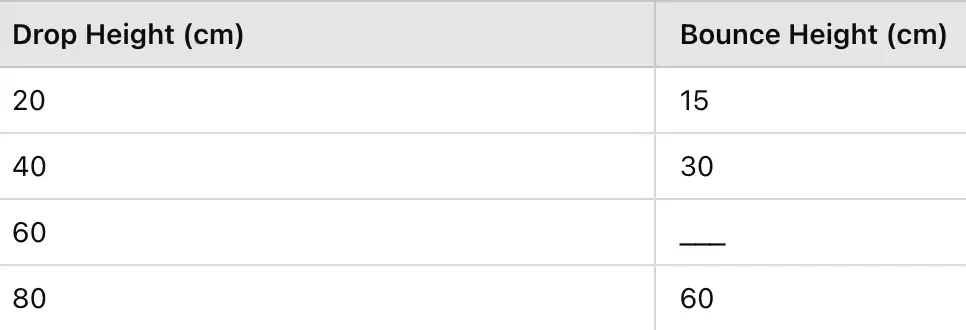
The table below shows the height of a ball’s bounce after being dropped from different heights. Some information is missing. Look at the pattern in the data and choose the correct bounce height for a ball dropped from 60 cm.
35
40
45
50

