
 Worksheets
Test Review - PT & EQ
Total questions: 49
Worksheet time: 25mins
Who was the first person to propose the idea that all the continents were once joined together in a single landmass?
Albert Einstein
Alfred Wegener
Isaac Newton
Mrs. Czach
What was the name of that landmass?
Eurasia
Africa
Pangaea
Fooltopia
Which of the following is an example of evidence supporting continental drift?
Fossil evidence
There is no evidence.
An increase in the intensity of hurricanes
Ice core samples
During the Triassic period, what two landmasses did Pangaea break into?
Jurassic and Cretaceous
Pangaea and Eurasia
Laurasia and Gondwanaland
Pangaea is still one landmass.

This letter represents ocean lithosphere.
A
B
C
D
E
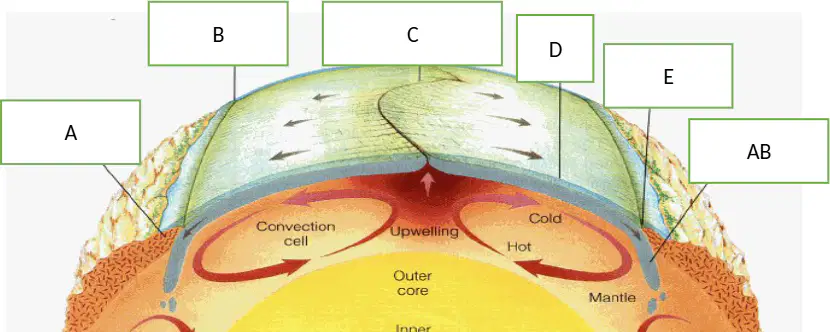
This letter shows the Mid-oceanic ridge.
A
B
C
D
E

The letter is showing continental lithosphere.
A
B
C
D
E
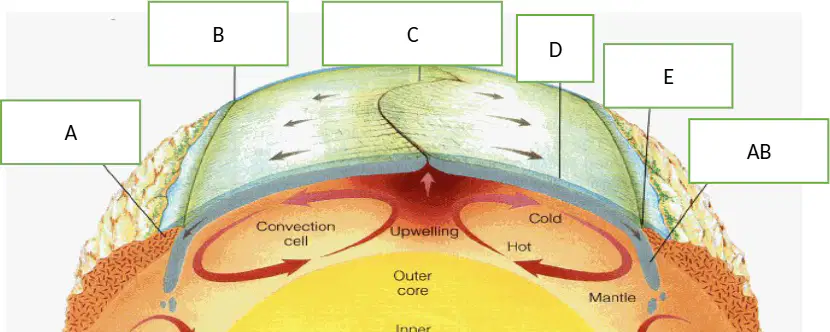
This letter is a trench.
A
B
C
D
E
What is a fault?
A place in the crust where volcanoes occur
A break in the crust where rocks have slipped past each other
A place in the ocean where hurricanes originate
Juan de Fuca
Which of the following is a plate boundary?
Convergent
Pangaea
Jurassic
There are no such thing as plates in the first place
When rocks are pulled apart at divergent boundaries, what type of stress is involved?
Tension
Compression
Elastic rebound theory
Pangaea
Which of the following can form at a divergent boundary?
Mid-Ocean Ridge
Trenches
Subduction zone
None of the above
Trenches form at subduction zones.
True
False
Shearing is the type of stress that occurs when two plate collide at a convergent boundary.
True
False
At transform boundaries two plates slide past each other in opposite directions.
True
False
The San Andreas Fault is a famous transform boundary.
True
False
New oceanic crust forms at transform fault boundaries.
True
False
Iceland is located on a divergent plate boundary.
True
False
Which of the following can cause an earthquake?
Tsunami
Volcanic eruption
Hot, moist ocean water
Earthquakes are fake news
Vibrations in the earth caused by the sudden movement of rock are called ____________.
By analyzing difference in the time it takes for S-waves and P-waves to arrive at a seismograph station, scientists can determine an earthquake’s _______________.
The Richter Scale expresses an earthquake’s ___________.
Major earthquakes are often followed by somewhat smaller events known as _____________.
The mechanism by which rocks store and eventually release energy in the form of an earthquake is known as _____________.
The instrument which records earthquake events is _____________.
Earthquakes frequently occur near ______________.
A succession of ocean waves set in motion by a submarine (underwater) earthquake is called:
tidal wave
czachami
tidal bore
tsunami
seismic sea monster
How many seismic stations are necessary to accurately determine the location of an earthquake's epicenter?
1
3
10
25

What is the picture/image called?
Seismogimic
seismograph
seismology
seismogram
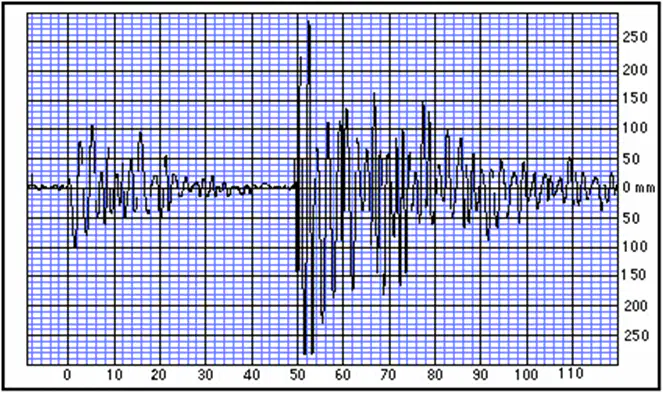
What is the difference in arrival times between the P and S waves?
285 mm
150 mm
50 minutes
110 seconds
50 seconds
Which scale ranks earthquakes according to their intensity?
Richter
Moment Magnitude
Mercalli
Which is NOT a way that tsunamis can be generated?
Submarine earthquake
Category 5 hurricane
Underwater land slide
Meteorite impact
Underwater Volcanic eruption
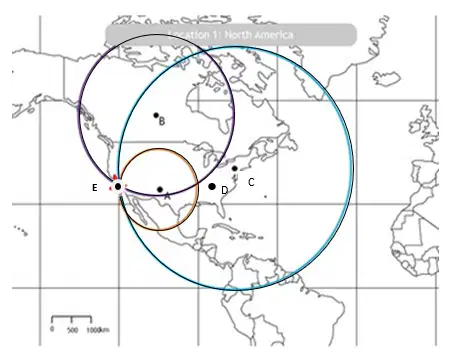
Where was the earthquake?
A
B
C
D
E
Where was the closest seismic station to the earthquake?
A
B
C
D
E
In 2004, the most horrific natural disaster occurred that killed over 220,000 people in multiple nations. Where did the tsunami originate?
Pacific Ocean
Atlantic Ocean
Indian Ocean
Mediterranean Sea
The focus is the location on the surface directly above where the earthquake occurred.
True
False
The epicenter is the location on the surface directly above where the earthquake occurred.
True
False
The 2 types of body waves are love waves and Rayleigh waves.
True
False
The 2 types of body waves are P waves and S waves.
True
False
P waves are compression waves.
True
False
P waves are always the first waves that are detected following an earthquake.
True
False
An aftershock occurs before the earthquake and indicates it is coming.
True
False
Liquefaction is when saturated materials turn to fluids.
True
False
The Atlantic Ocean is the only ocean with a Tsunami Warning System.
True
False
Earthquakes are easy to predict and the predictions are often very accurate.
True
False
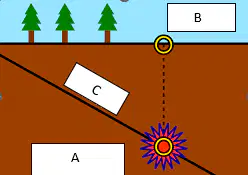
Which letter represents the epicenter?
A
B
C
Which letter represents the fault?
A
B
C
Which letter represents the focus?
A
B
C
How do the plates move?
they don't move...that's ridiculous
Convection currents in the mantle move them along like a conveyor belt
t
t

