
 Worksheets
Honors Chem Semester Review (Ch 1-5)
Total questions: 75
Worksheet time: 3hrs 1mins
The outside temperature is 290 C. What is the temperature in Kelvin?
302 K
Choose the pure substance from the list:
gatorade
sea water
fluorine
smoothie
Which one of the following is a chemical change?
leaves changing color in the fall
water freezing
oil boiling
ice melting
Which one of the following is a chemical property?
The boiling point of water is 100oC
Potassium reacts explosively with water
Water melts at 0oC
Condensation forms on the outside of a glass
Round the following number to 3 significant figures: 29,318
29,300
293
293.00
2.9318 x 10⁵
An object has a mass of 16.0 g and a volume of 3.81 mL. What is the density of the object in g/mL?
3.199 g/mL
0.199 g/mL
60.96 g/mL
4.20 g/mL
An object has a density of 3.30 g/mL, and a mass of 22.4 g. What is the volume of this object?
6.79 mL
73.92 mL
0.147 mL
0.587 mL
Convert and show your work with units: 3.56 miles to ft.
(1 mile = 5,280 feet)
52803.56=6.74x10⁻⁴
3.56mi(5280 mi1.0ft)=18796.8 ft
3.56mi(1.0 mi5280ft)=18796.8 ft
3.56 mi5280ft=1483 ft
Correctly show your work to convert 153kg to mg using the factors in Table 1.3 of the textbook.
153kg(103 kg1.0 g)(10−3g1.0mg)
153kg(1.0 kg103g)(10−3g1.0 mg)
153kg(1.0 g103kg)(10−3mg1.0 g)
153kg(103 kg1.0 g)(1.0g10−3 mg)
A metal cube has a volume of 3.25 mL, and a density of 7.85 g/mL. What is the mass of this metal cube?
5.12 g
0.414 g
25.51 g
2.42 g
Select the three subatomic particles that make up atoms:
protons
photons
neutrons
electrons
Protons have a (a) charge, electrons have a (b) charge, and neutrons are (c) .
Two subatomic particles, (a) are in the nucleus of the atom, and (b) are in the volume of space surrounding the nucleus.
A neutral lithium, Li, atom has how many protons and electrons?
3 protons and 3 electrons
3 protons and 2 electrons
2 protons and 3 electrons
2 protons and 2 electrons
A neutral sodium, Na, atom, has (a) protons, and (b) electrons. When it loses 1 electron, it now has (c) electrons and a (d) charge.
How many protons does a neutral nitrogen, N, atom have?
7
14
12
6
This is an atom of hydrogen with a mass number of 1. Label the red and blue circles.
neutron
electron
proton
photon
molecule
Predict the charge that a Mg ion would have.
+1
+2
-1
-2
Predict the charge that a F ion would have.
+1
+2
-1
-2
Predict the charge that the Fe ion has in the following compound: FeO
+3
+4
+1
+2
Predict the charge that the Cu ion has in the following compound: CuCl2
+3
+4
+1
+2
An atom has the following subatomic particles. Write the element symbol with atomic number, mass number, and charge:
30 protons
32 neutrons
28 electrons
3062Zn2+
3032Zn2+
3062Zn2−
3065Zn2+
6230Zn2+
Identify a cation
An atom with a positive charge because it has gained one or more protons
An atom with a negative charge because it has lost one or more protons
An atom with a positive charge because it has lost one or more electrons
An atom with a negative charge because it has gained one or more electrons
Identify an anion
An atom with a positive charge because it has gained one or more protons
An atom with a negative charge because it has lost one or more protons
An atom with a positive charge because it has lost one or more electrons
An atom with a negative charge because it has gained one or more electrons
Organize these elements according to group/family:
K
Li
F
Br
S
Se
Sr
Be
What is the chemical formula for oxygen difluoride?
OF2
O2F
FO
OF
What is the chemical formula for phosphorus pentabromide?
PBr5
PB5
P5Br
PBr6
What is the name for As2O3?
diarsenic trioxide
arsenic oxide
arsenic(III) oxide
arsenic(II) oxide
What is the name for MgBr2?
magnesium bromide
magnesium dibromide
magnesium(II) bromide
magnesium(I) dibromide
What is the chemical formula for iron(III) nitrate?
FeNO3
Fe(NO3)3
Fe3N
FeN
FeNO2
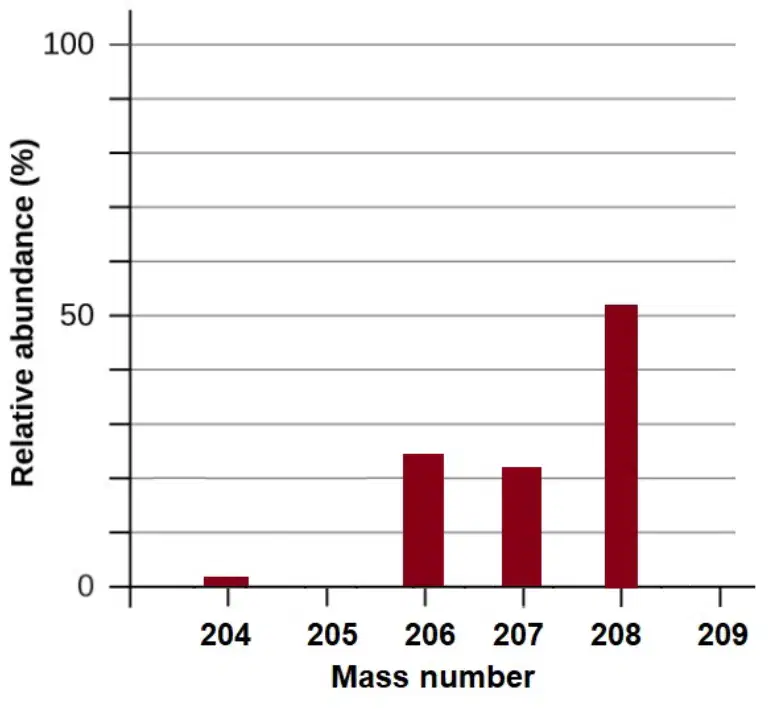
This mass spectrometer graph represents the (a) isotopes of (b)
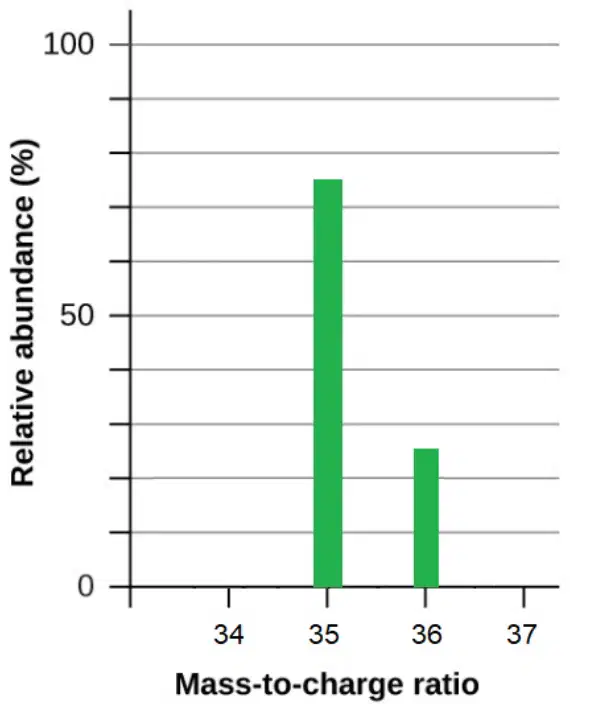
This mass spectrometer graph represents the element (a) , and the most abundant isotope is about (b) of all the isotopes
An unknown element found on the dwarf planet, Pluto, exists as 3 isotopes. Using the following masses and natural abundances, calculate the average atomic mass of this element that is temporarily being called peeyew, Pu.
34Pu has a mass of 34.05 amu and a percent abundance of 81.37%
32Pu has a mass of 31.97 amu and a percent abundance of 7.91 %
35Pu has a mass of 34.99 amu and a percent abundance of 10.72%
33.99 amu
56.75 amu
34.07 amu
33.78 amu
33.16 amu

What is the molar mass of As2Pe3?
(Pe is a fictional element said to have been found on the dwarf planet Pluto)
(a)

What is the molar mass of CH2Zf2?
(Zaepfelium is a new element your teacher discovered)
(a)
In one breath, about 0.037 g of CO2 is exhaled. How many moles of CO2 is this?
0.000841
1.628
1189.5
2.23E22
5.06E20

How many moles is 35.8 g of OZf2?
(Zaepfelium is a new element your teacher discovered)
0.558
2295
1.79
2.16E25
3.36E23

Convert 25 g of As2Pe3 to moles.
(Peeyew is a fictional element found on the dwarf planet Pluto)
0.0993
6.29E3
10.07
1.51E25
5.98E22
How many grams of NaCl is 1.28 moles of NaCl?
74.8
0.0219
45.66
7.71E23
1.32E22
What is the empirical formula (simplest whole number ratio) for this compound?
82.2% N
17.8% H
NH3
NH2
NH
N2H
N3H
A compound has the empirical formula of C2H8N and a molar mass of 92 g/mol. What is the molecular formula of this compound?
C2H8N
C4H16N2
CH4N
C6H24N3
A 1.25 L solution of CaCl2 has a Molarity of 0.901 M. How many grams of CaCl2 was used to make this solution?
125 g
1.41 g
1.11 g
100 g
110 g
A 1.25 L solution of CaCl2 has a Molarity of 0.901 M. How many moles of CaCl2 was used to make this solution?
125 mol
1.41 mol
1.13 mol
100 mol
110 mol
A solution was made with 0.118 mols of an ionic compound dissolved in enough water to make 400 mL. What is the Molarity (mol/L) of this solution?
0.295 M
0.047 M
3.39 M
0.370 M
MgCl2 → Mg2+ + 2Cl-
If you had 1 mole of MgCl2 completely dissolve in water according to the reaction above, how many moles of Mg2+ ions would be in solution?
1
2
3
4
5
K2SO4 → 2K+ + SO42-
If you had 2 moles of K2SO4 completely dissolve in water according to the reaction above, how many moles of K+ ions would be in the solution?
(a)
K2SO4 completely dissolves in water. Writing the charges on the ions in parenthesis, write the dissolution reaction below:
(a) → (b) + (c)
Balance the chemical reaction:
(a) Al + (b) NiBr2 → (c) AlBr3 + (d) Ni
What type of reaction is the above reaction?
(e)
Balance the chemical reaction:
(a) Al + (b) O2 → (c) Al2O3
What type of reaction is the above reaction?
(d)
Balance the chemical reaction:
(a) C3H8 + (b) O2 → (c) CO2 + (d) H2O
What type of reaction is the above reaction?
(e)
Write the following word equation as a balanced chemical reaction:
Aluminum fluoride plus chlorine yields aluminum chloride plum fluorine.
AlF3 + Cl2 → AlCl3 + F2
2 AlF3 + 3 Cl2 → 2 AlCl3 + 3 F2
AlF3 + 3 Cl → AlCl3 + 3 F
AlF + Cl → AlCl + F
2 AlF + Cl2 → 2 AlCl + F2
Which type of reaction is:
4 (NH4)3PO4 + 3 Pb(NO3)4 → 12 NH4NO3 + Pb3(PO4)4
Single Replacement
Double Replacement
Combustion
2 H2 + O2 → 2 H2O
When 1 mole of O2 reacts, how many moles of water are produced?
3
2
1
6
1.5
2 H2 + O2 → 2 H2O
When 15.0 grams H2 reacts, how many moles of water are produced?
7.44
15
134
30.24
3.72
2 KClO3 → 2 KCl + 3 O2
When 25.0 grams of KClO3 decomposes, how many moles of O2 are produced?
The molar mass of KClO3 is 122.5 g/mol
0.306
0.204
0.408
0.612
9.79
N2 + 3 H2 → 2 NH3
If there are 6.0 moles of N2 and 15.0 moles of H2, which one is the limiting reactant (runs out first)?
H2
N2
NH3
Neither, they both run out at the same time
Predict the products for the following Single Replacement reaction:
(You must have neutral products, but don't worry about balancing the whole reaction)
I2 + NaF → (a)
Predict the products for the following Single Replacement reaction:
(You must have neutral products, but don't worry about balancing the whole reaction)
Ca + LiF → (a)
What are the two products for this Double Replacement Reaction?
(You must have neutral products, but don't worry about balancing the whole reaction)
CaSO4 + Na3PO4 → ? + ?
Ca3(PO4)2
CaPO4
Na2SO4
Na3SO4
Ca3P2
What are the two products for this Double Replacement Reaction?
(You must have neutral products, but don't worry about balancing the whole reaction)
SrS + K3PO4 → ? + ?
Sr3(PO4)2
SrPO4
K2S
K3S
Sr3P2
Organize these compounds as either solid (s) or aqueous (aq)
CaCO3
SrF2
Ca(OH)2
Pb(CH3CO2)2
Which one is the solid precipitate?
CaCl2 + 2 AgNO3 → Ca(NO3)2 + 2 AgCl
CaCl2
AgNO3
Ca(NO3)2
AgCl
No precipitate is formed
What is the net ionic equation for the following molecular equation?
CaCl2 + 2 AgNO3 → Ca(NO3)2 + 2 AgCl
Ca2+ + 2 Cl-→ CaCl2
Ag+ + NO3-→ AgNO3
Ca2+ + 2 NO3- → Ca(NO3)2
Ag+ + Cl- → AgCl
CaCl2 + 2 AgNO3 → Ca(NO3)2 + 2 AgCl
What is the net ionic equation for the following molecular equation?
SrBr2 + Pb(NO3)2 → Sr(NO3)2 + PbBr2
Sr2+ + 2 Br- → SrBr2
Pb2+ + 2 NO3- → Pb(NO3)2
Sr2+ + 2 NO3- → Sr(NO3)2
Pb2+ + 2 Br- → PbBr2
SrBr2 + Pb(NO3)2 → Sr(NO3)2 + PbBr2
N2 + 3 H2 --> 2 NH3
When 50.0 grams of N2 completely reacted, only 45.0 grams of NH3 was actually produced. What is the percent yield of NH3?
74.1%
90.0%
82.4%
34.0%
28.3%
Calculate the amount of heat in joules that 35.2 g of liquid water would need to absorb to increase in temperature by 10.0oC.
1470 J
1820 J
737 J
656 J
A sample of CO2(g) increases in temperature from 50.0oC to 75.0oC by absorbing 4722 J. What is the mass of this sample of CO2?
221 g
1.38 x 10⁵ g
161 g
4.15x 10⁵ g
A 70.0 g piece of metal at 80.0 °C is placed in 100 g of water at 22.0 °C contained in a calorimeter. The metal and water come to the same temperature at 24.6 °C.
What is the specific heat of the metal?
0.28
1087
860
- 860
0.47
When 0.35 mols of N2 reacts, 63.21 kJ of heat is absorbed.
Calculate ΔH in kJ/mol for the reaction:
N2(g) + O2(g) → 2 NO(g)
+ 180.6 kJ
- 180.6 kJ
+ 2.26 kJ
- 2.26 kJ
2 H2O(l) + O2(g) → 2 H2O2(l) Δ H = + 196 kJ
When 2 moles of O2 react according to the above thermochemical reaction, how much heat energy is absorbed?
+ 392 kJ
- 392 kJ
+ 196 kJ
- 98 kJ
+ 98 kJ
Calculate ΔH° for the process
(i) Sb(s) + 5/2 Cl2(g) → SbCl5(s) ΔH° = ?
from the following information:
(ii) Sb(s) + 3/2 Cl2(g) → SbCl3(s) ΔH° = −314 kJ
(iii) SbCl3(s) + Cl2(g) → SbCl5(s) ΔH° = −80 kJ
- 394 kJ
- 234 kJ
- 314 kJ
- 80 kJ

When 2.0 moles of carbon monoxide combusts according to the reaction on this chart, how many kJ of energy is released?
566
283
10
141.5
When a sample of sulfur combusts according to the reaction written on this chart, 742 kJ of energy was released. How many moles of sulfur combusted?
2.5
1.5
0.40
2.2 x 10⁵
When a sample of methanol combusts according to the reaction written on this chart, 3478 kJ of energy is released. How many moles of methanol combusted?
4.79
2.86
0.209
2.53 x 10⁶
N2(g) + 3 H2(g) → 2 NH3(g) ΔH = -91.8 kJ
When 1.75 moles of NH3 is produced according to the above thermochemical reaction, how much heat energy is released?
+ 80.3 kJ
- 80.3 kJ
- 160.65 kJ
- 45.9 kJ
+ 45.9 kJ

