wayground logo

Free Printable Worksheets

NEW

Font size

S
M
L
XL
Worksheets

Unit 2 Test Review: The Atom

Total questions: 80

Worksheet time: 2hrs 41mins

Name
Class
Date
1.
This particle is found in the nucleus and has no charge
a)
Neutron
b)
Proton
c)
Electron
2.
This particle is found in the nucleus and has a positive charge
a)
Electron
b)
Proton
c)
Neutron
3.
This is a negatively charged particle found outside the nucleus
a)
Electron
b)
Proton
c)
Neutron
4.
This contains most of the mass of an atom
a)
Electron Cloud
b)
Nucleus
c)
Electron
5.
All matter is made of what?
a)
energy 
b)
atoms 
c)
electrons 
d)
compounds 
6.
How did Rutherford discover the proton?
a)
Cathode tube ray experiment
b)
Gold Foil Experiment
c)
Planetary Model
d)
Plum Pudding Model
7.
Who stated that all atoms of the same element are excacty alike?
a)
Democritus
b)
Dalton
c)
Thomson
d)
Borh
8.
What scientist is best known for his "Plum Pudding" model of the atom?
a)
J.J. Tomson
b)
Ernest Rutherford
c)
John Dalton
d)
Democritus
9.
Rutherford's gold foil experiment provided evidence that...
a)
negative and positive charges are spread evenly throughout the atom.
b)
alpha particles have a positive charge.
c)
gold is not a dense as previously thought.
d)
there is a dense positively charged nucleus at the center of an atom.
10.
An atom's overall charge is ________.
a)
positive 
b)
depends
c)
neutral 
d)
negative 
11.
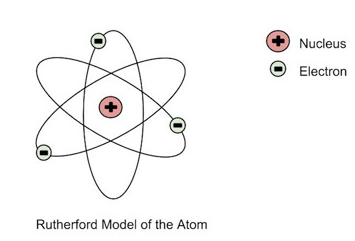
Who came up with this model of an atom?
a)
J.J. Thompson
b)
Ernest Rutherford
c)
Neils Bohr
d)
James Chadwick
12.
True or False: The majority of an atom is made up of empty space
a)
True
b)
False
13.
Which particle is responsible for the chemical properties of an atom?
a)
Neutron
b)
Protons
c)
Valence Electrons
d)
Nucleus
14.
Neon has an atomic number of 10 and an atomic mass of 20.180.  How many protons, electrons, and neutrons will it have?
a)
P=10 E=10 N=11
b)
P=5  E=5  N=10
c)
P=10  E=10  N=10
d)
P=10  E=5  N=5
15.
What element is pictured?
a)
Hydorgen
b)
Boron
c)
Beryllium
d)
Arsenic
16.
The atomic number for Oxygen is 8, so
a)
there are 8 protons in the atom
b)
the atomic mass is less than 8
c)
the mass of the atom is 8
d)
the atom is decaying
17.
Who was the Greek philosopher who called the smallest particle of matter as "atom"?
a)
Democritus
b)
Aristotle
c)
J.J Thompson
d)
Epididymis
18.

Discovered the neutron

a)

Ernest Rutherford

b)

James Chadwick

c)

J.J. Thomson

d)

John Dalton

19.

In his experiment, Rutherford concluded that atoms have a nucleus because

a)

most of the particles went straight through the foil.

b)

some of the particles were deflected near the front of the screen.

c)

some of the particles were deflected back towards the alpha source.

d)

not enough information is given.

20.
J.J. Thomson provided evidence that an atom...
a)
is the smallest particle of matter
b)
contains negatively charged particles
c)
has an overall negative charge
d)
has an overall positive charge
21.

The isotope of Bromine, bromine-67, has how many neutrons?

a)

34

b)

33

c)

32

d)

31

22.

What is an isotope?

a)

An element with the same number of neutrons and different number of protons

b)

An element with the same number of protons and different number of neutrons

c)

An element with the same number of protons and different number of electrons

d)

An element with the same number of neutrons and different number of electrons

23.

The correct electron configuration for Chlorine is

a)

1s22s22p5

b)

1s22s22p63s2

c)

1s22s22p63s23p4

d)

1s22s22p63s23p5

24.

How many valence electrons are in Chlorine

a)

4

b)

5

c)

6

d)

7

25.
What atom matches this electron configuration?
1s22s22p63s23p64s23d10
a)
Zinc
b)
Copper
c)
Nickel
d)
Germanium
26.
What atom matches this electron configuration?
1s22s22p63s2
a)
Neon
b)
Magnesium
c)
Aluminum
d)
Potassium
27.
What electron configuration matches an oxygen atom?
a)
1s22s22p63s2, 3p64s23d104p5
b)
1s22s22p4
c)
1s22s22p6
d)
1s22s22p63s23p64s23d1
28.
Electrons occupy orbitals of lowest energy first is part of what electron configuration rule?
a)
Hund’s Rule
b)
Aufbau Principle
c)
Pauli Exclusion Principle
29.
Electron arrangement that uses arrows
a)
Electron configuration
b)
Shorthand configuration
c)
Lewis dot structure
d)
Orbital diagram
30.
What is the shorthand electron configuration for Sulfur atom?
a)
[Ar] 3p4
b)
[He] 3s23p4
c)
[Ne] 3s23p4
d)
[Na] 3s23p3
31.
Which element is pictured?
a)
neon
b)
fluorine
c)
magnesium
d)
argon
32.
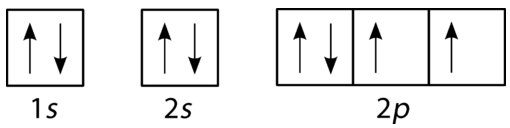
This orbital diagram represents:  
a)
C
b)
B
c)
N
d)
O
33.
This orbital diagram represents:  
a)
C
b)
B
c)
N
d)
O
34.
What is incorrect about this orbital diagram?
a)
Both arrows in the 2p box should be pointing up
b)
There is nothing incorrect with this diagram
c)
In the 2p box there should only be 1 electron in the first 2p box and one in the 2nd 2p box
d)
All the arrows should be pointing up.
35.
What is the Pauli Exclusion Principle?
a)
An atomic orbital can only hold a maximum of 2 electrons, each with opposite spins
b)
An atomic orbital can hold a minimum of 6 electrons, each with opposite spins
c)
An atomic orbital can hold a maximum of 6 electrons, each with the same spin
d)
An atomic orbital can hold a minimum of 2 electrons, each with opposite spins
36.
Which orbital shows a violation of Hund's Rule?
a)
A
b)
B
c)
C
d)
D
37.
Which orbital shows a violation of the Aufbau Principle?
a)
A
b)
B
c)
C
d)
D
38.
Which orbital shows a violation of the Pauli Exclusion Principle?
a)
A
b)
B
c)
C
d)
D
39.
This states that each orbital in an atom can hold at most 2 electrons, which must have opposite spins
a)
Pauli exclusion principle
b)
Hund's rule
c)
Aufbau principle
d)
quantum mechanical model
40.
This states that orbitals of equal energy are occupied by one electron each before any of those orbitals are occupied by a second electron (split 'em up before you pair 'em up)
a)
Hund's rule
b)
Pauli exclusion principle
c)
Aufbau principle
d)
quantum mechanical model
41.
This states that orbitals of equal energy are occupied by one electron each before any of those orbitals are occupied by a second electron (split 'em up before you pair 'em up)
a)
Hund's rule
b)
Pauli exclusion principle
c)
Aufbau principle
d)
quantum mechanical model
42.

Which type of decay is the most penetrating?

a)

Alpha

b)

Beta

c)

Gamma

d)

Delta

43.

Which type of decay is not stopped by aluminum?

a)

Alpha

b)

Beta

c)

Gamma

d)

Delta

44.

Which type of decay is stopped by air or paper?

a)

Alpha

b)

Beta

c)

Delta

d)

Gamma

45.

Which type of decay is the least penetrating?

a)

Alpha

b)

Beta

c)

Delta

d)

Which

46.

Which type of decay can pass through air or paper but is stopped by aluminum?

a)

Alpha

b)

Beta

c)

Gamma

d)

Delta

47.
Radiation can cause what?
a)
Superpowers
b)
Cancer
c)
Headaches
d)
The flu
48.
Balance the following equation:
146C --> 0-1e + ________
a)
145B
b)
146C
c)
147N
d)
42He
49.

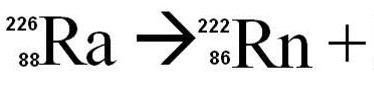
Solve this equation for alpha decay.

88226Ra --> ___ + 24He

a)

86222Rn

b)

89226Ac

c)

84224Po

d)

88225Ra

50.

Solve this equation for alpha decay.

85209At --> ___ + 24He

a)

83205Bi

b)

86209Rn

c)

81207Tl

d)

85208At

51.

Solve this equation for beta decay.

614C --> ___ + -10e

a)

410Be

b)

714N

c)

210He

d)

613C

52.

Solve this equation for beta decay.

2760Co --> ___ + -10e

a)

2556Mn

b)

2860Ni

c)

2358V

d)

2759Co

53.
Balance the following equation:
146C --> 0-1e + ________
a)
145B
b)
146C
c)
147N
d)
42He
54.

In the symbol 167N what the 7 stand for?

a)

Mass number

b)

Atomic number

c)

Atomic mass

d)

Number of neutrons

55.

Complete the nuclear equation and determine the type of decay.

a)

4 He alpha

2

b)

0 e beta

-1

c)

0 y gamma

0

d)

none

56.
What makes something radioactive?
a)
elements with an atomic number above 81
b)
an unstable nucleus
c)
contaminated sewage
d)
It decays over time
57.
What is Half-life?
a)
The amount of time it takes for some of the nuclei in a sample of the isotope to decay
b)
The amount of time it takes for half the electrons in a sample of the isotope to decay
c)
The amount of time it takes for half the nuclei in a sample of the isotope to decay
d)
the amount of time it takes to double the nuclei in a sample of the isotope to decay
58.
Barium-122 has a half-life of 2 minutes. A fresh sample weighing 80 g was obtained. If it takes 10 minutes to set up an experiment using barium-122, how much barium-122 will be left when the experiment begins?
a)
0.25g
b)
2.5g
c)
25g
d)
80g
59.
The half-life of strontium-90 is 25 years. How much strontium-90 will remain after 100 years if the initial amount is 4.0 g?
a)
3.0g
b)
0.25mg
c)
0.3g
d)
0.25g
60.
The half life of iodine-131 is 8.040 days. What percentage of an iodine-131 sample will remain after 40.20 days?
a)
312.5%
b)
31.25%
c)
.3125%
d)
3.125%
61.
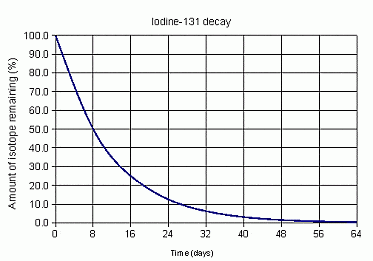
What is the half-life of iodine-131?
a)
32 days
b)
8 days
c)
16 days
d)
24 days
62.
What percent of carbon-14 would be left after 5730 years?
a)
100%
b)
75%
c)
50%
d)
25%
63.
What percent of carbon-14 would be left after 11,460 years?
a)
100%
b)
75%
c)
50%
d)
25%
64.
If one-fourth of the carbon-14 is remaining then how many half-lives have passed?
a)
1
b)
2
c)
3
d)
4
65.
The half-life of Zn-71 is 2.4 minutes. If one had 100.0 g at the beginning, how many grams would be left after 7.2 minutes has elapsed?
a)
100.0g
b)
50.0g
c)
12.5g
d)
8.5g
66.
If 10 mg of iodine 131 is given to a patient, how much is left after 24 days? The half-life of iodine-131 is 8 days.
a)
1.25mg
b)
1.25g
c)
10g
d)
10mg
67.
If the half-life of uranium-232 is 70 years, how many half-lives will it take for 10 g of it to be reduced to 1.25 g?
a)
1 half-life
b)
2 half-lives
c)
3 half-lives
d)
4 half-lives
68.
Magnesium consists of three naturally occurring isotopes. The percent abundance of  these isotopes is as follows: 24Mg (78.70%), 25Mg (10.13%), and 26Mg (11.7%). The average atomic mass of the three isotopes is 24.3050 amu. If the atomic mass of 25Mg is 24.98584 amu, and 26Mg is 25.98259 amu, calculate the actual atomic mass of 24Mg.  
a)
23.985 amu
b)
21.421 amu
c)
24.463 amu
d)
24.002 amu
69.
Magnesium consists of three naturally occurring isotopes. The percent abundance of  these isotopes is as follows: 24Mg (78.70%), 25Mg (10.13%), and 26Mg (11.7%). The average atomic mass of the three isotopes is 24.3050 amu. If the atomic mass of 25Mg is 24.98584 amu, and 26Mg is 25.98259 amu, calculate the actual atomic mass of 24Mg.  
a)
23.985 amu
b)
21.421 amu
c)
24.463 amu
d)
24.002 amu
70.
 Copper occurs naturally as Cu-63 and Cu-65. Which isotope is more abundant?
a)
Cu-63
b)
Cu-65
71.
The atomic masses and the relative abundances of 2 naturally occurring isotopes of an unknown element X are as following: isotope X-7 has a relative abundance of 95% and isotope X-10 has a relative abundance of 5%. Which of the following is correct
a)
(7 x 95) + (10 x 5)
b)
(7 x 0.95) + (10 x 0.05)
c)
(7 x 0.95) + (10 x 0.5)
d)
(0.7 x 95) + (0.10 x 5)
72.
If X is the symbol for an element, which of the following two symbols represent    isotopes of the same element?     I. 7735X  II. 7733X  III. 8137X  IV. 8135 X
a)
I and II
b)
III and IV
c)
I and IV
d)
I and III
73.
Four isotopes of lead include lead-204, lead-206, lead-207, and lead-208.  The average atomic mass of lead is 207.2.  Which isotope of lead is likely to be the most abundant.
a)
204
b)
206
c)
207
d)
208
74.
Calculate the average atomic mass of element X when 34% of element X exists as X-272 and the remainder exists as X-274.
a)
185.64amu
b)
273.32amu
c)
272.68amu
d)
27.33amu
75.
Calculate the average atomic mass of silver.
a)
106.38649amu
b)
111.91896amu
c)
107.8677amu
d)
121
76.

Element Z has 2 natural isotopes. One isotope has a mass of 15.0 amu and a relative abundance of 30%. The other isotope has a mass of 16.0 amu and a relative abundance of 70%. Estimate the average atomic mass for this one element.

a)

15.0 amu

b)

16.0 amu

c)

15.7 amu

d)

16.9 amu

77.

Which isotope of potassium do you think is the most abundant: K-39, K-40, or K-41? The average atomic mass of potassium is 39.10 amu.

a)

K-39

b)

K-40

c)

K-41

d)

They are all equally abundant.

78.

List the three types of nuclear radiation from weakest to strongest penetration power.

a)

Alpha, Beta, Gamma

b)

Beta, Alpha, Gamma

c)

Gamma, Beta, Alpha

d)

Gamma, Alpha Beta

79.
24.1% of all the isotopes of a an element have a mass of 75.23 amu, 48.7% have a mass of 74.61 amu, and 27.2% have a mass of 75.20 amu.
What is the average mass of this element?
a)
74.92 amu
b)
24.97 amu
c)
75.01 amu
d)
74.51 amu
80.
What is the name of the atom pictured here?
a)
Nitrogen
b)
Nitrogen-15
c)
Nitrogen-7
d)
Nitrogen-8