
 Worksheets
MDCAT Smash Test Session
Total questions: 123
Worksheet time: 1hrs 2mins
Name
Class
Date
1.
Name
4 lines
2.
Roll no.
(a)
3.
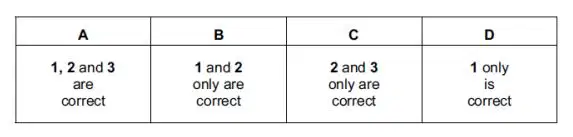
Which molecules would be present in the mixture produced by the photochemical chlorination of methane ?
1) Hydrogen
2) Hydrogen Chloride
3) dichloromethane
a)
a
b)
B
c)
C
d)
D
4.
Meets bonding requirement for CARBON atoms, YES or NO?
Three single bonds and a triple bond
a)
Yes
b)
No
c)
Maybe
5.
Formation of a single product from two reactant molecules is known as
a)
addition reaction
b)
substitution reaction
c)
elimination reaction
d)
oxidation reaction
6.
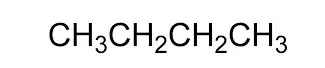
The given structure is an example of ...
a)
Expanded structure
b)
Condensed structure
c)
Skeletal structure
7.
What is a functional group
a)
Atoms or group of atoms that give specific characteristics to a molecule
b)
Group of molecules that make up a group of atoms
c)
Group of molecules that give specific characteristics to an atom
d)
Group of atoms that give specific characteristics to an element
8.
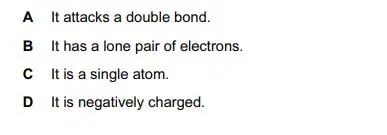
Which of these always applies to a nucleophile
a)
A
b)
B
c)
C
d)
D
9.
Which of the following is a HYDROCARBON DERIVATIVE?
a)
A
b)
B
c)
C
d)
D
10.
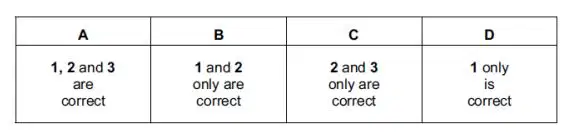
Which pair of homologous series have the same C:H ratio in their general formula
1) Aldehydes and Ketones
2) Carboxylic acids and esters
3) Alkenes and Ketones
a)
A
b)
B
c)
C
d)
D
11.
Which bond is weaker and is more prone to chemical attacks?
a)
Pi bond
b)
Sigma bond
c)
12.
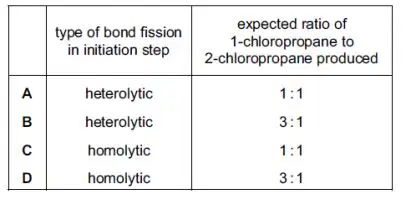
A reaction between chlorine and propane in UV light produces 2 isomeric monochloropropane , C3H7Cl, as products. Which information about this reaction is correct ?
a)
A
b)
B
c)
C
d)
D
13.
Carbon has _____ valence electrons.
a)
4
b)
2
c)
6
d)
8
14.
What is the name of the process in which one orbital "S" and three orbitals "P" combined to form new orbitals?
a)
Carbon and hydrogen
b)
Carbon and oxygen
c)
Carbon, nitrogen and hydrogen
15.
Covalent bonds can break through
a)
Homolytic fission
b)
Homolytic fusion
c)
Heterolytic fission
d)
Heterolytic fusion
16.
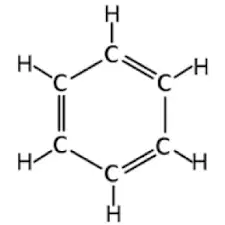
How many single covalent bonds does benzene (C6H6) molecule have?
a)
3
b)
9
c)
12
d)
6
17.
What is the name of the triple bonded compounds which are unsaturated?
a)
Alkanes
b)
Alkenes
c)
Alkynes
d)
Alkones
18.
All organic compounds are obtained from living organisms or "organic materials" while all inorganic compounds are obtained from earth's mineral constituents or "inorganic materials".
a)
True
b)
False
19.
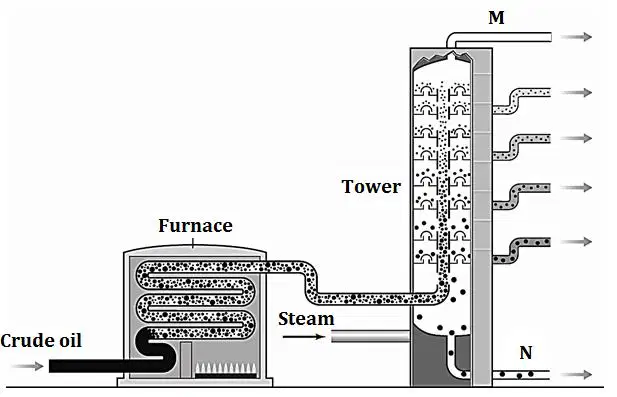
At which pipe: M or N are hydrocarbons with lower boiling points collected?
a)
M
b)
N
20.
This type of bond allows free rotation of the parts of the molecule with respect to each other
a)
Sigma bond
b)
Pi bond
c)
Covalent bond
d)
Electron bond
21.
How to determine that a molecule exhibit cis-trans isomerism?
a)
Restricted rotation in a carbon-carbon single bond of alkenes
b)
Each carbon of a site of restricted rotation has 2 different atoms or groups attached to it
c)
Exist in cyclic compouds only
d)
Similar chemical properties
22.
Which statement best defines chain isomerism?
a)
Existance of chemical compounds with same molecular formula
b)
Different ways the same number of carbons are connected which is either straight or branched
c)
Have mirror image of each other
d)
Similar chemical properties with different physical properties such as solubility
23.
The type of covalent bond present in a nitrogen molecule is a
a)
Double bond
b)
Triple bond
c)
Single bond
d)
Dative bond
24.
Which of the following is the correct name for the compound PbO?
a)
lead oxide
b)
lead monoxide
c)
lead (I) oxide
d)
lead (II) oxide
25.
When Alkali metals (Group 1) form ions, they ____.
a)
lose 1 proton
b)
gain 1 proton
c)
lose 1 electron
d)
gain 1 electron
26.
What is the correct IUPAC name for the compound P2O5?
*IUPAC stands for International Union of Pure and Applied Chemistry and it is the naming system that we use in class.
a)
phosphorus pentoxide
b)
diphosphorus pentoxide
c)
phosphorus oxide
d)
potassium oxide
27.
Which of the following elements is most likely to form an incomplete octet?
a)
Carbon
b)
Oxygen
c)
Boron
d)
Fluorine
28.
To determine if two atoms will bond, what would be helpful to know?
a)
Valence electrons, found by group number
b)
Whether the elements are metals or nonmetals
c)
The electronegativity of the atoms
d)
All of the above, all of which can be found on the Periodic Table
29.
How does fluorine (F) obey the octet rule when reacting to form compounds?
a)
It doesn’t change its number of electrons
b)
Fluorine does not obey the octet rule.
c)
It gains electrons.
d)
It gives up electrons.
30.
Consider the four pairs of elements below. Which pairs form an ionic bond and covalent bond?
a) Na and Br _____________
b) Mg and S _____________
c) Ca and Al ______________
d) N and O______________
a)
Both A and B are ionic bond
b)
Both A and C are covalent bond
c)
Both C and D are covalent bond
d)
Both D and B are ionic bond
31.
Which correctly describes the molecular polarity of water?
a)
nonpolar and symmetrical
b)
nonpolar and asymmetrical
c)
polar and symmetrical
d)
polar and asymmetrical
32.
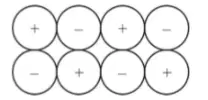
the diagram below represents particles of different elements in a crystal. What type of bond holds these particles together?
a)
covalent
b)
ionic
c)
polar
d)
hydrogen
33.
Which type of bond involves a transfer of electrons?
a)
Ionic
b)
polar covalent
c)
nonpolar covalent
d)
metallic
34.
Chemical bonds are formed when atoms
a)
combine nuclei
b)
give up neutrons
c)
gain protons
d)
share or transfer electrons
35.
What piece of evidence guarantees that a chemical change has occurred?
a)
A change in shape or size
b)
A change in the state of matter.
c)
A new substance being created.
36.
How many valence electrons are transferred from the sodium atom to fluoride in the formation of the compound sodium fluoride?
a)
0
b)
1
c)
2
d)
3
37.
When ionic bonds are formed electrons are
a)
shared between a metal and a nonmetal
b)
shared between metals
c)
transferred from nonmetals to metals
d)
transferred from metals to nonmetals
38.
Which of the following is true about a balanced chemical equation?
a)
Starting substances are called reactants, and ending substances are called products.
b)
The reactants and products are separated by an arrow.
c)
The equation must obey the Law of Conservation of Matter.
d)
All of these are true.
39.
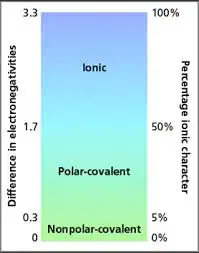
Using electronegativities, what type of bond is formed by Co and F.
a)
ionic
b)
metallic
c)
covalent
40.
Which compound is held together by electrostatic forces?
a)
NO2
b)
CaSO4
c)
Aluminum
d)
P4O10
41.
In chemical compounds, covalent bonds form when
a)
the electronegativity difference between two atoms is very large.
b)
electrons are completely transferred between two metals.
c)
pairs of electrons are shared between two nonmetal atoms.
d)
two nonmetal atoms are attracted to each other by opposite charges.
42.
What elements generally make a covalent bond?
a)
metal and nonmetal
b)
2 nonmetals
c)
metal
d)
none of the above
43.
An ionic compound made of copper (Cu^2+) and oxygen would be named
a)
Copper(II) oxide
b)
copper oxygen.
c)
copper oxide.
d)
dicopper oxide.
44.
Which compound would be a good conductor when in solution?
a)
aluminum
b)
sulfur dioxide
c)
ammonia
d)
sodium nitrate
45.
What happens when an atom loses an electron?
a)
It becomes Negatively Charged
b)
It remains neutral because the proton also leaves.
c)
It becomes Positively Charged
d)
It stays the same.
46.
What is viscosity?
a)
A liquid's resistance to flow.
b)
a liquids flow.
c)
a liquid
d)
gas to solid.
47.
Liquids with very high viscosity flow very _____________.
a)
fast
b)
not at all
c)
slow
d)
whenever it wants
48.
Which of the following is NOT a property of a liquid
a)
surface tension
b)
viscosity
c)
capillary action
d)
polar
49.
Cohesive forces
a)
Are the attraction of molecules within a liquid
b)
Are the attraction of molecules to the container walls
c)
Are only present when the liquid is exposed to glue
d)
Are important for upward movement in capillary action
50.
Water is a universal solvent because it...
a)
It can be found anywhere
b)
It freezes when it gets cold
c)
floats when frozen
d)
Dissolves most substances
51.
What is adhesion?
a)
Water's ability to stick to itself
b)
Water's ability to stick to other substances
c)
The strength of the cohesion of all the water molecules combined
d)
Tape, glue and other adhesives
52.
What is surface tension?
a)
Water's ability to stick to itself
b)
Water's ability to stick to other substances
c)
The strength of the cohesion of all the water molecules combined
d)
Tape,glue and other adhesives
53.
Heat Capacity is a measure of the heat required to raise the temperature of 1g of a substance by 1°C.
So...
True or False:
Water has a very high heat capacity, which means it resists changing temperature when heat is added or removed.
a)
True
b)
False
54.
What type of solids are malleable and ductile
a)
Molecular
b)
Ionic
c)
Metallic
d)
Covalent
55.
Which of the following set of solids contains only ionic solids
a)
NaCl, MgO and ZnS
b)
CaF2, ZnS,SiO2
c)
MgO, SiO2, KCl
d)
SiO2, SiC, AIN
56.
n-type semiconductor are
a)
negatively charged
b)
positively charged
c)
Either Negatively or Positively charged
d)
Neutral
57.
Which of the following is not a characteristic of a crystalline solid?
a)
Definite and characteristic heat of fusion
b)
Isotropic nature
c)
A regular periodically repeated pattern of arrangement of constituent particles in the entire crystal
d)
A true solid
58.
An example of something that is biodegradable is
a)
a leaf in a compost pile
b)
a plastic milk jug in a landfill
c)
a polystyrene burger container in a trash can
d)
All of the above
59.
Hazardous waste is:
a)
corrosive
b)
ignitable
c)
toxic
d)
all of these
60.
Which of the following conditions favours the existence of a substance in the solid state?
a)
High temperature
b)
Weak cohesive forces
c)
High thermal energy
d)
Low temperature
61.
Why are metals malleable?
a)
They are shiny
b)
The electrons are held tightly within the lattice structure making it strong
c)
The electrons are delocalized and able to move between the atoms
d)
The electrons are shared between two metal ions and this holds the atoms together
62.
Volume of a gas at STP is 10 dm3, at what temperature its volume will become
30dm3, keeping pressure constant
a)
3°C
b)
819°C
c)
3K
d)
819K
63.
A real gas behaves ideally at
a)
High pressure, low temperature
b)
High pressure, high temperature
c)
Low pressure, high temperature
d)
Low pressure, low temperature
64.
if temperature and pressure of 4dm3 of hydrogen is reduce to half, then new volumeof gas will be
a)
8dm3
b)
4dm3
c)
6dm3
d)
2dm3
65.
Gases are considered to be composed of minute discrete particles called
a)
Atoms
b)
Molecules
c)
Ions
d)
Elements
66.
CO2 will show more non-ideal behaviour at
a)
17°C
b)
0°C
c)
100°C
d)
273°C
67.
Water has high heat of vaporization due to extensive _______
a)
Covalent bonds
b)
Ion dipole forces
c)
Hydrogen bonding
d)
Debye forces
68.
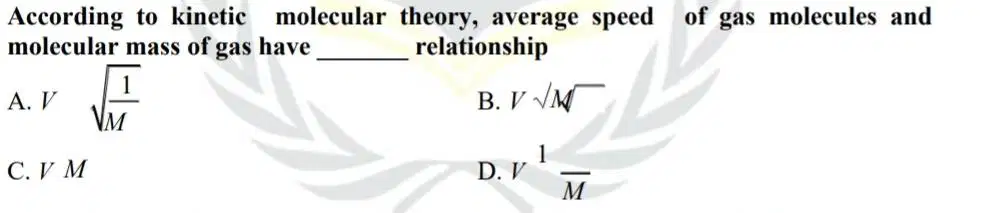
According to kinetic molecular theory, average speed of gas molecules and
molecular mass of gas have _______ relationship
a)
A
b)
B
c)
C
d)
D
69.
The hexagonal type empty spaces are present in the structure of ice. This is due to hydrogen bonding present between______ atom of one water molecule and________atom of other water molecule
a)
H,H
b)
H,N
c)
H,O
d)
O,O
70.
Critical temperature of O2, N2, H2 and CO2 are –118.8°C, –147.1°C, –239.9°C and 31.1°C respectively. Which gas among following is most ideal
a)
H2
b)
O2
c)
CO2
d)
N2
71.
Which of the following does not favors the increasing of vapor pressure?
a)
Increasing temperature
b)
Increasing surface area
c)
Decreasing intermolecular forces
d)
All of these
72.
At constant temperature volume of the given mass of a gas is directly proportional to the inverse of pressure exerted on it, is called
a)
General gas law
b)
Charles’s law
c)
Boyle’s law
d)
Avogadro’s law
73.
At 17°C, a sample of H2 gas occupies 125cm3. What would be the volume at 307°C by keeping pressure constant
a)
125cm3
b)
250cm3
c)
415cm3
d)
350cm3
74.
The rate law for the reaction is rate = k[A] [B] . The order of reaction is
a)
Zero
b)
2/3
c)
1/3
d)
5/3
75.
In the given reaction 2A + B →products , it is observed on quadrupling the conc. of B, rate of reaction increases 16times. The order of reaction with respect to B is
a)
0
b)
1
c)
2
d)
-1
76.
The rate of chemical reaction roughly doubles for every 10°C rise of temperature. If temperature is raised by 20 C, the rate may become
a)
4 times
b)
16 times
c)
8 times
d)
8 time
77.
Determine partial pressure of NO at equilibrium if partial pressure of N2 and O2 are 2 and 8 torr respectively (Kp = 4.0) N2 + O2 2NO
a)
8 torr
b)
16 torr
c)
4 torr
d)
64 torr
78.
At equilibrium, relationship between concentrations of reactants and products
a)
[Reactants] > [Products]
b)
[Reactants] = [Products]
c)
[Reactants] < [Products]
d)
All are possible
79.
For endothermic reaction, Ea is activation energy in kJ/mol. The maximum value of enthalpy of reaction (ΔH) will be
a)
Less than Ea
b)
More than Ea
c)
Equal to Ea
d)
Zero
80.
When 1 mole of HCl is added to 1 molar aqueous solution of H2S then
a)
pH of solution decreases
b)
S-2 ion concentration decreases
c)
Ionization of H2S decreases
d)
All of these
81.
Correct optimum conditions for synthesis of ammonia by Haber process is
a)
200-300 atm, 400°C, Fe/MgO, Al2O3 and SiO2
b)
1-2 atm 400-500°C, V2O5
c)
200-300 atm, 650°C, Pt
d)
10-20atm, 200°C
82.
The value of Kc for endothermic reversible reaction
a)
Increases with increase in temperature
b)
Decreases with increase in temperature
c)
Is independent of temperature
d)
No prediction can be madetion 1
83.
A buffer is prepared by mixing the solutions of equimolar acetic acid and sodium acetate. The pH should be equal to
a)
pKa of acid
b)
Less than pKa of acid
c)
Number of moles of acid
d)
More than pKa of acid
84.
In a reaction, A + B → Product, rate is doubled when the concentration of B is doubled, and rate increases by a factor of 8 when the concentrations of both the reactants A and B. are doubled, rate law for the reaction can be written as
a)
Rate = k [A][B]
b)
Rate = k [A]2[B]
c)
Rate = k [A]3[B]
d)
Rate = k [A][B]2ption 1
85.
For reaction A+2B →C, if concentration of A and B is doubled, then rate of reaction will increase
a)
4 times
b)
8 times
c)
6 times
d)
16 times
86.
Rate of first order reaction depends on ______
a)
Concentration of one reactant
b)
Concentration of two reactants
c)
Concentration of three reactants
d)
Independence of the initial concentration
87.
The rate expression of a reaction is, Rate = k[A][B]2 What happens to rate of reaction if concentrations of A and B are doubled?
a)
Increased two times
b)
Increased four times
c)
Increased eight times
d)
Increased nine times
88.
If Ef and Eb are the activation energies for forward and backward reaction respectively. How these can be compared for the exothermic reaction.
a)
Ef > Eb
b)
Ef < Eb
c)
Ef = Eb
d)
No prediction can be madeption 1
89.
The term common ion effect is used to describe the behavior of a solution in which _______ ion is produced by __________ compounds
a)
Same, different
b)
Different, same
c)
Same, same
90.
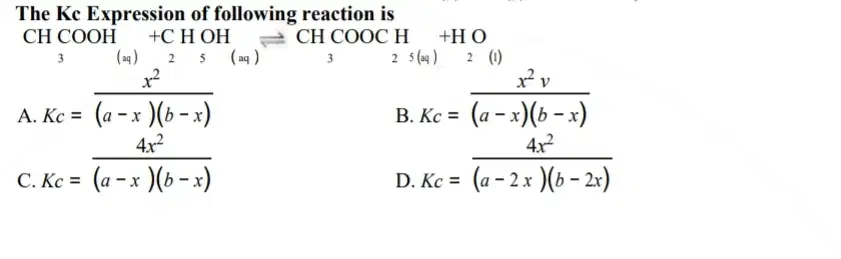
a)
A
b)
B
c)
C
d)
D
91.
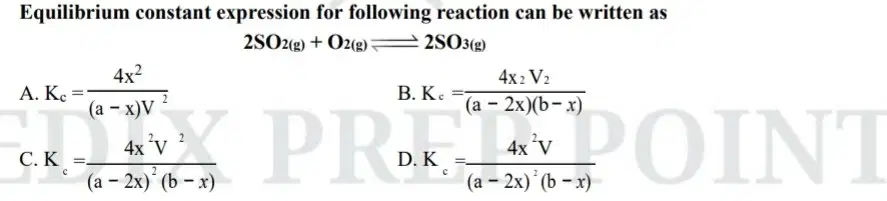
a)
A
b)
B
c)
C
d)
D
92.

a)
A
b)
B
c)
C
d)
D
93.
Kp and Kc has following relationship Kp = Kc (RT) n. Here n is equal to
a)
nP - nR
b)
nP + nR
c)
nP / nR
d)
nP nR
94.
Strong reducing agents have large negative value of
a)
Oxidation potential
b)
Redox potential
c)
Reduction potential
d)
Emf of cell
95.
Which of the following is true in the case of Zn-Cu cell?
a)
The flow of electrons takes place from copper to zinc
b)
E°red of copper electrode is less than that of zinc electrode
c)
Zinc acts as an anode and copper as cathode
d)
All are correct
96.
In a galvanic cell
a)
Chemical energy is converted into electrical energy
b)
Chemical energy is converted into heat
c)
Electrical energy is converted into chemical energy
d)
Electrical energy is converted into heat
97.
Salt bridge transfers
a)
Electrons
b)
Current
c)
Anion
d)
Ions
98.
Temperature for the measurement of standard electrode potential is
a)
298K
b)
273K
c)
25K
d)
310K
99.
The element that act as cathode always have ______ position in electrochemical series
a)
Higher
b)
In middle
c)
Lower
d)
No effect of position
100.
Zn + FeSO4 → ZnSO4 + Fe , in the given reaction which of the following is reduced
a)
Zn
b)
Fe^+2
c)
Zn^+2
d)
Fe
101.
Electrolysis is the process in which a chemical reaction takes place at the expense of
a)
Chemical energy
b)
Electrical energy
c)
Heat energy
d)
Potential energy
102.
Which of the following will form the cathode with respect to iron anode in an electrolyte?
a)
Mg
b)
Al
c)
Cu
d)
Zn
103.
Aqueous solution of caustic soda on electrolysis produce _____ and _____ at anode and cathode respectively
a)
H2 and O2
b)
O2 and H2
c)
Na and O2
d)
O2 and Na
104.
Smaller is the value of standard reduction potential of substance
a)
Greater is the oxidizing power of the substance
b)
Greater is the reducing power of the substance
c)
Lesser will be its tendency to combine with oxygen
d)
Lesser will be its tendency to displace hydrogen from acid
105.
Which one of the following elements occurs only in one oxidation state?
a)
Fluorine
b)
Chlorine
c)
Nitrogen
d)
Oxygen
106.
To balance oxygen in ion electron method in acidic medium, we add
a)
H+ion
b)
OH−ion
c)
H2O
d)
O2
107.
Which of the following is a redox reaction?
a)
KOH + HCl → KCl + H2O
b)
AgNO3 + NaCl → AgCl + NaNO3
c)
BaCl2 + H2SO4 → BaSO4 + 2HCl
d)
Zn + 2HCl → ZnCl2 + H2
108.
___________can displace Hydrogen from acid more easily
a)
Au
b)
Al
c)
Pb
d)
Ca
109.
Absorption of heat occurs when
a)
Carbon burns in air
b)
NH4Cl dissolved in water
c)
SO2 is oxidized to SO3
d)
CH4 gas is burntption 1
110.
For the neutralization of 1 mole of H2SO4 with 2 moles of NaOH in dilute solution, the heat liberated is
a)
Op=57 kJ
b)
< 57 kJ
c)
> 57kJ
d)
=28.5 kJtion 1
111.
The enthalpy change of a reaction does not depend on
a)
Initial and final enthalpy change of reaction
b)
Different intermediate reactions
c)
State of reactants and products
d)
Nature of reactant and product
112.
In exothermic reaction heat transfer from
a)
Surrounding to system
b)
System to surrounding
c)
System to system
d)
Surrounding to surrounding
113.
Enthalpy change during the formation of one mole of atoms from its elements is called enthalpy of atomization. The element in this change is in
a)
Solid state
b)
Liquid state
c)
Gaseous state
d)
Any of the above state
114.
Which of the following formula cannot be used in Hess’s law?
a)
H = H1 + H2
b)
Hf° = Hl° + Hx
c)
H(cycle) = 0
d)
Hl° = Hf° + Hx
115.
Which of the following metal can liberate hydrogen from halogen acid?
a)
Ag
b)
Cu
c)
Zn
d)
Hg
116.
Which one of the following metals will make a layer on other three metals when dipped in its aqueous solution?
a)
Cr
b)
Al
c)
Cu
d)
Zn
117.
Correct decreasing order of energy is
a)
1 erg > 1 Joule > 1 Cal
b)
1 Cal > 1 Joule > 1 erg
c)
1 erg > 1 Cal > 1 Joule
d)
1 Joule > 1 Cal > 1 erg
118.
When an exothermic reaction is reversed it
a)
Becomes another exothermic reaction
b)
Becomes an endothermic reaction
c)
Show no heat change at all
d)
Attains equilibrium
119.
Smaller is the value of standard reduction potential of substance
a)
Greater is the oxidizing power of the substance
b)
Greater is the reducing power of the substance
c)
Lesser will be its tendency to combine with oxygen
d)
Lesser will be its tendency to displace hydrogen from acid
120.
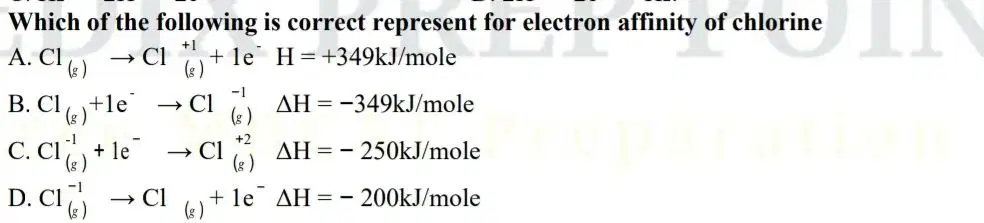
a)
A
b)
B
c)
C
d)
D
121.

a)
A
b)
B
c)
C
d)
D
122.
Reference electrode of _______ is used in the determination of electrode potential of different elements
a)
Hydrogen
b)
Carbon
c)
Lead
d)
Copper
123.
Feedback
4 lines
100 %

