

Wayground logo

Free Printable Worksheets

Font size

S
M
L
XL
Worksheets

1$2$3$4$5

Total questions: 80

Worksheet time: 1hrs 9mins

Name
Class
Date
1.
Movement of particles through the cell membrane from high to low concentrations
a)
diffusion
b)
photosynthesis
c)
mitochondria
d)
active transport
2.
Against the concentration gradient
low to high uses energy/ATP
a)
facilitated diffusion
b)
osmosis
c)
active transport
d)
diffusion
3.
Equal percentage of solutes inside and out. 
Concentration of substances is the same. 
a)
hypotonic
b)
isotonic
c)
nucleus
d)
hypertonic
4.
Particles are too large to enter the membrane.
Need help from channel proteins. No energy required.
a)
active transport
b)
passive transport
c)
facilitated diffusion
d)
osmosis
5.
Diffusion of water across a cell membrane
from high to low.
a)
osmosis
b)
active transport
c)
protein channel
d)
pinocytosis
6.
Engulfs large molecules and moves them inside the membrane.
Uses energy.
a)
exocytosis
b)
endocytosis
c)
protein channel 
d)
diffusion
7.
Engulfing a large substance from the inside of the cell to move it outside of the cell. 
Uses energy. 
a)
exocytosis
b)
endocytosis
c)
photosynthesis
d)
diffusion
8.
Particles move from high concentrations to low concentrations.
Doesn't need energy
a)
passive transport
b)
facilitated transport
c)
active transport
d)
exocytosis
9.
Cell is placed into a concentration of water that has the same makeup as the cell. The cell will 
a)
Explode
b)
Shrink
c)
Stay the same
d)
None of the above
10.
The substance that is dissolved in a solution. 
a)
solute
b)
solution
c)
solvent
d)
solidify
11.
A cell in an isotonic solution will
a)
swell
b)
shrink
c)
stay the same size
d)
impossible to tell
12.
A cell in a hypotonic solution will
a)
swell
b)
shrink 
c)
stay the same size
d)
impossible to tell
13.
When a cell is placed in a hypertonic solution water
a)
moves from the inside of the cell to the solution
b)
moves from the solution to the inside of the cell
c)
moves equally in and out of the cell
d)
none of these
14.
Diffusion is the movement of 
a)
water from low to high concentration
b)
particles from low to high concentration
c)
water from high to low concentration
d)
particles from high to low concentration
15.
A state of biological balance
a)
homeostasis
b)
hypertonic
c)
hypotonic
d)
hippocampus
16.
The picture is an example of...
a)
active tranport
b)
passive transport
c)
diffusion
d)
osmosis
17.

What is the overall goal of ALL cellular transport?

a)

to make a gradient

b)

to maintain homeostasis

c)

to make the cells shrink

d)

to keep molecules where they are

18.

What characteristic does the cell membrane have that describes it's ability to let some things in and keep other things out of the cell?

a)

selectively permeable

b)

impermeable

c)

controlling

d)

fluid

19.

Which of the following is NOT a type of passive transport?

a)

Facilitated Diffusion

b)

Diffusion

c)

Osmosis

d)

Protein Pump

20.

The difference between passive and active transport is that active transport

a)

uses energy

b)

does not use energy

c)

goes from HIGH to LOW

d)

moves molecules randomly

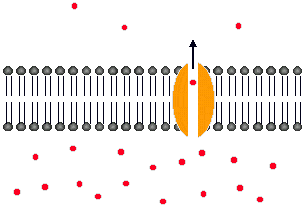
21.

What type of transport would use the structure shown in the picture?

a)

Facilitated Diffusion

b)

Diffusion

c)

Endocytosis

d)

Protein Pump

22.

What type of transport is this?

a)

Osmosis

b)

Endocytosis

c)

Exocytosis

d)

Protein Pump

23.
The movement of molecules against a concentration gradient
a)
simple diffusion
b)
facilitated diffusion
c)
active transport
d)
osmosis
24.
In which solution will water move out of the cell resulting in the cell shriveling up?
a)
Hypertonic
b)
Isotonic
c)
Hypotonic
25.
In which solution will water move into the cell resulting in the cell bursting?
a)
Hypertonic
b)
Isotonic
c)
Hypotonic
26.
which way would the purple molecules move through the semi permeable membrane?
a)
From the  A side  to the B-side
b)
From the B side to the A side
c)
none of the purple molecules would move
27.
This image shows animal blood cells that have been placed in a(n) _____ solution.
a)
hypotonic
b)
hypertonic
c)
isotonic
28.
This image shows blood cells that have been placed in a(n) _____ solution.
a)
isotonic
b)
hypertonic
c)
hypotonic
29.

Which organelle is responsible for maintaining homeostasis?

a)

Cell Wall

b)

Chloroplasts

c)

Lysosomes

d)

Cell Membrane

30.
The cell below is in a _____________ solution.
a)
Hypertonic
b)
Hypotonic
c)
Isotonic
31.

The energy required to start a reaction

a)

enzyme

b)

substrate

c)

activation energy

d)

product

32.

A substance formed by a chemical reaction

a)

product

b)

enzyme

c)

substrate

d)

activation energy

33.

A substance that binds to an enzyme

a)

activation energy

b)

substrate

c)

enzyme

d)

product

34.

In which of the following are bonds broken and new bonds form ?

a)

chemical reactions

b)

isotopes

c)

elements

d)

polar molecules

35.

Which statement is true of chemical equations ?

a)

Reactions are on the right

b)

products are on the right

c)

products are fewer atoms than reactants

d)

reactants are fewer atoms than products

36.
A chemical change is different than a physical change because in a chemical change
a)
Chemicals are used
b)
Molecules do not physically touch
c)
A new substance is formed and in a physical change no new substance is formed
d)
The change can be seen but in a physical change it cannot
37.
A chemical reaction that absorbs heat
a)
Single replacement
b)
Exothermic
c)
Endothermic
d)
Decomposition
38.
a chemical reaction that releases energy by light or heat
a)
Endothermic Reaction
b)
Exothermic Reaction
c)
Diffusion
d)
Fission
39.

A ____________ Is the process of breaking chemical bonds in one or more substances, and the reforming on newborns to create new substances.

a)

physical change

b)

chemical change

c)

energy

d)

law of conservation of mass

40.

A molecule added to a chemical reaction that increases the reaction rate without getting used up in the process.

a)

kinetic molecular

b)

catalyst

c)

reaction rate

d)

inhibitor

41.

Phospholipids have a -

a)

nonpolar head and a nonpolar tail.

b)

polar head and a polar tail.

c)

nonpolar head and a polar tail.

d)

polar head and a nonpolar tail.

42.

The process by which living things try to keep their internal conditions relatively stable (or balanced) is called - 

a)

homeostasis.

b)

cellular respiration.

c)

osmosis.

d)

diffusion.

43.

Susan sprayed perfume in one corner of the room.  John, who sits across the room and is allergic to perfume, soon begins to sneeze.  Perfume travels across the room by - 

a)

active transport.

b)

osmosis.

c)

endocytosis. 

d)

diffusion.

44.

The plasma membrane of a cell consists of - 

a)

a phospholipid bilayer

b)

lipid molecules that are between two carbohydrate layers.

c)

protein molecules arranged in two layers.

d)

protein molecules that have polar and nonpolar tails.

45.
What word describes when water is attracted to other substances?
a)
cohesion
b)
adhesion
c)
capillary action
d)
surface tension
46.
Attractions between the negative Oxygen atom of one water molecule and the positive Hydrogen atom of another water molecule are called
a)
Covalent bonds
b)
Ionic bonds
c)
Polar bonds
d)
Hydrogen bonds
47.
Why does ice float?
a)
As water freezes, it expands and its density decreases.
b)
As water freezes, it takes up more hydrogen from the atmosphere, causing it to have a greater buoyancy.
c)
As water freezes, air becomes trapped between the hydrogen bonds of water molecules.
d)
As water freezes, it takes up more oxygen from the atmosphere, causing it to have a greater buoyancy.
48.
 Small insects can walk across the surface of calm water. Their feet push the surface of the water down slightly, somewhat like a person walking across a trampoline, but they do not break the surface. What is the best explanation for why this happens?
a)
The insects are light enough so that they do not break the hydrogen bonds holding the water molecules together
b)
The insects actually use their wings to hover slightly above the water's surface and they only skim it with their feet
c)
The insects' feet are non-polar, so they are repelled by the polar water molecules and are pushed away from the water's surface
d)
The insects are small enough to see the individual water molecules, so they are able to step carefully from one molecule to the next
49.
When a molecule has an opposite electrical charge on each end, it is known as what?
a)
cohesion
b)
polar molecule
c)
hydrogen bond
d)
solution
50.
When water molecules stick easily to other water molecules, this is called what?
a)
cohesion
b)
adhesion
c)
solution
d)
polar molecule
51.

Carbohydrates ,lipids ,proteins and nucleic acids are

a)

macromolecules

b)

acids

c)

bases

d)

solution

52.

Proteins are made from

a)

monosaccharides

b)

polysaccharides

c)

amino acids

d)

peptide bonds

53.

........make up fats ,oils and waxes

a)

carbohydrates

b)

proteins

c)

nucleic acids

d)

lipids

54.

DNA and RNA are examples of

a)

amino acids

b)

nucleic acids

c)

carbohydrates

d)

proteins

55.

Which TWO elements are always found in amino acids ?

a)

sulfur and oxygen

b)

nitrogen and sulfur

c)

hydrogen and phosphorus

d)

carbon and oxygen

56.

Which joins amino acids together?

a)

peptide bonds

b)

hydrogen bonds

c)

van der Waals forces

d)

ionic bonds

57.

Example(s) of Lipids are...

a)

Sugar

b)

Olive Oil

c)

Bread

d)

Meat

58.
What is the function of nucleic acids?
a)
store genetic information
b)
store energy (long-term)
c)
store energy (short-term)
d)
build skin, hair, nails, muscles
59.
What is the primary function of carbohydrates in your body?
a)
Speed up chemical reactions.
b)
Give immediate energy.
c)
Help to store energy.
d)
Build cell walls in plants.
60.

_______ make up a cell's plasma membrane.

a)

Lipids

b)

Proteins

c)

Nucleic acids

d)

Carbohydrates

61.
Carbohydrates are made of... 
a)
C H O
b)
C H O N
c)
C H O N P
d)
C H O N S
62.

What are the monomers of carbohydrates?

a)

monosaccharides

b)

disaccharides

c)

polysaccharides

d)

amino acid

63.

Some proteins are catalysts in chemical reactions, meaning they speed them up. What are these proteins called?

a)

monomers

b)

enzymes

c)

quickens

d)

neutrons

64.

Which is FALSE?

a)

simple sugars are monosaccharides.

b)

DNA is made up of nucleotides.

c)

Proteins are made of amino acids.

d)

Monomers are made of polymers.

65.

This image depicts a

a)

monosaccharide

b)

disaccharide

c)

polysaccharide

66.
This cellular structure helps organisms maintain homeostasis by controlling what substances may enter or leave cells.
a)
vacuole
b)
nucleus
c)
cell membrane
d)
cell wall
67.

What is the name of the macromolecule that makes up the majority of the cell membrane?

a)

Lipid

b)

Carbohydrate

c)

Nucleic acid

d)

Protein

68.

The primary component of the cell membrane is the group of lipids called

a)

prostaglandins

b)

cholesterol

c)

phospholipids

d)

carbohydrate

69.

Describes the arrangement of the cell membrane as bendable and made of many parts.

a)

the fluid mosaic model

b)

the major mobility model

c)

the crazy cell model

d)

the cell theroy model

70.

Controls the passage of materials inside and outside of the cell

a)

Cell Membrane

b)

Cytoplasm

c)

Cell Wall

d)

Endoplasmic reticulum

71.
___________ strengthens and stabilizes the cell membrane.
a)
Carbohydrates 
b)
Proteins 
c)
Phospholipids 
d)
Cholesterol
72.
The maintenance of an organism’s internal environment is called:
a)
compensating
b)
homeostasis
c)
balancing
d)
routine
73.
The term used to describe when some molecules are able to pass through a membrane and others are not.
a)
Osmosis
b)
Diffusion
c)
Selective Permeability
d)
Equilibrium
74.

Molecule that forms a double layered (bi-layer) cell membrane. (phosphate, glycerol and two fatty acid chains)

a)

PROTEIN

b)

PHOSPHOLIPID

c)

CARBOHYDRATE

d)

CYTOSKELETON

75.

A model that describes the arrangement and movement of the molecules that make up a cell membrane.

a)

Fluid Mosaic Model

b)

Concentration Gradient

c)

Cell Membrane

d)

Phospholipids

76.

This describes the two layers of phospholipids that arranged to allow the membrane to exist in a watery environment

a)

phospholipid bilayer

b)

bilipid phospholayer

c)

dilipid phospholayer

d)

diphospholipid layer

77.

The plasma membrane forms a _____________ boundary between a cell and its environment

a)

thin and flexible

b)

thick and rigid

c)

thin and rigid

d)

thick and flexible

78.

The cell membrane is _______________ permeable.

a)

selectively

b)

somewhat

c)

physically

d)

ionically

79.
How many layers is the lipid bilayer?
a)
1
b)
2
c)
3
d)
4
80.

The following are the components of plasma membrane. EXCEPT one?

a)

cholesterol

b)

proteins

c)

carbohydrates

d)

nucleotide
