
Font size
 Worksheets
A&P Final
Total questions: 65
Worksheet time: 46mins
The greatest percentage of your blood is made of
plasma
platelets (thrombocytes)
white blood cells (leukocytes)
red blood cells (erythrocytes)
The process of hemostasis (forming a blood clot) is completed by which type of cells?
thrombocytes
granulocytes
agranulocytes
erythrocytes
A person with Type A blood needs a blood transfusion. Which blood types are safe to provide to her?
A blood only
B and O blood
A and O blood
O blood only
The human cardiovascular system has two loops. Which loop takes blood from the heart to the lungs and back?
pulmonary loop
systemic loop
coronary loop
systolic loop
The blood type that known as the “universal recipient” is
Type O
Type B
Type A
Type AB
Which blood vessels are the smallest and are the location where carbon dioxide is removed from cells and oxygen is delivered?
arteries
capillaries
veins
atria
The major blood vessel that carries oxygenated blood away from the heart is the
vena cava
pulmonary artery
aorta
pulmonary vein
Which of the following is the correct sequence for the intrinsic conduction system?
SA node AV node AV bundles Purkinje fibers bundle branches
AV node AV bundles SA node bundle branches Purkinje fibers
AV node AV bundles Purkinje fibers bundle branches SA node
SA node AV node AV bundles bundle branches Purkinje fibers
During the cardiac cycle, the relaxation period is known as
systole
stroke volume
cardiac output
Diastole
Because oxygen is nonpolar,
it must be absorbed by the lymphocytes.
it must diffuse directly into the blood.
it must be eliminated quickly.
it must be carried by hemoglobin.
Any substance that triggers an immune response is called a(n):
antibody
antigen
pathogen
lymphocyte
Although 90% of interstitial fluid returns to the blood vessels, 10% of it flows into capillaries of a different body system and becomes known as
lymph
humour
plasma
hemoglobin
The (a) are areas of a lymph node that have rapid mitosis and swell when the body gets an infection.
Which of the following is INCORRECT about lymph capillaries?
They have dead ends.
They contain valves.
They are lined with overlapping epithelial cells.
They actively pump lymph around the body.
Which of the following is part of the nonspecific/innate immune defense?
antibodies
fever
B-cells
T-cells
Which of the following structures is NOT paired with the correct description?
Tonsils nodules that form a protective ring around the throat
Peyer’s Patches a group of lymphocytes near the small intestine that filter bacteria
Thymus Gland located near the stomach and are responsible for B-cell maturation
Spleen found in abdomen and stores and filters blood
Which of the following cells is NOT paired with the correct description?
Plasma B-cells mark antigens on infected body cells.
Memory B-cells provide for a faster secondary response to the infection.
Helper T-cells recognize MHC2 receptors on infected body cells.
Cytotoxic T-cells destroy infected body cells through apoptosis.
Which of the following cells can not display antigens to another cell?
cytotoxic T-cell
macrophage
B-cell
dendritic cell
Receiving the COVID-19 vaccine provides that individual with
active natural immunity
passive natural immunity
active artificial immunity
passive artificial immunity
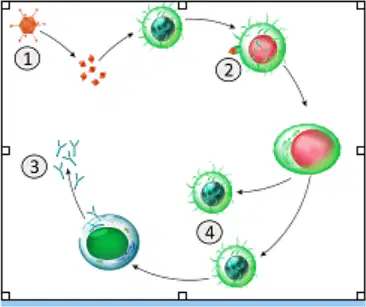
In the image above, location 2 shows a(n)
cloned cell
pathogen
antibody
antigen-presenting cell
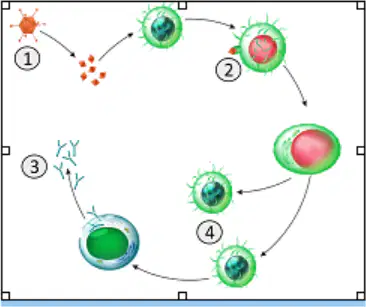
In the image above, location 3 shows a(n)
cloned cell
pathogen
antibody
antigen-presenting cell
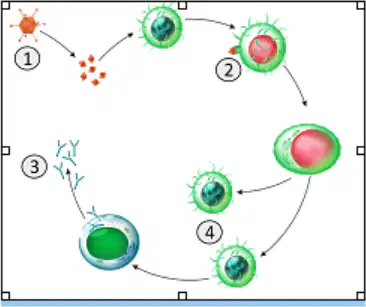
The image above shows a pathway that is part of the
nonspecific/innate response
humoral response
cell-mediated response
Which of the following structures is NOT part of the alimentary canal within the digestive system?
tongue
stomach
small intestine
large intestine
The layer of the alimentary canal that comes into contact with food is the
serosa
muscularis
submucosa
mucosa
Although bile is produced in the _________, it is stored in the _________ until release is necessary.
(a)
Gastric juices produced by the stomach include all of the following except
hydrochloric acid
bile
pepsinogen
mucus
Proteins, lipids, and carbohydrates are considered (a) because they are needed in large quantities.
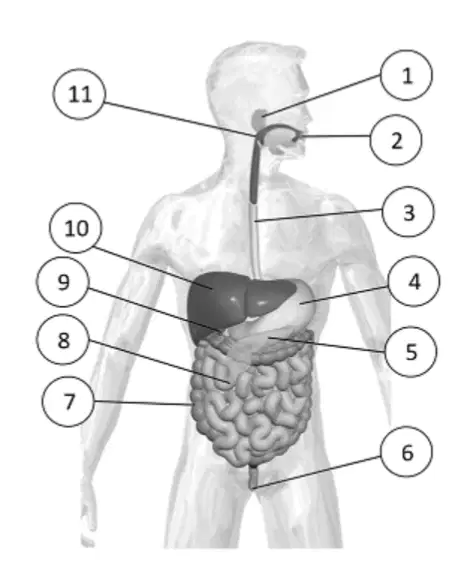
In which structure do rugae provide for expansion and contraction?
2
3
4
7
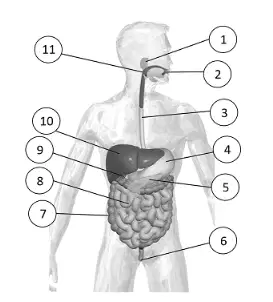
After deglutition, peristalsis occurs here:
2
3
4
7
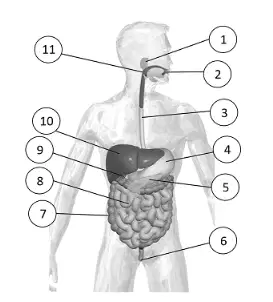
Absorption of water occurs here:
5
7
8
9
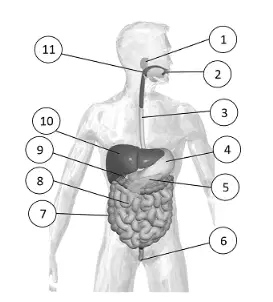
Contains three sections known as the duodenum, jejunum, and ileum.
5
7
8
9
Carbohydrates, fats, and proteins are broken down by the digestive system in a process known as
catabolism
anabolism
emulsification
secretion
Which structure contains large amounts of bacteria that help to produce vitamins B & K?
stomach
small intestine
large intestine
pancreas
The portion of the respiratory system that is protected by cartilaginous rings is the
nasal cavity
trachea
alveoli
bronchi
Which of the following described the path of oxygen as it enters your body?
mouth/nose, pharynx, larynx, trachea, bronchioles, bronchi, lungs, alveoli
mouth/nose, larynx, pharynx, trachea, alveoli, bronchioles, bronchi, lungs
mouth/nose, larynx, trachea, pharynx, bronchioles, alveoli, bronchi, lungs
mouth/nose, pharynx, larynx, trachea, bronchi, bronchioles, lungs, alveoli
The structure that contracts, allowing you to inhale is/are the
diaphragm
lungs
trachea
larynx
Which of the following is NOT part of the lower respiratory tract?
lungs
alveoli
pharynx
bronchi
Your friend had her larynx removed. What is she unable to do?
cough
swallow
breathe
speak
The alveoli of the lungs are closely associated with what structures from another body system?
lymph vessels
nerves
capillaries
villi
You are sitting calmly while you work on this test. The amount of air that is regularly being exchanged through your lungs during this time is called the
residual volume
vital capacity
total lung capacity
tidal volume
During the process of expiration, volume in the lungs __________ causing pressure in the lungs to __________.
(a)
After urine is produced, which of the following is the route that it will travel before leaving the body?
renal pyramids, major calyx, minor calyx, renal pelvis, ureter, bladder, urethra
renal pyramids, renal pelvis, major calyx, minor calyx, ureter, bladder, urethra
renal pyramids, minor calyx, major calyx, renal pelvis, ureter, bladder, urethra
renal pyramids, renal cortex, renal pelvis, renal capsule, ureter, bladder, urethra
After playing basketball for a few minutes, your respiratory rate begins to increase. Why?
You are consciously controlling it.
Your cells are building up more carbon dioxide.
The pH of your blood is rising.
Both B and C are correct.
The functional unit of the urinary system, where blood is filtered and urine is formed is the
capillary.
nephron.
ureter.
lymphocyte.
During the filtration of blood and production of urine (completed by the structure listed in the question above), all of the following occurs EXCEPT
water is filtered out and reabsorbed into the blood
the pH of the blood is regulated
collected urine is sent to the urethra
steroids, drugs, and other toxic substances are removed from the blood
What is the composition of urine?
95% water, 5% salt
95% water, 5% solutes
75% water, 25% urea
75% water, 25% solutes
Which of the following structures is NOT involved in filtering blood from capillaries?
collecting duct
glomerulus
podocytes
Bowman's capsule
Which blood vessel brings blood into the kidney for filtration?
renal vein
renal artery
major calyx
minor calyx
A man with a swollen prostate will likely have reduced
deglutition
micturition
filtration
respiration
Which two hormones in the female cause follicular development and ovulation?
estrogen & progesterone
FSH and LH
FSH & estrogen
LH & progesterone
Which is the correct journey for an ovum?
ovary, uterus, vagina, uterine tube
ovary, vagina, uterine tube, uterus
ovary, uterine tube, vagina, uterus
ovary, uterine tube, uterus, vagina
Semen does all of the following except
dilutes & protects sperm
helps break down the egg during fertilization
carries alkaline fluids to neutralize the urethra
provides nutrition & energy sources for sperm
Which of the following is NOT true of both oogenesis & spermatogenesis?
They both create 4 equally sized gametes.
They both involve 2 meiotic divisions.
They both reduce the chromosome number to 23.
Ideally, fertilization occurs in the _______________ and the embryo implants into the _______________ of the uterus.
(a)
Which of the following is NOT true regarding the male reproductive system?
sperm cells are created consistently throughout a male’s lifetime
each spermatogonia produces 4 sperm cells
sperm cells leave the body through the same opening as urine
sperm cells must be kept at a slightly higher temperature than body temperature
Which is the correct journey for a sperm cell?
testes, epididymis, ductus deferens, urethra
seminiferous tubules, epididymis, ductus deferens, ampulla, ejaculatory duct, urethra
epididymis, testes, ductus deferens, urethra
epididymis, testes, urethra, ductus deferens
Which of these is NOT true about the menstrual cycle?
progesterone helps maintain the cycle
menstruation is when ovulation occurs
the endometrium is changing throughout the cycle
secretion is the longest portion of the cycle
After ovulation, the follicle ejects the __________ oocyte and becomes the __________.
(a)
Which of these describes the baby nearest to delivery?
embryo
zygote
blastula
fetus
Which of the following would be helpful after the birth of a baby?
lactiferous ducts
Cowper’s glands
alveolar glands
vestibular glands
both B & D

How many 'las' are after the 'fa' in "Deck the Halls?"
Six
Seven
Eight
Four
What is Santa Claus's nickname?
St. Nick
Kris Kringle
Father Christmas
All of the above
What story do families read on Christmas Eve?
Twas the night before christmas story
Harry Potter and the Prisoner of Azkaban
Harry Potter and the Chamber of Secrets
Harry Potter and The Half-Blood Prince

At what temperature (in Fahrenheit) does water freeze?
-5 Degrees
10 Degrees
0 Degrees
32 Degrees

