
 Worksheets
Unit 3 Exam Review
Total questions: 28
Worksheet time: 43mins
______ decreases at 1”Hg per 1,000 foot increase in altitude.
Barometric pressure
Density pressure
True altitude
Measured pressure altitude
Viscosity is a fluid’s resistance to ______.
friction
light
flow
heat
What are the standard temperature and pressure values for sea level?
15 degrees C and 29.92” Hg.
59 degrees C and 1013.2 millibars
59 degrees C and 29.92” Hg.
0 degrees C and 1013.2 millibars
Knowing the pressure altitude is important to aircraft performance because it can be used as a tool to arrive at ______ .
humidity
air temperature
wind speed
density altitude
Pressure altitude corrects for the difference between _______ and standard pressure.
humidity
density altitude
barometric pressure
standard temperature
Which factor would tend to increase the density altitude at a given airport?
decrease in ambient temperature
increase in barometric pressure
decrease in relative humidity
increase in ambient temperature
Pressure altitude is calculated from (29.92 - 28.92) × 1,000 + 3,500. What information do these numbers give?
The barometric pressure is 29.92 "Hg and the elevation is 1,000 feet.
The barometric pressure is 28.92 "Hg and the elevation is 1,000 feet.
The barometric pressure is 29.92 "Hg and the elevation is 3,500 feet.
The barometric pressure is 28.92 "Hg and the elevation is 3,500 feet.
Which of the following are units of measure for atmospheric pressure? Select all that apply. (3.A.2)
feet per second (ft/s)
square centimeters (cm²)
millibars (mb)
pounds per square inch (psi)
inches of mercury (Hg)
Which combination of atmospheric conditions will reduce takeoff and climb performance? (3.B.1 and 3.A.2)
Low temperature, low relative humidity, and low density altitude
High temperature, low relative humidity, and low density altitude
Low temperature, high relative humidity, and high density altitude
High temperature, high relative humidity, and high density altitude
Which statement is true about an object moving through a fluid? (3.A.1)
Viscosity changes according to the size of the object.
The object moves faster if the fluid is more viscous.
Fluid friction increases as the object's velocity increases.
Less viscosity means more fluid friction.
Which formula is used for calculating density altitude? (3.B.1)
mass + volume
PA + [120 (OAT – ISA) ]
(29.92 – Barometric Pressure) 1,000 + Elevation
15 – (2 ÷ 1,000 x PA)
Atmospheric pressure is ______ to air density. (3.A.2)
equal to
directly proportional
inversely proportional
unrelated
The “standard day” serves as a universal baseline for measuring ______. (3.B.1)
atmospheric pressure
barometric temperature
density altitude
ground roll
The Magnus Effect occurs because a spinning object drags the air around it. The air being dragged by the object interacts with the surrounding air to create regions of _______.
high friction
warm and cool air
high and low pressure
high and low viscosity
An airport has an elevation of 1,700 feet. A density altitude of 2,200 feet means that an aircraft will perform as if it is _______ above sea level.
3,900 feet
500 feet
1,700 feet
2,200 feet
Which of these factors has the smallest effect on air density?
Pressure
Humidity
Temperature
Altitude
The Coanda Effect is the tendency for a jet of fluid to _______.
force objects to move faster
lift objects upward
attach to a convex or bulging surface
become more dense
True or False. The primary reason for computing density altitude is to determine airplane performance.
True
False
Objects with the same _______ but different masses have different densities.
temperature
volume
area
viscosity
In what way is the Coanda Effect similar to the Magnus Effect?
They both create air movement that influence the direction of an airborne object.
They both impact the direction of an object that has a convex or bulging surface.
They both involve spinning objects that create regions of low pressure.
They both describe the movement of air molecules creating regions of high and low pressure.
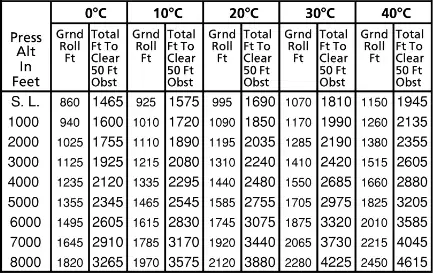
Explain how the chart would be used to determine the distance needed for an aircraft to take off. Explain why this is important.
You identify PA, temp, and locate the correct column. It is important so you can enough room to takeoff.
The chart provides a visual representation of aircraft speed during takeoff.
The chart indicates the fuel consumption rate during takeoff.
The chart is used to determine the weight distribution of the aircraft.
Explain how the Magnus Effect works and give a real-world example.
Explain what limits an aircraft’s ability to perform and fly at extremely high altitudes.
Why does an aircraft have diminished performance on a hot day at a high-altitude airport?
What does the equation DA = PA + [120 (OAT – ISA)] calculate?
Fuel efficiency
Density altitude
Engine power
Wing lift
In the equation DA = PA + [120 (OAT – ISA)], what does PA represent?
Pressure altitude
Power altitude
Performance altitude
Pilot altitude
In the equation DA = PA + [120 (OAT – ISA)], what does OAT represent?
Outside air temperature
Overall air thrust
Optimal air turbulence
Operational air time
In the equation DA = PA + [120 (OAT – ISA)], what does ISA represent?
International Standard Atmosphere
Internal System Altitude
Integrated Safety Analysis
Initial Speed Adjustment

