wayground logo

Free Printable Worksheets

NEW

Font size

S
M
L
XL
Worksheets

Biology Semester 1 Review

Total questions: 50

Worksheet time: 1hrs 5mins

Name
Class
Date
1.
What are the building blocks of proteins?
a)
amino acid
b)
fatty acid
c)
nucleotide
d)
lipid
2.
What are the single sugars that are the building blocks of carbohydrates?
a)
monosaccharides
b)
disaccharides
c)
polysaccharides
d)
amino acid
3.
DNA and RNA are examples of 
a)
Carbohydrates
b)
Lipids
c)
Proteins
d)
Nucleic Acids
4.
How does your body use lipids?
a)
Primary source of energy
b)
energy storage and insulation
c)
speeds up chemical reaction
d)
defense
5.

This macromolecule can form many highly complex structures.  Some of the many functions include structural support, speed up chemical reactions, and cell membrane channels.

a)

carbohydrates

b)

proteins

c)

nucleic acids

d)

lipids

6.
The function of this macromolecule is to store and pass on genetic information to offspring.
a)
carbohydrates
b)
proteins
c)
nucleic acids
d)
lipids
7.
The function of the plasma membrane is....
a)
to regulate what enters and leaves the cell.
b)
fight bacteria and viruses that enter the cell.
c)
provide rigid support and protection to the cell.
d)
make sure each cell can move
8.
Maintaining a constant internal state in a changing environment.
a)
Homeostasis
b)
Active Transport
c)
Mitosis
d)
Photosynthesis
9.

Diffusion & Facilitated Diffusion are both __________ transport.

a)

Passive

b)

Active

c)

Easy

d)

Free

10.

Prokaryotes do not have a nucleus. Which of the following organelles is also NOT found in a prokaryote?

a)

cell wall

b)

ribososme

c)

flagellum

d)

mitochondria

11.

Which structure within the cell plays an important role in energy production for the cell?

a)

ribosome

b)

endoplasmic reticulum

c)

mitochondria

d)

Golgi apparatus

12.

When we say a process that does not require oxygen, we call it what?

a)

Anaerobic

b)

Aerobic

c)

Oxyphillic

d)

Oxygenphilia

13.

What is the name of the organelle where photosynthesis takes place?

a)

Chloroplast

b)

Thylakoid

c)

Chrlorophyll

d)

Mitochondria

14.

Which source provides the initial energy required in photosynthesis?

a)

Sunlight

b)

ATP

c)

Mitochondria

d)

Sugar

15.
During which part of the cell cycle is DNA copied?
a)
Mitosis
b)
Cytokinesis
c)
S phase
16.
During which parts of the cell cycle does the cell grow?
a)
G1 and G2
b)
G1 and S
c)
M phase and cytokinesis
17.
What part of the cell cycle results in the splitting of the new cells?
a)
Interphase
b)
Mitosis
c)
Metaphase
d)
Cytokinesis
18.
What phase is this cell in?
a)
Cytokinesis
b)
Mitosis
c)
Prophase
d)
Metaphase
19.

What is the G0 phase?

a)

The phase where mitosis occurs

b)

A non-dividing state of the cell

c)

A phase where DNA is replicated

d)

A phase where cells divide frequently

20.
Which of the following is a possible result of a disruption in the cell cycle?
a)
cancer
b)
photosynthesis
c)
cellular respiration
d)
protein synthesis
21.

The process by which a cell nucleus divides is called:

a)

interphase

b)

mitosis

c)

cytokinesis

d)

cell cycle

22.
What is the cell cycle?
a)
The gradual development of something, especially from a simple to a more complex form.
b)
The study of heredity and the variation of inherited characteristics.
c)
The branch of biology that deals with the relations of organisms to one another and to their physical surroundings.
d)
The series of events that take place in a cell leading to its division and duplication of its DNA to produce two daughter cells.
23.
Put the following stages of mitosis in order: anaphase, prophase, metaphase, and telophase. 
a)
prophase, metaphase, telophase, anaphase
b)
prophase, anaphase, metaphase, telophase
c)
prophase, metaphase, anaphase, telophase
d)
prophase, telophase, metaphase, anaphase
24.
What is the process of turning DNA into mRNA?
a)
Central Dogma
b)
Transcription
c)
Translation
d)
Trapezoid
25.
Which type of RNA takes the instructions from the nucleus to the cytoplasm?
a)
mRNA
b)
tRNA
c)
rRNA
d)
RNA polymerase
26.

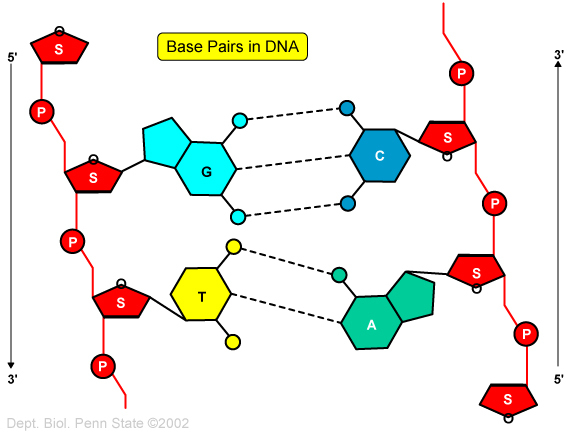
What makes up the SIDES of a DNA ladder?

a)

nitrogen bases

b)

sugars & phosphates

c)

genes & chromosomes

d)

RNA

27.

What makes up the rungs (steps) of a DNA ladder?

a)

sugars & phosphates

b)

nitrogen bases

c)

sugars

d)

genes & chromosomes

28.
Nitrogenous bases are joined by which type of bond?
a)
polar bonds
b)
ionic bonds
c)
covalent bonds
d)
hydrogen bonds
29.
What are the three components of a nucleotide?
a)
sugar, hydrogen, nitrogen base
b)
sugar, oxygen, nitrogen base
c)
sugar, phosphate, nitrogen base
d)
sugar, phosphate, protein
30.
Why is DNA important?
a)
it is very small and very complicated
b)
it's in everything
c)
it serves as the blueprint for traits of all living things
d)
because we eat it every day for energy
31.
Which sequence of DNA bases would pair with this partial strand
ATG TGA CAG
a)
ATG TGA CAG
b)
TAC ACT GTC
c)
GTA AGT GAC
d)
CAT TCA CTG
32.
Which amino acid is made from the RNA codon GUA?
a)
Phenylalanine
b)
Leucine
c)
Serine
d)
Valine
33.
Which amino acid is made from the RNA codon ACC?
a)
Tyrosine
b)
Isoleucine
c)
Threonine
d)
Valine
34.

Translate the mRNA molecule for this gene:

C-A-T-G-T-A-A-A-C

a)

T-C-G-A-T-U-U-C-C

b)

G-G-G-A-T-C-U-U-T

c)

G-U-A-C-A-U-U-U-G

d)

G-T-A-C-A-T-T-T-G

35.

The goal of mitosis is to

a)

make a new parent cell

b)

make two new daughter cells with the same DNA

c)

make two new daughter cells with different DNA

d)

to grow a larger toe

36.

DNA replication is semi-conservative, which means that at the end of replication, each new DNA molecule is composed of...

a)

two new strands of DNA

b)

two original (old) strands of DNA

c)

either two new or two original strands of DNA

d)

one new strand and one original strand of DNA

37.
Why are insertion and deletion mutations so harmful?
a)
They change all of the codons from the mutation on down the line, which changes the amino acid sequence
b)
They insert things that an organism doesn't need.
c)
They often delete things that organisms need.
d)
Insertion and deletions are not any more harmful than substitution mutations.
38.
Normal-
GAG-CTC-GAC-AGA
Mutant
GAG CTC-CAC-AGA
a)
no mutation
b)
substitution
c)
insertion
d)
deletion
39.

A point mutation in which the amino acid does not change.

a)

Missense

b)

Nonsense

c)

Deletion

d)

Silent mutation

40.

This type of substitution codes for a stop codon

a)

Missense

b)

Nonsense

c)

Silent

d)

Deletion

41.

8 A cellular process is shown. Which statement best describes the significance of this process?

a)

The process allows organisms to grow and heal.

b)

The process produces clones of the parent organism.

c)

The process copies DNA before cell division

d)

The process creates genetic variation in the resulting cells
42.

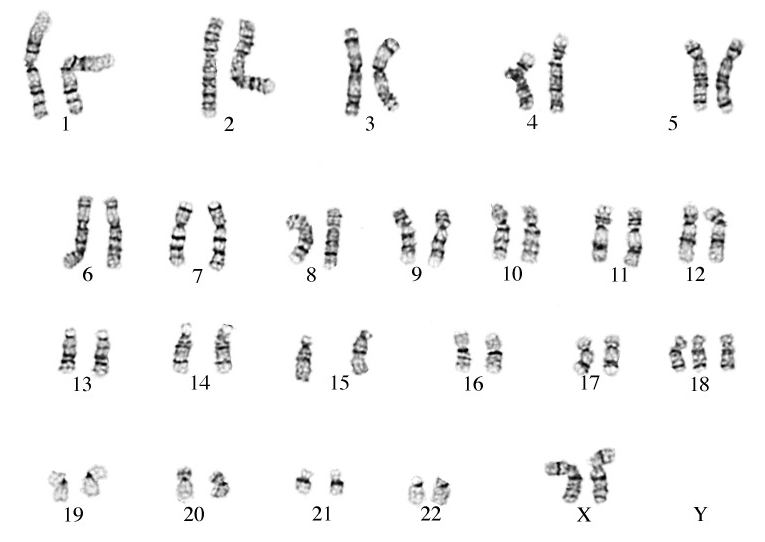
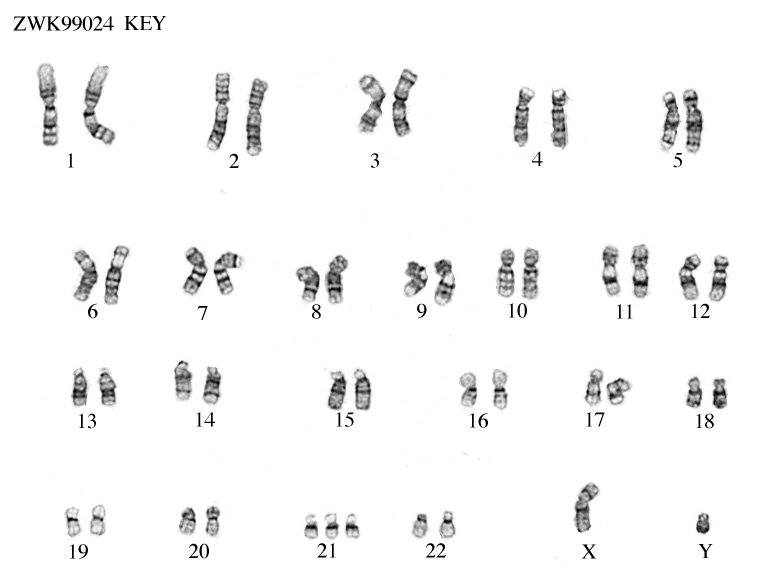
By looking at the chromosomes how can you tell that this person is biologically female?

a)

Because there are two X chromosomes

b)

Because there are more chromosomes than in a male
43.

What is the mutation in this persons chromosomes?

a)

There is only one X

b)

7 is shaped like a hockey stick

c)

There's an extra 21

d)

1 is too curved

44.

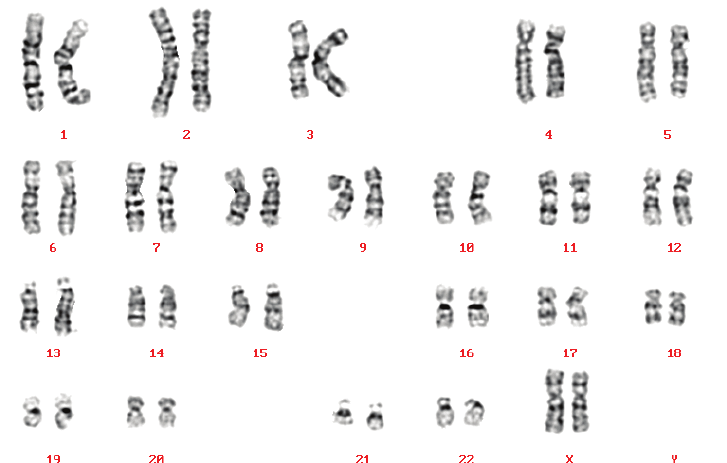
This is known as Edwards Syndrome, can you identify the chromosomal mutation?

a)

Chromosomes 1 and 2 are bent

b)

There is no Y chromosome

c)

This persons chromosomes are normal

d)

There are 3 of chromosomes 18

45.

When one allele mask/hides the presence of another, the allele is ___. It is written using a capital letter.

a)

recessive

b)

hybrid

c)

dominant

d)

phenotype

46.

An allele that is masked/hidden by another is ___. It is written using a lower case letter.

a)

Phenotype

b)

Homozygous

c)

Dominant

d)

Recessive

47.

How many are heterozygous?

a)

0%

b)

25%

c)

50%

d)

100%

48.
What allele combination should go in the missing box?
a)
AA
b)
Aa
c)
aa
d)
none of these
49.

Which genotype(s) would lead to the phenotype of yellow seeds?

a)

aa

b)

Aa

c)

AA

d)

AA or Aa

50.

Based off this punnett square, what fraction of the offspring will have wrinkled, green seeds?

a)

9/16

b)

3/16

c)

1/16

d)

16/16