
 Worksheets
Biology Semester 1 Final Study Guide
Total questions: 118
Worksheet time: 30hrs 30mins
Independent Variable
Test Variable
Measured Variable
No-Change Variable
Dependent Variable
Test Variable
Measured Variable
No-Change Variable
Control Variable
Test Variable
Measured Variable
No-Change Variable
TRUE OR FALSE:
Matter is made of atoms; Protons (+), Neutrons (0), Electrons (-).
True
False
Who knows?
Who cares?
The Periodic Table is arranged by…
Atomic #
Atomic Mass
Number of people who use them
Atomic #
Number of Electrons
Number of Neutrons
Number of Protons
Number of Protons plus the Number of Neutrons
Atomic Mass
Number of Protons
Number of Protons plus the Number of Neutrons
Number of Neutrons
Number of Electrons
Electron Cloud is the…
Volume
Mass
Surface
Nucleus is the…
Volume
Mass
Surface
Types of Matter
Solid
Liquid
Water
Gas
Bread
A solid’s atoms are…
Really close together
Semi-close together
Far apart
A liquid’s atoms are…
Really close together
Semi-close together
Far apart
A gas’s atoms are…
Really close together
Semi-close together
Far apart
TRUE OR FALSE:
Products yeild reactants
True
False
TRUE OR FALSE:
Macromolecules are large biomolecules that make up all food.
True
False
TRUE OR FALSE:
Monomers are made of polymers
True
False
Is protein a polymer or monomer?
Polymer
Monomer
Is a lipid a polymer or monomer?
Polymer
Monomer
Is a carbohydrate a polymer or monomer?
Polymer
Monomer
Is a nucleic acid a polymer or monomer?
Polymer
Monomer
Is a amino acid a polymer or monomer?
Polymer
Monomer
Is a fatty acid a polymer or monomer?
Polymer
Monomer
Is a monosaccharide a polymer or monomer?
Polymer
Monomer
Is a nucleotide a polymer or monomer?
Polymer
Monomer
Proteins are for…
Cell funtion and structure (enzymes)
Long-term energy storage
Short-term energy storage
Genetic code
Lipids are for…
Cell structure and function
Long-term energy storage
Short-term energy storage
Genetic code
Carbohydrates are for…
Cell structure and function
Long-term energy storage
Short-term energy storage
Genetic code
Nucleic acids are for…
Cell structure and function
Long-term energy storage
Short-term energy storage
Genetic code
Amino acids are made of…
NH2
Long C-H Chains
Sugar ring(s)
Phosphate + Sugar ring + Nitrogenous Base
Fatty acids are made of…
NH2
Long C-H Chains
Sugar ring(s)
Phosphate + Sugar ring + Nitrogenous Base
Monosaccharides are made of…
NH2
Long C-H Chains
Sugar ring(s)
Phosphate + Sugar ring + Nitrogenous Base
Nucleotides are made of…
NH2
Long C-H Chains
Sugar ring(s)
Phosphate + Sugar ring + Nitrogenous Base
TRUE OR FALSE:
Dehydration Synthesis is the building of polymers with the loss of H2O to create the reactants for Hydrolosis.
True
False
TRUE OR FALSE:
Hydrolysis consumes or breaks water to create the reactants for Dehydration Synthesis.
True
False
TRUE OR FALSE:
Enzymes are proteins.
True
False
Catalysts…
Speed up reactions
Slow down reactions
Do absolutely nothing
Lowers activation energy
An enzyme’s shape allows it to…
Function properly
Build biomolecules
Attach to the substrate at the Active site
Run in circles
TRUE OR FALSE:
If an enzyme is denatured (Heat, pH, Mutation), it still works normally.
True
False
Protons have what kind of charge?
Positive
Negative
Neutral
Neutrons have what kind of charge?
Positive
Negative
Neutral
Electrons have what kind of charge?
Positive
Negative
Neutral
The nucleus…
Houses and produces DNA/RNA/ genetic code
Builds Proteins
Creates Cell Energy
The ribosomes…
House and produce DNA
Build proteins
Make cell energy
Package vesicles
The mitochondria…
Makes sugar
Houses and produces DNA/RNA/ genetic code
Creates cell energy
The lysosomes…
Recycle/ breakdown old cells and/or infections
Makes and Houses DNA/RNA/ genetic code
Makes protiens
Package vesicles
The Rough Endoplasmic Reticulum…
Houses ribosomes to make proteins
Packaging vesicles
Makes and houses DNA/RNA/ genetic code
The Golgi Body…
Holds packaging vesicles
Recycles/ breaks down old cells/infections
Makes and houses DNA/RNA/ genetic code
Builds proteins
Cell Wall
Animal Cells
Plant Cells
Both
Cell Membrane
Animal Cells
Plant Cells
Both
Large cell vacuole stores…
Carbon Dioxide
Water
Glucose
DNA
Large Cell Vacuole
Animal Cells
Plant Cells
Both
Chloroplasts…
Make sugar
Make DNA
Make water
Chloroplasts are located in…
Autotrophs
Heterotrophs
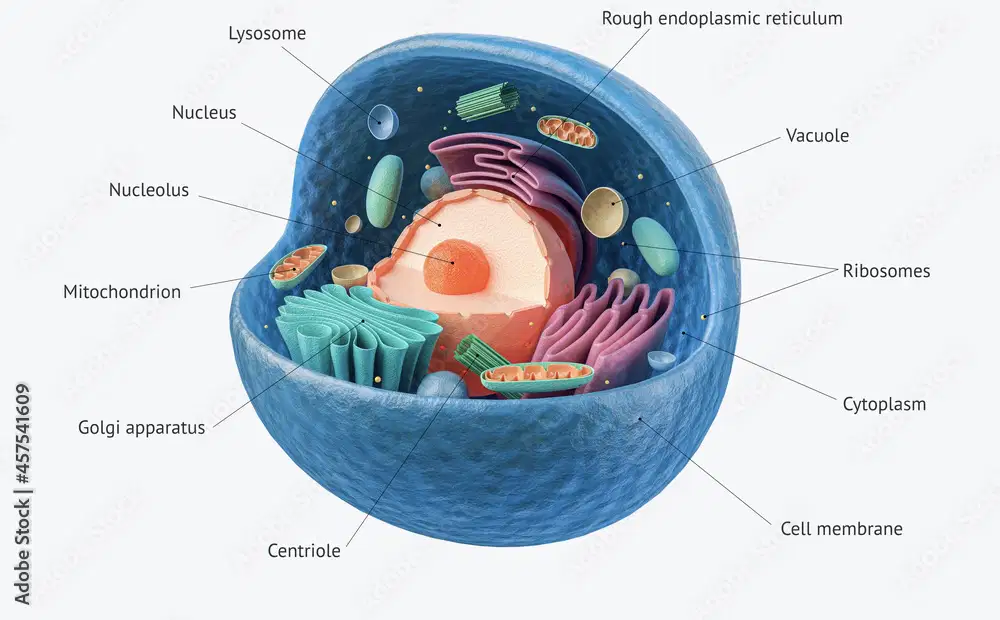
What type of cell is this?
Animal
Plant

What type of cell is this?
Plant
Animal
The cell membrane is made of…
A phospholipid bilayer
Membrane-bound Proteins
Cholesterol
Channel proteins
DNA
Passive transport
Diffusion
Osmosis
Phagocytosis
Diffusion sends areas of…
Low concentration to high concentration
High concentration to low concentration
If water is being diffused, it is…
Osmosis
Endocytosis
Exocytosis
Diffusion
Hypertonic means…
Low water
High solute
Cell shrinks
High water
Cell swells
Isotonic means
Equal water
Equal solute
Equilibrium
Cell shriks
Cell swells
Hypotonic means…
High water
Low solute
Cell swells
Equal water
Low water
Active transport uses…
Protein pumps
Osmosis
Endocytosis
Exocytosis
TRUE OR FALSE
Active transport pumps Na+ in and K+ out.
True
False
Endocytosis is also known as…
Osmosis
Phagocytosis
Diffusion
Exocytosis
Endocytosis…
Envelops pathogens
Leaves the cell
Exocytosis…
Envelops pathogens
Leaves the cell
Cell Respiration is located in…
The cytoplasm/ cytosol
The mitochondria
The chloroplast
The nucleus
Glycolosis
In cytoplasm, changes glucose to 2 pyruvic acids
In the mitochondria, gets out CO2 + 2ATP
In the mitochondria, gets out 32-34 ATP
Krebs Cycle
In the cytoplasm/ cytosol, and changes glucose to 2 pyruvic acids
In the mitochondria, gets out CO2 + 2ATP
In the mitochondria, gets out 32-34 ATP
Electron Transport Chain
In the cytoplasm/ cytosol, and changes glucose to 2 pyruvic acids
In the mitochondria, gets out CO2 + 2ATP
In the mitochondria, gets out 32-34 ATP
Fermentation
Lactic Acid (muscle)
CO2 and Ethanol (yeast/ bacteria)
Produces 2 ATP
TRUE OR FALSE:
ATP turns into ADP because a phosphate leaves, resulting in an energy release.
True
False
TRUE OR FALSE:
Fermentation is an anaerobic reaction.
True
False
TRUE OR FALSE:
The Krebs Cycle is an anaerobic reaction.
True
False
TRUE OR FALSE:
The Electron Transport Chain is an aerobic reaction.
True
False
Photosynthesis is in the…
Mitochondria
Chloroplast
Vacuole
Lysosome
TRUE OR FALSE:
An autotroph is an organism that can produce its own food using light, water, carbon dioxide, or other chemicals.
True
False
TRUE OR FALSE:
Heterotrophs, not autotrophs, perform photosynthesis.
True
False
Photosynthesis…
Builds large sugars (from smaller molecules like water and carbon dioxide)
Splits the genetic code to help create more cells
Creates amino acids for proteins
TRUE OR FALSE:
Photosynthesis is a reduction oxydation reaction.
True
False
Which molecule is reduced in photosynthesis?
The 6 CO2
The 6 H2O
What molecule is oxidized in photosynthesis?
The 6 CO2
The 6 H20
The Light Reactions occur in the…
Thylakoid/granum
Stroma
The Dark Reactions occur in the…
Thylakoid/granum
Stroma
TRUE OR FALSE:
The positively charged Phosphate in the molecule NADP+ picks up the negatively charged Hydrogen to create NADPH, which then goes into the stroma.
True
False
TRUE OR FALSE:
ATP + NADPH goes into the Calvin Cycle
True
False
TRUE OR FALSE:
ADP + NADP+ goes into the Calvin Cycle.
True
False
ATP stands for…
Adenosine Triphosphate
Adenosine Diphosphate
Deoxyribose Nucleic Acid
ADP stands for…
Adenosine Triphosphate
Adenosine Diphosphate
Deoxyribose Nucleic Acid
What are the three parts of a nucleotide?
Phosphate Group
Deoxyribose
Nitrogenous Base (N-Group)
DNA
What are the Nitrogenous Bases?
Adenine
Thymine
Guanine
Cytosime
Trimine
How many Nitrogenous Bases are there? (Other than Uracil)
2
3
4
5
What kind of sugar is found in a nucleotide
Phosphate Group
Deoxyribose
Nitrogenous Base
Which nucleotide component contains nitrogen?
Phosphate Group
Deoxyribose
Nitrogenous Base
What makes up the backbone of DNA?
Phosphate Group
Deoxyribose
Nitrogenous Base
What is the shape of DNA
Helix
Double Helix
Triple Helix
Quadruple Helix
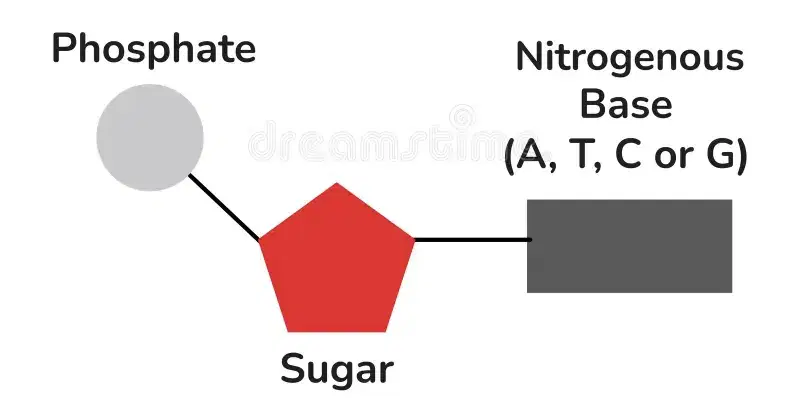
TRUE OR FALSE:
This is a nucleotide.
True
False
Which Nitrogenous Base is paired with Adenine?
Adenine
Thymine
Cytosine
Guanine
Which Nitrogenous Base is paired with Thymine?
Adenine
Thymine
Cytosine
Guanine
Which Nitrogenous Base is paired with Cytosine?
Adenine
Thymine
Cytosine
Guanine
Which Nitrogenous Base is paired with Guanine?
Adenine
Thymine
Cytosine
Guanine
How many hydrogen bonds are between Adenine and Thymine?
1
2
3
4
How many hydrogen bonds are between Cytosine and Guanine?
1
2
3
4
What is the DNA pairing for the sequence ATCCAG?
TAGGTC
ATCCAG
GACCAT
CTGGAT
What type of biological molecule is DNA helicase?
Carbohydrate
Lipid
Protein
Nucleic Acid
What role does DNA helicase have in the replication of DNA?
It unzipps the DNA
It gets the DNA ready to be unzipped
It pairs the Okazaki Fragments to the new DNA strand
What type of replication is DNA replication?
Semi-Conservative replication
Conservative replication
Non-Conservative replication
DNA contains the genetic blueprint for making…
Proteins
Lipids
Carbohydrates
Nucleic Acids
The DNA template is used to make…
mRNA
tRNA
rRNA
What is the new Nitrogenous Base that is only found in RNA?
Adenine
Uracil
Guanine
Cytosine
What is Adenine Paired with in RNA?
Thymine
Uracil
Cytosine
Guanine
If the mRNA sequence reads AGGCTA, what is the tRNA pairing?
UCCGAU
AGGCTA
ATCGGA
UAGCCU
What is the start codon?
AUG
CCG
ACU
GCA
Translation continues on the ribosome until a _______ is reached.
START codon
STOP codon
mRNA binds to _________
A ribosome
The mitochondria
The nucleus
The lysosome
What are ribosomes made of?
rRNA
mRNA
tRNA
What does tRNA carry to the ribosome for translation?
(SELECT ALL THAT APPLY)
Amino acid
Anticodons
Codons

