
 Worksheets
Practice Test - Light & the e- (Ch 11)
Total questions: 40
Worksheet time: 55mins
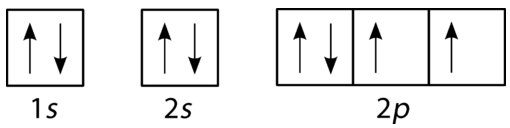
1s2 2s2 2p6 3s2
How many orbitals are there in a d sublevel?
How many orbitals are there in a p sublevel?
What is this element?
1s22s22p63s23p64s23d104p6
How many electrons can the first principal energy level hold?
What electron configuration matches a neon atom?

There are 4 different types of sublevels: s,p,d,f.


varying
long
the same
short

Which color on the visible spectrum has the longest wavelength?
blue
green
yellow
red
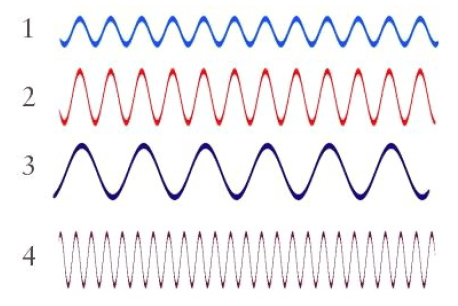
Which wave in the diagram has the greatest energy?
1
2
3
4
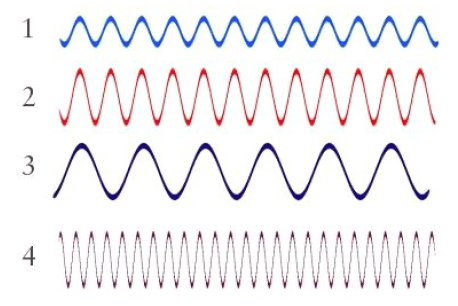
When an electron in the _______state absorbs energy, it goes to the ________ state.
lower, excited
ground state, higher state
ground state, excited state
excited state, ground state
What are spectral lines?
Dark or bright lines in a spectrum that correspond to specific wavelengths of light emitted or absorbed by an atom or molecule.
Lines that indicate the density of a liquid
Lines that indicate the pressure of a gas
Lines that indicate the temperature of a star
What is the purpose of flame tests in atomic emission?
The purpose of flame tests in atomic emission is to create a chemical reaction between the sample and the flame.
The purpose of flame tests in atomic emission is to identify the presence of specific elements in a sample based on the color of the flame produced when the sample is heated.
The purpose of flame tests in atomic emission is to determine the pH level of the sample based on the color of the flame produced.
The purpose of flame tests in atomic emission is to measure the temperature of the flame produced when the sample is heated.
What is the relationship between spectral lines and energy levels?
Spectral lines are produced when photons transition between different energy levels in an atom.
Spectral lines are produced when neutrons transition between different energy levels in an atom.
Spectral lines are produced when electrons transition between different energy levels in an atom.
Spectral lines are produced when protons transition between different energy levels in an atom.
According to the Bohr model, what are energy levels in atoms?
The fixed energies an electron can have in an atom.
The specific frequencies of light emitted by an element.
The distances between crests of waves.
The different colors of light in the atomic emission spectrum.
What does the Bohr model represent with its orbits?
The different elements in the periodic table.
The energy levels of the electrons in the atom.
The specific wavelengths of light emitted by the element.
The distances between crests of waves.

The picture shows an atom in the ground state absorbing energy and the electron jumps to the excited state. Which state has higher energy?
Ground State
Excited State
The number of wave cycles to pass a given point per unit of time.
Amplitude
Wavelength
Frequency
When atoms absorb energy, electrons ..............energy level
move to higher
move to lower
stays in the same


True or False: The ground state is the highest energy state of an atom.
True
False
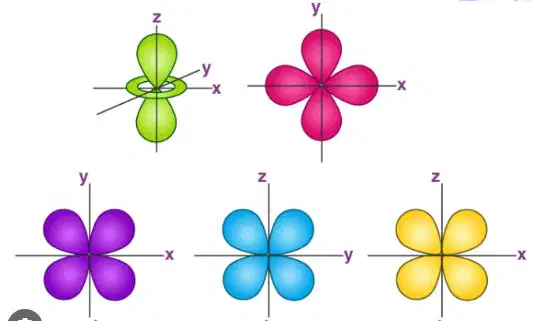
What type of sublevel is shown in the image?
s
p
d
f

What is the energy of a photon that has a frequency of 3.0 x 10²⁰ Hz?
Remember that ...
c = 3.0 x 10 8 m/s
h = 6.626 x 10⁻³⁴ J s
EXTRA CREDIT:
Pick the correct configuration for a potassium ion.
1s22s22p63s1
1s22s22p63s23p6
1s22s22p63s23p64s1
1s22p83s1

