
 Worksheets
biology midterm
Total questions: 68
Worksheet time: 36mins
Which of the following would best describe a hypothesis?
A proven fact
A question
An educated prediction
A random assumption
A researcher wants to know if music affects concentration. They have participants solve puzzles in three conditions: silence, soft instrumental music, and loud rock music. The time taken to solve the puzzles is recorded. What is the dependent variable in this experiment?
The type of music played
The difficulty of the puzzles
The time taken to solve the puzzles
The number of participants
In an experiment testing plant growth under different light conditions, what is the dependent variable?
Type of light
Amount of water
Height of plant
Soil type
What is the purpose of a control group of an experiment?
Change multiple variables at once
Test the dependent variable
Serve as a comparison for the experimental group
Prove the hypothesis is correct
Experiments must contain factors that do not change. These factors are known as _____________.
Control groups
Dependent variables
Independent variables
Constants
While writing the conclusion of an experiment, which of the following should be included?
Summarizing whether the hypothesis was supported or rejected.
Summary of your procedures.
Analysis of your data.
Both A and C.
What would be the best way to collect data for an experiment?
Anecdotes
Tables and graphs
Essays
Abstract drawings
Which of the following statements is an observation?
Plants need sunlight to grow.
The plant grew 5 cm in one week.
If I water the plant more, it will grow faster.
Plants with larger leaves grow better in shade.
A scientist wants to know if caffeine affects reaction time. They divide participants into two groups: one group drinks a cup of caffeinated coffee, and the other drinks decaffeinated coffee. Both groups then complete a reaction time test, and their results are compared. Which is the experimental group in this experiment?
The group drinking decaffeinated coffee
The group drinking caffeinated coffee
Neither group, this experiment does not contain an experimental group.
Both groups
What is the primary function of carbohydrates?
Store genetic information
Provide energy
Build muscle
Transport oxygen
Which of the following is the monomer unit of a protein?
Nucleotides
Fatty acids
Amino acids
Simple sugars
Which macromolecule is responsible for storing genetic information?
Nucleic acids
Proteins
Carbohydrates
Lipids
Which of the following is true about enzymes?
They are consumed during the reaction.
They slow down chemical reactions.
They are lipids.
They lower the activation energy of a reaction.
Lipids are primarily used by organisms for _____________________________.
Long-term energy storage.
Building muscle tissue.
Transporting oxygen in the blood.
Conducting nerve impulses.
What happens when a protein is denatured?
It gains energy.
Its shape and function are altered.
It becomes a lipid.
It stops being a macromolecule.
In the chemical structure of water, 2 hydrogen atoms and an oxygen atom share electrons creating a(n) __________ bond that forms a(n) __________.
covalent; molecule
ionic; molecule
metallic; compound
ionic; ion
covalent; ion
What is the name of the property of water that allows it to stick to other substances?
Cohesion
Adhesion
Surface tension
Polarity

Take a look at the image below and identify label 1.
Covalent bonds
Ionic bonds
Hydrogen bonds
Water bonds
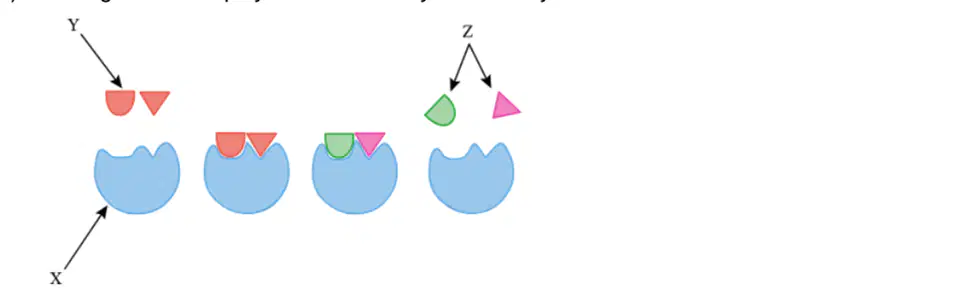
The image below displays the use of enzymes. Identify label Y.
Product
Enzyme-substrate complex
Lactase
Substrate
Which organelle is responsible for producing energy in the form of ATP?
Nucleus
Mitochondria
Ribosome
Golgi apparatus
Which of the following describes the composition of the cell membrane?
Proteins and carbohydrates
Nucleic acids and lipids
Phospholipid bilayer
Nucleic acid bilayer
Which organelle contains the cell's genetic material?
Ribosomes
Nucleus
Chloroplast
Lysosomes
What is the primary function of ribosomes?
Synthesize proteins
Store energy
Transport materials
Break down waste
Plant cells differ from animal cells due to the presence of which organelle(s)?
Mitochondria
A nucleus
A cell wall and chloroplasts
A cell membrane
If you were to draw and label a diagram of a prokaryotic and eukaryotic cell, which of the following would you add to the eukaryotic cell that you would NOT add to the prokaryotic cell?
Cell membrane
Cytoplasm
DNA
Nucleus
Which structure of a cell regulates what enters and exits the cell?
Nucleus
Cytoplasm
Cell membrane
Vacuole
Which of the following describes passive transport?
Movement of substances against a concentration gradient using energy.
Movement of substances down a concentration gradient without using energy.
Movement of large molecules out of the cell via vesicles.
Movement of substances only into the cell using ATP.
Which type of transport requires energy in the form of ATP?
Osmosis
Active transport
Diffusion
Facilitated diffusion
What happens to an animal cell placed in a hypotonic solution?
It shrinks as water leaves the cell.
It swells and may burst as water enters the cell.
It remains the same size as water moves in and out equally.
It divides to balance water levels.
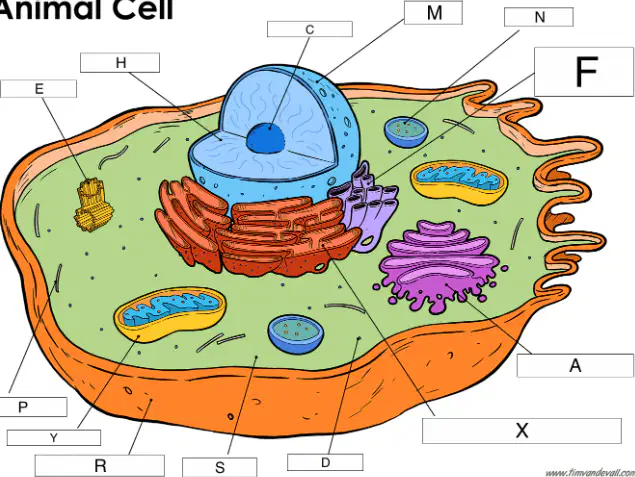
Identify label X.
Golgi apparatus
Mitochondria
Rough endoplasmic reticulum
Smooth endoplasmic reticulum
Identify label S (the free space).
Cytoskeleton
Cell membrane
Vacuole
Cytoplasm
What is the main purpose of photosynthesis?
To break down glucose into energy.
To convert solar energy into chemical energy.
To release carbon dioxide into the atmosphere.
To create proteins.
Which organelle is responsible for photosynthesis?
Mitochondria
Chloroplast
Nucleus
Ribosome
The primary pigment involved in photosynthesis is _____________.
Chlorophyll
Carotenoid
Hemoglobin
Melanin
What are the 2 stages of photosynthesis?
Light-independent reactions & Calvin cycle
Light-dependent reactions & Calvin cycle
Light-independent reactions & Krebs cycle
Light-dependent reactions & Krebs cycle
During photosynthesis, water is split to release which gas?
Glucose
Carbon dioxide
Oxygen
ATP
The energy used to drive the Calvin cycle comes from which of the following molecules?
Carbon and oxygen
ATP and NADPH
Glucose and oxygen
Carbon dioxide and water
What is the main product of the Calvin cycle?
Oxygen
Glucose
ATP
NADP+
What is the main purpose of cellular respiration?
To produce glucose
To generate ATP
To store energy as fat
To create oxygen
In what area of the cell does glycolysis occur?
Cytoplasm
Nucleus
Mitochondria
Cell membrane
What are the main products of glycolysis?
ATP and water
Pyruvate and ATP
Carbon dioxide and water
Oxygen and glucose
The Krebs cycle takes place in the ____________________.
Cytoplasm
Mitochondrial matrix
Chloroplast
Thylakoid membranes
What is the final stage of cellular respiration and where the most ATP is produced?
Glycolysis
The Calvin cycle
The Krebs cycle
The electron transport chain
In the absence of oxygen, cells undergo _______________.
Photosynthesis
Fermentation
The electron transport chain
The Calvin cycle
What is the result of mitosis?
Four genetically unique cells
Two identical daughter cells
Gametes
Zygotes
During which phase of mitosis do the chromosomes align at the cell's equator?
Prophase
Metaphase
Anaphase
Telophase
What is the purpose of meiosis?
To produce identical cells
To repair damaged cells
To produce gametes
To create energy
How many chromosomes are present in human gametes?
23
46
92
12
Which phase of the cell cycle does DNA replication occur in?
Prophase
Metaphase
S phase of interphase
G1 of interphase
Who is considered the father of genetics?
Charles Darwin
Gregor Mendel
Louis Pasteur
James Watson
If a trait is controlled by a recessive allele, an individual must have:
Two recessive alleles
One dominant and one recessive allele
Two dominant alleles
A dominant allele
A homozygous dominant genotype is represented with the letters _____.
Aa
AA
Aa
AB
Which of the following best describes the definition of an allele?
A type of chromosome
A version of a gene
A trait passed to offspring
The physical expression of a gene
During incomplete dominance, the phenotype would be seen as…
A mix of both parent phenotypes
Completely dominant
Completely recessive
Unaffected by genetics
What is the shape of a DNA molecule?
Single helix
Beta sheet
Double helix
Linear strand
Which components make up the backbone of a DNA molecule?
Phosphate groups and nitrogenous bases
Deoxyribose sugars and phosphate groups
Deoxyribose sugars and nitrogenous bases
Ribose sugars and nitrogenous bases
What important role did Oswald Avery play in the history of DNA?
He was the first to observe the structure of DNA.
He demonstrated that DNA is the material responsible for heredity.
He was the first to sequence the human genome.
He identified the roles of proteins in genetics.
Which nitrogenous bases are found in DNA?
Adenine, uracil, cytosine, guanine
Adenine, thymine, cytosine, guanine
Thymine, uracil, guanine, adenine
Adenine, thymine, cytosine, ribose
In DNA, adenine pairs with _______ and cytosine pairs with _______.
thymine; guanine
guanine; thymine
cytosine; uracil
thymine; uracil
uracil; adenine
What type of bond holds the two strands of DNA together?
Ionic bonds
Hydrogen bonds
Covalent bonds
Peptide bonds
Which enzyme is responsible for unwinding the DNA double helix during replication?
DNA polymerase
Helicase
Ligase
Primase
What is the role of DNA polymerase in DNA replication?
Breaking hydrogen bonds between base pairs
Synthesizing new strands by adding complementary nucleotides
Sealing gaps between fragments of DNA
Removing RNA primers
What was the significance of Rosalind Franklin's work in the discovery of DNA's structure?
She was the first to discover the double helix structure.
She provided X-ray images that helped identify the structure of DNA.
She synthesized the first artificial DNA molecule.
She was the first to clone a DNA molecule.
Which of the following would be the correct complementary strand to the following strand of nucleotides? ATTCGGTGA
TAAGCCACT
CATTAGCAC
ACTGCACTA
TCAACCGAT
What is the chemical equation for photosynthesis
(a)
What is the chemical equation for cellular respiration
(a)
"sac-like" structures name one organelle and explain the function
(a)
explain codominance and how the genotype of 2 individuals would affect the phenotype of the offspring
(a)

