
 Worksheets
East Asia & Byzantine Empire Review
Total questions: 100
Worksheet time: 51mins
Which leader is most closely associated with the Mongol Empire?
Charlemagne
Marco Polo
Genghis Khan
Confucius
Who was Marco Polo?
A famous Mongol soldier who was imprisoned by Europeans
A missionary trying to spread Christianity in China
An Italian merchant and explorer who traveled to Mongol controlled China
None of the above
What is the Buddhist belief of nirvana?
Reincarnation or rebirth into another life on Earth
The worship of ancestor spirits
Goal of Buddhism; state of enlightened peace and happiness
A start to new life and end of suffering from an old life
What was Confucianism?
A polytheistic religion that incorporated ancient Chinese gods/goddesses
An ancient Chinese social and political philosophy (way of thinking)
A religion that spread along the Silk Road throughout Asia
The worship of ancestors
Who was Kublai Khan?
Emperor of Japan
Leader of the Persian Army
The man who united the Mongols into an empire
Genghis Khan's grandson who conquered China
Which of the following was NOT invented during the Song Dynasty?
Movable type printing
Steam Engine
Compass
Fireworks
How did Buddhism spread throughout China?
The Emperor paid citizens become Buddhist
Traders and missionaries spread information along the Silk Road
Peoples were conquered and forced to convert
Confucianism and other Chinese philosophies were banned

Which number correctly identifies the location of the Mongol Empire?
1
2
3
4
In the Song Dynasty, new irrigation systems and farm improvements led to food surpluses.
True
False
Because of Marco Polo's explorations and the Mongol conquests...
Confucianism spread to Western Europe
Buddhism became an unpopular religion in East Asia
Technology such as fireworks/gunpowder spread to Western Europe
Trade across the Silk Road from East Asia to Europe stopped
Who was the founder of Buddhism?
Gabriel
Joan of Arc
Muhammad
Siddhartha Gautama
Which of these WAS NOT a reason the Mongol Empire expanded (grew) so quickly?
Violent conquest
Use of horses in war
The bubonic plague
Using enemy soldiers and citizens against the enemy

The image below shows the spread of...
Buddhism in East Asia
The Song Dynasty
Christianity in East Asia
The Mongols and the Mongol Empire
Who was Genghis Khan?
A philosopher who believed in the importance of inner peace
A merchant prince who became the richest man in East Asia
A samurai warrior that overthew the Japanese emperor in 1243
A Mongol that united the Mongols into an empire
What were two tactical advantages held by the Mongol army when it conquered other groups?
Gunpowder and using enslaved people
Camels and huge amounts of supplies
Long-range arrows and horsemanship skills
Knowledge of geography and cannons
What effect did Marco Polo's journeys and his book have on Western Europe?
Some Europeans became interested in East Asia and traveled there
He increased hatred of Chinese culture and traditions
He helped to create new tax laws in southern Europe
He invented a new sailing technology brought from his travels
The Ming Dynasty wanted China to follow policies of isolationism. Isolationism is...
Attempting to cooperate with many countries/empires
A military policy focused on conquering one target at a time
Avoiding involvement in other countries affairs
Why did the Ming Dynasty rebuild parts of the Great Wall?
To create a border between China and other countries
To provide a transportation system for the Empire
To create a place for Chinese Buddhists to worship
To isolate themselves from northern invaders, like the remaining Mongols
Who lived in the Forbidden City?
Any citizen who could afford to live there
The Chinese imperial family and certain government officials
Genghis Khan and his descendants
Chinese merchants and business owners
After the Yuan Dynasty (Mongols) what dynasty took its place?
Han
Song
Tang
Ming
What was one of the reasons the Ming Dynasty followed policies of isolationism?
European explorers and armies threatened Chinese culture and society
The Ming Dynasty had conflicts with India and Japan
They wanted to spend more money on Zheng He's voyages
They wanted to focus on protecting China from being reconquered by the Mongols
Who was Zheng He?
The final emperor of Ming Dynasty China
A European merchant who traveled to China and wrote a book about his travels
A military commander of the Mongol Empire
A naval commander who sailed around Asia with his large "treasure ships"
Wendi was a Chinese emperor in the Sui Dynasty. The Sui Dynasty came before the Tang Dynasty and helped spread _______________________.
Confucianism
Neo-Confucianism
Buddhism
Christianity
Which emperor helped reunify China BEFORE the Tang Dynasty?
Wendi
Zhu Di
Zheng He
Kublai Kahn
Commercial trade expanded during the Song Dynasty due to the
new ships being built
advancement of horse drawn carts
trade deals with Japan
the Silk Road
How did Genghis Khan create such a large empire?
Through ruthlessness and leniency
Through religion and culture
Through exploration and invention
Through economy and government

What can we infer from the map?
Genghis Kahn's empire shrank in size after his death
Genghis Kahn's empire conquered Africa
Genghis Kahn's respected Japanese culture
Genghis Kahn's empire grew in size after his death
Kublai Khan conquered which Chinese Dynasty?
Han
Song
Tang
Shang
Kublai Khan created which Chinese Dynasty?
Sui
Tang
Song
Yuan
Which of the following helped Kublai Khan rule most effectively?
Military force
Strong central government and respect for local cultures
He helped spread Buddhism from India to China
He conquered Japan and built the Forbidden City
How did the Mongols help expand trade on the Silk Road?
The paved the road near the Roman Empire
They made a trade deal with India
They lowered taxes and protected travelers
They built an extra road that led to Africa
Which of these were ways that Kublai Khan adopted Confucianism into his government in the Mongol Empire? Choose all that apply.
Appointed a council of Confucian advisors
He himself followed the religion of Confucianism and converted people
Appointed people to jobs based on merit rather than connections
Held special meditating sessions every day with the people
How did the Ming Dynasty have a lasting impact on China?
It made practicing Buddhism illegal
It allowed European nations to create colonies that lasted centuries
Zheng He's voyages allowed China to establish colonies all over the world before European countries could
It started a policy of isolationism that lasted centuries
Why did the Ming Dynasty build the Forbidden City?
To create a space for the Chinese merchants and business owners to trade
To create a space to hold public celebrations and festivals
To create a space for the Chinese imperial family and certain government officials to live in the new capital
To create a space to hold political prisoners and other enemies
The "treasure fleet" traveled to places like India, Thailand, and the eastern coast of Africa, brining Chinese goods to trade. In return, good were brought back to China that amazed the emperor. Who was in command of these voyages?
Zheng He
Wendi
Liu Bang
Zhu Di
What was the main religion of ancient Japan?
Buddhism
Islam
Hinduism
Shintoism
Which two countries influenced ancient Japan the most?
Mongolia
China
India
Korea
Which of the following two religions/philosophies influenced Prince Shotoku's constitution?
Buddhism
Hinduism
Confucianism
Islam
How many sacred/holy books are there in Shinto?
3
2
1
0
Which of the following is important in the Shinto belief system?
Kami
Animism
Ritual Practices
All of the above
Which term refers to the "Spirit of a god"?
Animism
Kami
Which term refers to the idea that all living things and inanimate objects contain spirits?
Animism
Kami

What is this a picture of?
A Buddhist temple
A Confucian arch
A Japanese lacquered case
A Shinto shrine
The Japanese writing system was mostly based off of the
Korean writing system
Mongol writing system
Japanese pictograph system
Chinese writing system
Japanese aristocracy refers to the
upper class of Japanese society
lower class of Japanese society
Which time period in Japan created Japan's national culture?
The Yamato clan
The Heian
The Kamakura
The Tokugawa
Which is NOT a characteristic of the Heian Period in Japan?
The capital city was Heiankyo
They created paintings and buddhist sculptures
Women wrote poems and "The Tale of Genji" was written
The Emperor had all of the power in society
The Heian period ended in the _______ century and the Japanese military took over.
8th
10th
12th
14th
What was the role of the Shogun in Japanese society?
Farming
Landowner
Military Leader
Merchant
What was the role of the Samurai in Japanese society?
Warrior
Landowner
Merchant
Priest
Who was at the top of Japanese military society?
Peasants
Samurai
Daimyo
Shogun
Who was just above the peasants in Japanese military society?
Daimyo
Shogun
Samurai
What does "Bushido" mean?
The way of the sword
The way of the warrior
Who practiced "Bushido"?
Samurai
Daimyo
Shintoism is an original Japanese religion but which religion came to Japan from China and India?
Hinduism
Christianity
Islam
Buddhism
How did Japan's geography shape its culture?
The island nation could trade more on the Silk Road
It was mostly farmland which led to farming inventions
It was covered primarily with deserts which led to caravans
It was isolated so they adapted Chinese culture to their needs
What is a major geographic effect on Japan?
Seas isolated it
trade routes made it easy to get to
Famine was common due to lack of farmland
Water was scarce
What was the role of the samurai?
To protect Shogun lands
To protect the emperor at all cost
To protect Daimyo lands
To protect against outside invaders
Which of these options are NOT related to the Heian Period?
Art was important
A peaceful period with a stable government
A unique national culture
A time of war with strong military
Which is closely related to the Japanese sponsoring various forms of art during the Heian?
Russia invaded
Missionaries established Christianity in Japan
China adopted the Japanese writing system
A unique Japanese culture developed
Why did the Japanese Feudal Pyramid not combine the merchants with the peasants and artisans?
Because merchants were seen as higher because they made money for the Emperor
Because merchants were seen as lower because they made money off of other people
Because peasants and artisans were seen as the lowest class because their jobs were unimportant
Because merchants were seen as lower because they did not make enough money
The belief in one god is known as what?
Monotheistic
Polytheistic
Atheist
Agnostic
The belief in more than one god is known as what?
Monotheistic
Polytheistic
Atheist
Agnostic
Shintoism is considered what type of religion?
Monotheistic
Polytheistic
Atheist
Agnostic
What type of characters represent whole words in the Japanese writing system?
Kanji
Kami
Kana
Kimchi
Which is NOT true about Zen Buddhism?
It emphasized simplicity.
It requires focus and meditation.
It encourages inner peace.
It requires followers to pray in a Buddhist temple with specific prayers.
Who had the real power in Japan's social pyramid?
the figurehead
the emperor
the shogun
the daimyo
Which was the first shogunate established by Minamoto Yoritomo?
Tokugawa Shogunate
Kamakura Shogunate
Yamato Shogunate
Ashikaga Shogunate
Which clan became the Japanese Imperial Family?
The Kamakura Clan
The Tokugawa Clan
The Heian Clan
The Yamato Clan
Who moved the capital city from Rome to the ancient city of Byzantium?
Justinian
Procopius
Justin
Constantine
What religion did Constantine promote in the Empire?
Christianity
Islam
Zoroastrianism
Polytheism
After the capital was moved from Rome to Byzantium, what was the new name of Byzantium?
Old Rome
Constantinople
Corinth
Philippi
Why was Constantinople such an economically successful city? (Economically successful = money!)
It was in the middle of nowhere
It was right next to the Mediterranean Sea
It was a crossroads of major trade routes
It was very pretty
Which art style used bits of colored stone or glass to create a picture, often religious?
Stone carving
Pottery
Glass blowing
Mosaics
What is the event in the year 1054 that marked the split between the Roman Catholic Church and the Eastern Orthodox Church?
The Great Rift
The Little Split
The Great Schism
The Large Dissent
Theodora's influence on Justinian resulted in:
Limiting the people's freedoms
Increasing the number of gladatorial games
The creation of laws that protected women and children
The creation of laws that banned most religions
What was the Hippodrome?
The place where gladiators went to fight
A large stadium that held chariot races
A dome made in the center of Greece
The only place where women could compete in sports
Why was the Justinian Code important?
It was the history of the Byzantine Empire
It gave detailed instructions on how to make Greek fire.
It organized and simplified and old Roman Empire laws and made them fair
It was detailed history of Muhammad that Muslims use as an example of how to live their lives.
What two churches came from the Great Schism?
Roman Catholic Church and Eastern Orthodox Church
The Baptist Church and the Jewish Church
The West and The East
The Greek Orthodox Church and Russian Orthodox Church
Which of the following is Theodora known for?
Fighting for the rights of slaves
Fighting for the rights of women and children
Fighting the Romans
Running away to be part of the Greeks.
Why was Constantinople a great site for a capital?
The site was easy to defend as a peninsula.
It was a walled city.
It was a crossroads of east and west trade routes.
All of the above.
The Byzantine Empire connects which two continents?
Asia and Europe
Asia and Australia
Europe and Africa
Asia and Africa
The organized system of Byzantine laws and government was known as ________________
The Ten Commandments
Declaration of Independence
Code of Hammurabi
Justinian Code
Which part of the Roman Empire was the Byzantine Empire a part of and was free from Barbarian invasion?
North
South
East
West
Which of the following is NOT an achievement of the Emperor Justinian?
Justinian's military conquest restored the Roman Empire.
Justinian's contribution to the arts led to advancements in architecture.
Justinian's loss of the empire due to invaders from other lands.
Justinian's Code of Laws created a significant legal system.
What physical feature made Constantinople easy to defend?
It was entirely surrounded by deserts.
It was located on a mountaintop in the Alps.
It was located on a peninsula and was surrounded by water on three sides.
It sat on a plateau that overlooked the Northern European Plain.

The Byzantine military conquered territories once part of the Roman Empire that included
Britain and Gaul
Italy, Spain, and Northern Africa
Egypt and Syria
China and India
What was a primary goal of the Justinian Code?
To consolidate the emperor's power by eliminating old laws
To ensure fair treatment under the law for all citizens
To expand the empire through military conquest
To increase taxes on the wealthy to support the poor
The Byzantine Empire is best known for its...
beautiful metalwork and pottery
expression of Islamic values and beliefs
hand-woven, colorful clothing
religious art and architecture
Which of the following is NOT a reason the Byzantine Empire lasted so long?
It was a center of trade
It had diverse(different)
religions
It had a good, strong government
It was in a very good location
When the citizens rioted against Justinian it was known as the ____ Revolt
Blue
Green
Nika
Nike
As Roman influence faded in the Eastern Empire, which language became dominant?
Latin
Phoenician
Greek
Coptic
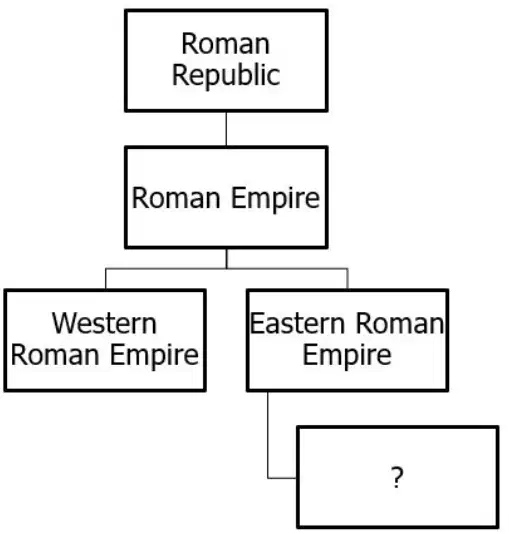
This chart shows several changes to the structure of Roman civilization. Which term best completes this chart?
Heian Period
Ming Dynasty
Kingdom of Mali
Byzantine Empire
Why did Christianity blossom in the lands controlled by the Byzantine Empire?
The Byzantine Empire built churches and made Christianity the official religion.
The Turkish invaders brought Christianity to the region, increasing its popularity.
Trade with the Middle East brought Christianity to the region.
Justinian attempted to ban all religion, but local churches controlled the Senate.
How was the Byzantine Empire related to the Roman Empire?
The Byzantine Empire provided many cultural ideas that the Roman Empire copied.
The Byzantine Empire rose out of the eastern Roman Empire.
The Byzantine Empire invaded and destroyed the Roman Empire.
The Byzantine Empire prevented the Roman Empire from trading with the Middle East.
Which of the following directly led to the fall of the Western Roman Empire?
Bubonic Plague
Germanic Invasions
Opening of the Silk Road
Spread of Islam
What sparked the Nika Riots in Constantinople in 532?
Religious conflict between Christians and pagans
Disputes over Justinian's military campaigns
Rivalry between chariot racing factions at the Hippodrome
A famine caused by poor harvests
Which two chariot racing factions were primarily involved in the Nika Riots?
Reds and Greens
Blues and Whites
Blues and Greens
Reds and Whites
What role did Empress Theodora play during the Nika Riots?
She convinced Justinian to flee the palace
She negotiated with the rioters to end the violence
She fled the city for safety
She urged Justinian to stay and suppress the revolt
What was the result of the Nika Riots for Constantinople?
Justinian was overthrown by the rioters
The Blues and Greens were banished from the city
The Eastern Roman Empire lost control of Constantinople
The city was severely damaged, including the destruction of the Hagia Sophia

