wayground logo

Free Printable Worksheets

NEW

Font size

S
M
L
XL
Worksheets

EM Spec

Total questions: 56

Worksheet time: 52mins

Name
Class
Date
1.

Cell phones use this type of wave

a)

Microwaves

b)

Ultraviolet

c)

X-rays

d)

Gamma rays

2.

The most dangerous type of electromagnetic radiation.

a)

Microwaves

b)

Ultraviolet

c)

X-rays

d)

Gamma rays

3.

Comes from Sun and darkens your skin in the summer.

a)

Microwaves

b)

Ultraviolet

c)

X-rays

d)

Gamma rays

4.

The longest wavelength

a)

Radio waves

b)

infrared waves

c)

Visible light

d)

Gamma rays

5.

The highest frequency

a)

Radio waves

b)

infrared waves

c)

Visible light

d)

Gamma rays

6.

Used by night vision goggles

a)

Radio waves

b)

Infrared waves

c)

Visible light

d)

Gamma rays

7.

Color with the longest wavelength

a)

Red

b)

Yellow

c)

Blue

d)

Violet

8.

Color with the highest frequency

a)

Red

b)

Yellow

c)

Blue

d)

Violet

9.

Electromagnetic radiation is

a)

mechanical

b)

compressional

c)

transverse

d)

longitudinal

10.

The fastest EM wave.

a)

All travel at the same speed

b)

Radio waves

c)

Visible light

d)

Gamma rays

11.

Which electromagnetic waves have the highest frequencies and the shortest wavelengths?

a)

microwaves

b)

gamma rays

c)

visible light

d)

radio waves

12.
Which type of waves are used in broadcasting?
a)
radio waves
b)
infrared rays
c)
x-rays
13.
For waves in any medium, as the wavelength decreases, what happens to the frequency?
a)
It also decrease
b)
It stays the same
c)
It increases
14.
Which of the following has wavelengths longer than microwaves?
a)
Infrared waves
b)
Radio waves
c)
Visible light
15.
Which of the following has frequencies higher than ultraviolet rays?
a)
visible light
b)
infrared rays
c)
x-rays
16.
Which electromagnetic waves help doctors detect broken bones inside your body?
a)
gamma rays
b)
x-rays
c)
ultraviolet rays
17.
Which electromagnetic waves are used in devices such as heat lamps & TV remote controls?
a)
ultraviolet rays
b)
microwaves
c)
infrared rays
18.
What happens to frequency when the energy increases?
a)
it increases
b)
it decreases
c)
it stays the same
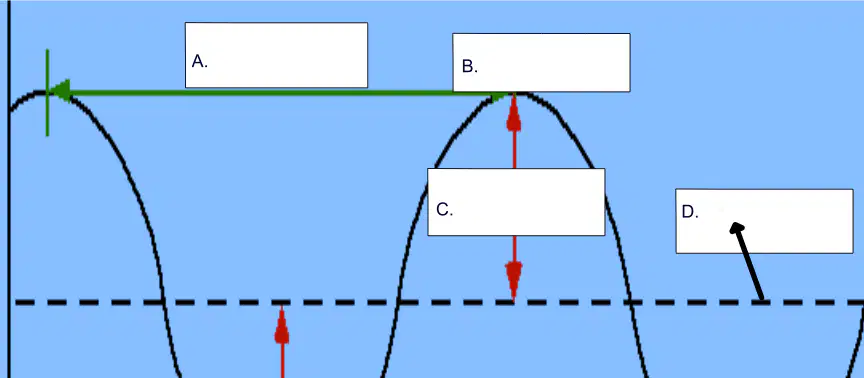
19.
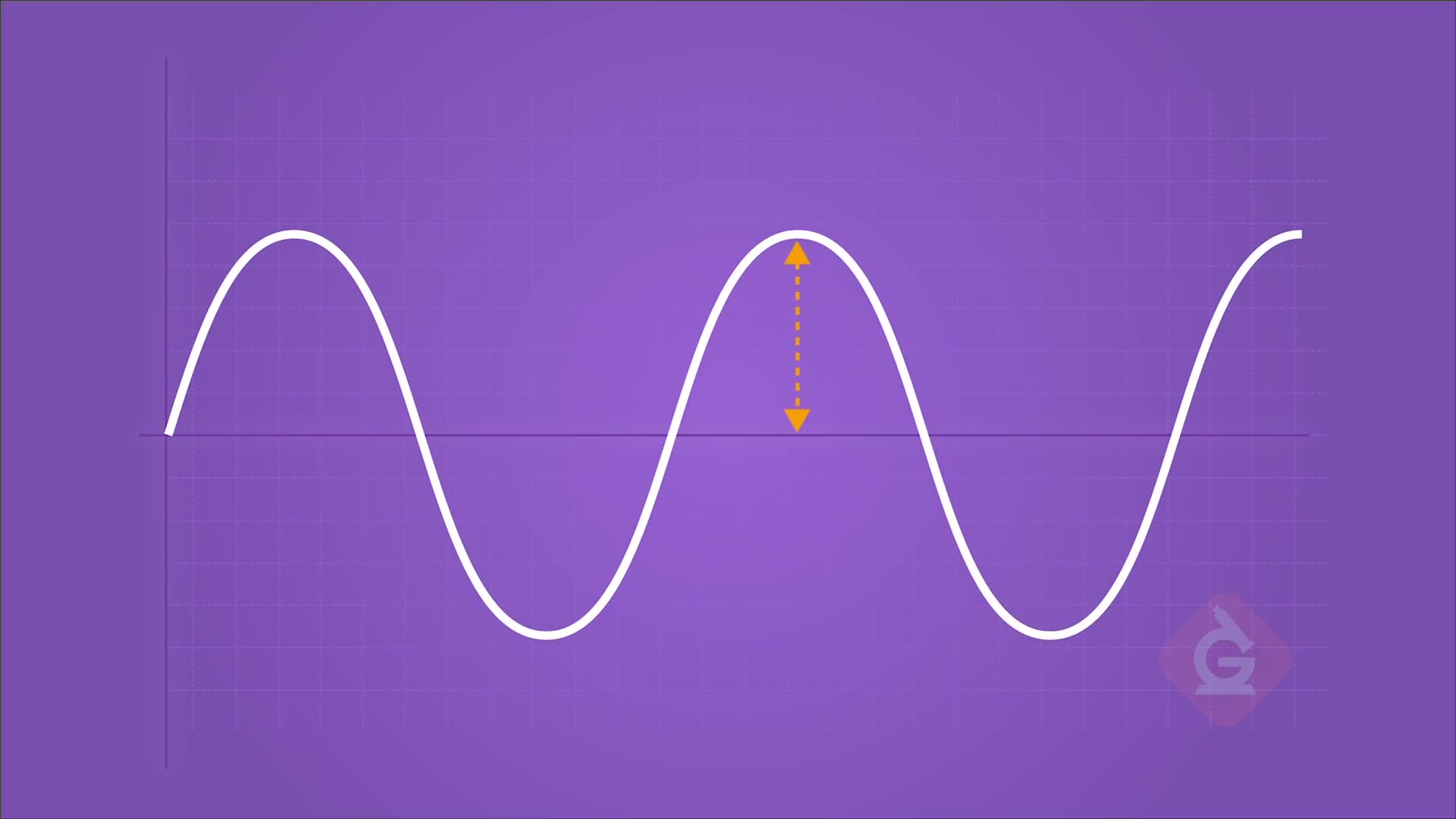
What part of the wave is shown at letter A?
a)
crest
b)
trough
c)
wavelength
d)
frequency
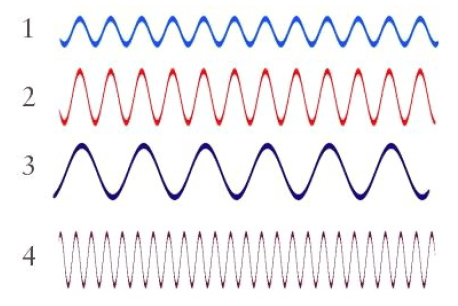
20.
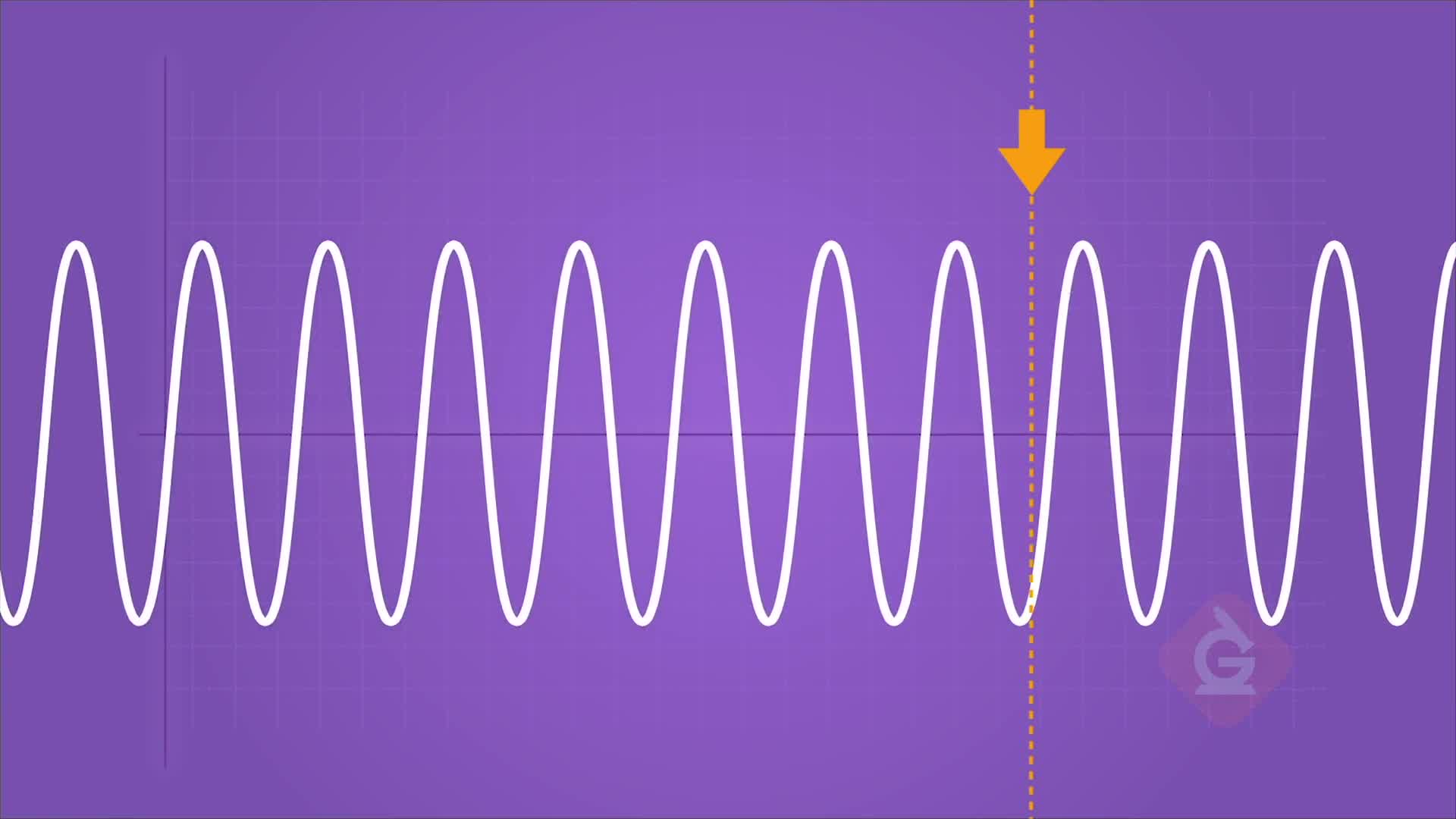
Which wave in the diagram has the greatest frequency?
a)
1
b)
2
c)
3
d)
4
21.

The number of waves that pass somewhere in a second is:

a)

amplitude

b)

frequency

c)

wavelength

22.
If the wavelength of an electromagnetic wave is longer, what is true about the energy? 
a)
Energy is higher.
b)
Energy is lower. 
c)
Energy is not dependent on wavelength. 
d)
energy is cancelled out
23.

Which portion of the electromagnetic spectrum includes the range of light that can be detected by the human eye?

a)

ultraviolet light

b)

visible light

c)

infrared light

d)

x-rays

24.
The type of wave that can travel through either matter or empty space:
a)
Mechanical Waves
b)
Electromagnetic Waves
25.
All waves carry
a)
energy
b)
light 
c)
matter
d)
particles
26.
What is NOT part of the electromagnetic spectrum?
a)
Visible light 
b)
X rays 
c)
Gamma Rays
d)
Magnetic Rays
27.

Which wavelength gives you sunburn?

a)

radio

b)

microwaves

c)

infra red

d)

Ultra violet

28.

A disturbance that transfers energy from one place to another

a)

Medium

b)

Wave

c)

Spectrum

d)

Matter

29.

What is the name given to the lowest point of a wave?

a)

crest

b)

trough

c)

wavelength

d)

amplitude

30.

What is the term for the distance from the highest part of one wave to the highest part of the next wave?

a)

wavelength

b)

amplitude

c)

frequency

d)

period

31.

Electromagnetic energy travels through space in waves. The electromagnetic spectrum includes all electromagnetic waves, arranged according to frequency and wavelength. Which of these is not an example of an electromagnetic wave and cannot travel in space?

a)

radio wave

b)

sound wave

c)

gamma wave

d)

microwaves

32.
White light is the entire range of
a)
colors of visible light combined.
b)
ultraviolet light.
c)
gamma rays and X rays.
d)
EM waves.
33.
The highest point of  a transverse wave
a)
crest
b)
trough
c)
amplitude
d)
wavelength
34.

The HEIGHT of the wave from the resting point is ______________.

a)

Frequency

b)

Wavelength

c)

Trough

d)

Amplitude

35.
Light waves travel fastest in ________ 
a)
solid
b)
liquid
c)
gas
d)
vacuum
36.
What is a repeating pattern that can transfer energy?
a)
Motif
b)
Prism
c)
Radio
d)
Wave
37.
What is the distance from the peak of one wave to the next peak?
a)
Amplitude
b)
Frequency
c)
Period
d)
Wavelength
38.
What is the height of a wave from its resting point?
a)
Amplitude
b)
Frequency
c)
Period
d)
Wavelength
39.
What is the number of waves that pass a point in one second?
a)
Amplitude
b)
Frequency
c)
Period
d)
Wavelength
40.
These waves make water molecules vibrate and warm up.
a)
Gamma
b)
Microwaves
c)
Radio
d)
Ultraviolet
41.
These high-energy waves are given off by radioactive materials.
a)
Gamma
b)
Microwaves
c)
Radio
d)
Ultraviolet
42.
These waves are used to send signals, including WiFi and text messages.
a)
Gamma
b)
Microwaves
c)
Radio
d)
Ultraviolet
43.
These waves are used to send signals, including WiFi and text messages.
a)
Gamma
b)
Microwaves
c)
Radio
d)
Ultraviolet
44.
These waves from the sun cause sunburn.
a)
Gamma
b)
Microwaves
c)
Radio
d)
Ultraviolet
45.
Increasing the amplitude of a wave, _________ the wave's energy.
a)
increases
b)
decreases
c)
does not change
46.
The energy of waves _______ as the wavelength gets shorter.
a)
increases
b)
decreases
c)
stays the same
47.

A wave with a large wavelength will have...

a)

Low Frequency & Low Energy

b)

High Frequency & High Energy

c)

High Frequency & Low Energy

d)

Low Frequency & High Energy

48.

How are electromagnetic waves different from other waves?

a)

They have short wavelengths

b)

they transmit energy instead of matter

c)

they can travel through empty space

d)

they can change direction by reflection

49.

Which electromagnetic waves are used in devices such as heat lamps and TV remote controls?

a)

Ultraviolet rays

b)

Infrared Rays

c)

Microwaves

50.

Which section of the electromagnetic spectrum is the ONLY part humans can see?

a)

X-Rays

b)

Gamma Rays

c)

Visible Light

d)

Ultraviolet Rays

51.

Electromagnetic waves that help your body produce vitamin D are called ___. Hint: These waves are invisible to humans but some insects can see them.

a)

Gamma Rays

b)

Ultraviolet Rays

c)

X-Rays

d)

Visible Light

52.

Which electromagnetic waves are used by doctors to detect broken bones inside your body?

a)

X-Rays

b)

Gamma Rays

c)

Ultraviolet Rays

d)

Infrared Rays

53.

Which has the SHORTEST wavelength and therefore the highest frequency/most energy? Hint: These waves are also used in cancer treatments.

a)

Gamma Rays

b)

Radio Waves

c)

Ultraviolet Rays

d)

X-rays

54.

What high energy waves are given off by radioactive materials?

a)

Gamma Rays

b)

Microwaves

c)

Ultraviolet Rays

d)

Radio Waves

55.

Which wave has a high frequency, a short wavelength, and high energy?

a)

A

b)

B

c)

Not enough information to determine

56.

Which wave has a low frequency, a long wavelength, and low energy?

a)

A

b)

B

c)

Not enough information to determine