
 Worksheets
P.2 Review
Total questions: 39
Worksheet time: 29mins
Which type of crust is constantly being recycled into the mantle and reformed due to seafloor spreading?
oceanic
continental
Which type of Earth's crust is denser?
oceanic
continental
Which type of Earth's crust is older?
oceanic
continental
The portion of the Earth between the crust and the core is the
Mantle
Plates
Lithosphere
Crust
The outer layer of the Earth is the
Crust
Mantle
Inner core
Outer core
The type of rock found in the continental crust.
Magma
Granite
Obsidian
Basalt
What are the two types of Earth's crust?
lithosphere and asthenosphere
oceanic and continental
lithosphere and atmosphere
divergent and convergent
The OLDEST rocks on the seafloor are located?
Closest to the mid-ocean ridge
Farthest from the mid-ocean ridge
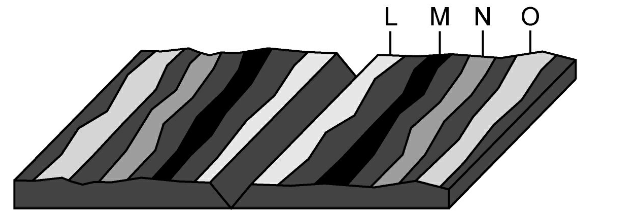

Earth's plates meet at ____________.
plate tectonics
plate boundaries
continental drift
oceans
The element that is the product of radioactive decay is known as the...
daughter element
half-life
parent element
carbon-14
The time taken for 50% of an isotope to decay is known as the _____.
half life
quarter life
mid life
whole life
relative life
Radioactive decay is the process by which an atomic nucleus of an unstable atom loses energy by emitting particles, like protons and neutrons.

What happens to the crust at a subduction zone?
New crust is made
Crust separates to form a mid-ocean ridge
Crust is recycled into the mantle and melted down
Crust separates to form a volcano

Which color is the most dense?
Blue
Yellow
Red
Which color is the least dense?
Blue
Yellow
Red

Which type of boundary is this?
Divergent
Convergent (oceanic / continental)
Convergent (continental / continental)
Transform

Oceanic crust is less dense than continental crust.
True
False

Which type of boundary is this?
Divergent
Convergent (oceanic / continental)
Convergent (continental / continental)
Transform
Is it possible that even though new crust is being formed on Earth, the surface area of Earth is not changing?
Yes, because as the new crust is being made, older crust is being destroyed
Yes, because as new crust is being formed, plates collide with more force to create higher mountains
No, the surface area of Earth must be expanding

How much of the parent isotope is present at 0 half-lives?
100
50
25
75
How much of the daughter isotope is present at 0 half-lives?
100
50
25
0

When a radioactive element decays, it decays from a "parent" atom into a different "daughter" atom. If we had a rock sample that had 25% of the parent atom remaining, how much of the daughter atom would have formed?
The process in which a radioactive isotope tends to break down into a stable isotope of the same element or another element.
Radioactive Decay
Isotope
Half-life
Full-life

The process by which the ocean floor sinks beneath a deep-ocean trench and back into the mantle is known as _______
convection.
continental drift.
subduction.
conduction.


What is happening in the picture?
layers of the Earth are changing positions
the inner and outer core are solid
convection currents are causing the tectonic plates to move
the mantle is growing
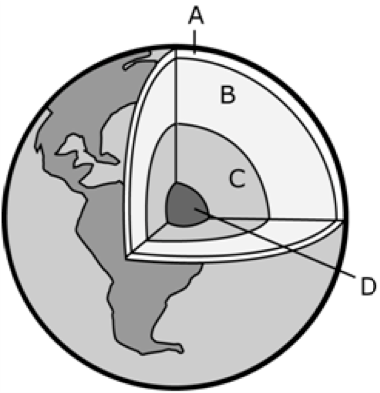
What letter in the diagram identifies the layer that is composed of moving continental and oceanic plates?
layer A
layer B
layer C
layer D

Peru and Chile are part of South America, which sits on the South American tectonic plate. The Nazca plate is moving toward the South American plate. It is pushed downward, which causes it to slide under the South American plate. Based on this information, what feature could we expect to see off the coast of Peru and Chile?
new Continent formation
Poor fishing conditions
Deep ocean trench
Severe tropical storms
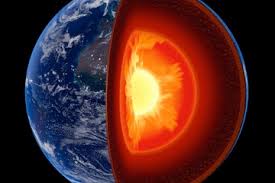

The molton rock UNDER Earth's surface
Lava
Magma
Core
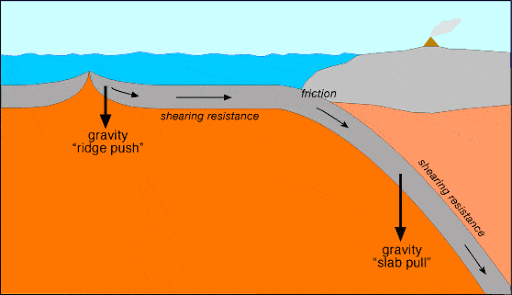
When the force of gravity pulls a lithospheric plate downward and away from a ridge pushing it toward a trench.
Sea Floor Spreading
Subduction
Ridge Push
Slab Pull
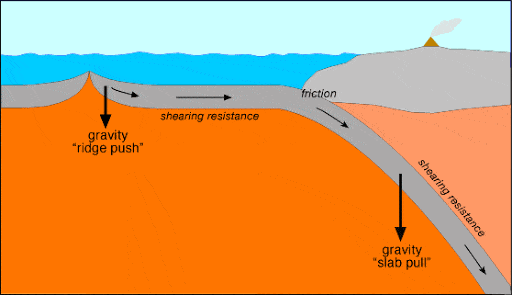
When the force of subduction and gravity moves a lithospheric plate downward into a trench and pulls it away from a ridge.
Sea Floor Spreading
Subduction
Ridge Push
Slab Pull
Which Theory of plate movement occurs as oceanic crust moves away from the mid-ocean ridge and becomes cooler and more dense, sinking into a trench?
convection
ridge push
slab pull

