
 Worksheets
QA2 Review
Total questions: 59
Worksheet time: 1hrs 27mins
What does Newton's first law state about an object's motion?
An object's motion can change without any force acting on it.
A force is needed to keep an object moving.
An object's motion cannot change unless a force acts on it.
Friction is the only force affecting an object's motion.
According to Newton's second law, what happens to the acceleration of an object if the force applied to it increases?
The acceleration decreases
The acceleration remains the same
The acceleration increases
The acceleration becomes negative
What does Newton's third law state about forces?
Forces act independently of each other
Forces always result in motion
Every force has an equal and opposite reaction force
Forces are directly proportional to mass
An object moves with the same motion as the car until something stops it.
True
False
When one object exerts a force on another, what happens according to Newton's third law?
The object doesn't react
The other object applies an equal and opposite force
The other object applies a different sized force
The other object applies a force in the same direction
What force is responsible for slowing down a rolling ball on the ground?
Gravity
Magnetism
Friction
Electromagnetic Force
Which law of motion describes an object's resistance to a change in its motion?
Newton's 1st Law
Newton's 2nd Law
Newton's 3rd Law
None of these
When forces acting on an object are balanced, what happens to the object's motion?
The object accelerates
The object moves in a circular path
The object slows down
The object's motion remains unchanged
Which law of motion states that the force required to accelerate an object is directly proportional to its mass?
Newton's 1st Law
Newton's 2nd Law
Newton's 3rd Law
None of these
What type of force is needed to change an object's motion?
Balanced Forces
Frictional Forces
Gravitational Forces
Unbalanced Forces
According to Newton's 2nd Law, what happens to acceleration if force remains constant but mass increases? The acceleration will _____.
decrease
increase
remain constant
become zero
Only objects that have balanced forces can have Newton's laws of motion applied to them.
True
False
Which law of motion describes the phenomenon where forces always occur in pairs?
Newton's 1st Law
Newton's 2nd Law
Newton's 3rd Law
None of these
What happens to the speed of an object as it falls freely under the influence of gravity (ignoring air resistance)?
It remains constant
It decreases
It increases
It first increases, then decreases

The nozzle of a rocket is pointed downward so that as fuel is ignited, the exhaust pushes downward. Why is this arrangement necessary for a rocket to function properly?
The rocket is protected from the heat of the exhaust
Burned fuel can be collected on the ground
As fuel is combusted, the rocket pushes the gases backward and the gases push the rocket forward
This allows the rocket to be steered properly
Al + O2 --> Al2O3
What is the total number of atoms present in 5Na3PO4?
5
55
40
8
How many Mn atoms are found in the following compound?
2MnO4
1
2
4
8
The pH of a solution is tested, and it is found to be a basic solution. Of the following choices, what could the pH have been?
3
7
9
5
_______ are corrosive substances characterized as having a strong smell, a sour taste, and a _______.

What PH number would be an example of a strong acid?
14
13
7
1

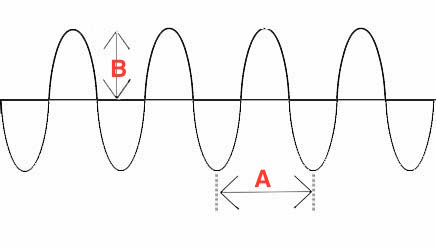
What kind of wave is pictured below?
compressional wave
transverse wave
sound wave
mechanical wave
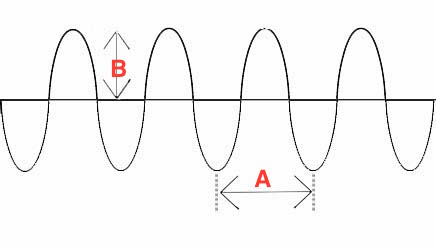
Low point of a wave
crest
trough
Amplitude
wavelength
Number of waves passing a given point in a certain amount of time, measured in Hertz (Hz)
wavelength
frequency
amplitude
wave speed

Which color has the lowest frequency?
Red
Pink
Green
Blue


On the EMS, which wave has the shortest wavelength?
Radio
Gamma
Soft X-Rays
Ultraviolet


Amplitude is the distance between
the crest and the trough
each wave
the middle point of a wave and the clouds
the crest or trough and the middle point of the wave

which wave has a lower amplitude?
x
y
they are the same
not enough info

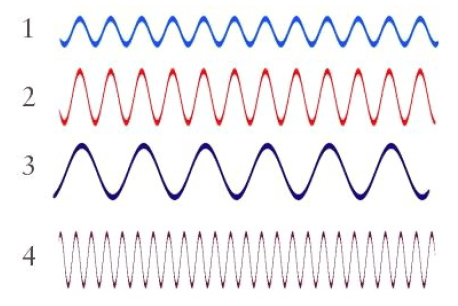
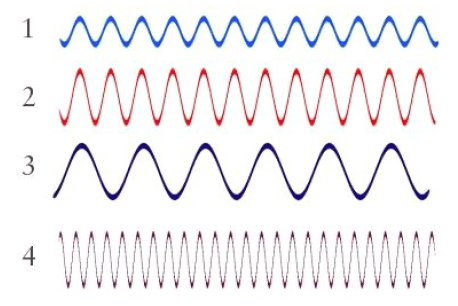
Which wave has the highest frequency?
1
2
3
they are all of the same
Which wave has the longest wavelegth?
1
2
3
they are all of the same

