
Font size
 Worksheets
Medical Detectives Final
Total questions: 35
Worksheet time: 1hrs 22mins
A person is running a race. Which of the following will happen to their vital signs as they’re running?
Blood pressure will decrease
Pulse will increase
Respiratory rate will increase
Blood pressure will decrease
Pulse will decrease
Respiratory rate will decrease
Blood pressure will increase
Pulse will increase
Respiratory rate will increase
Blood pressure will increase
Pulse will decrease
Respiratory rate will increase
This microorganism causes the common cold. It can only multiply when inside a human host. It is so small, it can’t be seen with microscopes you will use in school, and it has the ability to mutate or change.
What type of disease agent is this microorganism?
Virus
Bacteria
Fungus
This microorganism is not a disease agent.

Does the patient have strep throat?
Yes
No
A patient comes to you with complaints of muscle weakness, muscle spasms, and twitches in the left arm.
-During the exam you notice no problems with sensation, and the patient reports no loss of sensation, no pain, tingling, or numbness.
-All neurological tests were normal, except for the nerve conduction velocity tests and EMG results.
Given the choices below, which structure is the most likely location of the problem?
Sensory neurons
Motor neurons
Brain
Spinal cord

Which label identifies a part of the central nervous system?
A
B
C
D
Which statement below describes the correct function of the central nervous system (CNS) and peripheral nervous system (PNS)?
The PNS functions to process input from the CNS, and if necessary, triggers a response to act on the input.
The CNS is responsible for connecting and triggering the muscle cells throughout the body to respond to stimuli.
The CNS functions to process input from the PNS, and if necessary, triggers a response to act on the input.
The CNS is responsible for receiving stimuli from the body’s environment and sends them as signals to the PNS.

Several students came to the office with stomach aches and vomiting a few hours after a pancake breakfast. A foodborne illness was suspected for the outbreak, and students were interviewed about the food they ate earlier that day.
Given the attack rates shown in Table 1, which food item is the most likely source of the illness that’s causing several students to get sick?
Sausage
Butter
Milk
Juice

Based on the test results, what is the patient’s diagnosis?
The patient does not have strep throat or influenza.
The patient has both strep throat and influenza.
The patient has influenza and not strep throat.
The patient has strep throat and not influenza.
A patient comes to you with complaints of pain, tingling, and numbness in her left foot.
-The patient has no problems with movement.
-Brain scans, CSF, and EMG tests were all normal.
-Nerve conduction velocity tests were abnormal.
This information leads you to believe the problem is in the peripheral nervous system.
Given the choices below, which structure is the most likely location of the problem?
Sensory neurons
Brain
Motor neurons
Spinal cord
What functions might be affected in a patient with a tumor in the occipital lobe?
Behavior and personality, such as planning, initiated movements, social and emotional processing, and attention.
Sensing touch, spatial processing, language, and memory.
Visual perception and some forms of visual short-term memory.
Processing smell and sound, and the ability to recognize and understand words and language.
This microorganism causes strep throat. It can multiply without a host. It can be treated with antibiotics. It is so small, you would need to view it through a microscope at school.
What type of disease agent is this microorganism?
Bacteria
Virus
Fungus
The microorganism is not a disease agent
Which is an example of 4 important vital signs we've learned about?
blood sugar
respiration rate
glucose level
blood level
Javier's heart beats 15 times in 20 seconds. What is his beats per minute?
45 bpm
40 bpm
30 bpm
60 bpm


Neurons that pass sensory information from the peripheral nervous system to the brain are called
sensory neurons
motor neurons
interneurons
reflex arc neurons
What part of the brain monitors higher-order thinking, directs problem solving, and regulates the excesses of the emotional system?
Amygdala
brain stem
cerebellum
frontal lobe

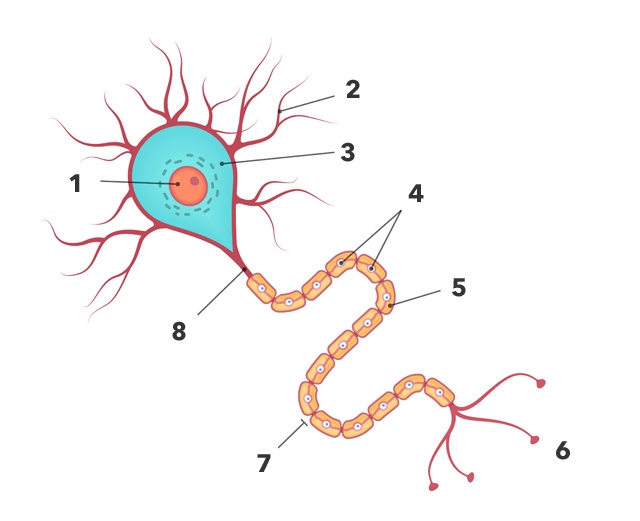
Identify #3
axon
cell body
dendrite
myelin sheath
The Three Major Parts of the Brain are
The brain stem, cerebellum, cerebrum
cerebellum, temporal, medulla
spinal cord, medulla, pons
temporal, frontal, parietal
What is the Corpus Callosum?
Outer 3mm of gray matter that covers the cerebrum. Controls - consciousness, sensory/motor processing, reasoning and language
Nerve fibers that connect the right and left hemisphere
regulates - thirst, hunger, blood pressure, body temp and glandular secretion of hormones
What is heart rate?
The amount of blood pumped by the heart per minute.
The number of breaths a person takes per minute.
The temperature of the heart.
The number of times a person's heart beats per minute.

What is attach rate of Romaine lettuce on their tacos?
Formula: TotalSick
48
75
77
90

A marathon runner has just completed the race. Over the next ten minutes, what would you expect to happen to his vital signs? Choose all that apply
Blood Pressure will decrease
Pulse will decrease
Respiration rate will decrease
All of the above

This structure in the red circle is responsible for controlling the flow of messages between the brain and the rest of the body; it also controls basic body functions such as breathing, swallowing, heart rate, blood pressure, and consciousness.
Brainstem
Cerebellum
Sulcus
Chiasma

Use the chart to answer the following:
A patient comes to the ER complaining of the following symptoms:
Coughing (sometimes coughs up blood)
Fever
Chills
Fatigue
Weakness
Pain in the chest
Common cold
Influenza (Flu)
Pneumococcal Pneumonia
Tuberculosis (TB)
What are the two main divisions of the nervous system?
Central nervous system
Autonomic nervous system
Peripheral nervous system
Somatic nervous system
The identification of an illness or other problem by examination of the medical evidence.
Diagnosis
Treatment plan
Vitals
Blood pressure
These reflect essential body functions, including your heartbeat, breathing rate, temperature, and blood pressure
Vital Signs
Blood Pressure
Running
Nurtrition

Signs of disease or injury.
diagnosis
symptoms
bacteria
valid

