
 Worksheets
Test: Thermal Energy
Total questions: 54
Worksheet time: 27mins
Name
Class
Date
1.
Which is the best surface for absorbing heat radiation?
a)
shiny white
b)
shiny black
c)
dull white
d)
dull black
2.
The transfer of energy as heat through a material
a)
temperature
b)
thermometer
c)
heat
d)
thermal conduction
3.
Particles that make up matter are in constant motion
a)
True
b)
False
4.
The faster particles move the less kinetic energy they have.
a)
True
b)
False
5.
Temperature is the measure of the average kinetic energy of the particles in an object.
a)
True
b)
False
6.
Change in thermal energy can be calculated using the equation Q = m ( (Tf – Ti) ( C. What does C represent?
a)
Specific heat
b)
Final temperature
c)
initial temperature
d)
temperature change
e)
mass
7.
_____ is a measure of the average kinetic energy of all the particles that make up an object.
a)
Density
b)
Conduction
c)
Radiation
d)
Temperature
8.
a measurement of the average motion of the particles in a substance or object
a)
temperature
b)
thermometer
c)
heat
d)
thermal conduction
9.
the total energy of the particles that make up any matter
a)
thermal energy
b)
thermal conduction
c)
contract
d)
convection
10.
a flow of energy from warmer matter to cooler matter
a)
thermal energy
b)
heat
c)
temperature
d)
conduction
11.
to take up more space; to get larger
a)
expand
b)
contract
c)
temperature
d)
conduction
12.
to take up less space; to get smaller
a)
expand
b)
contract
c)
radiation
d)
conductor
13.
the flow of heat from one object to another by direct contact between the objects
a)
conduction
b)
convection
c)
radiation
d)
expand
14.
a substance through which energy travels easily
a)
conduction
b)
convection
c)
conductor
d)
insulator
15.
a substance that slows down the transfer of heat
a)
conduction
b)
convection
c)
conductor
d)
insulator
16.
the flow of thermal energy that occurs when a warm liquid or gas moves from one place to another
a)
conduction
b)
convection
c)
conductor
d)
insulator
17.
the transfer of energy from one place to another without the use of matter
a)
conduction
b)
convection
c)
radiation
d)
insulator
18.
The temperature at which molecular energy is at a minimum
a)
absolute cold
b)
absolute zero
c)
zero Fahrenheit
d)
entropy
19.
Which of these choices best describes thermal energy of a substance?
a)
average kinetic energy of particles
b)
difference between KE and PE of material
c)
sum of KE and PE of particles of material
20.
Two beakers of different sizes have the same temperature water.Which has more thermal energy?
a)
they have same thermal energy
b)
the beaker with more water
c)
they don't have thermal energy
d)
the beaker with less water
21.
How is temperature related to heat?
a)
Heat causes a change in temperature
b)
Raising the temperature causes the heat to increase
c)
Temperature is a measure of heat of an object
22.
What is the definition of heat?
a)
change of temperature of substance
b)
total thermal energy of an object
c)
energy transferred between things at different temperature
d)
average kinetic energy of particles
23.
When do hot objects begin to cool?
a)
when cool air is transferred to the object
b)
when thermal energy in the object is transferred to the surrounding air
c)
when thermal energy becomes less than its kinetic energy
d)
when thermal energy around it becomes higher than that of the object
24.
When is thermal energy transferred between objects?
a)
when they have equal temperatures
b)
it does not transfer at all
c)
when they have different temperatures
25.
Iced coffee has ______ thermal energy than hot coffee of same size
a)
more
b)
less
c)
same
26.
What happens to thermal energy when you increase the object's temperature?
a)
Decreases
b)
Remains the same
c)
Increases
d)
None of the above
27.
An object's temperature can be increased without changing the thermal energy
a)
True
b)
False
28.
What is the definition of CONDUCTION?
a)
When heat is transferred from objects like rays of light or electromagnetically.
b)
When heat transfers from objects that are touching.
c)
a hot liquid or air that expands, becomes less dense, and rises or becomes more dense, and sinks.
d)
When heat transfers through the heater or AC in your house.
29.
What is the definition of CONVECTION
a)
When heat transfers through waves.
b)
a hot liquid or air that expands, becomes less dense, and rises or becomes more dense, and sinks.
c)
When heat transfers from objects that are touching.
d)
Heat traveling from the sun
30.
Which of the following is an example of convection?
a)
A hair dryer is drying up your hair.
b)
When a car engine turns hot after being turned on.
c)
When the AC or heater changes the temperature.
d)
When you are making soup and the water is rising and lowering.
31.
When baby chickens are kept warm from the heat lamps demonstrates this type of heat transfer.
a)
conduction
b)
radiation
c)
convection
32.
Near the ceiling of a room the air is warmer. The warm air rises because of
a)
conduction
b)
radiation
c)
convection
33.
In heat transfer, heat always flows from the _______________ substance to the _______________ substance.
a)
Hotter to colder
b)
Hotter to hotter
c)
Colder to hotter
d)
Colder to colder
34.
The handle of a metal spoon warms up when it is placed in a hot bowl of soup because of
a)
Convection
b)
Radiation
c)
Conduction
d)
insulation.
35.
Which of the following is the best example of conduction?
a)
A light bulb warming a lampshade
b)
Water boiling in a pot
c)
An egg cooking in a frying pan
d)
Gases circulating in the atmosphere
36.
a device that converts electric energy into thermal energy
a)
heating appliance
b)
refrigerator
c)
thermostat
d)
heat engine
37.
a device that uses electric energy to pump thermal energy from a cooler location to a warmer location.
a)
heating appliance
b)
refrigerator
c)
thermostat
d)
heat engine
38.
Typical automobile engine
a)
heating appliance
b)
refrigerator
c)
thermostat
d)
heat engine
39.
a machine that converts thermal energy into mechanical energy
a)
heating appliance
b)
refrigerator
c)
thermostat
d)
heat engine
40.
Can not be created or destroyed
a)
Heat
b)
Energy
c)
Metal
41.
Computers and cell phones get hot when you use them because ___ energy is always converted into ____ energy in an electronic device
a)
Heat;electric
b)
electric;thermal
c)
thermal;heat
42.
Internal combustion engines use ___ energy to produce thermal energy.
a)
Electrical
b)
Mechanical
c)
Chemical
43.
Solar energy can be changed into thermal energy without any work being done.
a)
True
b)
False
44.
A machine can never be 100 percent efficient because some energy is lost as waste heat.
a)
True
b)
False
45.
When a closed can is heated, the pressure inside it increases. This happens because:
a)
The number of molecules increases on heating.
b)
The molecules move faster and each molecule strikes the walls of the tin more often.
c)
The molecules become heavier and strike the walls of the tin harder.
d)
The molecules now collide more with the walls of the tin than among themselves.
46.
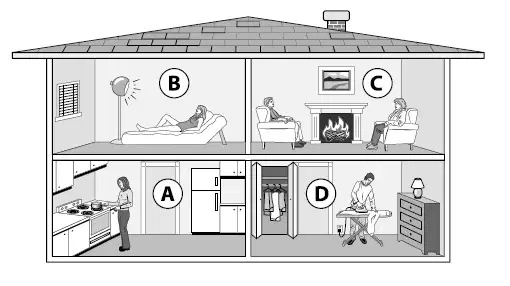
How will the thermal energy from the pot in room A move to its handle?
a)
convection
b)
radiation
c)
conduction
d)
both convection and radiation
47.

Where does most of the thermal energy provided by the fire in room C go?
a)
up the chimney
b)
to the people
c)
into the room
d)
none of these
48.
Two equal masses of two different kinds of matter _______.
a)
always have the same thermal energy
b)
never have the same thermal energy
c)
probably have the same thermal energy
d)
probably have different thermal energy
49.
Materials that are poor conductors are poor insulators.
a)
True
b)
False
50.
Air is a poor conductor of thermal energy.
a)
True
b)
False
51.
All heating systems for homes require _____.
a)
electricity
b)
energy
c)
fuel oil
d)
heat
52.
Heat engines convert _____ energy into _____ energy.
a)
mechanical, thermal
b)
thermal, mechanical
c)
potential, kinetic
d)
kinetic, potential
53.
Which is a better conductor of thermal energy.
a)
a plastic foam cup
b)
window glass
54.
Any material that flows is a _____.
a)
current
b)
fluid
c)
gas
d)
liquid
100 %

