
 Worksheets
ktqt
Total questions: 465
Worksheet time: 4hrs 53mins
A primary reason why nations conduct international trade is because
Some nations prefer to produce one thing while others produce another
resources are not equally distributed to all trading nations
trade enhances opportunities to accumulate profits
interest rates are not identical in all trading nations
A main advantage of specialization results from
economics of large scale production
the specializing country behaving as a monopoly
smaller production runs resulting in lower unit costs
high wages paid to foreign workers
International trade in goods and services is sometimes used as a substitute for all of the following except
international movements of capital
international movements of labor
international movements of technology
domestic production of different goods and services
If a nation has an open economy it means that the nation
allows private ownership of capital
has flexible exchange rates
has fixed exchange rates
conducts trade with other countries
international trade forces domestic firms to become more competitive in terms of
the introduction of new products
product design and quality
product price
all of the above
the movement to free international trade is most likely to generate short-term unemployment in which industries
industries in which there are neither imports nor exports
import-competing industries
industries that sell to domestic and foreign buyers
industries that sell to only foreign buyers
international trade is based on the idea that:
exports should exceed imports
improts should exceed exports
resources are more mobile interationally than are goods
resources are less mobile interationally than are goods
arguments for free trade are sometimes disregarded by politicians because:
maximizing domestic efficiency is not considered important
maximizing consumer welfare may not be a chief priority
there exist sound economic reasons for keeping one's economy isolated from other economies
economists tend to favor highly protected domestic markets
which american industry has least been affected by import competition in recent years
automobiles
steel
radios and TVs
computer software
the largest amount of trade with the united states in recent years has been conducted by
canada
germany
mexico
united kingdom
increased foreign competition tend to
intesify inflationary pressure at home
induce falling ouput per worker-hour for domestic workers
place constraints on the wages of domestic workers
increase profits of domestic import-competing industries
For the united states, exports plus imports are about ... of its gross national product
5 percent
10 percent
25 percent
55 percent
major trading partners of the united states including all of the following countries except
cannada
mexico
china
north korea
free trades maintain that an open economy is advantageous in that it provides all of the following except
increased competition for world producers
a wider selection of products for consumers
the utilization of the most efficient production methods
relatively high wages levels for all domestic workers
recent pressures for protectionism in the united states have been motivated by all of the following except
us firm shipping component production overseas
high profit levels for american corporations
sluggish rates of productivity growth in the united states
high unemployment rates among american workers
international trade tends to cause welfare losses to at least some groups in a country
the less mobile the country's resources
the more mobile the country's resources
the lower the country;s initial living standard
the higher the country's initial living standard
for the united states automobiles are
imported but not exported
exported but not imported
exported and imported
neither imported not exported
a feasible effect of international trade is that a(an)
monopoly in the home market becomes an oligopoly in the world market
oligopoly in the home market becomes a monopoly in the world market
purely competitive firm in the home market becomes an oligopolist
purely competitive firm in the home market becomes a monopolist
international trade in goods and services tends to
increase all domestic costs and prices
keep all domestic costs and prices at the same level
lessen the amount of competition facing home manufactures
increase the amount of competition facing home manufactures
The real income of domestic producers and consumers can be increased by
technological progress but not international trade
international trade but not technological progress
technological progress and international trade
neither technological progress nor international trade
for united states commercial jetliners are
imported but not exported
exported but not imported
imported and exported
neither exported nor imported
Which exchange rate system involves a "leaning against the wind" strategy in which short-term fluctuations in exchange rates are reduced without adhering to any particular exchange rate over the long run?
pegged of fixed exchange rates
adjustable pegged exchange rates
managed floating exchange rates
freely floating exchange rates
Small nations with more than one major trading partner tend to peg the value of their currencies to:
gold
silver
a single currency
a basket of currencies
Small nations whose trade and financial relationships are mainly with a single partner tend to utilize:
pegged exchange rates
freely floating exchange rates
managed floating exchange rates
crawling exchange rates
Which exchange rate system does not require monetary reserves for official exchange rate intervention?
floating exchange rates
pegged exchange rates
managed floating exchange rates
dual exchange rates
Under a pegged exchange rate system, which does not explain why a country would have a balance-of-payments deficit?
very high rates of inflation occur domestically
foreigners discriminate against domestic products
technological advance is superior abroad
the domestic currency is undervalued relative to other currencies
Under adjustable pegged exchange rates, if the rate of inflation in the United States exceeds the rate of inflation of its trading partners:
U.S. exports tend to rise and imports tend to fall
U.S. imports tend to rise and exports tend to fall
U.S. foreign exchange reserves tend to rise
U.S. foreign exchange reserves remain constant
Under managed floating exchange rates, if the rate of inflation in the United States is less than the rate of inflation of its trading partners, the dollar will likely:
appreciate against foreign currencies
depreciate against foreign currencies
be officially revalued by the government
be officially devalued by the government
Which exchange rate mechanism calls for frequent redefining of the par value by small amounts to remove a payments disequilibrium?
dual exchange rates
adjustable pegged exchange rates
managed floating exchange rates
crawling pegged exchange rates
Which exchange rate mechanism is intended to insulate the balance of payments from short-term capital movements while providing exchange rate stability for commercial transactions?
dual exchange rates
managed floating exchange rates
adjustable pegged exchange rates
crawling pegged exchange rates
The exchange rate system that best characterizes the present international monetary arrangement used by industrialized countries is:
freely fluctuating exchange rates
adjustable pegged exchange rates
managed floating exchange rates
pegged or fixed exchange rates
According to the Marshall-Lerner condition, if a country's currency depreciates its trade balance will worsen if
elasticity of demand for exports = 0.9; elasticity of demand for imports = 0.4
elasticity of demand for exports = 0.7; elasticity of demand for imports = 0.3
elasticity of demand for exports = 0.5; elasticity of demand for imports = 0.7
elasticity of demand for exports = 0.3; elasticity of demand for imports = 0.6
Empirical evidence regarding the effects of currency depreciation on the balance of trade indicates that
depreciation generally improves the trade balance
depreciation generally hurts the trade balance
no strong generalization are possible
depreciation has no effect on the trade balance
The balance of trade can only worsen if income ______ relative to absorption
increases
decreases
does not change
none of the above
The shorter the "pass-through" period, the _______ the desirable BOT effects of evaluation
on quantities traded will appear.
sooner
longer
bigger
smaller
The _____ analysis considers the ability of domestic and foreign prices to adjust to
devaluation in the short run.
pass-through
absorption
adjustment mechanism
currency contract period
Suppose that the United Kingdom devalues the pound. If both exports and imports are written in terms of pounds, then the United Kingdom balance of trade _______ during a currency contract period.
improves
worsens
is unaffected
falls for a while before increasing
The notion that, following a currency depreciation, the balance of trade falls for a while before increasing is called a _____ effect
relative price
elasticity
J-Curve
pass-through
If export contracts are written in terms of foreign currency and import contracts are denominated in domestic currency, a depreciation of the dollar during the currency contract period
should increase the dollar value of exports
should not have any effect on the dollar value of U.S. imports
must increase the balance of trade
all of the above
Which approach predicts that is an economy operates at full employment and faces a trade deficit, currency devaluation will improve the trade balance only if domestic spending is cut, thus freeing resources to produce exports:
the absorption approach
the Marshall-Lerner approach
the monetary approach
the elasticities approach
Complete currency pass through arises when a 10 percent depreciation in the value of the dollar causes U.S.
import prices to fall by 10 percent
import prices to rise by 10 percent
export prices to rise by 10 percent
export prices to rise by 20 percent
The extent to which a change in the exchange rate leads to changes in import and export prices is known as the:
J-Curve effect
Marshall-Lerner effect
absorption effect
pass-through effect
Given a two country world, suppose Japan devalues the yen by 20 percent and West Germany devalues the mark by 15 percent. This results in a (an):
appreciation in the value of both currencies
depreciation in the value of both currencies
appreciation in the value of the yen against the mark
depreciation in the value of the yen against the mark
The shift toward imperfectly competitive markets in domestic and international trade questions the concept of:
official exchange rates
complete currency pass through
exchange arbitrage
trade adjustment assistance
If foreign manufacturing costs and profit margins in response to a depreciation in the U.S. dollar, the effect of these actions is to:
shorten the amount of time in which the depreciation leads to a smaller trade deficit
shorten the amount of times in which the depreciation leads to a smaller trade surplus
lengthen the amount of time in which the depreciation leads to a smaller trade deficit
lengthen the amount of time in which the depreciation leads to a smaller trade surplus
Economic theory predicts that a currency depreciation will least lead to an improvement in the home country's trade balance when:
home demand for imports is inelastic and foreign export demand is inelastic
home demand for imports is elastic and foreign export demand is inelastic
home demand for imports is inelastic and foreign export demand is elastic
home demand for imports is elastic and foreign export demand is elastic
Because of the J-Curve effect and partial currency pass through, a depreciation of the domestic currency tends to increase the size of a:
trade surplus in the short run
trade surplus in the long run
trade deficit in the short run
trade deficit in the long run
Suppose that U.S. dollar depreciates 70 percent against the yen, yet Japanese export prices to Americans did not decrease by the full extent of the dollar depreciation. This is best explained by:
partial currency pass through
complete currency pass through
partial J-curve effect
complete J-curve effect
The purchasing-power-parity theory has limitations in forecasting exchange rate fluctuations for all of the following reasons except:
inflation affects exchange rates
international capital flows affect exchange rates
governments sometimes impose trade restrictions such as tariffs and quotas
not all products are internationally tradeable
The asset market approach views exchange rates as being determined mainly by
the use of import tariffs and quotas by governments
the current account balance of each country
the relative growth rate of national output between countries
efforts of investors to balance their portfolios among financial assets denominated in different currencies
According to the asset market approach, increased investor contidence in the Mexican economy would cause the peso to
appreciate because of an increased supply of peso-denominated assets
depreciate because of an increased supply of peso-denominated assets
appreciate because of an increased demand for peso-denominated assets
depreciate because of an increased demand for peso-denominated assets
The asset market approach is most helpful in explaining
why exchange rates remain quite stable
why governments change their money supplies
long-term exchange rate movements
short-term exchange rate movements
Exchange rate overshooting often occurs because
domestic prices adjust slowly to shifts in demand
military spending increases during military conflicts
elasticities are smaller in the long run than the short run
elasticities are smaller in the short run than the long run
Consulting firms that use large-scale econometric models to forecast exchange rate movements are engaging in
judgmental analysis
fundamental analysis
technical analysis
nontechnical analysis
Assume that a "Big Mac" hamburger costs $3 in the United States and 2 pesos in Mexico. The implied purchasing-power-parity exchange rate between the peso and the dollar is
0.67 pesos = $1
0.8 pesos = $1
1.25 pesos = $1
1.67 pesos = $1
Suppose that the purchasing-power-parity estimate of the dollar/euro exchange rate is $1.30 per euro, and the current spot rate is $1.38 per euro. Comparing these two exchange rates, from a long-run viewpoint you would
anticipate the dollar to depreciate against the euro
anticipate the dollar to appreciate against the euro
anticipate the dollar's exchange rate against the euro to remain constant
have no anticipation concerning future movements in the dollar/euro exchange rate
Due to Japan's high saving rate, suppose that the Japanese invest abroad. This investment may result in a/an ______ of the Japanese yen and therefore a _____ for Japan.
appreciation; trade surplus
appreciation; trade deficit
depreciation; trade surplus
depreciation; trade deficit
Suppose that rising U.S. income leads to higher sales and profits in the United States. This would likely result in:
increasing portfolio investment into the United States
decreasing portfolio investment into the United States
increasing direct investment into the United States
decreasing direct investment into the United States
Assume identical interest rates on comparable securities in the United States and foreign countries. Suppose investors anticipate that in the future the U.S. dollar will depreciate against foreign currencies. Investment funds would tend to:
flow from the United States to foreign countries
flow from foreign countries to the United States
remain totally in foreign countries
remain totally in the United States
Starting from a position where the nation's money demand equals the money supply and its balance of payments is in equilibrium, economic theory suggests that the nation's balance of payments would move into a surplus positions if there occurred in the nation a (an):
increase in the money demand
decrease in the money demand
increase in the money demand
any of the above
Starting from a position where the nations's money demand equals the money supply and its BOP is in equilibriumm, economic theory suggests that nation's BOP would move into a surplus position if there occurred in the nation a (an):
decrease in the money supply
increase in the money supply
decrease in the money demand
any of the above
Which example of market expectations causes the dollar to depreciate against the yen-expectations that the U.S. economy will have:
faster growth than Japan
higher future interest rates than Japan
more rapid money supply growth than Japan
lower inflation rates than Japan
Which example of market expectations causes the dollar to appreciate against the yen---expectations that the U.S. economy will have:
faster economic growth than Japan
higher future interest rates than Japan
more rapid money supply growth than Japan
higher inflation rates than Japan
Under a system of floating exchange rate, relatively high productivity and low inflation rates in the US results in a (an)
increase in the demand for foreign currency, a decrease in the supply of foreign currency, and a depreciation in the dollar
increase in the demand for foreign currency, an increase in the supply of foreign currency, and an appreciation in the dollar
decrease in the demand for foreign currency, a decrease in the supply of foreign currency, and a depreciation in the dollar
decrease in the demand for foreign currency, an increase in the supply of foreign currency, and an appreciation in the dollar
Under a system of floating exchange rates, relatively low productivity and high inflation rates in the United States results in a (an):
increase in the demand for foreign currency, a decrease in the supply of foreign currency, and a depreciation in the dollar
increase in the demand for foreign currency, an increase in the supply of foreign currency, and an appreciation in the dollar
decrease in the demand for foreign currency, a decrease in the supply of foreign currency, and a depreciation in the dollar
decrease in the demand for foreign currency, and increase in the supply of foreign currency, and an appreciation in the dollar
Given a system of floating exchange rates, falling income in the United States would trigger a (an):
increase in the demand for imports and an increase in the demand for foreign currency
increase in the demand for imports and a decrease in the demand for foreign currency
decrease in the demand for imports and an increase in the demand for foreign currency
decrease in the demand for imports and a decrease in the demand for foreign currency
Given a system of floating exchange rates, rising income in the United States would trigger a (an):
increase in the demand for imports and an increase in the demand for foreign currency
increase in the demand for imports and a decrease in the demand for foreign currency
decrease in the demand for imports and an increase in the demand for foreign currency
decrease in the demand for imports and a decrease in the demand for foreign currency
For the United States, suppose the annual interest rate on government securities equals 12 percent while the annual inflation rate equals 8 percent. For Japan, the annual interest rate on government securities equals 10 percent while the annual inflation rate equals 5 percent. The above variables would cause investment funds to flow from:
the United States to Japan, causing the dollar to depreciate
the United States to Japan, causing the dollar to appreciate
Japan to the United States, causing the mark to depreciate
Japan to the United States, causing the mark to appreciate
For the United States, suppose the annual interest rate on government securities equals 8 percent while the annual inflation rate equals 4 percent. For Switzerland, the annual interest rate on government securities equal 10 percent while the annual inflation rate equals 7 percent. The above variables would cause investment funds to flow from:
the United States to Switzerland, causing the dollar to depreciate
the United States to Switzerland, causing the dollar to appreciate
Switzerland to the United States, causing the franc to depreciate
Switzerland to the United States, causing the franc to appreciate
The exchange value of the U.S. dollar is primarily determined by:
the rate of inflation in the United States
the number of dollars printed by the U.S. government
the international demand and supply for dollars
the monetary value of gold held at Fort Knox, Kentucky
If Japan runs current-account deficit and exchange rates are floating:
Japanese exports become more expensive to foreign buyers
Japanese exports become less expensive to foreign buyers
Japanese imports become less expensive for German buyers
Japanese imports become more prestigious to German buyers
If Canada runs a balance-of-payments surplus and exchange rates are floating:
the value of other currencies will rise relative to the dollar
the dollar will depreciate relative to other currencies
the price of foreign goods will become cheaper to Canadians
the price of foreign goods will rise for Canadians
Suppose Canada and Switzerland were the only two countries in the world. There exists an excess supply of Swiss francs on the foreign exchange market. This suggests that:
the Canadian current-account balance is in surplus
the Swiss current-account balance is in deficit
the Canadian current-account balance is in equilibrium
the Swiss current-account balance is in equilibrium
The appreciation in the value of the dollar in the early 1980s is explained by all of the following except:
the United States being considered a safe haven by foreign investors
relatively high real interest rates in the United States
confidence of foreign investors in the U.S. economy
relatively high inflation rates in the United States
When the price of foreign currency (the exchange rate) is above the equilibrium level:
an excess supply of that currency exists in the foreign exchange market
an excess demand for that currency exists in the foreign exchange market
the supply of foreign exchange shifts outward to the right
the supply of foreign exchange shifts backward to the left
When the price of foreign currency (i.e. the exchange rate) is below the equilibrium level:
an excess demand for that currency exists in the foreign exchange market
an excess supply of the currency exists in the foreign exchange market
the demand for foreign exchange shifts outward to the right
the demand for foreign exchange shifts backward to the left
The high foreign exchange value of the U.S. dollar in the early 1980s can best be explained by:
additional investment funds made available from overseas
lack of investor confidence in U.S. fiscal policy
market expectations of rising inflation in the United States
American tourists overseas finding costs increasing
A primary reason that explains the appreciation in the value of the U.S. dollar would be:
large trade surpluses for the United States
high inflation rates in the United States
lack of investor confidence in U.S. monetary policy
high interest rates in the United States
If wheat costs $4 per bushel in the United States and 2 pounds per bushel in Great Britain, then in the presence of purchasing power parity the exchange rate should be:
$.50 per pound
$1.00 per pound
$2.00 per pound
$8.00 per pound
In the presence of purchasing power parity, if one dollar exchanges for 2 British pounds and if a DVD player costs $400 in the United States, then in Britain the DVD player should cost:
200 pounds
400 pounds
600 pounds
800 pounds
Assume that the United States faces an 8 percent inflation rate while no (zero) inflation exists in Japan. According to the purchasing power parity theory, over the long run the dollar would be expected to:
appreciate by 8 percent against the yen
depreciate by 8 percent against the yen
remain at its existing exchange rate
any of the above
Relatively high real interest rates in the United States tend to:
decrease the foreign demand for dollars, causing the dollar to depreciate
decrease the foreign demand for dollars, causing the dollar to appreciate
increase the foreign demand for dollars, causing the dollar to depreciate
increase the foreign demand for dollars, causing the dollar to appreciate
Relatively low real interest rates in the United States tend to:
decrease the foreign demand for dollars, causing the dollar to depreciate
decrease the foreign demand for dollars, causing the dollar to appreciate
Increase the foreign demand for dollars, causing the dollar to depreciate
decrease the foreign demand for dollars, causing the dollar to appreciate
If a Big Mac hamburger sells for the same dollar value in New York as in London then
the inflation rate in each country will necessarily equal zero
the inflation rate in each country will necessarily equal 1 percent
the exchange rates are said to be fixed or pegged to each other
purchasing power parity holds
The relationship between the exchange rate and the prices of tradable goods is known as the:
purchasing power parity theory
asset markets theory
monetary theory
balance of payments theory
Speculators in foreign exchange markets do all of the following except
attempt to profit by trading on expectations about future currency prices
bear risk as they attempt to "beat the market"
attempt to buy currency at a low price and later resell that currency at a higher price
simultaneously buy a currency at a low price and sell that currency at a higher price, making a riskless profit
A difference between forward and futures contracts is that
forward contracts occur in a specific location —for example, the Chicago Mercantile Exchange
futures contracts have negotiable delivery dates
forward contracts can be tailored in amount and delivery date to the needs of importers or exporters
futures contracts involve no brokerage fees or other transactions costs
The real effective exchange rate for the U.S. dollar
reflects only the influence of merchandise or real trade on the dollar's exchange value
reflects only transactions in the currency futures market
is the weighted average of the dollar exchange rate relative to the currencies of important
U.S. trading partners, adjusted for inflation
is the weighted average of the dollar exchange rate relative to the currencies of important
U.S. trading partners, unadjusted for inflation
Currency speculation is ______ if speculators bet against market forces that cause exchange
fluctuations, thus moderating such fluctuations.
destabilizing
stabilizing
inflationary
deflationary
Investors engage in _____ when they move funds into foreign currencies in order to take advantage of interest rates abroad that are higher than domestics interest rates
currency arbitrage
interest arbitrage
short positions
long positions
_____ represent the most widely used tool in international finance for measuring the average value of a currency relative to a number of other currencies.
nominal exchange rates
real exchange rates
cross exchange rates
exchange rate indexes
Which of the following is not a reason why Joe Smith (an American) might participate as a demander in the foreign exchange market?
his desire to open a bank account in Japan
his desire to purchase an automobile produced domestically
his desire to travel to Europe
his desire to purchase Treasury bills issued by the British government
If the exchange rate is 11 Mexican pesos per U.S. dollar, then it takes _____ to buy 1 peso
$0.0909
$0.1002
$0.2826
$1.1024
If Sweden's currency depreciates relative to Norway's currency
Norway's export goods become more expensive to Norway's residents
Norway's exports goods become cheaper to Sweden's residents
Sweden's export goods become cheaper to Norway's residents
Seden's export goods become cheaper to Sweden's residents
Suppose that Boeing is to receive payment in euros in 6 months and wants to engage in hedging
The firm would _____ euros on the 6-month forward market in order to protect itself from a/an _____ of the euro.
sell; appreciation
sell; depreciation
buy; depreciation
buy; appreciation
The franc is said to be selling at a _____ if the spot dollar price is $0.48 and the nine-month forward rate is $0.42.
forward discount
forward premium
forward spread
none of the above
The essential feature of a _____ is that it immediately fixed the rate at which a specified
amount of one currency is to be delivered in exchange for a specific amount of another at a future date.
forward contract
spot contract
money contract
bid contract
Riskless transactions to take advantage of profit opportunities due to a price differential or a yield differential in excess of transaction costs are called
differential actions
cash transactions
arbitrage
forward transactions
The difference between bid (buying) rates and ask (selling) rates is called the
profit
arbitrage
spread
forward transaction
If the bank is selling francs for $0.45, then what is the implied franc price of the dollar?
2.0
1.999
2.323
2.222
The least common type of transaction in the foreign exchange is a
forward transaction
spot transaction
swap transaction
none of the above
An important feature of a _____ is that the holder has the right, but not the obligation, to buy or sell currency.
swap
foreign exchange arbitrage
foreign exchange option
futures market contract
The reduction or covering of foreign exchange risk is called
hedging
speculation
intervention
arbitrage
The exchange rate is kept the same across geographically-separate markets by
hedging
speculation
government regulation
arbitrage
Suppose there occurs an increase in the Canadian demand for Japanese computers. This results in a (an):
increase in the demand for yen
decrease in the demand for yen
increase in the
supply of yen
decrease in the supply of yen
In a supply-and-demand diagram for Japanese yen, with the exchange rate in dollars per yen on the vertical axis, the demand schedule for yen is drawn sloping:
upward
vertical
downward
horizontal
Given the foreign currency market for the Swiss franc, the supply of francs slopes upward, because as the dollar price of the franc rises:
America's demand for Swiss merchandise rises
America's demand for Swiss merchandise falls
Switzerland's demand for American merchandise rises
Switzerland's demand for American merchandise falls
The largest volume of foreign exchange trading takes place in
China
Germany
the United Kingdom
the United States
Which financial instrument provides a buyer the right to purchase or sell a fixed amount of currency at a prearranged price, within a few days to a couple of years:
letter of credit
foreign currency option
cable transfer
bill of exchange
During the era of dollar appreciation, from 1981 to 1985, a main reason why the dollar did not fall in value was:
flows of foreign investment into the United States
rising price inflation in the United States
a substantial decrease in U.S. imports
a substantial increase in U.S. exports
A depreciation of the dollar will have its most pronounced impact on imports if the demand for imports is:
constant
inelastic
elastic
unitary elastic
Under a system of floating exchange rates, the pound would depreciate in value if there occurs:
price inflation in the United States
an increase in U.S. real income
a decrease in the British money supply
falling interest rates in Britain
In the early eighties, the Federal Reserve pursued a tight monetary policy. All else being equal, the impact of that policy was to _____ interest rates in the United States relative to those in Europe and cause the dollar to _____ against European currencies.
decreases, depreciate
decreases, appreciate
increases, depreciate
increases, appreciate
Suppose that a Swiss television set that costs 400 francs in Switzerland costs $200 in the United States. The exchange rate between the franc and the dollar is:
2 francs per dollar
1 franc per dollar
$2 per franc
$3 per franc
The supply of foreign currency tends to be:
upward sloping
downward sloping
vertical
any of the above
The most widely traded currency in the foreign exchange market is the
euro
Chinese yuan
British pound
U.S. dollar
_____ is needed to "balance" the balance of payments statement.
credit transactions
debit transactions
unilateral transfers
statistical discrepancy
Direct investment and security purchases are classified as
capital account transactions
current account transactions
unilateral transfer transactions
merchandise trade transactions
The "balance of trade" is a record of
exports and imports of financial assets
the current account plus capital account
the net export of goods and services
the value of merchandise exports minus imports
The argument that U.S. current account deficits cause net job losses for Americans
is true by definition in all possible circumstances
is supported by recent U.S. history
focuses only on the overall economy and is thus always true
fails to recognize that a current account deficit is matched by an equal inflow of foreign funds which finances employment increasing investment spending
Historically, countries at early stages of rapid economic development have tended to experience
trade deficits and an excess of investment over domestic saving
trade surpluses and an excess of investment over domestic saving
trade deficits and an excess of domestic saving over investment
trade surpluses and an excess of domestic saving over investment
In balance-of- payments accounting, tourism and travel are classified in the
merchandise trade account
services account
unilateral transfers account
capital account
When a country has a trade deficit, it
purchases more stocks and bonds from the rest of the world than it sells
purchases more goods from the rest of the world than it sells
sells more good to the rest of the world than it purchases
sells more stocks and bonds to the rest of the world than it purchases
Purchases of government securities in the United States by foreigners is
a credit item in the current account
a debit item in the capital account
a credit item in the capital account
a debit item in the current account
A current account surplus implies that
the country is a net lender to the rest of the world
the country is running a net capital account surplus
foreign investment in domestic securities is at very low levels
all of the above
In the calculation of gross domestic product, net exports are
the sum of merchandise trade and services
the current account plus long-term capital
the value of merchandise exports minus imports
short-term capital plus the basic balance
A nation with a current account deficit will be
lending more money to other nations
experiencing a surplus in exports of goods and services
reducing its indebtedness to other nations
going further into debt with other nations
A nation wishing to reduce its current account deficit would be advised to
engage in more government spending
reduce government taxes
increase private investment spending
decrease domestic consumption spending
The difference between a country's balance of payments and its balance of international indebtedness
is equal to official reserve transactions
occurs because of foreign exchange fluctuations
reflects statistical discrepancies
reflects the difference between flow and stock concepts
Current account deficits are offset by
merchandise trade deficits
merchandise trade surpluses
capital/financial account surpluses
capital/financial account deficits
In the balance of payments, travel and tourism are included in the category of
unilateral transfers
capital account
merchandise account
services account
Debit entries on the balance of payments are the entries that would
mean a loss of foreign exchange
bring foreign exchange into the country
indicate a surplus exists
exist at the bottom line after all accounts are totaled
The U.S. balance of payments is constructed by
the U.S. Department of Labor
the U.S. Department of Agriculture
the U.S. Department of Commerce
the Council of Economic Advisers to the President
The current account includes
the value of trade in merchandise
services
unilateral transfers
all of the above
The role of _____ is to direct one nation's savings into investments of another nation:
merchandise trade flows
services flows
current account flows
capital flows
A capital account surplus might be expected to cause a current account deficit because the associated
capital outflow would cause the nation's currency to depreciate, contributing to a trade deficit
capital inflow would cause the nation's currency to depreciate, contributing to a trade deficit
capital inflow would cause the nation's currency to appreciate, contributing to a trade deficit
capital outflow would cause the nation's currency to appreciate, contributing to a trade deficit
All of the following are debit items in the balance of payments, except:
capital outflows
merchandise exports
private gifts to foreigners
foreign aid granted to other nations
All of the following are credit items in the balance of payments, except:
investment inflows
merchandise exports
payments for American services to foreigners
private gives to foreign residents
In the balance of payments, the statistical discrepancy is used to:
insure that the sum of all debits matches the sum of all credits
insure that trade imports equal the value of trade exports
obtain an accurate account of a balance-of-payments deficit
obtain an accurate account of a balance-of-payments surplus
When all of the debit or credit items in the balance of payments are combined:
merchandise imports equal merchandise exports
capital imports equal capital exports
services exports equal services imports
the total surplus or deficit equals zero
Debit (-) items in the balance of payments correspond to anything that:
involves receipts from foreigners
involves payments to foreigners
increases the domestic money supply
decreases the demand for foreign exchange
Credit (+) items in the balance of payments correspond to anything that:
involves receipts from foreigners
involves payments to foreigners
increases the domestic money supply
decreases the demand for foreign exchange
A country that is a net international debtor initially experiences a (an):
larger savings pool available to finance domestic spending
higher interest rate which leads to lower domestic investment
loss of funds to trading partners overseas
decrease in its services exports to other countries
For the first time since World War I, in the mid 1980s the United States became a net international:
exporter
importer
debtor
creditor
International Investment Position of the U.S., 2009
U.S. Assets Abroad.
U.S. government assets. $800 billion
U.S. private assets. 200
Foreign Assets in the U.S.
Foreign official assets. 600
Foreign private assets. 300
Referring to the above table, the U.S. balance of international indebtedness suggests that the U.S. is a net:
debtor
spender
creditor
exporter
"Guest worker" programs usually result in temporary migration of workers from
impoverished countries to impoverished countries
impoverished countries to wealthy countries
wealthy countries to wealthy countries
wealthy countries to impoverished countries
Which of the following is not an example of foreign direct investment?
the construction of a new auto assembly plant overseas
the acquisition of an existing steel mill overseas
the purchase of bonds or stock issued by a textile company overseas
the creation of a wholly owned business firm overseas
_____ was a strategy for industrial development, popular in Latin America in the 1950s-1960s, for promoting domestic production by erecting high protective tariffs on imports of manufactured goods.
export led growth
import substitution
dynamic hedging
countervailing duties
_____ refers to the price charged for products sold to a subsidiary to a multinational corporation by another subsidiary in another country
marginal cost pricing
full cost pricing
price discrimination
transfer pricing
The migration of electricians from low-paying nations to high-paying nations is most likely to be challenged by
electrician unions in the high-paying nations
electrician unions in the low-paying nations
electrician employers in the high-paying nations
electricians who stay in the low-paying nations
The migration of employable workers from low-paying nations to high-paying nations will
decrease wage rates in the low-paying nations
decrease productivity and real output in the world
increase business or capitalist incomes in the high-paying nations
increase business or capitalist incomes in the low-paying nations
Multinational corporations:
always produce primary goods
always produce manufactured goods
produce primary goods or manufactured goods
none of the above
International joint ventures can lead to welfare losses when the newly established firm:
adds to the pre-existing productive capacity
enters markets neither parent could have entered individually
yields cost reductions unavailable to parent firms
gives rise to increased amounts of market power
Which business device involves the creation of a new business by two or more companies, often for a limited period of time:
multinational corporation
international joint venture
horizontal merger
vertical merger
Accusations of American labor unions against U.S. multinational firms include all of the following except:
enjoy unfair advantage in taxation
export jobs by shifting technology overseas
export jobs by shifting investment overseas
operating at output levels where scale economies occur
American labor unions have maintained that U.S. multinational corporations have been:
exporting American jobs by investing overseas
exporting American jobs by keeping investment in the U.S.
importing cheap foreign workers by shifting U.S. investment overseas
importing cheap foreign workers by keeping U.S. investment at home
Multinational corporations face problems since they:
cannot benefit from the advantage of comparative advantage
may raise political problems in countries where their subsidiaries operate
can only invest at home, but not overseas
can only invest overseas, but not at home
Firms undertake multinational operations in order to:
hire low-income workers
manufacture in nations they have difficulty exporting to
obtain necessary factor inputs
all of the above
Multinational corporations:
increase the transfer of technology between nations
make it harder to nations to foster activities of comparative advantage
always enjoy political harmony in nations where their subsidiaries operate
require governmental subsidies in order to conduct worldwide operations
The migration of employable workers from low-paying nations to high-paying nations tends to decrease
total wage income in the world
wage disparities
business or capitalist income in the world
the productivity of labor
All of the following are potential advantages of an international joint venture except:
sharing research and development costs among corporations
forestalling protectionism against imports
establishing work rules promoting higher labor productivity
operating at diseconomy-of-scale output levels
The market power effect of an international joint venture can lead to welfare losses for the domestic economy unless offset by cost reductions. Which type of cost reduction would not lead to offsetting welfare gains for the overall economy:
R&D generating welfare improved technology
development of more productive machinery
new work rules promoting worker efficiency
lower wages extracted from workers
Technological improvements are similar to international trade since they both
provide benefits for all producers and consumers
increase the nation's aggregate income
reduce unemployment for all domestic workers
ensure that industries can operate at less than full capacity
a sudden shift from import tariffs to free trade may induce short-term unemployment in
import-competing industries
industries that are only exporters
industries that sell domestically as well as export
industries that neither import nor export
a reduced share of the world export market for the united states would be attributed to
decreased productivity in US manufacturing
high incomes of american households
relatively low interest rates in the united states
high levels of investment by american corporations
the most recent wave of globalization which began in the 1980s has emphasized the outsourcing of
services and white-collar jobs
manufacturing and blue-collar jobs
natural resource extraction and mining jobs
agriculture and farming jobs
a country's openess to international trade can be measured by the formula
exports + imports + gdp
exports - imports - gdp
(exports + imports) / gdp
(exports + imports) x gdp
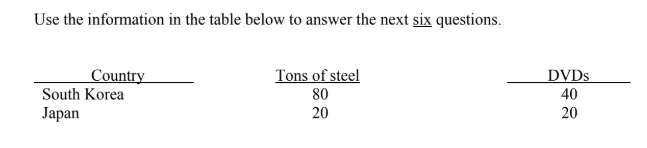
The opportunity cost of one DVD in Japan is
one ton of steel
two tons of steel
three tons of steel
four tons of steel
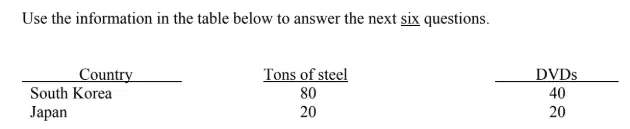
the opportunity cost of one DVD in south korea is
one-half ton of steel
one ton of steel
one and one-half tons of steel
two tons of steel
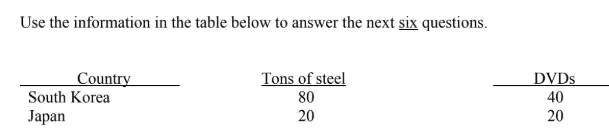
according to the principle of absolute advantage Japan should
export steel
export DVDs
export steel and DVDs
There is no basis for gainful specialization and trade
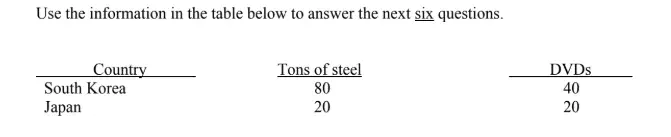
with international trade, what would be the maximum amount of steel that south korea would be willing to export to japan in exchange for each DVD
one-half ton of steel
one ton of steel
two tons of steel
two and one-half tons of steel
with international trade, what would be the maximum number of DVDs that Japan would be willing to export to south korea in exchange for each ton of steel
one DVD
two DVDs
three DVDs
four DVDs
the earliest statement of the principle of comparative advantage is associated with
adam smith
david ricardo
eli heckscher
bertil ohlin
if Hongkong and taiwan have identical production possibilities curves that are subject to increasing opportunity costs
trade would depend on differences in demand conditions
trade would depend on economies of large-scale production
trade would depend on the use of different currencies
there would be no basis for gainful trade
if the international terms of trade settle at a level that is between each country's opportunity cost
there is no basis for gainful trade for either country
both countries gain from trade
only one country gains from trade
one country gains and the other country loses from trade
international trade is based on the notion that
different currencies are an obstacle to international trade
goods are more mobile interationally than are resources
resources are more mobile internationally that are goods
a country's exports should always exceeds its imports
mercantilism
is the philosophy of free international trade
was a system of export promotion and barriers to imports practiced by goverments
was praised by adam smith in the wealth of nations
both a and c
the classical trade theories of smith and ricardo predict that
countries will completely specialize in the production of export goods
considerate trade will occur between countries with different levels of technology
small countries could obtain all of the gaisn from trade when trading with large countries
all of the above
the gains from international trade are closely related to
the labor theory of trade
howmuch the autarky price differs from international terms of trade change
the fact that a country must lose from trade
all of the above
according to the classical theory of international trade
only countries with low wages will export
only countries with high wages will export
countries with high wages will have higher prices
all the above are false
in the classical model of ricardo, the direction of trade is determined by
absolute advantage
comparative advantage
physical advantage
which way the wind blows
absolute advantage determined by
actual differences in labor productivity between countries
relative differences in labor productivity between countries
both a and b
neither a nor b
Trade diversion takes place when
a country moves from autarky to free trade
a movement to a customs union reduces the costs of trade through standardization
economic integration results in a movement in product origin to a lower-cost member country
economic integration results in a shift in product origin from a lower-cost, nonmember country to a member country having higher costs
Trade creation takes place when
a country moves from autarky to free trade
a movement to a customs union reduces the costs of trade through standardization
economic integration results in a movement in product origin to a lower-cost member country
economic integration results in a shift in product origin from a lower-cost, nonmember country to a member country having higher costs
Criticisms against the North American Free Trade Agreement include all of the following except
wages in the United States will rise relative to Mexican wages
American jobs will be lost to workers in Mexico
the environment is not adequately protected by NAFTA
none of the above
When imports from a higher-cost supplier within a customs union replace imports from a lower-cost supplier outside the custom union, there exists
trade creation
trade diversion
dynamic welfare effects
comprehensive welfare effects
Trade creation will more likely outweigh trade diversion for Country X that forms a customs union if the level of tariffs in Country X prior to the customs union is _____
and the total number of countries forming the customs union is _____
relatively high; relatively large
relatively high; relatively small
relatively low; relatively large
relatively low; relatively small
Suppose that tomatoes from Mexico face a 20 percent tariff in the United States and a 25 percent tariff in Canada. If the United States and Canada maintain free trade between each other, the
these two countries belong to a
free-trade area
customs union
common market
monetary union
A positive, dynamic effect of economic integration is illustrated by
trade diversion effect
increased monopoly power of firms
decreased customs costs
economy-of-scale effect
Which level of economic integration best applies to the U.S. economy?
free trade area
common market
customs union
monetary union
A _____ is a regional trading bloc in which member countries eliminate internal trade barriers but maintain existing barriers against countries that are not members
free trade area
customs union
common market
monetary union
_____ is said to exist when the formation of a regional trading group leads to an expansion of trade above pregroup levels.
trade creation
trade diversion
trade exclusion
trade distortion
_____ is said to exist when the formation of a regional trading group leads to the reduction of
trade with nonmember countries in favor of member countries.
trade creation
trade diversion
trade exclusion
trade distortion
The European Monetary Union is an example of a
customs union
free trade area
reciprocal trade agreement
monetary union
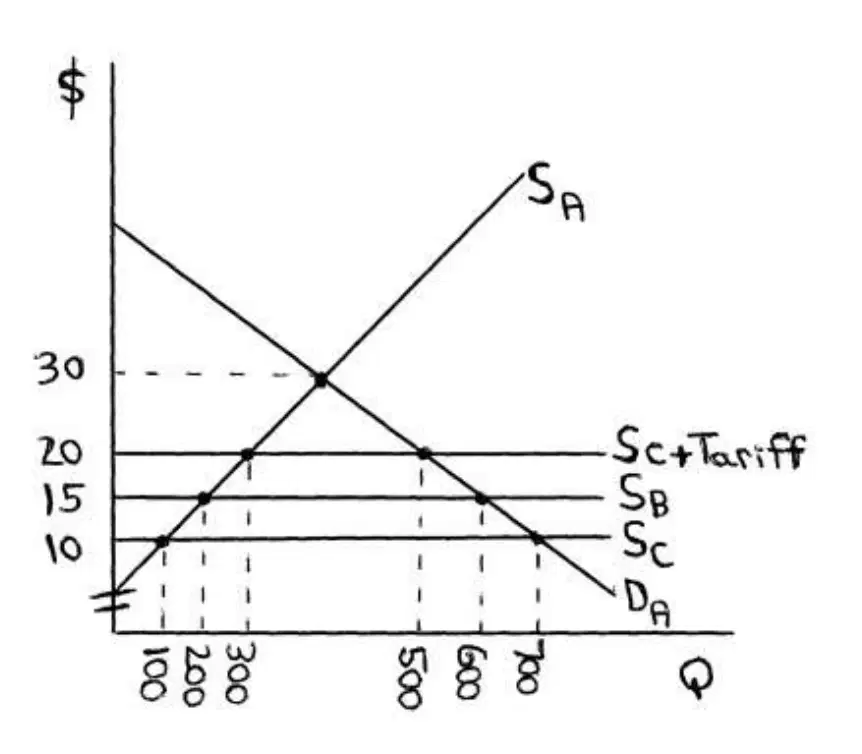
If A forms a customs union with C, the value of trade diversion will be
$0
$10,000.
$20,000
$40,000.
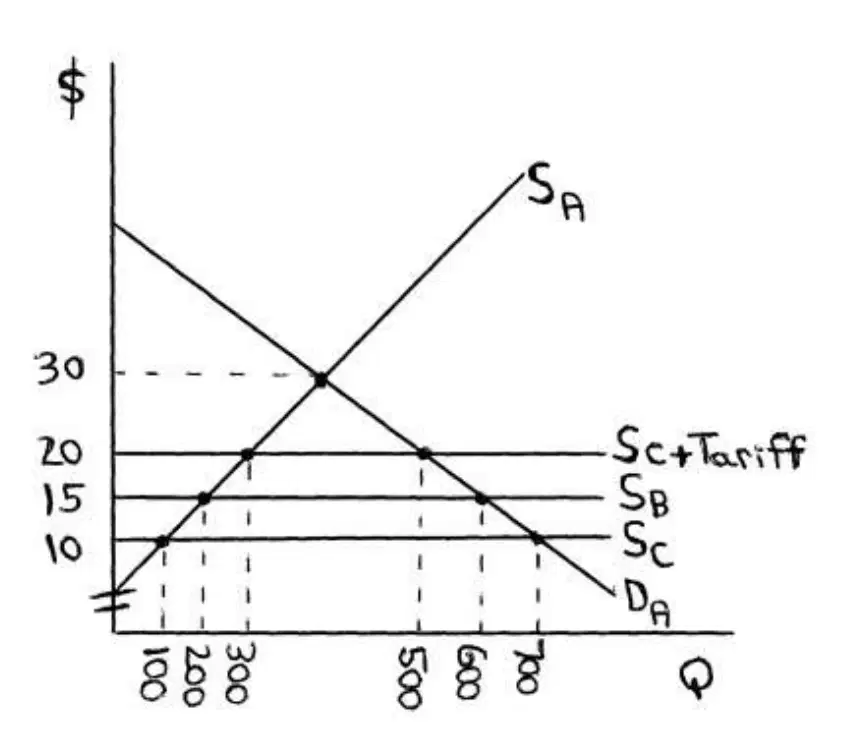
If A forms a customs union with B, A will import
400 units from B
200 units from C.
200 units from each.
400 units from B and 200 units from C.
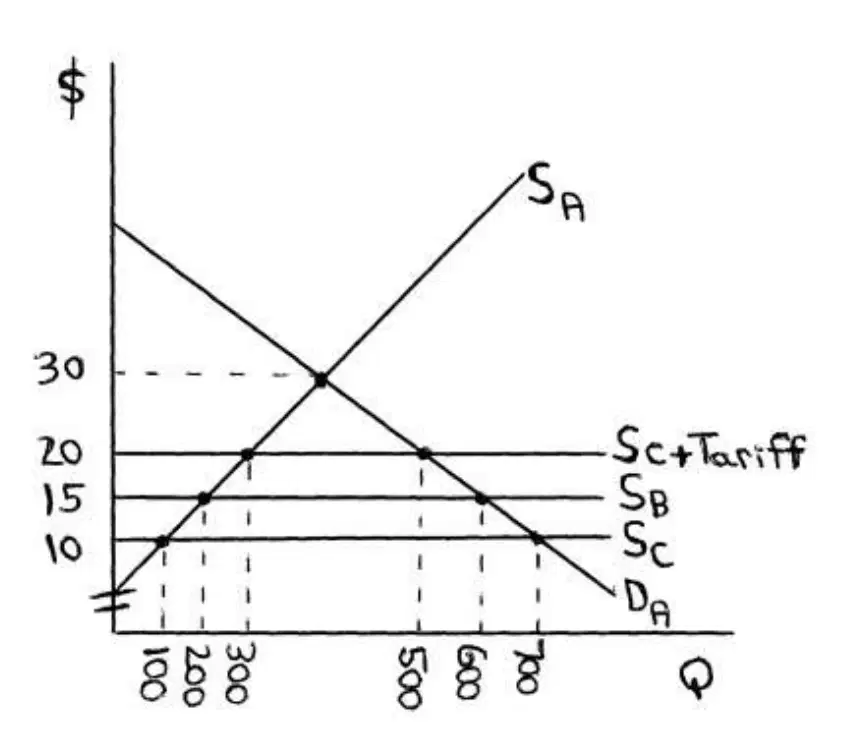
If A imposes a per unit tariff of $10 on imports from both B and C, A will import
400 units from B.
200 units from C.
200 units from each.
400 units from B and 200 units from C.
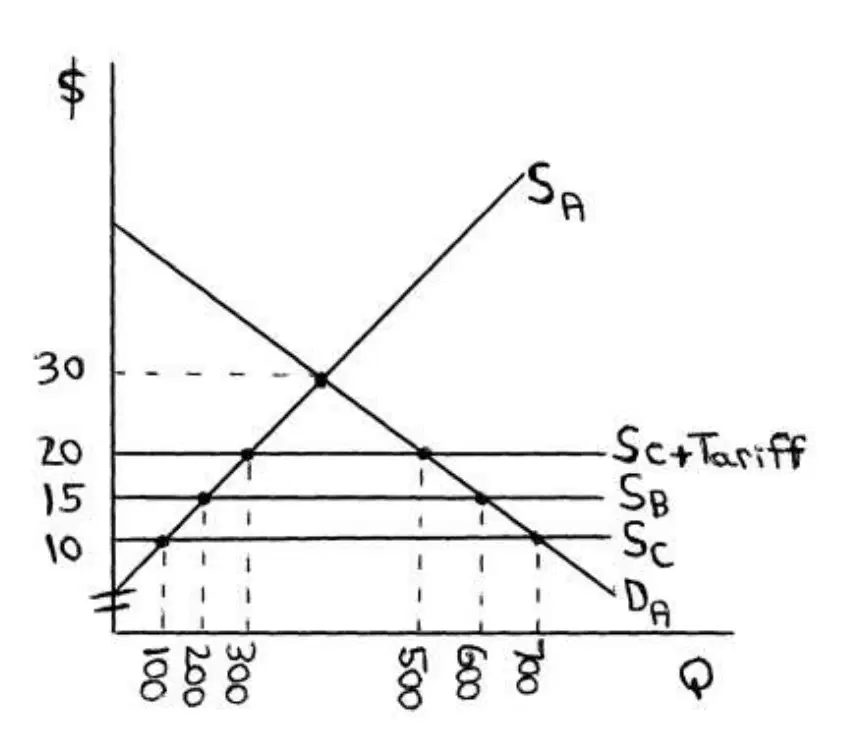
In free trade, A will import
700 units from country C
700 units from country C and 600 units from country B.
600 units from country C
600 units from country C and 400 units from country B.
Under the Common Agricultural Policy, exports of any surplus quantities of EU produce are encouraged through the usage of:
variable levies
export subsidies
trigger prices
countertrade
The implementation of a common market involves all of the following except:
elimination of trade restrictions among member countries
a common tax system and monetary union
prohibition of restrictions on factor movements
a common tariff levied in imports from nonmembers
When several countries jointly impose common external tariffs, eliminate tariffs on each other, and eliminate barriers to the movement of labor and capital among themselves, they have formed a/an
free trade area
customs union
common market
economic union
As of 2002, the _____ became the official currency union of the European Monetary System:
dollar
mark
franc
euro
The Common Agricultural Policy of the European Union has:
increased American farm exports to the EU
decreased American farm exports to the EU
lowered the price of American farm exports to the EU
not affected the price of American farm exports to the EU
The implementation of the European Union has:
made it harder for Americans to compete against the Germans in the British market
made it easier for Americans to compete against the Germans in the British market
made it harder for Americans to compete against the Japanese in the British market
made it easier for Americans to compete against the Japanese in the British
Which factor of production in the United States is most likely to be made worse off (its factor payment will decrease) because of the North American Free Trade Agreement?
capital
land
skilled labor
unskilled labor
The European Union is an example of a/an
customs union
economic union
common market
free trade area
Which country is not a member of the European Union:
Spain
Germany
France
Iceland
The European Union has achieved all of the following except:
adopted a common fiscal policy for member nations
established a common system of agricultural price supports
disbanded all tariffs between its member countries
levied common tariffs on products imported from nonmembers
Members of the EU find that "trade creation" is fostered when their economies are:
highly competitive
highly noncompetitive
small in economic importance
geographically distant
Under the EU's Common Agricultural Policy, a variable import levy equals the:
amount by which the EU's support price exceeds the world price
amount by which the world price exceeds the EU's support price
support price of the EU
world price
NAFTA is a
monetary union
free trade area
common market
customs union
Which industrialization policy have developing countries used which places emphasis on the comparative advantage principle as a guide to resource allocation:
export promotion
import substitution
international commodity agreements
multilateral contracts
A widely used indicator to differentiate developed countries from developing countries is:
international trade per capita
real income per capita
unemployment per capita
calories per capita
Concerning the hypothesis that there has occurred a long-run deterioration in the developing countries' terms of trade, empirical studies provide
mixed evidence that does not substantiate the deterioration hypothesis
overwhelming support for the deterioration hypothesis
overwhelming opposition to the deterioration hypothesis
any of the above
A widely used indicator to differentiate developed countries from developing countries is:
international trade per capita
real income per capita
unemployment per capita
calories per capita
Which industrialization policy have developing countries used which places emphasis on the comparative advantage principle as a guide to resource allocation:
export promotion
import substitution
international commodity agreements
multilateral contracts
Hong Kong and South Korea are examples of developing nations that have recently pursued _____ industrialization policies:
import substitution
export promotion
commercial dumping
multilateral contract
To be considered a good candidate for an export cartel, a commodity should:
be a manufactured good
be a primary product
have a high price elasticity of supply
have a low price elasticity of demand
To be considered a good candidate for an export cartel, a commodity should:
be a manufactured good
be a primary product
have a low price elasticity of supply
have a high price elasticity of demand
To help developing nations strengthen their international competitiveness, many industrial nations have granted non-reciprocal tariff reductions to developing nations under the:
international commodity agreements program
multilateral contract program
generalized system of preferences program
export-led growth program
All of the following are trade problems of developing countries except
unstable export markets
improving terms of trade
limited access to the markets of industrial countries
highly elastic demand curves for their products
To stabilize the prices of primary products, international commodity agreements have utilized all of the following except
tariff-rate quotas applied to imported goods
production and export controls
buffer stocks
multilateral contracts
The ability of the Organization of Petroleum Exporting Countries (OPEC) to maximize profits is hampered by
a lack of substitutes for oil
similar cost schedules for member countries
highly inelastic world demand curve for oil
economic recession for oil importing nations
Among the institutions and policies that have been created to support developing countries are
the World Bank
the International Monetary Fund
the Generalized System of Preferences
all of the above
Which of the following strategies have developing countries not used to deal with the problem of unstable export markets?
multilateral contracts
production and export controls
buffer stock arrangements
tariff-rate quotas
Concerning tariff policy, the United States does not charge
lower tariff rates on goods from nations with normal trade relation status
lower tariff rates on goods from nations with most favored nation status
low or zero tariffs on goods from certain developing countries
identical tariff rates in products from all countries of the world
Because supply and demand conditions for primary products are very price inelastic, their prices
have been steadily rising in recent decades
have been more stable than the prices of manufactured goods
fluctuate about as much as the prices of manufactured goods
tend to be very unstable from year to year
Most of developing-country exports consist of
primary products such as tin and bauxite
intermediate products
labor-intensive agricultural products
labor-intensive manufacturing products
Import substitution is an example of
the principle of comparative advantage
the principle of absolute advantage
an outward-looking growth strategy
an inward-looking growth strategy
Tariff levels in advanced countries tend to be
higher than
equal to
lower than
there is no general pattern
Export-led growth strategies tend to emphasize
resource allocation based on the principle of absolute advantage
resource allocation based on the principle of comparative advantage
trade protection for import-competing firms
trade protection for exporting-competing firms
Developing countries that emphasize the production of raw materials or agricultural goods may realize a long-run deterioration in the international terms of trade because of
relatively low import tariffs maintained by advanced countries
highly elastic demand for these products in advanced countries
declines in the supplies of these products on world markets
sluggish demand for these products in advanced countries
_____ policies attempt to foster industrialization by establishing high barriers to imports of foreign goods to promote local production
absolute advantage
comparative advantage
export-led growth
import substitution
The Generalized System of Preferences (GSP) program allows
developing country exports to advanced countries to receive preferential tariff treatment
developing country imports from advanced countries to receive preferential tariff treatment
any developing country to ignore the most-favored-nation clause
any advanced country to ignore the most-favored-nation clause
In this question, Px = export price index, Pm = import price index, Qx = export quantity index,
and Qm = import quantity index. Developing countries tend to maintain that their commodity
terms of trade have declined over the long run, suggesting that _____
has declined
Px/Pm
Pm/Px
(Pm/Px)Qm
(Px/Pm)Qx
Suppose that the world price of tin is above the target (ceiling) price that is defined by an international commodity agreement. To move the world price toward the target price, a buffer stock agreement would require its buffer stock manager to _____ tin, and an export quota
agreement would require that member countries _____ their exports of tin
purchase; decrease
purchase; increase
sell; increase
sell; decrease
Suppose that the demand curve for tin is highly inelastic. If the supply curve of tin
the price fluctuations will be ______ the size of the quantity fluctuations.
relatively greater than
relatively less than
the same as
any of the above
Suppose that the supply curve of tin is highly inelastic. If the demand curve of tin decreases and increases cyclically along the supply curve of tin, then in this market the size of the quantity fluctuations will be _____ the size of the price fluctuations.
relatively greater than
relatively less than
the same as
any of the above
An export quota agreement to stabilize the price of bauxite tends to be more successful when the member producer countries as a percentage of the world's producer countries is ______, and the
_____ it is for the member producer countries to store/stockpile bauxite.
relatively small; more difficult
relatively small; easier
relatively large; more difficult
relatively large; easier
Economic growth occurs because
labor forces increase
capital stocks increase
new inventions increase productivity
all of the above
Developing countries that concentrate production in agricultural products or raw materials may face a long-run decline in their international terms of trade because of
inelastic demand for these products in advanced countries
large increases in the supplies of these products on world markets because of export expansion policies
sluggish demand for these products in advanced countries
all of the above
The OPEC oil cartel
has shown that is easy to achieve cooperation among cartel members
was successful in raising oil prices in the 1970s, but was disbanded in the 1980s
has shown greater success in realizing profits during periods of global recession
has had a level of success in raising oil prices that other developing countries are unlikely to achieve with other primary commodities
The _____ pattern of economic growth describes the phenomenon of countries moving up in
technological development by following the patterns of countries ahead of them in the development process.
flying geese
import substitution
export orientation
commodity expansion
The People's Republic of China
is the first of the East Asian countries to be recognized for a successful outward-oriented development strategy
has retained to the present time its strategy of import substitution as a source of economic
growth
has always accounted for a significant share of international trade, given its very large population
has significantly increased its openness to international trade and foreign investment in recent decades
Membership in the World Trade Organization for China
has been a matter of low priority for the Chinese government
was achieved in the early 1950s
has been opposed by a number of labor and human rights organizations in other countries
has had negligible effect on trade between China and the United States
Which of the following organizations primarily provides long-term loans to developing countries to help them develop their infrastructure such as schools, hospitals, and roads?
World Bank
International Monetary Fund
Council on Foreign Relations
Organization of Petroleum Exporting Countries
Poor developing countries typically impose ______ tariffs than rich advanced nations on imports.
lower
higher
about the same height
none of the above
Assume that the firms operate as purely competitive sellers (a purely competitive industry). In the long run, equilibrium price equals _____, quantity equals _____, and profit total _____
$100, 2million barrels per day, $60million
$80, 4 million barrels per day, $70 million
$60, 6 million barrels per day, $20 million
$40, 8 million barrels per day, SO million
Suppose that the firms collude and become a cartel. The best level of output for the cartel as a whole is ____, the price equals _____, and profits total _____
2 million barrels per day, $100, $60 million
4 million barrels per day, $80, $160 million
6 million barrels per day, $60, $60 million
8 million barrels per day, $40, $20 million
Assume that global recession causes the quantity of tin demanded to decrease by 4 million pounds at each price. To maintain the price of tin at the target price, you would
sell 4 million pounds of tin
sell 8 million pounds of tin
buy 4 million pounds of tin
buy 8 million pounds of tin
Instead, assume that global economic expansion causes the quantity of tin demanded to increase by 4 million pounds at each price. To maintain the price of tin at the target price, you would
sell 4 million pounds of tin
sell 8 million pounds of tin
buy 4 million pounds of tin
buy 8 million pounds of tin
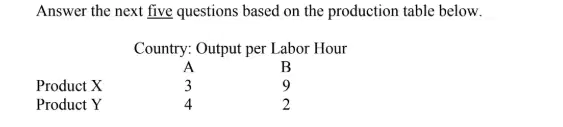
Country A has an absolute advantage in
product X
product Y
Neither X nor Y
Both X and Y
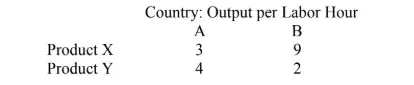
country B has an absolute advantage in
product x
product Y
neither X nor Y
both x and y
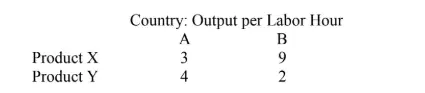
If countries were to trade along the lines of absolute advantage
a would export X to B
B would import Y from A
neither country would want to trade
no
if countries were to trade along the lines of comparative advantage:
A would export X to B
A would export Y to B
Neither country would want to trade
no

In autarky, the relative price of X in terms of Y in A would be
1/2 Y
3/4 Y
1Y
4/3Y
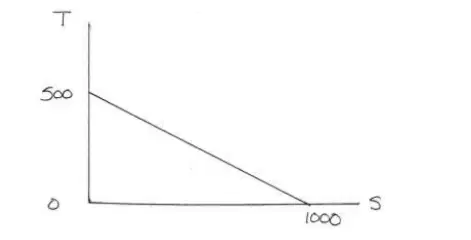
the relative price(MRT) of S in terms of T is:
2
1/2
00
1000
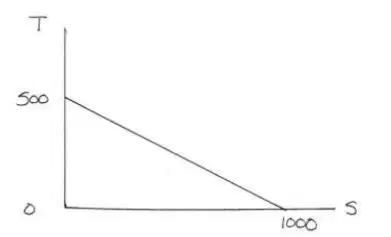
The relative price(MRT) of T in terms of S is
2
1/2
500
1000

shift out in a parallel fashion
shift in a parallel fashion
become steeper
become flatter
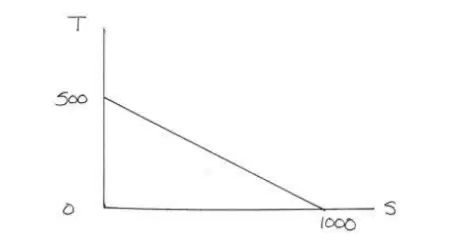
If a country has a bowed out(concave to the origin) production possibility frontier then production is said to be subject to
constant opportunity costs
decreasing opportunity costs
first increasing and then decreasing OCs
increasing OCs
If a country has a linear (downward sloping) production possibilities frontier, then production is said to be subject to:
constant opportunity costs.
decreasing opportunity costs.
first increasing and then decreasing opportunity costs.
increasing opportunity costs.
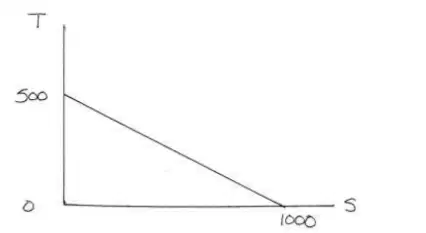
The terms of trade is given by the prices:
Paid for all goods exported by the home country.
Received for all goods exported by the home country.
Received for exports and paid for imports.
Of primary products as opposed to manufactured products.
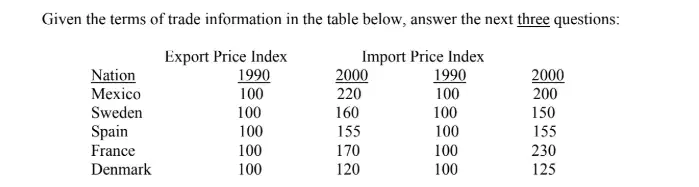
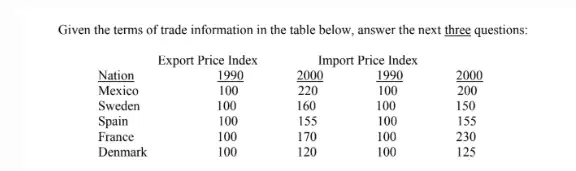
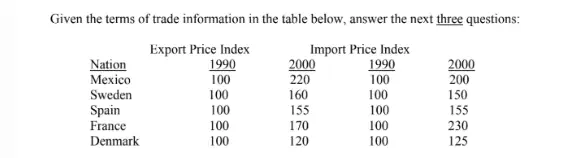
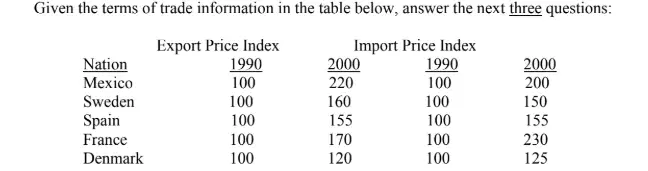
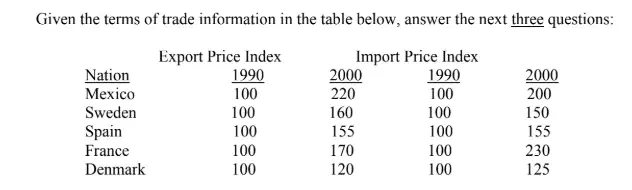
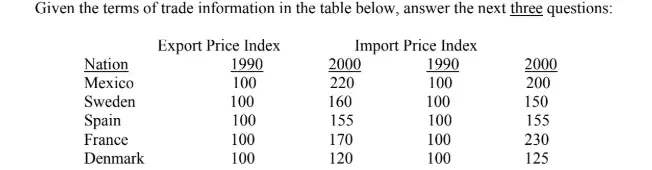
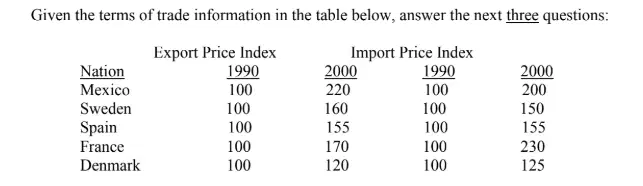
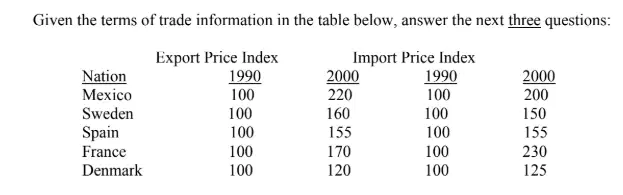
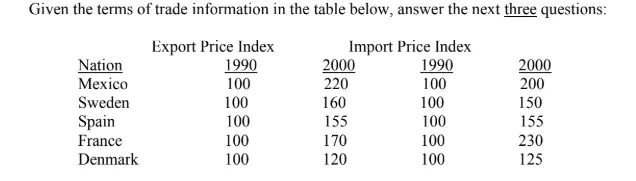
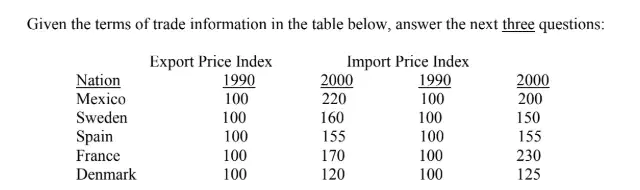
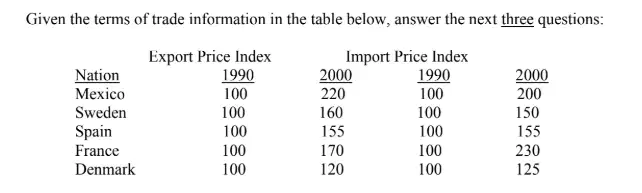
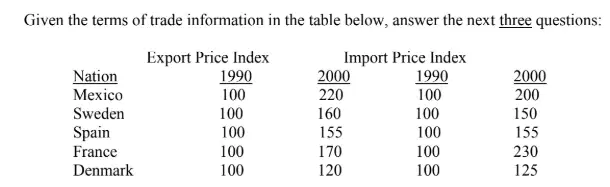
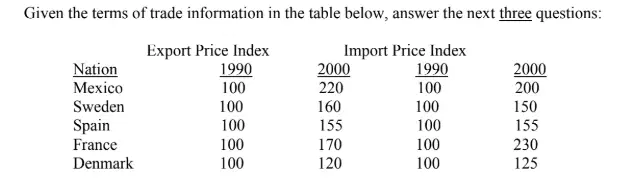
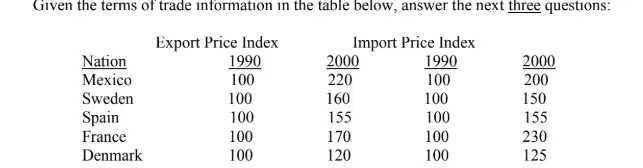
Which countries' terms of trade improved between 1990 and 2000.
Mexico and Denmark
Sweden and Denmark
Sweden and Spain
Mexico and Sweden
Given free trade, small nations tend to benefit the most from trade since they:
Are more productive than their large trading partners.
Are less productive than their large trading partners.
Have demand preferences and income levels lower than their large trading partners.
Realize terms of trade lying near the MRTs of their large trading partners.
In autarky, when a community maximizes its standard of living, its production and consumption
point is:
below the production possibility frontier.
on the production possibility frontier.
above the production possibility frontier.
can't tell without more information.
In autarky, when a community maximizes its standard of living, its production and consumption
point is:
below the production possibility frontier.
on the production possibility frontier.
above the production possibility frontier.
can't tell without more information.
In autarky equilibrium,
production equals consumption.
exports equal imports.
there is no trade.
all of the above.
In autarky, when a community maximizes its standard of living, its production point is:
below the production possibility frontier.
on the production possibility frontier.
above the production possibility frontier.
can't tell without more information.
If the autarky price of S were lower in country A than in country B, then if trade were allowed:
A would likely export S to B.
A would likely import S from B.
neither country would want to trade.
none of the above.
Under free trade, Canada would not realize any gains from trade with Sweden if Canada:
Trades at Canada's marginal rate of transformation.
Trades at Sweden's marginal rate of transformation.
Specializes completely in the production of its export good.
Specializes partially in the production of its export good.
John Stuart Mill was the founder of the
Theory of reciprocal demand
Theory of absolute advantage
Theory of comparative advantage
Theory of mercantilism
John Stuart Mill was the founder of the
Theory of reciprocal demand
Theory of absolute advantage
Theory of comparative advantage
Theory of mercantilism
Dynamic gains from trade could result from
The stimulus of additional investment spending as markets open
Economies of large scale production as markets open
Additional competition made possible by the opening of markets
All of the above
G. MacDougall compared export ratios and labor productivity ratios for the United States and the
United Kingdom in order to test the
Ricardian theory of comparative advantage
Heckscher Ohlin theory of comparative advantage
Linder theory of overlapping demand
all of the above
G. MacDougall showed in his tests that
relatively higher U.S. labor productivity was associated with relatively higher U.K export ratios
relatively higher U.K. labor productivity was associated with relatively higher U.K export ratios
labor productivity ratios and export ratios were not associated with each other.
none of the above
G. MacDougall's empirical results can be interpreted as
evidence against the classical model
evidence against the Heckscher-Ohlin model
support for the Ricardian model
support for the Heckscher-Ohlin model
The Heckscher-Ohlin theory explains comparative advantage as the result of differences in countries':
Economies of large-scale production.
Relative abundance of various resources.
Relative costs of labor.
Research and development expenditures.
The factor endowment model of international trade was developed by
Adam Smith
David Ricardo
John Stuart Mill
Eli Heckscher and Bertil Ohlin
Boeing aircraft company was able to cover its production costs of the first "jumbo jet" in these venties because Boeing could market it to several foreign airlines in addition to domestic airlines. This illustrates:
How economies of scale make possible a larger variety of products in international trade.
A transfer of wealth from domestic consumers to domestic producers as the result of
trade
How a natural monopoly is forced to behave more competitively with international trade.
How a natural monopoly is forced to behave less competitively with international trade.
Which trade theory contends that a country that initially develops and exports a new product may eventually become an importer of it, and may no longer manufacture the product:
Theory of factor endowments
Theory of overlapping demands
Economies of scale theory
Product life cycle theory
The theory of overlapping demands predicts that trade in manufactured goods is unimportant for countries with very different:
Tastes and preferences
Expectations of future interest rate levels
Per-capita income levels
Labor productivities
The trade model of the Swedish economists Heckscher and Ohlin maintains that:
Absolute advantage determines the distribution of the gains from trade.
Comparative advantage determines the distribution of the gains from trade.
The division of labor is limited by the size of the world market.
A country exports goods for which its resource endowments are most suited.
According to the factor endowment model of Heckscher and Ohlin, countries heavily endowed
with land will:
Devote excessive amounts of resources to agricultural production.
Devote insufficient amounts of resources to agricultural production.
Export products that are land-intensive.
Import products that are land-intensive.
According to the .... the export of the product that embodies large amounts of the relatively cheap, abundant resource results in an increase in its price and income; at the sametime, the price and income of the resource used intensively in the import-competing product
decreases as its demand falls.
Ricardian equivalence theorem
Smithian equivalence theorem
Stolpher-Samuelson theorem *
Bernanke-Greenspan theorem
For the United States, empirical studies indicate that over the past two hundred years the cost of international transportation relative to the value of U.S. imports has:
Increased
Decreased
Not changed
Any of the above
According to the trade theory of Staffan Linder, trade tends to be most pronounced in manufactured goods when trading countries have
similar endowments of natural resources
similar levels of technology
similar per-capita incomes
similar wage levels
.... 1954 study of U.S. trade patterns showed that U.S. exports were labor-intensive compared with U.S. imports, even though the United States was widely regarded as a relatively capital-abundant nation.
Paul Samuelson's
Wolfgang Stolpher's
Staffan Linder's
Wassily Leontief's
Should international transportation costs decrease, the effect on international trade would include
a (an):
Increase in the volume of trade
Smaller gain from trade
Decline in the income of home producers.
Decrease in the level of specialization in production.
That the division of labor is limited by the size of the market best applies to which explanation of trade:
Factor endowment theory
Product life cycle theory
Economies of scale theory
Overlapping demand theory
Intra-industry trade theory
explains why the United States might export autos and import clothing
explains why the United States might export and import differentiated versions of the same product, such as different types of autos
assumes that transport costs are very low or do not exist
ignores seasonal considerations for agricultural goods
Dynamic comparative advantage theory
helps explain why some nations use industrial policy to support potentially competitive new firms
cannot explain strategic competition between firms such as Boeing and Airbus
is another name for Ricardo's comparative advantage theory
Differences in environmental standards or other government regulations among nations
have no impact on patterns of international trade
have tended to make U.S. steel companies more competitive internationally
can affect production costs and thus alter comparative advantages and trade patterns
have been eliminated by the nations participating in NAFTA
Declining costs per unit of output results from international trade especially if:
International trade affords producers monopoly power.
National governments levy import tariffs and quotas.
Producing goods entails increasing costs.
economies of scale exist for producers.
The Heckscher-Ohlin model rules out the classical model's basis for trade by assuming that is (are) identical between countries.
factor endowments
factor intensities
technology
opportunity costs
The comparative advantage model of Ricardo was based on
intraindustry specialization and trade
interindustry specialization and trade
demand conditions underlying specialization and trade
income conditions underlying specialization and trade
The product cycle theory of trade is essentially a
static, short run trade theory
dynamic, long run trade theory
zero-sum theory of trade
negative-sum theory of trade
The .... analyzes the income distribution effects of trade in the short run, when resources are immobile among industries.
Stolpher-Samuelson theory
factor endowment theory
specific factors theory
overlapping demand theory
According to the Heckscher-Ohlin model, the source of comparative advantage is a country's:
technology
advertising
factor endowments
both (a) and (c)
Industrial policies intended to foster comparative advantage for domestic industries could result
in the implementation of
research and development subsidies
loan guarantees
low interest rate loans
all of the above
By reducing the volume of trade, transportation costs tend to
stop the process of product price equalization and factor price equalization before they
are complete
ensure that the process of product price equalization and factor price equalization are
complete
eliminate all of the feasible gains from international trade
maximize all of the feasible gains from international trade
If tastes are identical between countries, then comparative advantage is determined by:
supply conditions only.
demand conditions only.
supply and demand conditions.
can't tell without more information.
The Heckscher-Ohlin theorem states that a country will have comparative advantage in the good whose production is relatively intensive in the........ with which the country is relatively
tastes
technology
factor/resource
opportunity cost
One of the predictions of the Heckscher-Ohlin model is that:
countries with different factor endowments but similar technologies and preferences will
have a strong basis for trade with each other.
countries will tend to specialize, but not completely, in their comparative
advantage good.
reciprocal demand leads to an equilibrium terms of trade by inducing changes in both
demand and supply.
all of the above.
Wassily Leontief used an input-output table in order to test the
Ricardian theory of comparative advantage
Heckscher Ohlin theory of comparative advantage
Linder theory of overlapping demand
all of the above
The Heckscher-Ohlin assumes that ....... are identical between countries.
tastes and preferences
technology levels
factor endowments
both (a) and (b)
In his empirical tests, Wassily Leontief used an input-output table to
calculate the capital and labor required to produce $1 million of U.S. exports and imports.
calculate the labor productivity of American workers relative to foreign workers.
calculate the capital productivity of American capital relative to foreign capital.
all of the above
In his empirical test of comparative advantage, Wassily Leontief found that
U.S. exports are capital intensive relative to U.S. imports
U.S. imports are labor intensive relative to U.S. exports
U.S. exports are neither labor nor capital intensive
none of the above
Leontief's results were considered paradoxical because the United Stated was believed to be
technologically efficient relative to the rest of the world
capital abundant relative to the rest of the world
labor abundant relative to the rest of the world
all of the above
According to the Heckscher-Ohlin model
everyone automatically gains from trade
the gainers from trade outnumber the losers from trade
the scarce factor necessarily gains from trade
none of the above
Wassily Leontief's results can be interpreted as
evidence against the Ricardian model
evidence against the Heckscher-Ohlin model
support for the Ricardian model
support for the Heckscher-Ohlin model
Advocates of industrial policy maintain that government should
pursue free trade as a policy that leads to maximum global efficiency
grant subsidies to firms offering potential comparative advantage
provide loans to domestic workers in exporting industries
increase interest rates on loans made to firms in import-competing industries
The factor endowment theory was pioneered by:
Adam Smith
Wassily Leontief
David Ricardo
Eli Heckscher and Bertil Ohlin
By adjusting the model of comparative advantage to include transportation costs along with
production costs, we would expect
the prices of traded goods to be lower than when there are no transportation costs
specialization to stop when the production costs of the trading partners equalize
the volume of trade to be less than when there are no transportation costs
the gains from trade to be greater than when there are no transportation costs
By adjusting the model of comparative advantage to include transportation costs along with
production costs, we would expect
the prices of traded goods to be lower than when there are no transportation costs
specialization to stop when the production costs of the trading partners equalize
the volume of trade to be less than when there are no transportation costs
the gains from trade to be greater than when there are no transportation costs
Assume that Country A is relatively abundant in labor and Country B is relatively abundant in
land. Note that wages are the returns to labor and rents are the returns to land. According to the
factor price equalization theorem, once Country A begins specializing according to comparative
advantage and trading with Country B
wages and rents should fall in Country A
wages and rents should rise in Country A
wages should rise and rents should fall in Country A
wages should fall and rents should rise in Country A
According to the factor price equalization theorem, the ....... factor should oppose free trade policies in any given country,
abundant
scarce
neither
can't tell without more information
A product will be traded only if the pretrade price difference between the two countries
is less than the cost of transporting it between them
is greater than the cost of transporting it between them
equals the cost of transporting it between them
more information is needed to answer this question
Intraindustry trade can be explained by all of the following except
high transportation costs as a proportion of product value
different growing seasons of the year for agricultural products
product differentiation for goods such as automobiles
high per capita incomes in exporting countries
high per capita incomes in exporting countries
Compound tariff
Effective tariff
Ad valorem tariff
Specific tariff
A tax of 15 percent per imported item would be an example of a (an):
Ad valorem tariff
Specific tariff
Effective tariff
Compound tariff
A tax of 15 percent per imported item would be an example of a (an):
Ad valorem tariff
Specific tariff
Effective tariff
Compound tariff
Which type of tariff is expressly forbidden by the U.S. Constitution?
Import tariff
Export tariff
Specific tariff
Ad valorem tariff
Which trade policy results in the government levying both a specific tariff and an ad-valorem
tariff on imported goods:
Compound tariff
Nominal tariff
Effective tariff
Revenue tariff
For advanced countries such as the United States, tariffs on imported raw materials tend to be
equal to tariffs on imported manufactured goods
lower than tariffs on imported manufactured goods
higher than tariffs on imported manufactured goods
the highest of all tariffs
If we consider the impact on both consumers and producers, then protection of the steel industry is
If we consider the impact on both consumers and producers, then protection of the steel industry
In the interest of the U.S. as a whole and in the interest of the state of Pennsylvania
Not in the interest of the U.S. as a whole, but it might be in the interest of the state of Pennsylvania
Not in the interest of the U.S. as a whole, nor in the interest of the state of Pennsylvania
If I purchase a stereo from South Korea, I obtain the stereo and South Korea obtains the dollars.
But if I purchase a stereo produced in the United States, I obtain the stereo and the dollars remain
in America. This line of reasoning is:
valid for stereos, but nor for most products imported by the U.S.
valid for most products imported by the U.S., but not for stereos
deceiving since Koreans eventually spend the dollars on U.S. goods
deceiving since the dollars spent on a stereo built in the U.S. eventually wind up overseas
If a nation fitting the criteria for the small nation model imposes a 10 percent tariff on imports of autos
the price of autos within the nation will rise by 10 percent
the price of autos within the nation will rise by less than 10 percent
the price of autos within the nation will rise by more than 10 percent
the price of autos will not rise because of internal competition
According to the _____ argument for protection, tariffs can shield new industries from import
competition until they have grown strong and efficient enough to withstand the competition by foreign producers.
scientific tariff argument
infant industry argument
beggar they neighbor argument
foreign dumping argument
_____ represents the difference between what consumers have to pay for a product and what they are willing and able to pay.
producer surplus
deadweight surplus
government surplus
consumer surplus
If a nation fitting the criteria for the large nation model imposes an import tariff
the domestic price of the product will increase by more than the tariff itself
the domestic price of the product will increase by the same amount as the tariff
the domestic price of the product will increase by less than the tariff
none of the above
The difference between what consumers have to pay for a particular and what they are willing to pay is known asconsumer surplus
consumer surplus
producer surplus
deadweight costs
deadweight surplus
A tariff can _____ raise a country's welfare
never
sometimes
always
In developed countries, tariffs on raw materials tend to be
highest of all
higher than on manufactured goods
equal to tariffs on manufactured goods
lower than on manufactured goods

With free trade, the total quantity of imports would equal
10,000 units
40,000 units
42,000 units
50,000 units

With free trade, the total value of imports would equal
$100,000
$400,000.
$600,000.
$800,000.

With the tariff, the quantity of imports falls to
12,000 units
20,000 units
30,000 units
42,000 units

With the tariff, the government collects
$75,000.
$100,000.
$125,000.
$150,000.

The deadweight cost of the tariff equals
$10,000.
$25,000.
$50,000.
$75,000.
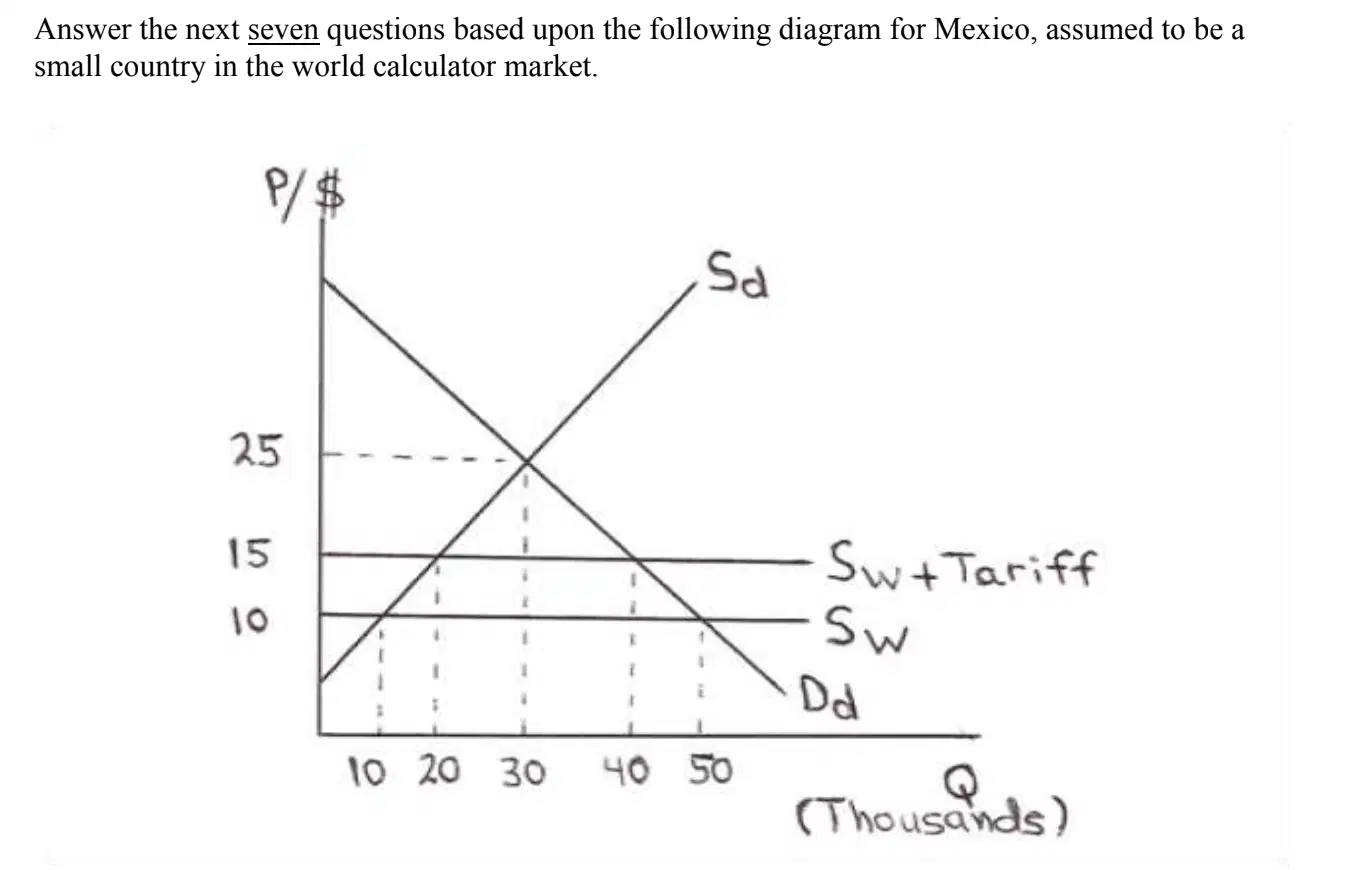
Domestic producers gain
$50,000.
$75.000
$120,000
$150,000.

A tariff of _____ would be prohibitive, causing imports to fall to zero.
$10
$15
$20
$25
In today's world, most countries impose tariffs
only on imports
only on exports
on both imports and exports
on imports, exports and nontraded goods
If a small country imposes a tariff on an imported good, its terms of trade will
improve
worsen
not change
any of the above
If the world price of steel is $500 a ton, a specific tariff of $50 is equivalent to an ad valorem tariff of
5 percent
10 percent
15 percent
20 percent
If a country an imposes an import tariff, its welfare can improve if
the country is a "small country" rather than a "large country"
its terms of trade improve enough
the tariff enhances the welfare of its trading partners
its government's tax revenue increases because of the tariff
Suppose that the United States imposes a tariff on ballpoint pens of 25 cents per pen plus 12 percent of the pen's value. This is an example of a (an)
specific tariff
ad valorem tariff
compound tariff
effective tariff
A tariff _____ increase a country' overall welfare.
will always
will never
can sometimes
Suppose that the nominal tariff rate on finished computers is 12 percent and that the weighted average of the nominal tariff rates on the inputs used in producing computers is 18 percent.
Thus, the effective rate of protection for the computer industry must
be less than 12 percent, and can be negative
be less than 12 percent, but must be greater than zero
equal 6 percent
exceed 30 percent
Suppose that the offshore assembly provisions (OAP) of the United States are granted to finished computers that are imported and also produced domestically. This policy will tend to
cause foreign assemblers of computers to use more computer components that are supplied by countries other than the United States
increase the price of computers to consumers in the United States
Increase the production of computers in the United States
increase the production of computer components in the United States
Concerning a government's trade policy, all of the following generally apply except
economic downturn and recession generally result in greater protectionism
because domestic consumers outnumber domestic producers, policy makers usually enact Free-trade policies to satisfy the consumer majority
when domestic exporting companies are organized, policy tends to favor freer trade
policy tends to favor freer trade in countries whose imports are inputs into critical industries
If no imported inputs (hard-disk drive) go into the domestic production of a final product (desktop computer), then the
nominal tariff rate on the final product equals the effective tariff rate on the product
nominal tariff rate on the final product is greater than the effective tariff rate on the product
nominal tariff rate on the final product is less than the effective tariff rate on the final product
none of the above
Concerning import tariffs of the United States, empirical studies tend to conclude that these tariffs are
progressive and thus bear down on the wealthy
regressive and thus bear down on the poor
proportional and thus bear down on all consumers in the same manner
deflationary and thus result in reductions in the price of imports
The national security argument for protection is more likely to be valid when
the purpose is to maintain protection for an indefinite time period
the industry is characterized by increasing returns to scale
the economy operates during a recession
the protected industry provides invaluable goods during periods of war
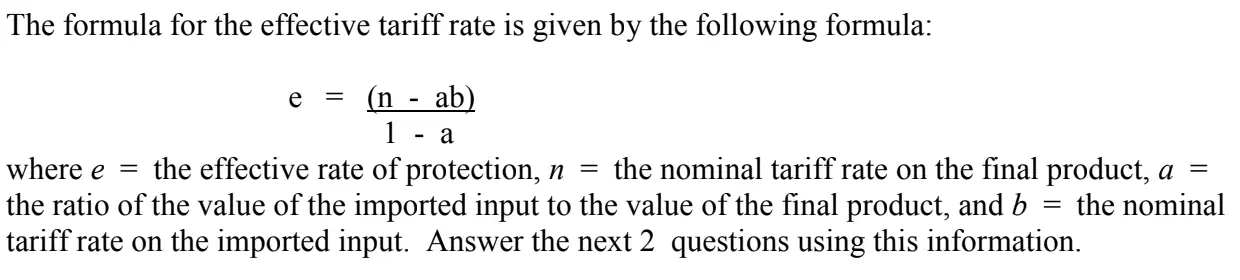
Suppose that the tariff rate on the final product is 5 percent. If no imported inputs are used in the domestic production of the final product, the effective tariff rate is
3 percent
5 percent
8 percent
12 percent
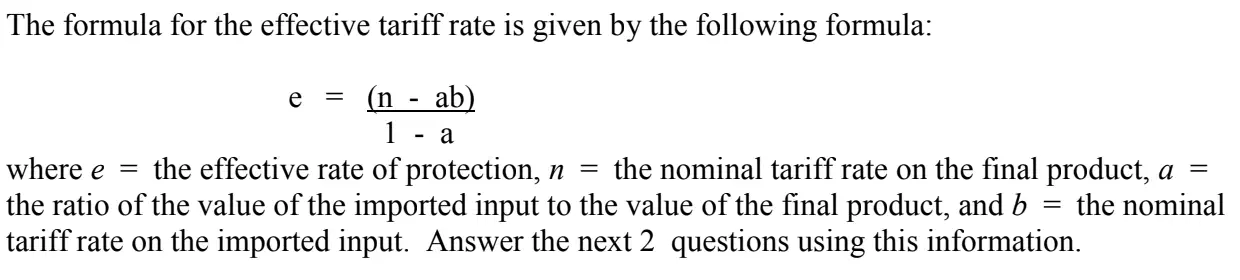
Suppose there is no tariff on imported inputs and the ratio of the value of imported inputs to the value of the final product is 0.5. If the nominal tariff rate on the final product is 10 percent, the effective tariff rate equals
5 percent
10 percent
15 percent
20 percent
Following the levying of the Smoot Hawley tariff of 1930 by the United States
employment in the United States increased rapidly
many other countries imposed retaliatory tariffs against the United States
global trade continued to increase
employment in foreign countries increased rapidly
Economic sanctions
are prohibited by the World Trade Organization
affect international trade but not international financial flows
involve restrictions on imports, but not exports
involve restrictions in imports, exports, and or financial flows
The U.S. has granted China permanent most-favored-nation treatment (normal trade relations).
This means that the tariff schedules which apply to U.S. imports from China
have tariff rates equal to zero, suggesting a free trade policy for the United States
have lower tariff rates than the rates that apply to any other country sending goods to the United States
have tariff rates that are identical to the rates that apply to other countries to which the
U.S. grants most-favored-nation treatment
have lower tariff rates than the rates that apply to other countries to which the U.S. grants most-favored-nation treatment
The theory of _____ suggests that government can assist domestic companies in capturing economic profits from foreign competitors
international dumping
countervailing duties
strategic trade policy
export promotion policy
The organization that currently establishes rules of conduct for firms engaging in international trade is the
World Bank
International Trade Commission
Department of Justice
World Trade Organization
The effect of the most-favored-nation (normal trade relations) clause is to
eliminate all tariffs between countries
increase all tariff rates between countries
maintain a nondiscriminatory structure of tariffs
maintain a discriminatory structure of tariffs
Which round of international trade negotiations resulted in the creation of the World Trade Organization?
Kennedy Round of 1964-1967
Tokyo Round of 1973-1979
Uruguay Round of 1986-1993
Doha Round of 2003-2007
According to U.S. trade law, maintaining "normal trade relations" with another country is also known as providing
most favored nation treatment
trade remedy treatment
safeguard treatment
escape clause treatment
The result of antidumping tariffs is to
increase consumer surplus in the importing country
decrease producer surplus in the importing country
impose a price floor on foreign prices in the importing country
impose a price ceiling on foreign prices in the importing country
Allegations of foreign company dumping in the United States result in investigations by the U.S.
Department of Justice
Treasury Department
Interior Department
Commerce Department and the International Trade Commission
_____ are quotas that result in a total prohibition of trade
embargoes
tariff-rate quotas
voluntary export restraints
nontariff barriers
Concerning U.S. trade law, Section 301 cases involve allegations of
foreign export subsidies
foreign income taxes on corporations
foreign monopoly dumping
foreign barriers to American exports
Concerning dumping, which of the following is true?
predatory dumping represents the most common form of dumping by U.S. firms
U.S. firms can obtain protection from foreign dumping, even though this protection tends to harm overall U.S. welfare
dumping can never be a profit-maximizing strategy for U.S. firms to pursue
U.S. firms rarely, if ever, engage in distress dumping or persistent dumping
Suppose that Russia steel firms engage in dumping in the German market. In terms of overall economic welfare, German welfare would _____ as the result of the dumping.
increase
decrease
not change
Ad valorem tariffs are collected as
fixed amounts of money per unit traded
a percentage of the price of the product
a percentage of the quantity of imports
all of the above
Specific tariffs are collected as
fixed amount of money per unit traded
a percentage of the price of the product
a percentage of the quantity of imports
all of the above
Most tariffs have
only revenue effects
only protective effects
both protective and revenue effects
neither protective or revenue effects
The effective rate of protection
distinguishes between tariffs that are effective and those that are ineffective
is the minimum level at which a tariff becomes effective in limiting imports
shows how effective a tariff is in raising revenue for the government
shows the increase in value added for domestic production that a particular tariff structure makes possible, in percentage terms
A foreign-trade zone (FTZ) is
a regional area within which trade with foreign nations is allowed
a free trade agreement among several nations
designed to limit exports of manufactured goods by placing export taxes on goods made
within the zone
designed to promote exports by deferring import duties on intermediate inputs and
waving such duties if the final product is re-exported rather than sold domestically
A tariff that prohibits imports has only
a revenue effect and redistribution effect
revenue effect and protection effect
consumption effect and protection effect
redistribution effect and consumption effect
If a nation fitting the criteria for the small nation model imposes a 10 percent tariff on imports of
autos
the price of autos within the nation will rise by 10 percent
the price of autos within the nation will rise by less than 10 percent
the price of autos within the nation will rise by more than 10 percent
the price of autos will not rise because of internal competition
According to the ..... argument for protection, tariffs can shield new industries from import competition until they have grown strong and efficient enough to withstand the competition by foreign producers.
scientific tariff argument
infant industry argument
beggar they neighbor argument
foreign dumping argument
represents the difference between what consumers have to pay for a product and what
they are willing and able to pay.
producer surplus
deadweight surplus
government surplus
consumer surplus
If a nation fitting the criteria for the large nation model imposes an import tariff
the domestic price of the product will increase by more than the tariff itself
the domestic price of the product will increase by the same amount as the tariff
the domestic price of the product will increase by less than the tariff
none of the above
The difference between what consumers have to pay for a particular and what they are willing to
pay is known as
consumer surplus
producer surplus
deadweight costs
deadweight surplus
A tariff can .... raise a country's welfare
never
sometimes
always
In developed countries, tariffs on raw materials tend to be
highest of all
higher than on manufactured goods
equal to tariffs on manufactured goods
lower than on manufactured goods
If a country an imposes an import tariff, its welfare can improve if
the country is a "small country" rather than a "large country"
its terms of trade improve enough
the tariff enhances the welfare of its trading partners
its government's tax revenue increases because of the tariff
Suppose that the United States imposes a tariff on ballpoint pens of 25 cents per pen plus 12
percent of the pen's value. This is an example of a (an)
specific tariff
ad valorem tariff
compound tariff
effective tariff
A tariff .... increase a country' overall welfare.
will always
will never
can sometimes
Suppose that the nominal tariff rate on finished computers is 12 percent and that the weighted
average of the nominal tariff rates on the inputs used in producing computers is 18 percent.
Thus, the effective rate of protection for the computer industry must
be less than 12 percent, and can be negative
be less than 12 percent, but must be greater than zero
equal 6 percent
exceed 30 percent
Suppose that the offshore assembly provisions (OAP) of the United States are granted to finished
computers that are imported and also produced domestically. This policy will tend to
cause foreign assemblers of computers to use more computer components that are
supplied by countries other than the United States
increase the price of computers to consumers in the United States
Increase the production of computers in the United States
increase the production of computer components in the United States
Concerning a government's trade policy, all of the following generally apply except
economic downturn and recession generally result in greater protectionism
because domestic consumers outnumber domestic producers, policy makers usually enact
Free-trade policies to satisfy the consumer majority
when domestic exporting companies are organized, policy tends to favor freer trade
policy tends to favor freer trade in countries whose imports are inputs into critical
industries
If no imported inputs (hard-disk drive) go into the domestic production of a final product
(desktop computer), then the
nominal tariff rate on the final product equals the effective tariff rate on the product
nominal tariff rate on the final product is greater than the effective tariff rate on the
product
nominal tariff rate on the final product is less than the effective tariff rate on the final
product
none of the above
Concerning import tariffs of the United States, empirical studies tend to conclude that these
tariffs are
progressive and thus bear down on the wealthy
regressive and thus bear down on the poor
proportional and thus bear down on all consumers in the same manner
deflationary and thus result in reductions in the price of imports
The national security argument for protection is more likely to be valid when
the purpose is to maintain protection for an indefinite time period
the industry is characterized by increasing returns to scale
the economy operates during a recession
the protected industry provides invaluable goods during periods of war
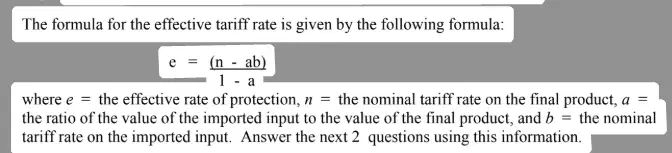
Suppose that the tariff rate on the final product is 5 percent. If no imported inputs are used in the
domestic production of the final product, the effective tariff rate is
3 percent
5 percent
8 percent
12 percent
Suppose there is no tariff on imported inputs and the ratio of the value of imported inputs to the
value of the final product is 0.5. If the nominal tariff rate on the final product is 10 percent, the
effective tariff rate equals
5 percent
10 percent
15 percent
20 percent
If a tariff and import quota lead to equivalent increases in the domestic price of steel, then:
the quota results in efficiency reductions but the tariff does not
the tariff results in efficiency reductions but the quota does not
they have different impacts on how much is produced and consumed
they have different impacts on how income is distributed
If a tariff and import quota lead to equivalent increases in the domestic price of steel, then:
the quota results in efficiency reductions but the tariff does not
the tariff results in efficiency reductions but the quota does not
they have identical impacts on how much is produced and consumed
they have identical impacts on how income is distributed
Under a tariff-rate quota:
the within-quota tariff rate exceeds the over-quota tariff rate
the over-quota tariff rate exceeds the within-quota tariff rate
the within-quota tariff rate equals the over-quota tariff rate
the within-quota tariff rate plus over-quota tariff rate equal 100 percent
Suppose that the domestic government allows a specific number of goods to be imported each
year, but it does not specify from where the product is shipped or who is permitted to import.
Such a trade barrier is known as
an import tariff
a tariff-rate quota
a selective quota
a global quota
Antidumping duties are used to
offset the "margin of dumping"
punish domestic consumers for buying high-priced imported goods
discourage foreign governments from subsidizing their exporters
reduce the tariff revenues of the domestic government
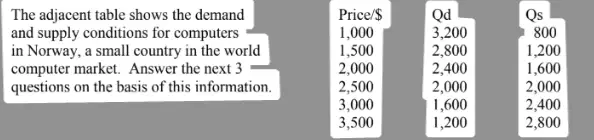
In the absence of trade, Norway's equilibrium price and quantity equal
$1,500 and 2,800 computers
$2,000 and 1,600 computers
$2,500 and 2,000 computers
$3,500 and 2,000 computers
With free trade, suppose that the rest of the world can supply computers to Norway at a price of $1,500. Norway's imports will now equal ..... Compared to what occurred in the absence of trade, Norway's consumer surplus will .... and its producer surplus will..... Can you calculate these amounts? Try plotting the information of this table on a sheet of graph paper.
1,600 computers, decrease, increase
1,600 computers, increase, decrease
1,200 computers, decrease, increase
1,200 computers, increase, decrease
To reduce imports, suppose that the government of Norway imposes a quota equal to 800
computers. Compared to what occurred under free trade, Norway's consumer surplus will .... and its producer surplus will .... Can you calculate these amounts? Try plotting the information of this table on a sheet of graph paper.
increase, increase
increase, decrease
decrease, increase
decrease, decrease
From the perspective of the American public as a whole, export subsidies levied by overseas
governments on goods sold to the United States:
help more than they hurt
hurt more then they help
are equivalent to an import quota
are equivalent to an export quota
During periods of growing domestic demand, an import quota
is less restrictive on a country's imports than a tariff
is more restrictive on a country's imports than a tariff
has the same restrictive effect on a country's imports as a tariff
will always generate increased tax revenue for the government
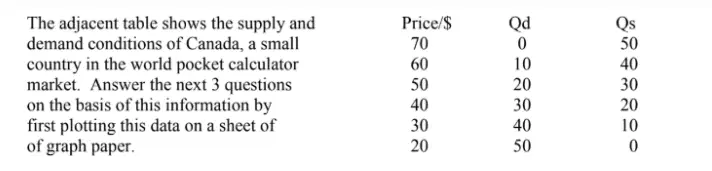
In the absence of trade, Canada's equilibrium price and quantity equal
$65 and 40 calculators
$55 and 20 calculators
$45 and 25 calculators
$30 and 40 calculators
With free trade, suppose that the rest of the world can supply calculators to Canada at a price of
$30. Canada's imports would now equal .... and its consumer surplus would ..... relative to what occurred in the absence of trade. What is the change in consumer surplus?
Refer to the figure that you have plotted.
20 calculators, increase
25 calculators, decrease
25 calculators, increase
30 calculators, increase
To aid its calculator producers, suppose that the government provides them a subsidy of $10 for
each calculator produced. The amount of imports now equals .... and the deadweight loss of the subsidy to the Canadian economy equals .....
20 calculators, $50
20 calculators, $100
25 calculators, $50
25 calculators, $100
Export subsidies levied by foreign governments on products in which the United States has
comparative disadvantage:
lower the welfare of all Americans
lead to increases in U.S. consumer surplus
encourage U.S. production of competing goods
encourage U.S. workers to demand higher wages
If import licenses are auctioned off to domestic importers in a competitive market, their scarcity
value (revenue effect) accrues to:
foreign corporations
foreign workers
domestic corporations
the domestic government
A specification of a maximum amount of a foreign produced good that will be allowed to enter
the country over a given time period is referred to as a (an):
domestic subsidy
export subsidy
import quota
export quota
Import quotas tend to result in all of the following except:
domestic producers of the imported good being harmed
domestic consumers of the imported good being harmed
prices increasing in the importing country
prices falling in the exporting country
A tariff-rate quota
is a limit on the number of tariffs that a country can place on imports
uses a single tariff along with import quotas to restrict imports
is designed to avoid the price increases caused by simple tariffs
is a two-tier tariff system intended to restrict imports
To maintain that South Koreans are dumping their DVDs in the United States is to maintain that:
Koreans are selling DVDs in the U.S. below their production cost
Koreans are selling DVDs in the U.S. above their production cost
the cost of manufacturing DVDs in Korea is lower in Korea than in the U.S. since wages
are lower in Korea
the cost of manufacturing DVDs in Korea is higher in Korea than in the U.S. since wages
are higher in Korea
If the home country government grants a subsidy on a domestically produced good, domestic
producers tend to:
capture the entire subsidy in the form of higher profits
increase their level of production
reduce wages paid to domestic workers
consider the subsidy as an increase in production cost
Throughout the world, governments tend to auction quota licenses to their highest bidder
always
often
seldom
never
For years the U.S. government levied quotas on inexpensive oil imported from the Middle East. The quotas led to cost increases for U.S. consumers totaling $3 billion for oil products. An apparent justification for this policy was that:
U.S. oil companies and workers deserved higher incomes
U.S. oil was of superior quality and merited higher prices
one should not be too dependent on foreign suppliers of crucial resources
the U.S. government needed the quota revenue to balance its budget
In certain industries, Japanese employers hesitate to lay off workers. Therefore, they sometimes
have excess supplies of goods that they cannot sell on the home market without lowering prices.
To hold down losses, they sell goods in overseas markets at prices well beneath those in Japan.
This practice is best referred to as:
orderly marketing
trigger pricing
domestic content pricing
dumping
Quotas are government imposed limits on the .... of goods trade between countries.
prices
quantity
revenue
costs
.... are quotas that lead to a complete abolishment of trade.
embargoes
voluntary export restraints
nontariff barriers
orderly marketing agreements
Similar to import tariffs, import quotas tend to result in
higher prices and reduced imports
increased government revenue
increased consumer surplus
decreased producer surplus
The welfare effects of a quota depend to a considerable extent upon
who has the quota license
the size of the quota
elasticities of domestic demand and supply
all of the above
.... are profits that accrue to whomever has the right to import the good that is restricted
by the quota.
quota license
quota rents
quota prices
none of the above
The home-country government can confiscate the revenue effect of an import quota if
quota licenses are given to foreign exporting companies
quota licenses are auctioned to the highest-bidding importing company
if quota licenses are given to domestic consumers of the good
both (a) and (c)
Governments around the world tend to auction quota licenses
never
seldom
often
always
A(n) .... is an example of a quota where foreigners hold quota licenses.
export quota
embargo
auction quota
tariff quota
International dumping may involve
selling goods to foreigners at a price below that charged domestic consumers
selling goods to foreigners at a price below the cost of production
antidumping duties being levied on the imported, dumped goods
all of the above
Nontariff trade barriers could include all of the following except
domestic content laws
government procurement policies
health, safety, and environmental standards
antidumping/countervailing duties applied to imports
A production subsidy that is granted to a producer of an import-competing good
does not require governmental taxes to finance it
yields the same deadweight welfare loss as an import tariff or import quota
has only a consumption effect deadweight loss
has only a protective effect deadweight loss
A tariff-rate quota is essentially a
two-tier tariff applied to a country's imports
three-tier tariff applied to a country's imports
two-tier quota applied to a country's exports
three-tier quota applied to a country's exports
A ..... attempts to limit outsourcing of jobs to foreigners by requiring that a minimum
percentage of a product's value must be produced domestically if that good is to be sold in the domestic market
domestic subsidy
voluntary restraint agreement
domestic content requirement
tariff-rate quota
The form of international price discrimination (dumping) normally associated with economic recession or excess inventories in the exporting nation is known as
predatory dumping
sporadic dumping
persistent dumping
year-end dumping
The form of dumping that represents the greatest potential net welfare loss the for importing
nation is
predatory dumping
sporadic dumping
persistent dumping
year-end dumping
...... occurs when a firm disposes on foreign markets a temporary increase in inventories caused by unforeseen changes in supply and demand conditions in the home economy
sporadic dumping
predatory dumping
persistent dumping
foreign dumping
According to the cost-based definition of dumping, dumping occurs when a firm sells a product abroad at a price that is less than
average total cost
average variable cost
average fixed cost
marginal cost
What type of trade barrier was used to protect U.S. auto firms from foreign competition during
1981-1984?
export quotas imposed by the Japanese government
export tariffs imposed by the Japanese government
import quotas imposed by the U.S. government
domestic subsidies granted by the U.S. government
A.......allows a specified number of goods to be imported each year, and it not specifies from where the product is shipped and who is permitted to import
import quota
export quota
selective quota
global quota
Buy national policies
result in government purchase policies favoring domestic over foreign producers
result in government purchase policies favoring foreign over domestic producers
attempt to restrict the number of tourists leaving a nation
are intended to publicize the advantages of the most efficient domestic companies
Which company in the United States would likely be most concerned about Brazil's dumping of
steel in the U.S. market?
General Motors, the manufacturer of automobiles
Tennessee Mining Co., an iron-ore mining company
Caterpillar Corp., the producer of earth-moving equipment
Sneva Construction Co., the builder of skyscrapers
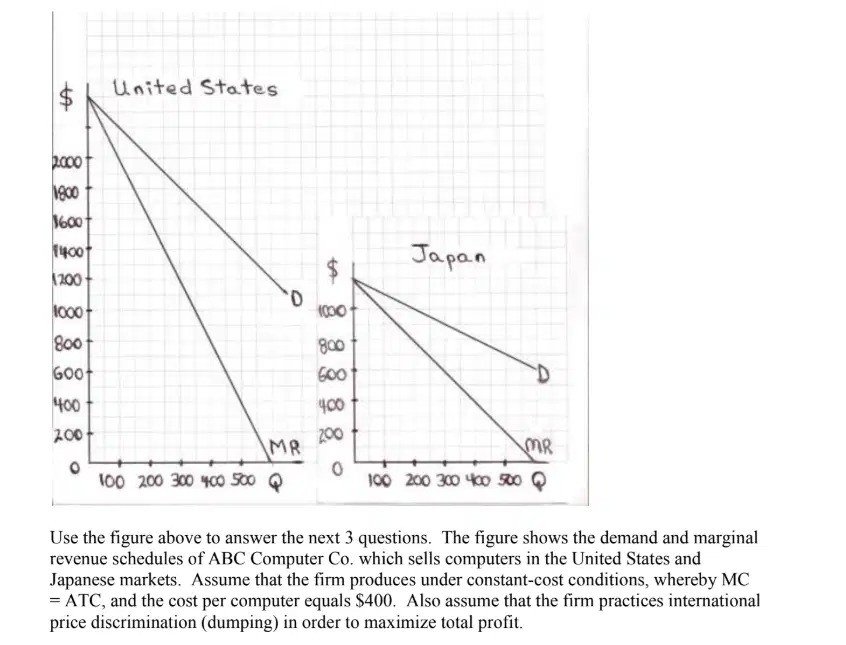
The firm would maximize profit by selling ..... computers in the United States at a price of and .... computers in Japan at a price of
200, $2,000; 100, $1,000
300, $1,800; 300, $600
300, $1,800; 400, $800
500, $1,400; 400, $800
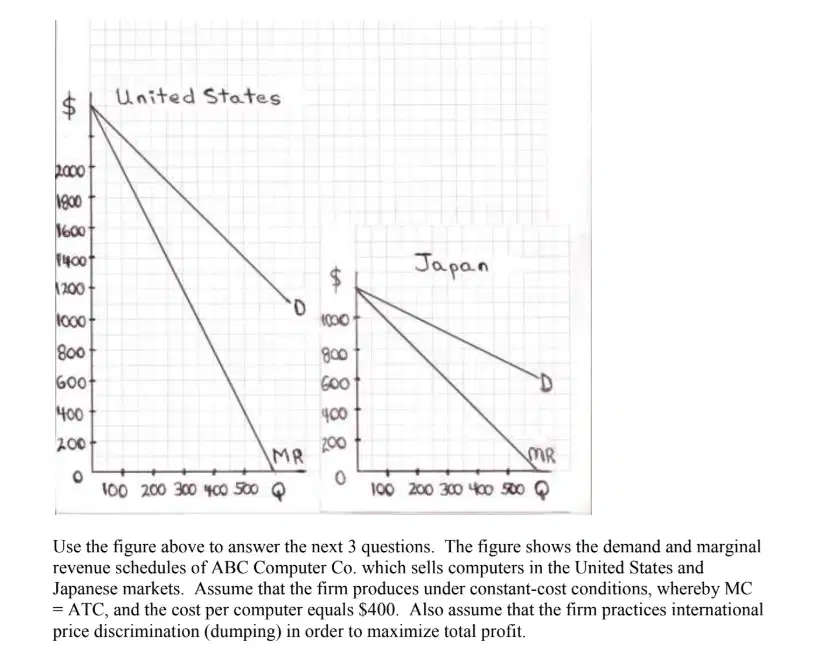
By practicing price discrimination, the firm would realize profits totaling:
$160,000
$420,000
$540,000
$660,000
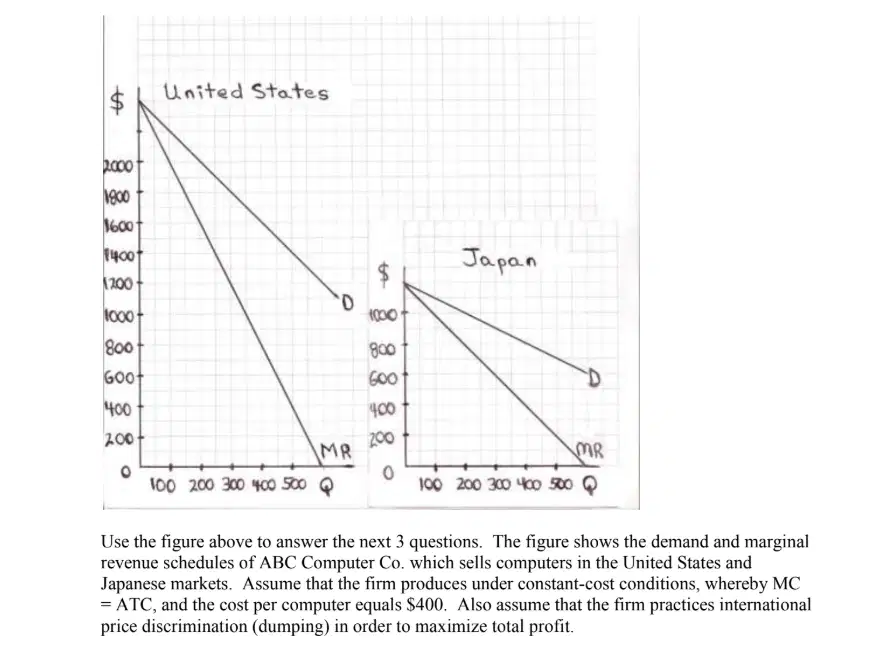
The reason for dumping is that the demand curve for ABC Co.'s computers is .... because .... are available from other nations.
more elastic in Japan; more substitutes are available from other nations
more elastic in Japan; fewer substitutes are available from other nations
more inelastic in Japan; more substitutes are available from other nations
more inelastic in Japan; fewer substitutes are available from other nations
In 1980 the U.S. imposed export quotas on grain sold to the Soviet Union in response to its
armed invasion of Afghanistan. If other nations do not increase grain exports to the Soviets, all
the following would likely occur except:
Grain prices would rise in the Soviet Union
Consumer surplus would decrease for the Soviets
Grain prices would rise in the United States
Export revenues would decrease for U.S. producers
Referring to the above question, the embargo was mainly resisted by:
U.S. grain consumers and producers of bread
U.S. farmers and grain companies
Grain producers in foreign countries
Grain consumers in foreign countries
Concerning economic sanctions, export embargos induce greater losses in consumer surplus for
the target country the:
lesser its initial dependence on foreign produced goods
more elastic the target country demand schedule
greater the available output from alternative suppliers
more inelastic the target country supply schedule
Suppose the President eliminates import tariffs on radios as the result of a free trade agreement
reached with Japan. Radio producers in the United States can appeal for import protection under
the:
escape clause if rising imports substantially injure the U.S. radio industry.
escape clause if rising unemployment occurs even though imports remain unchanged
infant industry clause if rising imports cause unemployment to rise among U.S. radio
workers.
infant industry clause if rising imports result in losses for U.S. radio companies
During the post-World War II era:
Nontariff barriers (NTBs) and tariffs have increased in relative importance
NTBs and tariffs have decreased in relative importance
NTBs have increased and tariffs have decreased in relative importance
NTBs have decreased and tariffs have increased in relative importance
The strongest political pressure for a trade policy that results in higher protectionism comes
from:
domestic workers lobbying for import restrictions
domestic workers lobbying for export restrictions
domestic consumers lobbying for export restrictions
domestic consumers lobbying for import restrictions
The average tariff rate today on dutiable imports into the United States is approximately:
4 percent of the value of imports
15 percent of the value of imports
20 percent of the value of imports
25 percent of the value of imports
The institutional framework developed in 1947 to promote trade liberalization is known as
the WTO
the GATT
the IMF
the World Bank
When one country provides most favored nation status (normal trade relations) for another, it
agrees to
charge that nation's products a lower tariff than any other nation's
charge that nation's products a tariff rate no higher than that on any other nation
charge that nation's products a higher tariff than any other nation's
exports to that nation any products that it wants to purchase
Those who argue in favor of import protection generally give the impression that such restricted
trade will:
decrease the level of national security
provide benefits to some particular industry
provide benefits to the entire nation
not yield welfare losses for the nation
Countervailing duties levied by the U.S. government are imposed to offset
foreign dumping of goods in the U.S.
subsidies granted to foreign firms that export to the U.S.
"buy national" policies of foreign governments
stringent environmental regulations of foreign governments
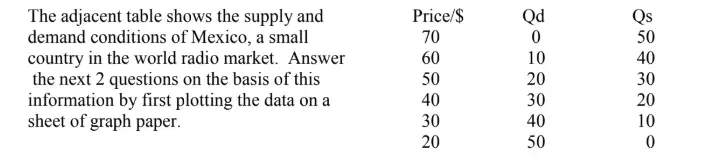
Under free trade, suppose that Japan can supply radios to Mexico at the price of $45. Therefore,
Mexico's imports equal
5 radios
10 radios
15 radios
zero radios
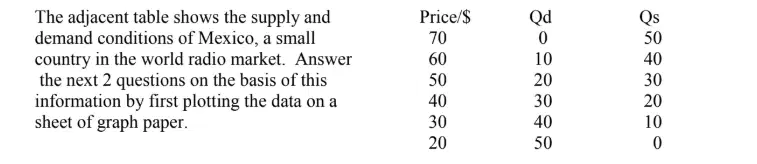
To help its firms penetrate Mexico's radio market, suppose the Japanese government provides
them a subsidy of $15 for each radio shipped to Mexico. As a result of this trade policy
the price of radios in Mexico equals $60 and its imports equal 30 radios
the price of radios in Mexico equals $30 and its imports equal 30 radios
the price of radios in Mexico equals $40 and its imports equal 20 radios
the price of radios in Mexico equals $20 and its imports equal 40 radios

Compared to what occurred under free trade, Mexico's producer surplus ..... and consumer ... as a result of the subsidy. Use the figure that you have plotted to calculate the
surplus amounts.
decreases, decreases
decreases, increases
increases, decreases
increases, increases
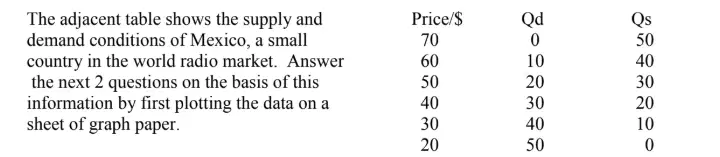
All of the following are fundamental to the World Trade Organization except
bilateral tariff reductions to promote trade liberalization
the use of the most-favored-nation clause (normal trade relations)
nondiscrimination in trading relationships
the prohibition of import quotas and export quotas
The World Trade Organization is sometimes criticized for all of the following reasons except
it reduces the sovereignty of member countries
favors free trade over the quality of the environment
it has no way to solve trade disputes among member countries
it is a "puppet" of multinational corporations
Under the Smoot-Hawley Act of 1930, the United States
liberalized trade with most of its trading partners
abolished tariff-rate quotas as a trading instrument
resulted in the termination of the General Agreement on Tariffs and Trade
increased its import tariffs to an average of 53 percent
Antidumping duties applied to imported goods
are abolished by the World Trade Organization
result in decreases in consumer surplus for domestic households
are imposed by industrial countries but not developing countries
result in lower-priced goods for domestic consumers
According to the United States, ... is the number one violator of intellectual property rights
Canada
Australia
Japan
China
The trade adjustment assistance program results in the U.S. government
imposing tariffs on goods from countries that do not practice fair trade
imposing quotas on goods from countries that do not practice fair trade
providing financial assistance and training to workers who lose jobs because of rising
imports
buying the assets of companies that are driven out of business by foreign competition
Section 301 of the 1974 Trade Act emphasized
unfair trading practices of U.S. trading partners
the use of industrial policies
wage differentials of developing countries and advanced countries
the welfare effects of import quotas
If .... is/are approved, the President has a limited time period in which to complete trade
negotiations, and Congress must vote up-or-down on the negotiated agreement within 90
legislative days of submission
the escape clause
safeguards
trade promotion authority (fast-track)
trade remedy laws
..... protection, such as the escape clause, provide temporary protection to domestic
industries facing competition from fairly traded foreign goods
generalized system of preference
countervailing duty
domestic content
safeguards
Suppose that Russia steel firms engage in dumping in the German market. In terms of overall economic welfare, German welfare would ..... as the result of the dumping.
increase
decrease
not change
Concerning dumping, which of the following is true?
predatory dumping represents the most common form of dumping by U.S. firms
U.S. firms can obtain protection from foreign dumping, even though this protection tends
to harm overall U.S. welfare
dumping can never be a profit-maximizing strategy for U.S. firms to pursue
U.S. firms rarely, if ever, engage in distress dumping or persistent dumping
Concerning U.S. trade law, Section 301 cases involve allegations of
foreign export subsidies
foreign income taxes on corporations
foreign monopoly dumping
foreign barriers to American exports

