wayground logo

Free Printable Worksheets

Font size

S
M
L
XL
Worksheets

unit 2

Total questions: 74

Worksheet time: 47mins

Name
Class
Date
1.

Matter and mass can not be

a)

Shaken or stirred

b)

Made

c)

created or destroyed

d)

Transferred

2.
True or False
In a chemical reaction, no new atoms are created, and no atoms are destroyed. 
a)
true
b)
false
3.
The left side of the equation below is called
a)
Products
b)
Reactants
4.
The right side of the equation below is called the
a)
products
b)
reactants
5.
the starting materials in a chemical reaction
a)
Products
b)
Reactants
c)
Starters
d)
Enders
6.
If reaction starts with 20g of reactants it should produce... 
a)
a total of 40g of product
b)
a total of 10g of product
c)
a total of 80 g of product
d)
a total of 20g of product
7.
a)

Element

b)

Compound

c)

Mixture

8.
a)

Element

b)

Compound

c)

Mixture

9.
a)

Element

b)

Compound

c)

Mixture

10.
a)

Element

b)

Compound

c)

Mixture

11.
a)

Compound

b)

Element

c)

Mixture

12.
a)

Mixture

b)

Compound

c)

Element

13.
a)

Element

b)

Compound

c)

Mixture

14.
What is the name of a single type of atom?
a)
cell
b)
proton
c)
element
d)
atom
15.
What is the tiniest particle in the entire universe?
a)
cells
b)
gases
c)
atoms
d)
liquids
16.
What is the term for combining 2 or more atoms together?
a)
atoms
b)
elements
c)
molecules
d)
compounds
17.
What is the term for combining 2 or more DIFFERENT atoms together?
a)
atoms
b)
elements
c)
molecules
d)
compounds
18.

The polymer called Nucleic Acids are made of the monomers....

a)

Nucleotides

b)

Amino Acids

c)

Glucose/Monosaccharides

d)

Glycerol

e)

Fatty Acids

19.

The polymer called Proteins are made of the monomers....

a)

Nucleic Acids

b)

Amino Acids

c)

Glucose/Monosaccharides

d)

Glycerol

e)

Fatty Acids

20.

The polymer called Lipids are made of the monomers....

a)

Nucleic Acids

b)

Amino Acids

c)

Glucose/Monosaccharides

d)

Glycerol

21.

The polymer called Lipids are made of the monomers....

a)

Nucleic Acids

b)

Amino Acids

c)

Glucose/Monosaccharides

d)

Fatty Acids

22.

The monomer Amino acids make up the polymer....

a)

Proteins

b)

Lipids

c)

Nucleic Acids

d)

Carbohydrates

23.

The monomer Glucose/Monosaccharides make up the polymer....

a)

Proteins

b)

Lipids

c)

Nucleic Acids

d)

Carbohydrates

24.
Starch is composed of what monomers?
a)
sucrose
b)
glucose
c)
nucleic acids
d)
glycogen
25.
What are the monomers of DNA?
a)
glycerols
b)
amino acids
c)
fatty acids
d)
nucleotides
26.
Which group of biomolecules provides quick energy to organisms?
a)
proteins
b)
carbohydrates
c)
lipids
d)
nucleic acids
27.
Genetic information is stored in which class of organic compounds?
a)
proteins
b)
lipids
c)
nucleic acids
d)
carbohydrates
28.
Which group of organic molecules serve as long-term energy storage and waterproof coverings?
a)
proteins
b)
carbohydrates
c)
lipids
d)
nucleic acids
29.
Which group of organic molecules speed up chemical reactions and serve as immune defense mechanisms?
a)
proteins
b)
carbohydrates
c)
nucleic acids
d)
lipids
30.
Building block of ...
a)
carbohydrates
b)
proteins
c)
lipids
d)
nucleic acids
31.

Building block of ...

a)

nucleic acids

b)

proteins

c)

lipids

d)

carbohydrates

32.

Provides quick energy

a)

carbohydrates

b)

lipids

c)

proteins

d)

nucleic acids

33.

provides genetic information

a)

carbohydrates

b)

lipids

c)

proteins

d)

nucleic acids

34.

stores energy long term

a)

carbohydrates

b)

lipids

c)

proteins

d)

nucleic acids

35.

stores energy in plants as starch

a)

carbohydrates

b)

lipids

c)

proteins

d)

nucleic acids

36.

stores energy in animals as glycogen

a)

carbohydrates

b)

lipids

c)

proteins

d)

nucleic acids

37.

also called a polysaccharide

a)

carbohydrates

b)

lipids

c)

proteins

d)

nucleic acids

38.

a polypeptide will become a

a)

carbohydrates

b)

lipids

c)

proteins

d)

nucleic acids

39.

forms polymers

a)

monomer

b)

polymer

40.

polypeptide

a)

monomer

b)

polymer

41.

made of monomers

a)

monomer

b)

polymer

42.

amino acid

a)

monomer

b)

polymer

43.

carbohydrate

a)

monomer

b)

polymer

44.

nucleotide

a)

monomer

b)

polymer

45.

monosaccharide

a)

monomer

b)

polymer

46.

nucleic acid

a)

monomer

b)

polymer

47.

polysaccharide

a)

monomer

b)

polymer

48.
What is the function of ATP in living things?
a)
provides energy for cells
b)
stores genetic information
c)
provides structure in the nucleus
49.
Which structures shown in the Figure make up the ADP molecule?
a)
A and B
b)
A, B and C
c)
A, B, C, and D
d)
C and D
50.
What does the "TP" in ATP stand for?
a)
2 phosphates
b)
tri (3) phosphates
c)
Two proteins
d)
tri (3) proteins
51.
What are the parts of the ATP molecule?
a)
adenine, thylakoids, stroma
b)
stroma, grana, chlorophyll
c)
adenine, ribose, phosphate groups
d)
NADH, NAHPH, FADH
52.
Which bond of the ATP molecule is broken in order to release energy?
a)
A
b)
B
c)
C
d)
D
53.
Where is the energy stored in ATP molecules
a)
In the Ribose Sugar
b)
In the Adenine group
c)
In the Phosphate bonds
d)
In the Bank
54.
Which of the following can be compared to a battery in need of recharging?  (empty wallet)
a)
ADP
b)
ATP
c)
Ribose
d)
Adenosine
55.
What are the products of photosynthesis?
a)
water and carbon dioxide
b)
oxygen and glucose
c)
oxygen and carbon dioxide
d)
oxygen and water
56.
Which of the following is the correct equation for PHOTOSYNTHESIS?
a)
carbon dioxide + water --> oxygen + glucose
b)
carbon dioxide + glucose + water --> oxygen 
c)
oxygen + water --> carbon dioxide + glucose
d)
glucose+ oxygen ---> water + carbon dioxide 
57.
What are the products of photosynthesis?
a)
Carbon dioxide and water
b)
Carbon dioxide and oxygen
c)
Glucose and oxygen
d)
Glucose and water
58.

Select all that are raw materials for Photosynthesis.

a)

Water

b)

Carbon Dioxide

c)

Oxygen

d)

Sunlight (Light Energy)

e)

Glucose (Sugar/food)

59.

Select all that are products of Photosynthesis.

a)

Water

b)

Carbon Dioxide

c)

Oxygen

d)

Sunlight (Light Energy)

e)

Glucose (Sugar/food)

60.

How does most of the water needed by the plant get into its leaves?

a)

It enters through the stomata

b)

The roots absorb it and then it travels up the stem

c)

It's made during a chemical reaction in the leaf

d)

The flowers capture water and deliver it to the leaves

61.
Why do plants conduct photosynthesis?
a)
To make light
b)
To make mitochondria
c)
To make glucose
d)
To release carbon dioxide
62.
Which choice correctly shows the gases that enter and exit plants during photosynthesis?
a)
Enter: Oxygen
Exit: Carbon dioxide
b)
Enter: Water vapor
Exit: Glucose
c)
Enter: Carbon dioxide
Exit: Oxygen
d)
Enter: Light
Exit: Water vapor
63.

Which of the following is the correct equation for PHOTOSYNTHESIS?

a)

light + carbon dioxide + water --> glucose + oxygen

b)

carbon dioxide + sugar + water --> oxygen + light

c)

oxygen + light + water --> carbon dioxide + sugar

d)

carbon dioxide + oxygen + water --> Light+ Sugar

64.

What is this reaction showing? (select 2 correct)

a)

production of carbon dioxide

b)

production of oxygen gas

c)

production of sugar

d)

production of water

65.
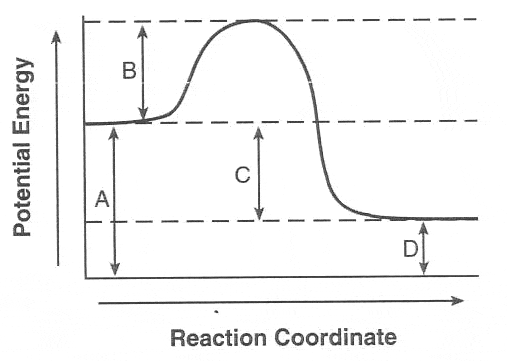
What is the activation energy?
a)
The energy of the products
b)
The energy of the reactants
c)
The minimum energy needed by the reactants to form the products.
d)
The energy lost in the reaction
66.
What kind of reaction is this?
a)
Endothermic
b)
Exothermic
c)
Cannot be determined
67.

How does a catalyst work in speeding up a reaction?

a)

By lowering the activation energy or reaction

b)

by giving them more energy

c)

by making them more available

68.

What term is given to a reaction which transfers heat energy to the surroundings?

a)

Endothermic

b)

Reversible

c)

Exothermic

d)

Exotermic

69.

When barium hydroxide and ammonium chloride react, the temperature of the mixture decreases. What kind of reaction is this?

a)

Endothermic

b)

Decomposition

c)

Exothermic

d)

Indothermic

70.
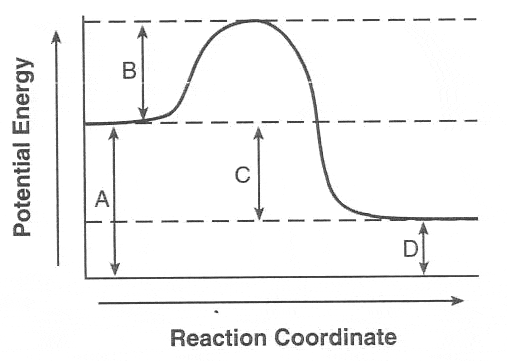
What letter represents the energy of the products?
a)
A
b)
B
c)
C
d)
D
71.
What type of reaction is this?
a)
Endothermic
b)
Exothermic
72.
Which letter corresponds to the energy of the products?
a)
A
b)
B
c)
C
d)
D
73.
Which letter corresponds to the energy of the reactants?
a)
A
b)
B
c)
C
d)
D
74.

What do you call a biological catalyst?

a)

Product

b)

Reactant

c)

Biological reaction

d)

Enzyme